Chairs Guide: Types, Buying and Care
Author note: I’m Daniel Reed, a home-furnishings editor who has spent more than a decade reviewing seating, measuring room layouts, and troubleshooting real-world fit issues in small apartments, family kitchens, and work-from-home setups. I have assembled dining chairs, tested office chairs over full workdays, and compared lounge chairs in homes where spills, pets, and tight clearances matter more than showroom styling.
Choose chairs by job first: dining seats often need around 18 inches for tables in the 28- to 30-inch range; desk chairs should allow adjustment; lounge, bar, and outdoor chairs should fit body size, how long they’ll be used, and how easy they are to clean. Get this wrong and you pay in discomfort, crowded rooms, back strain, and early reupholstery, rust, or frame failure. I sort chairs room by room, then check body fit, clearances, and care habits, because those are the things that keep a purchase from turning into an expensive regret.
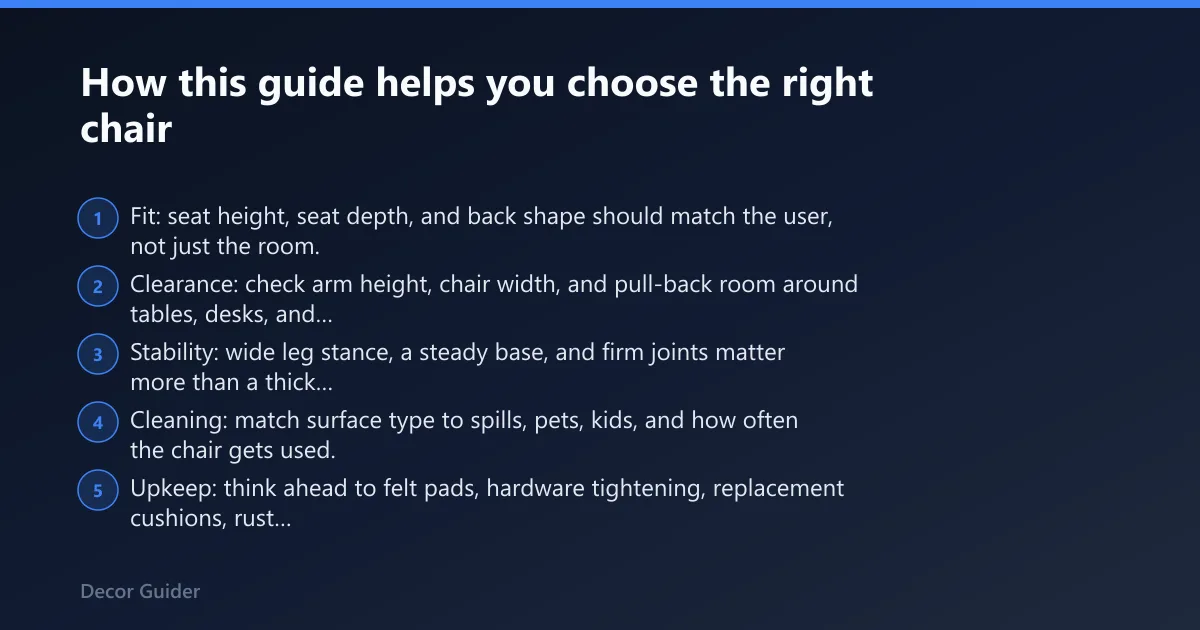
How this guide helps you choose the right chair


Start with use time, posture, and room limits
The fastest way to narrow chairs is to decide what the body is doing in them. I start with the sitting task, upright eating, keyboard work, reading, casual TV use, quick kitchen perching, or patio sitting, because each one asks for a different seat depth, back angle, arm position, and base feel.
That matters more than style language. I have seen plenty of chairs look perfect, then fail because the arms hit the table apron, the seat is too deep for a shorter sitter, or the finish shows every spill by week two.
The five checks that prevent bad buys
- Fit: seat height, seat depth, and back shape should match the user, not just the room.
- Clearance: check arm height, chair width, and pull-back room around tables, desks, and islands.
- Stability: wide leg stance, a steady base, and firm joints matter more than a thick cushion.
- Cleaning: match surface type to spills, pets, kids, and how often the chair gets used.
- Upkeep: think ahead to felt pads, hardware tightening, replacement cushions, rust treatment, or refinishing.
Why chair choice fails
Most bad chair purchases come down to four things: wobble, poor seat depth, arm clashes, and surfaces that are hard to clean. Wobble usually starts at weak joints or hardware that loosens with daily shifting. Poor depth pushes people into either slouching or perching on the front edge.
Arm clashes show up all the time at dining tables and desks. Upholstered seats tend to fail slowly through stain buildup, cushion sag, and covers that cannot be removed. Those are ownership problems, not style problems.
Methodology and sourcing note: I built the selection matrix from repeated checks I use in product reviews and room planning: seat height versus surface height, seat depth versus user size, arm clearance, pull-back distance, cleanability, and likely maintenance over the first few years. Dimension baselines and ergonomic posture guidance were cross-checked against OSHA and Mayo Clinic, and safety or care guidance was cross-checked against the U.S. Consumer Product Safety Commission and furniture-care instructions from major manufacturers. s: OSHA chair guidance, Mayo Clinic office ergonomics, CPSC high chair safety tips, and Herman Miller product care.
Firsthand testing note: In my own checks, the most common misses are not dramatic failures. They are the annoying ones: a dining armchair that cannot tuck in by half an inch, a deep lounge chair that leaves a shorter sitter dangling forward, or a coated metal patio chair that seems low-maintenance until chipped edges start rusting around fasteners.
What are the different types of chairs?
Home chairs fall into a few working groups: dining chairs for upright meals, office chairs for desk tasks, armchairs and easy chairs for lounge use, folding chairs for storage and overflow, bar stools for raised surfaces, and outdoor chairs for weather exposure. Each works best when its shape matches sitting time, clearance, and cleaning demands. If you want a broader taxonomy before narrowing by room, see our guide to different types of chairs for dining, lounge, office, and outdoor use.
Dining, lounge, and task chairs
Dining chairs keep the sitter fairly upright. They suit tables, homework, and short laptop sessions, but they usually disappoint for long desk work because the seat and back rarely adjust.
Armchairs add side support and a better place to rest elbows. They work well in living rooms, bedrooms, and reading corners, but they often fail at dining tables when the arms block push-in clearance.
Easy chairs are deeper and more reclined. They are better for long sitting, but they can be harder to enter and exit for some users and can feel too large in compact rooms.
Office chairs are built around movement at a desk. They fit mixed-use homes when one chair must handle work first and dining second, though they can look bulky in small rooms.
Flexible, raised, and outdoor seating
Folding chairs are the space-saving workhorses. They are no longer just event seating. In small homes, I often see them doing daily duty at drop-leaf tables, craft stations, and guest-ready corners where fixed chairs would block circulation.
Bar stools fit kitchen islands and bars. Stools save visual space, but they bring more tip risk and need a closer look at base width, foot support, and how often people get on and off.
Outdoor chairs need weather-tolerant finishes, non-rusting hardware, and easy cleanup. Many homes now use them as crossover seating for balconies, patios, and indoor guest overflow, so weight, stackability, and drying time matter almost as much as weather resistance.
Where each type works best
Category names help, but they never tell me enough on their own. The real choice is whether the chair fits the body, clears nearby furniture, and can be cleaned at the pace of the household. A sleek dining chair may be perfect for a breakfast table and miserable at a desk; a compact office chair may solve a work problem but feel visually heavy in a narrow dining nook.

What’s the difference between an armchair and an easy chair?
An armchair is usually more upright, easier to get in and out of, and better for conversation or occasional reading. An easy chair usually has a deeper seat, a more relaxed back angle, and a posture meant for longer stays. I pick between them by looking at mobility, room size, and what will actually happen in that chair day after day.
Posture, depth, and back angle
Armchairs support a neutral seated posture. The sitter can read, talk, or work on a tablet without feeling sunk into the chair. Easy chairs invite a reclined position and often place the knees higher or farther forward.
That sounds minor. It changes everything. A shorter user may find a deep easy chair tiring because the back cushion can sit too far away, while a taller user may get better thigh support than a shallower armchair provides.
Arm height and entry ease
Armchairs tend to have firmer, more usable arms for standing up and sitting down. Easy chairs may have lower, wider, or softer arms that support lounging but offer less push-off help.
This is one of the fit issues people miss most often. In bedrooms, reading corners, and mixed-use living rooms, easy entry and exit often matter more than extra cushion softness.
Best room uses
Choose an armchair for a living room conversation seat, a bedroom corner, or a place where guests may sit upright. Choose an easy chair for TV watching, long reading sessions, or a lounge zone where a larger footprint is acceptable.
How do I choose the right chair for my space?
Choose by matching the chair to the room’s main task, the time spent sitting, and the fixed obstacles around it. In practice, I check table or desk fit, pull-back room, arm clearance, storage needs, and cleaning tolerance before I spend any time on finish or cushion details.
Dining rooms and kitchens
Start at the table. A useful benchmark is that dining seats often need around 18 inches for tables in the 28- to 30-inch range. Then check width so chairs do not crowd each other, and check whether arms can slide under the tabletop.
For busy kitchens, wipeable surfaces and removable seat pads cut a lot of hassle. If children eat there, skip textured fabric that traps crumbs and sticky spills around welting or tufting.
Home offices and mixed-use work zones
Desk chairs should let your feet reach the floor, support the lower back, and keep the elbows from riding too high. If the chair must leave the desk and join the dining area, keep the footprint compact and avoid oversized headrests or wide caster bases.
A fixed dining chair can work for short admin tasks. It usually fails once sitting time rises, because there is no fine adjustment for height, recline tension, or arm position.
Living rooms and bedrooms
Lounge chairs need side-table compatibility, walking space, and a back angle suited to reading or screen viewing. A chair that looks trim from the front can still consume a room if the recline pushes its depth too far into circulation.
Bedrooms usually reward smaller armchairs with a compact footprint. Deep easy chairs belong there only when floor space allows the chair to breathe.
Small homes, guest use, and patios
For overflow seating, look at folding or stackable chairs first. Fixed guest chairs often become clutter. A foldable design can be the right long-term answer when the room must switch between dining, working, and open floor space.
On patios and balconies, weather exposure changes everything. Outdoor chairs should tolerate wipe-down cleaning, damp air, and seasonal storage without rusting fast or fading unevenly.
Dining Chairs vs Side Chairs: Sizing and Room Fit
Dining chairs are wider, taller, and built specifically for table use, while side chairs are lighter, more compact, and designed to move easily between rooms. Choosing the wrong type leads to cramped knees at meals or bulky furniture that overwhelms a hallway or bedroom.
This comparison breaks down exact size differences, comfort factors, and practical room scenarios so you can match each chair to its best job. It includes a decision matrix that clarifies when a dining chair can double as a desk seat and when a dining versus side chair swap actually works in tight spaces.
Choosing a sofa for a small apartment
A sofa that is too deep or too wide quickly eats up walking space in a compact living room. For most small apartments, a 72- to 78-inch sofa or a two-seat loveseat with raised legs keeps the floor plan open while still offering comfortable seating. Room shape matters just as much as total square footage: straight walls suit slim profiles, narrow layouts need shallower depths under 30 inches, and tight hallways dictate what can actually be delivered.
Before comparing upholstery or price, measure your clearances, door widths, and delivery path first. Our guide to small apartment sofas breaks down the best options by layout type, including corner sectionals, sleepers for frequent guests, and modular pieces you can reconfigure when you move.
Fitting a Recliner Into a Small Living Room
A wall-hugger or zero-wall recliner measuring 28 to 32 inches wide needs only 3 to 6 inches of rear clearance, preserving the 30 to 36 inches of walkway space required for comfortable traffic flow. Choosing an oversized model pinches door swings and crowds side tables, making the entire room feel smaller.
The guide on small living room recliners breaks down exact dimensions for swivel, push-back, and power models. It includes a fit matrix to help you measure clearances, compare placement types, and select a chair that matches your specific layout without sacrificing floor space.
Choosing a Bed Frame for Apartment Bedrooms
The right bed frame preserves floor space and simplifies moving in rental apartments. Platform beds with 12–14 inches of clearance suit most layouts, while storage or lift-up models replace dressers in rooms without closets. Foldable metal frames are ideal for frequent movers or walk-up buildings where bulky furniture is impractical.
Selecting the wrong frame can block doors, reduce usable area, or complicate move-out. This guide matches frame types to room size, storage needs, and relocation frequency so you avoid costly mistakes. For detailed recommendations by layout and lifestyle, see apartment bed frames.
Sectional vs Sleeper Sofa: Picking the Right Fit for Your Space
Choosing between a sectional and a sleeper sofa hinges on how you use the room. The guide breaks down the core trade‑off—daily seating versus guest‑room functionality—then walks you through layout considerations, comfort of sleeper mechanisms, and the niche of sleeper sectionals for larger spaces. It also supplies a quick decision matrix and a checklist of measurements (wall length, door swing, traffic flow) to prevent costly mis‑fits. By matching your room size, guest frequency, and seating habits to the right option, you avoid wasted floor space and an under‑used bed. See the full comparison in the sectional vs sleeper sofa guide.
How to Evaluate Wayfair Sofas Before You Buy
Wayfair sofas range from excellent budget options to poor investments, and the difference comes down to verifying frame material, seat depth, overall dimensions, and review patterns before ordering. Listings with vague specifications or repeated complaints about sagging cushions, warped legs, or difficult assembly often lead to wasted delivery fees and furniture that fails within months.
A detailed Wayfair sofa review breaks down exactly what to compare across listings so you can spot common failure points early. It covers how to match specific models to apartments, families with pets, and tighter budgets, ensuring the piece actually fits through your door and holds up to daily use without pilling or losing its shape.
What to look for in Ashley sofas before you buy
Ashley furniture offers many price points, but quality varies sharply by build spec. Our review breaks down which Ashley sofas hold up over years of daily use versus those that sag or wear out quickly, focusing on frame material, spring systems, and foam density. Ashley sofa review details specific model scorecards and sizing pitfalls, helping you avoid the trap of buying a sofa that looks good but fails structurally.
Understanding these differences is critical because the cheapest models often use cheaper joinery and low-density cushions that compress within months. By checking the internal construction against these benchmarks, you can separate the durable, value-focused options from the disposable ones, ensuring your investment actually lasts.
Choosing a Bookcase That Won’t Sag Under Heavy Books
Standard shelves bow or crack when loaded with oversized hardcovers, cookbooks, or textbooks. A bookcase built for heavy books uses short shelf spans, deeper boards, and thicker solid wood or high-density engineered wood to keep weight distributed evenly. Wall-anchoring hardware is also essential, since concentrated loads shift the center of gravity and create a tipping hazard.
Evaluating fasteners, material thickness, and per-shelf capacity before you buy prevents costly replacements and safety risks. Our breakdown of bookcases for heavy books compares solid-wood, metal-frame, and reinforced engineered-wood options, explaining how to judge shelf span, depth, and anchoring features so your storage handles real weight long-term.
Nightstand vs Bedside Table: Matching Storage and Height to Your Bed
A nightstand and a bedside table serve different functions. If you need drawers or a cabinet for medication, books, and chargers, a nightstand is the right choice. If you only need a surface for a lamp and a glass of water, a simpler bedside table works, provided its top sits within about two inches of your mattress height.
Picking the wrong piece means wasted floor space or an awkward reach every night. The full breakdown of nightstand vs bedside table compares storage capacity, ideal clearance, and height requirements across bedroom setups so you can match the furniture to how you actually use the space beside your bed.
Coffee Table vs Side Table: Sizing Surfaces to Your Seating Layout
A side table can replace a coffee table only when every seated person has a reachable surface nearby and you do not need a central landing zone. Pick the wrong option, and drinks, remotes, and foot traffic compete for the same floor space.
This comparison breaks down six common room layouts, showing exactly when a side table works, when it fails, and how to size your choice around seating depth and circulation paths. It also covers how shape, storage, and material affect the decision. Use this coffee table sizing guide to match your table footprint to your sofa arrangement before buying.
Matching TV Stand Scale to Your Room Layout
Choosing a Sauder TV stand often fails when buyers pick by size alone, resulting in blocked outlets or poor viewing height. Our breakdown of the Sauder TV stand review clarifies how to select corner units for tight spaces or long consoles for wide walls. It evaluates storage capacity against assembly complexity, ensuring you avoid models with excessive parts unless you need deep cabinet storage.
This approach prevents common fitment errors in apartments and living rooms with fireplaces. By prioritizing layout compatibility over raw dimensions, you secure a media console that supports your viewing habits without obstructing essential utilities.
Storage Ottoman vs Bench: Picking the Right Hidden Storage
A storage ottoman works best for single-seat use and small to moderate storage needs, while a storage bench seats multiple people and provides a longer surface for larger items. Choosing incorrectly wastes floor space, blocks traffic flow, or leaves you with compartments too small for what you intended to hide.
The comparison breaks down seat size, interior volume, and room clearance so you can measure your space and decide quickly. It also includes a decision table that matches specific use cases—like entryways, foot-of-bed placement, or living rooms—to the right piece. Reviewing this storage ottoman vs bench guide ensures your choice fits both your seating requirements and your organizational goals without crowding the room.
Choosing Beginner-Friendly Floating Shelves
The safest first floating shelf project uses pre-routed shelves with hidden brackets anchored into wall studs, avoiding common failures like wood splitting or hardware pull-out. For drywall without stud access, only rated anchor systems should support light decor to prevent dangerous collapses.
This guide matches beginner floating shelves to your wall type, tool budget, and intended load before you purchase materials. It covers weight limits, wood selection, essential tools, and a decision table so new builders choose a viable path that prevents wasted money and unsafe installations on the first attempt.
When ClosetMaid shelves are the right storage choice
ClosetMaid shelves are a practical option when you need inexpensive modular wire storage that can be anchored securely into studs or installed with the correct drywall hardware. The supporting ClosetMaid shelf review explains which setups work best in closets, pantries, garages, and rental rooms, and which ones are more likely to sag or fail.
That matters because the wrong shelf size, span, or anchor can lead to pulled-out fasteners, wall repair, and wasted money. The article breaks down install difficulty, load risk, and where ClosetMaid is a smart buy versus where a solid-surface shelf or a different storage system is the safer choice.
Where the Prepac bookcase fits in your storage plan
The Prepac bookcase is best suited for light-to-moderate household storage rather than heavy library loads. If you need a stable, apartment-friendly shelf, anchor it securely and keep the heaviest items on the lower shelves to prevent particleboard from racking, tipping, or sagging.
To determine if this model matches your specific load limits and room dimensions, check our detailed Prepac bookcase review. This breakdown covers build quality, assembly requirements, and how it compares against IKEA and Sauder options, ensuring you avoid common stability pitfalls.
Configuring IKEA KALLAX Cubes for Stable, Long-Lasting Storage
IKEA’s KALLAX modular shelving works best when you respect its roughly 13-inch cube dimensions and keep heavier items like books and vinyl records on the lowest shelves. Ignoring these constraints leads to sagging boards, unstable stacks, and wasted money on incompatible inserts.
This IKEA KALLAX shelf review breaks down the most reliable configurations for storing games, media, and everyday essentials. It also explains where the system fails under heavy loads, which accessories actually improve stability, and how the current KALLAX design differs from the older EXPEDIT line. Renters evaluating room dividers or compact storage will find specific setup recommendations tailored to temporary living spaces.
What chair height or seat depth should I look for?
A good chair height keeps feet planted and the work surface at a usable arm position; a good seat depth supports the thighs without forcing the sitter to slouch away from the back. The right target depends on the table, desk, or counter and on the user’s leg length, build, and sitting duration.
Seat height by use
For dining, the opening benchmark is a reliable starting point: about 18 inches for 28- to 30-inch tables. At desks, I focus less on a fixed chair number and more on whether the user can sit with shoulders relaxed and wrists level to the work surface.
For counters and bars, test the gap between the seat and the underside of the surface. Too little gap crowds the thighs. Too much leaves the arms lifted and the feet hunting for support.
Seat depth by user height and build
Shorter users often do better with shallower seats that let the back make contact without pressing into the back of the knees. Taller users and broader builds often need more depth and a wider seat pan so weight is spread more evenly across the thighs instead of being concentrated at the edges.
Poor depth creates fake comfort in the showroom. It may feel plush for a minute, then force slumping at home.
Back support, armrests, and weight distribution
A stable chair spreads load through the seat, back, and base. Look for a back that meets the body where support is needed, not a decorative panel that sits too low or too far back.
Armrests should allow relaxed shoulders. At dining tables and desks, high arms are a common deal-breaker. They stop the chair before the user gets close enough to the surface, which leads to reaching, hunching, and edge-sitting.
How to check clearance before buying
Measure the chair’s total width, seat width, arm height, and how far it needs to pull back for someone to sit down. Then compare that with the table apron, desk drawers, nearby walls, and traffic paths. This is where many attractive chairs lose on practicality.
Chair materials and construction: what holds up, what cleans easily
Wood and veneer
Solid wood can age well if joints stay tight and the finish is maintained. It can also show edge wear, water rings, and finish scratches faster than many shoppers expect. Veneer gives a crisp furniture look but offers less room for aggressive sanding or repeated refinishing.
Check joinery and racking resistance. A good-looking wood chair that twists under diagonal pressure will likely wobble later.
Metal and plastic
Metal frames often feel stiff and durable, and they may be a practical choice for daily dining or outdoor use. Watch for rough welds, thin connection plates, and finishes that chip where chairs stack or scrape.
Plastic is often the easiest to wipe down. It also hides fewer flaws: if the shell flexes too much or the legs feel narrow, the chair can feel unstable even if the surface cleans quickly. Outdoor plastics also need protection from long sun exposure.
Upholstery and cushions
Upholstered chairs vary widely. Tight woven fabric, faux leather, removable covers, and separate seat pads all behave differently under spills and pet hair. Removable cushions reduce replacement cost because the whole chair does not have to be redone when one pad sags or stains. For a more specific material comparison, our guide to PU leather vs fabric chair upholstery breaks down wipe-down speed, heat buildup, and long-term wear.
Spill behavior matters more than softness. A lightly textured dining fabric can trap grease and dust in ways a smoother cover will not.
Durability, load, and common failure points
Daily-use durability comes from frame stability, joint strength, and hardware quality. Look for chairs that stay quiet when shifted. Creaking can signal movement where there should be none.
Typical failure cases include wobble from loose fasteners, racking in light wood frames, seat sag in webbed upholstery, finish wear on front seat rails, and rust beginning at chipped coating edges. Long-term cost often comes from replacement cushions, felt pads, touch-up finish, and missing parts more than from the original purchase price.
Renter-Safe Kitchen Cabinet Solutions
Renters can add functional kitchen storage without risking security deposits by choosing freestanding base cabinets, rolling pantry units, or adhesive-free covers that require zero drilling. Selecting the wrong option often leads to wall damage or unstable storage that fails under daily use, so prioritizing lease-safe installation is essential.
This guide compares renter-friendly cabinet options based on storage capacity, lease compliance, and ease of removal at move-out. It covers freestanding units for real storage, modular systems for awkward layouts, and peel-and-stick wraps for quick visual updates. Explore the full breakdown of renter kitchen cabinets to find solutions that balance utility with deposit protection.
Drawer Slides vs Drawer Glides: Choosing the Right Hardware
Modern furniture typically requires drawer slides, while “glides” often refers to low-friction runners or regional terminology. Selecting the correct hardware depends on load capacity, side clearance, and mounting style to prevent drawers from binding or sagging under weight.
This comparison clarifies these terms and outlines which option suits dressers, cabinets, desks, and retrofit projects based on specific functional needs. Understanding the distinction ensures smooth operation and longevity for your storage solutions. Consult our detailed breakdown of drawer slides vs glides to match hardware precisely to your application and avoid costly installation errors.
Chair-selection matrix: best type by room, body fit, cleaning tolerance, and storage

How to use the matrix
Use the matrix to narrow the field before comparing looks. Read across by room first, then body fit, then cleanup and storage. If two rows fit, choose the one with fewer compromises in clearance and maintenance, because those are the problems owners feel every day.
How I scored it: each row reflects a practical “least-regret” choice after balancing ergonomics, stability, cleanability, and storage. I favored chairs that still work when the home is less than ideal, for example, when a narrow kitchen leaves little pull-back room, when a family wants wipe-down dining seats, or when one chair has to serve both laptop time and meals.
| Room or use | User fit cue | Cleaning tolerance | Storage constraint | Maintenance level | Best chair type | Why it fits |
|---|---|---|---|---|---|---|
| Dining room, daily meals | Average height, varied users | Low tolerance for stains | Chairs stay out | Low | Dining chair with wipeable seat or removable pad | Upright posture, table fit, faster cleanup |
| Small kitchen nook | Shorter users | Medium | Tight pull-back room | Low | Armless compact dining chair | Shallower feel, easier push-in, less arm clash |
| Home office | Long sitting sessions | Medium | Chair stays at desk | Medium | Office chair | Adjustment matters more than styling here |
| Living room reading corner | Taller user or long legs | Medium | Moderate footprint available | Medium | Easy chair | Deeper seat and relaxed back suit longer sessions |
| Bedroom corner seat | Needs easy entry and exit | Medium | Limited floor space | Low to medium | Armchair | More upright, easier to stand from, smaller visual mass |
| Kitchen island | Adults and older kids | Low tolerance for spills | No hidden storage | Low | Bar stool with stable base and foot support | Fits raised eating surface; prioritize anti-tip stance |
| Guest overflow | Mixed heights and builds | Low | Closet or under-bed storage needed | Low | Folding chair | Portable, storable, and useful on demand |
| Balcony or patio | Mixed users | Very low tolerance for upkeep | Seasonal storage likely | Low | Outdoor chair in metal or plastic | Wipe-down care and weather-minded construction |
| Mixed-use apartment | One chair must do several jobs | Low to medium | Needs portability | Low | Compact office chair or supportive dining chair | Choose office first for work-heavy days, dining first for meal-heavy use |
Special cases shoppers often miss
Broader builds usually need a wider seat and less aggressive side bolstering. Shorter users often do better in chairs with less seat depth and firmer back support. Homes with pets should favor tighter weaves, wipeable surfaces, or removable covers over loose, textured upholstery.
For young children, high chairs are typically designed for use from around 6 months old to 3 years of age. Some grow-with-me high chairs convert into chairs suitable for grown-up use. Booster seat high chairs should be used only with babies who can sit up fully unassisted. Hook-on high chairs can loosen if kids push their feet against a table’s support, and that is one reason I treat them as a use-case product rather than a default recommendation.
Are folding chairs good for small spaces?
Yes, folding chairs are often an excellent fit for small spaces when floor area must switch between uses. They work best when storage is tight, guest count changes, or a dining spot doubles as a work zone. The key is choosing models that still feel stable, clean easily, and do not pinch on setup.
When foldable design beats fixed seating
Folding chairs win when permanent seating blocks circulation, crowds a wall, or keeps a room from doing a second job. In apartments, studios, and multi-use family rooms, reclaiming open floor space can matter more than owning heavier fixed chairs.
Stackability, portable use, and stability checks
Check the lock or stop point, the hinge hardware, and any side-to-side sway. A good folding chair should open fully, sit flat, and feel planted when weight shifts. Non-slip feet help on hard flooring.
Stackable chairs solve a similar problem without hinges. They suit patios, dining overflow, and utility rooms where a small stack can live in a corner or closet.
Best small-space uses
Use folding chairs for dining overflow, compact desks, balconies, hobby rooms, and holiday seating. They make the most sense when the room changes jobs during the week and when permanent chairs would be in the way more often than they would be used.
Which chair material is easiest to clean?
Plastic and many coated metal chairs are usually the easiest to clean because they have wipeable surfaces and fewer absorbent seams. That said, the easiest material in real life depends on texture, finish, cushion design, and whether parts come off for washing or replacement.
Best choices for spills, pets, and fast wipe-downs
Smooth plastic shells, powder-coated metal, and dining chairs with removable seat pads are strong low-fuss choices. Faux leather can also clean quickly, though edges and stitching still need attention.
Where easy-clean claims fall apart
Textured plastic can hold grime in its grain. Metal frames with many crevices trap grease near the seat frame. Upholstered chairs with fixed cushions may resist spills at first, then become harder to deep clean because food and dust collect where fabric meets the frame.
How do I care for wood, upholstered, and metal chairs?

Care starts with routine, not rescue. Dust and wipe chairs weekly, treat spills as they happen, tighten hardware before wobble grows, and match cleaners to the actual material and finish. Wood, upholstery, metal, plastic, and outdoor coatings each need different methods if the goal is long life rather than quick shine.
Weekly care checklist by material
| Material | Weekly care | Spot treatment | Long-term upkeep |
|---|---|---|---|
| Wood | Dry dusting, light wipe with a barely damp cloth | Dry spills fast; avoid soaking joints | Check finish wear, renew pads, tighten joints and screws |
| Veneer | Soft dusting, light wipe only | Blot moisture quickly | Avoid harsh abrasion; protect edges from chips |
| Upholstery | Vacuum seams and seat deck | Blot, then use fabric-safe cleaner as directed | Rotate loose cushions, wash removable covers if permitted |
| Metal | Wipe with mild soap and water, then dry | Dry fully after spills | Watch for chipped coating, rust spots, and loose hardware |
| Plastic | Wipe clean with mild soap | Clean textured areas with a soft brush | Keep out of harsh sun when possible to limit fading |
| Outdoor chair with cushion | Brush off dirt, wipe frame, air cushions | Dry after rain and treat mildew early | Store or cover in bad weather; inspect feet and fasteners |
Wood finish care
Wood dislikes standing moisture, repeated impact on the front rail, and dragged movement on rough floors. Use felt pads, lift rather than drag, and clean spills before they creep into joints or worn finish. Veneer needs extra care at edges, where chips start.
Fabric, faux leather, and cushion care
Vacuum first. Rubbing dry crumbs into fabric during wipe-down is a common mistake. Blot liquid spills, do not grind them deeper. Removable covers reduce stress because one stained cover is easier to clean or replace than a fully upholstered shell.
Cushion sag is a cost issue, so rotate loose pads when possible. If the seat is fixed and already dipping, repair gets harder and pricier.
Metal, plastic, and outdoor care
Dry metal after cleaning. Water left around fasteners, welds, or chipped coating is where rust often begins. Plastic generally asks for little beyond washing, but outdoor pieces should not sit dirty and wet for long periods.
For seasonal storage, fold or stack chairs clean and dry. Store cushions off the ground. Check non-slip feet before putting chairs back into use, since worn feet can make an otherwise sound frame feel unstable.
Seasonal maintenance steps
- Tighten visible screws, bolts, and brackets.
- Check for wobble on a flat floor before it becomes joint damage.
- Replace worn felt pads and damaged glides.
- Inspect wood finish wear on hand-contact and spill zones.
- Look for rust at chips, welds, and hardware.
- Vacuum and rotate removable cushions.
What chair is best for dining, office, or lounge use?
The best dining chair is upright and easy to clean, the best office chair adjusts to the user and desk, and the best lounge chair supports longer sitting without forcing a slouch. I get the best results by matching posture, time in seat, and room clearance, rather than trying to make one chair shape do every job.
Best picks by room
For dining, choose a chair that fits the table height, pushes in cleanly, and survives frequent wipe-downs. For office use, choose an office chair first if work hours are substantial. For lounge spaces, choose an armchair for upright comfort or an easy chair for deeper relaxation.
One practical edge case: if a single chair has to move between a desk and a dining table, prioritize the task that lasts longer. For a two-hour work block and twenty-minute meals, an office chair is usually the better compromise. For brief laptop use and daily family dinners, a supportive dining chair is often the cleaner fit.
Frequently asked questions
Can one chair work for both dining and desk use?
Sometimes, but only for light mixed use. If you work in the chair for long stretches, adjustability matters more than looks. If the chair spends most of its life at a table, compact size, push-in clearance, and easy cleanup usually matter more than desk ergonomics.
What measurements should I bring when shopping for chairs?
Bring the surface height, apron or drawer clearance, available chair width per person, and the pull-back space behind the chair. If arms are involved, bring arm-height limits too. Those numbers eliminate a surprising number of “almost right” chairs before they waste your time.
How can I tell if a chair will wobble later?
Check it on a flat floor, then apply light diagonal pressure to see whether the frame racks or the joints move. Listen for creaks and look at fastener quality, welds, and connection plates. In my experience, a chair that feels slightly loose in the showroom rarely improves at home.
Products related to this article
Sponsored / affiliate links. As an Amazon Associate I earn from qualifying purchases. I may earn additional commission from eligible campaigns.