Ikea BILLY Bookcase Review: Is It Worth It for Small Spaces?
Ikea’s BILLY is a smart buy for light-to-moderate books and display storage, especially in apartments, but it needs wall anchoring and extra support if you plan to load it heavily. Skip the wrong setup and you can get sagging shelves, a tipping risk, and a DIY built-in that costs more than expected. This review covers load limits, stability, safety, and the real cost of customizing BILLY into a better storage system.
This guide is part of our Chairs guide: types, buying and care series.
Verdict


For the money, BILLY makes sense because it is a modular base, not a finished luxury bookcase. The published size is 31 1/2 x 11 x 79 1/2 inches, the price is $79.00, and IKEA lists a 4.5 out of 5 star rating from 2,095 reviews. That points to broad buyer approval, but the value drops fast if you need deep shelves, moisture resistance, or heavy-load performance without careful planning.
📊 Each BILLY shelf can hold a maximum load of 66 lb. Source: Billy white bookcase, 31 1/2x11x79 1/2".
Specs at a glance
| Spec | IKEA BILLY bookcase |
|---|---|
| Dimensions | 31 1/2 inches wide, 11 inches deep, 79 1/2 inches high |
| Price | $79.00 |
| Rating | 4.5 out of 5 stars |
| Review count | 2,095 reviews |
| Shelves | 1 stationary shelf and 4 adjustable shelves |
| Published shelf load | 66 lb maximum per shelf |
| Main material | Particleboard with paper foil |
| Back panel | Fiberboard with paint and paper foil |
| Anchoring | Must be securely anchored to the wall |
Materials and finish
BILLY’s main parts and plinth front are made of particleboard with paper foil. The back panel is fiberboard with paint and paper foil. That construction keeps the price down, but it also means moisture sensitivity, edge wear, and lower repairability than solid wood if the unit gets chipped or swollen.
Wall anchoring hardware
IKEA includes bookcase brackets, but wall fixings are sold separately and need to match the wall material. That detail matters more than many shoppers expect. Drywall, plaster, brick, and concrete each call for different fasteners, and the wrong fixing can leave the unit less secure than the shelf rating suggests.

Who is the BILLY bookcase for?
BILLY is for buyers who want a budget-friendly storage base with a tall footprint and flexible shelf spacing. It fits apartment storage, reader collections, display objects, and future add-ons better than many cheap bookcases because the platform is simple, common, and easy to build around.
Apartment storage on a budget
If you need vertical storage in a small room, BILLY uses wall space well for the price. Its 11-inch depth fits paperbacks, decor, binders, and many standard storage needs. It is less ideal for oversized art books, records stacked carelessly, or deep bins that need more front-to-back room.
Readers who need adjustable shelves
The 1 stationary shelf and 4 adjustable shelves make it easy to change spacing without starting over. That flexibility matters for mixed collections, where one shelf may hold slim paperbacks and another needs extra height for taller hardcovers or display pieces.
Decor buyers who want a simple display unit
BILLY works well for display storage because the shelves can be spaced for framed objects, baskets, and accent pieces. The clean, plain format is part of the appeal. It is not a statement piece by itself, but it is a practical base for people who want storage to fade into the background.
People planning future add-ons
If you may want doors, more shelves, or a height extension unit later, BILLY is built for that path. The key is to budget beyond the base cabinet, because the upgrade ladder changes the real cost. A plain unit stays affordable. A customized run can climb quickly.
What works about the BILLY bookcase
BILLY works because it starts low, scales in useful ways, and has a huge owner base. It is affordable and widely bought, and easy to adapt. For ordinary books and display items, that combination is hard to beat at this price.
Adjustable shelves and flexible spacing
The shelf layout is the main practical advantage. You can tune the interior for books, decor, or storage boxes instead of being stuck with fixed gaps. That makes BILLY more adaptable than many cheap bookcases with one rigid shelf pattern.
Low starting cost for the size
At $79.00, BILLY gives you a tall, narrow cabinet footprint for modest money. That matters if you need a storage wall, not a single accent piece. The price is especially attractive when compared with many pricier alternatives that do not add much useful flexibility.
Strong community popularity and easy availability
IKEA’s 4.5 out of 5 star rating from 2,095 reviews suggests broad satisfaction, with the usual caveat that user experiences vary by setup. Community sentiment tends to be practical rather than romantic: people buy it because it is available, inexpensive, and useful.
Useful add-on ecosystem
IKEA says BILLY can be used with doors in different colors and designs, extra shelves, and a height extension unit in the same width. That makes it more than a simple shelf tower. It is a platform for a gradual storage build, provided you keep compatibility in mind.
What does not work as well?
BILLY has clear weak points: shelf bowing over time under heavy loads, moisture sensitivity, a thin back panel that limits stiffness, and edge wear that is harder to repair than solid wood damage. Those are manageable flaws for light-duty storage, but they are real limits.
Shelf bowing under heavier books over time
The published limit is 66 lb per shelf, but that is not a blanket target you should chase for every shelf. Heavy art books, dense hardcovers, and mixed loads can push shelves toward visible bowing over time, especially if weight sits in one area instead of being spread out.
Say your shelf holds a row of oversized art books with the spines all facing out and the densest volumes parked in the middle. The load is concentrated, not evenly spread. That is the kind of setup that can make a shelf look tired before the rest of the unit does.
Moisture sensitivity and edge wear
Particleboard with paper foil is fine in a dry room, but it is not forgiving around water, damp corners, or repeated spills. Once the surface or edges are damaged, repair options are limited compared with solid wood. That is why BILLY belongs in controlled indoor use, not rough or humid conditions.
Thin back panel limits stiffness
The fiberboard back panel helps close the box, but it is thin, so it does more for basic support than for heavy structural rigidity. That is one reason wall anchoring matters so much. The unit is stronger when the wall and fixings help carry the job it is not built to do alone.
Why wall anchoring is non-negotiable
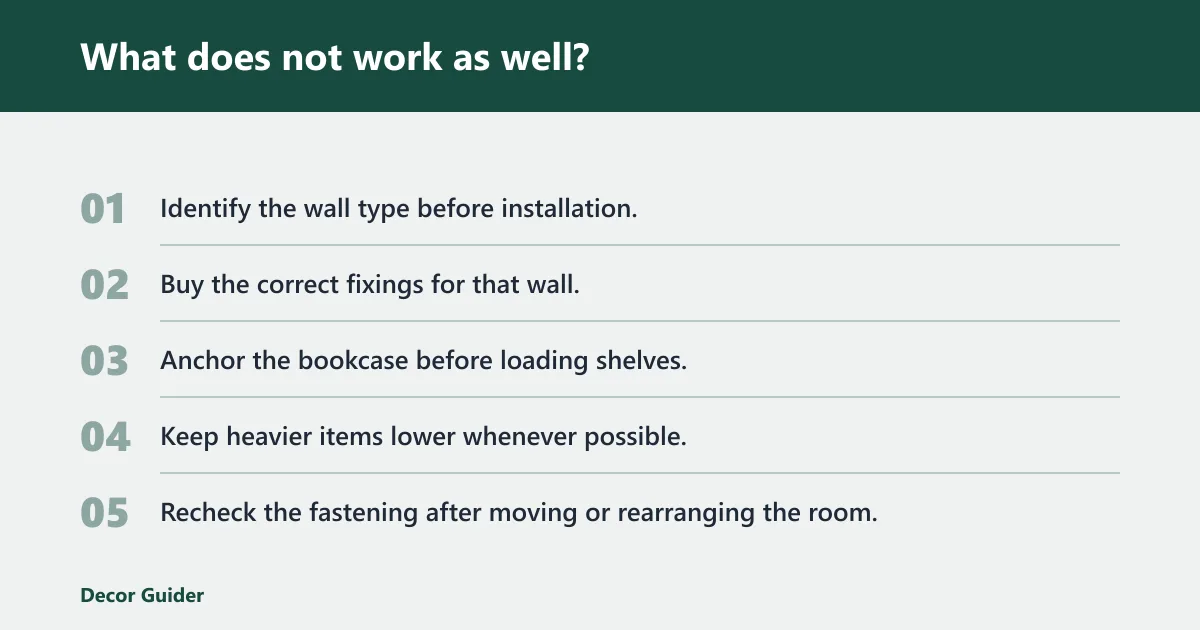
IKEA says BILLY must be securely anchored to the wall to prevent tipping. Treat that as a requirement, not a suggestion. The included brackets are only part of the solution; the wall fixings depend on your wall material, so you need the right hardware for the job.
- Identify the wall type before installation.
- Buy the correct fixings for that wall.
- Anchor the bookcase before loading shelves.
- Keep heavier items lower whenever possible.
- Recheck the fastening after moving or rearranging the room.
How much weight can an IKEA BILLY shelf hold?
IKEA lists a maximum load of 66 lb per shelf, but practical loading depends on item type, spacing, and how evenly you distribute weight. A shelf full of paperbacks behaves differently from one stacked with large hardcovers or a few dense art books. The safest approach is to stay well below the ceiling when possible.
Practical loading guidance
For paperback collections, BILLY is usually a comfortable fit if you spread the books across the shelf width. For standard hardcovers, the shelf can still work well, but avoid piling the heaviest titles in one area. For art books, treat the shelf as a light-to-moderate storage surface unless the load is split across more shelves.
For decor, the weight is usually less of a problem than point loading. A few ceramic objects, stacked boxes, or dense photo frames can concentrate pressure in a small area. If the shelf starts to deflect in the middle, move part of the load to another shelf right away.
When to split weight across more shelves
Use more shelves whenever one shelf looks crowded with dense items. The easier fix is usually to spread the same collection over two levels instead of forcing it onto one. That also improves access and cuts down on long-term stress.
Signs the shelf is being pushed too hard
Watch for visible center bowing, shelf edges that look stressed, doors that no longer sit as cleanly, or a back panel that seems to flex more than before. Those are practical warning signs. They do not mean instant failure, but they do mean the load should come down.
Best BILLY setup by use case
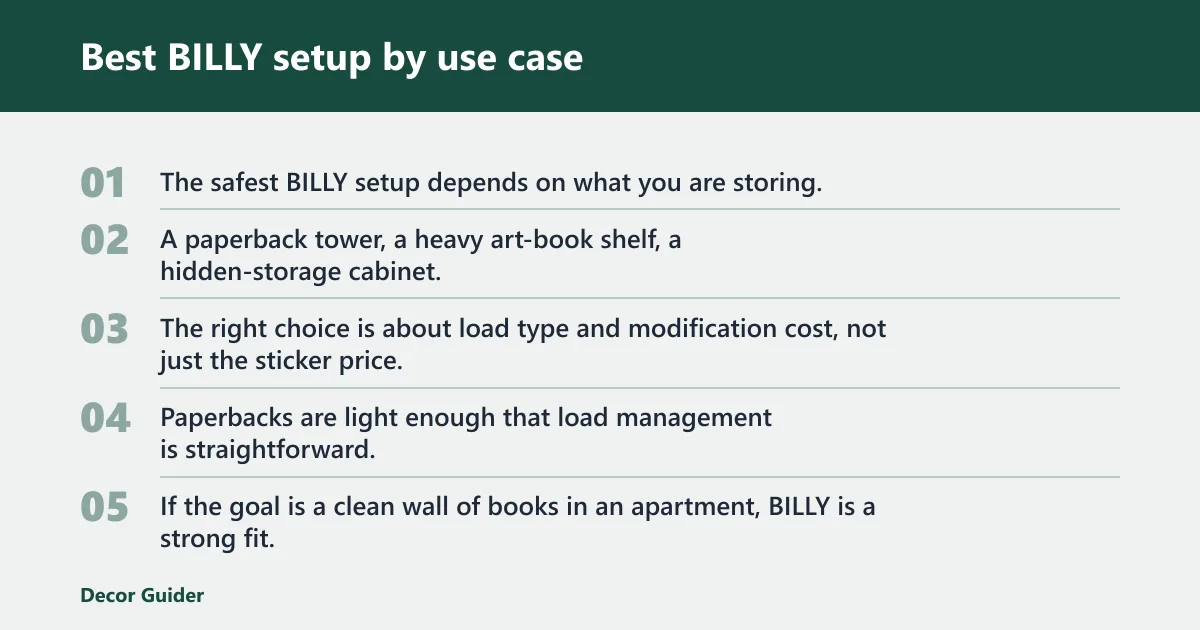
The safest BILLY setup depends on what you are storing. A paperback tower, a heavy art-book shelf, a hidden-storage cabinet, and a built-in hack base all want different decisions. The right choice is about load type and modification cost, not just the sticker price.
| Use case | Safest BILLY setup | Estimated risk level | Smarter add-ons or alternatives |
|---|---|---|---|
| Paperback library | Standard BILLY with shelves spaced for rows of paperbacks; anchor to wall; keep heavier titles lower | Low | Extra shelves if you need tighter spacing; a deeper bookcase only if oversized slipcases are common |
| Heavy art books | Use fewer books per shelf, spread weight evenly, and keep the densest volumes on lower shelves | Moderate to high | Consider a sturdier, deeper bookcase if the collection is large or very dense |
| Hidden storage with doors | BILLY with compatible doors and careful model matching; avoid overfilling the cabinet | Moderate | Doors, internal shelf planning, and proper anchoring; if humidity is an issue, choose a different material class |
| Built-in hack base | Multiple BILLY units with a same-width height extension unit, plus trim and careful ceiling checks | Moderate to high | Only proceed if wall type, ceiling height, and finishing budget are clear; otherwise keep it freestanding |
Paperback library
This is BILLY’s safest lane. Paperbacks are light enough that load management is straightforward, and the adjustable shelves make spacing efficient. If the goal is a clean wall of books in an apartment, BILLY is a strong fit.
Heavy art books
This is where BILLY becomes more conditional. It can work, but the 66 lb rating should not tempt you into dense, overstuffed shelves. If the collection is full of large-format volumes, a sturdier or deeper unit may be the better long-term choice.
Hidden storage with doors
Doors can turn BILLY into a tidier storage piece, but compatibility matters. IKEA says the unit can be used with doors in different colors and designs, and model matching is essential. This setup is best for people who want visual calm and are willing to pay for the extra parts.
Built-in hack base
BILLY is often used as the base for built-in projects, but this is where the costs widen. Once you add extensions, trim, filler, and finishing, the total can move far beyond the base price. Ceiling clearance, wall type, and the ability to anchor properly all need to be planned first.
Should you buy the BILLY bookcase?
Buy BILLY if you want an affordable, modular storage base for books, display, or a future cabinet project. Skip it if you need deep shelves, high moisture tolerance, or a heavy-load unit that will stay at the edge of its capacity for years. The value is real, but only in the right setup.
Best reasons to buy
The best case is a dry room, modest load, wall anchoring, and a need for flexible storage. BILLY is also attractive if you want a base unit you can grow over time with doors, shelves, or a height extension. The low entry price helps the math.
Best reasons to choose something sturdier
If your collection includes many heavy art books, vinyl, or dense decor items, the shelf limit is only part of the story. You may also want a deeper body, stronger material, and more resistance to wear. That is where a pricier alternative can make more sense.
How the IKEA Family offer changes the value call
IKEA lists a Family offer of $65.00 in-store only, valid from Sep 8, 2026 until Dec 24, 2026. That discount improves the case for a standard, lightly loaded BILLY. It does not change the material limits, but it does make the base unit easier to justify.
A common first-timer mistake is choosing a BILLY for a narrow office nook, then forgetting to account for wall anchors, adjustable shelves, and assembly time before committting. The cabinet starts as a bargain and ends as a project. That is fine if you plan for it from the start.
Final buying rule
If your use case is light-to-moderate books, display storage, or a planned modular wall system, BILLY is worth it in 2026. If you need strength first and customization second, look elsewhere. The smartest rule is simple: buy BILLY for flexibility and cost control, not for brute strength.
Alternatives

FACBOTALL’s 82-inch tall black bookshelf is the more obvious pick when you want a taller open-display look and a more substantial visual presence. Based on its spec sheet and owner feedback, the tradeoff is that it is less of a modular system than BILLY, so it gives you fewer expansion paths and less of the built-in ecosystem that makes BILLY useful.

BOXOB’s replacement shelf pegs are a small but practical buy if you already own a BILLY and need better shelf support hardware. The drawback is obvious: this is not a storage solution by itself. It is a maintenance accessory, useful when missing or worn pins are the problem, not when the whole bookcase is undersized.
Frequently asked questions
are ikea billy bookcases any good
Yes, if you want affordable, adjustable storage for light-to-moderate loads. BILLY is widely bought for a reason: it is simple, flexible, and easy to fit into small rooms. It is less suitable if you need deep shelves, moisture resistance, or a heavy-duty cabinet for dense books.
are ikea billy bookcases strong
They are strong enough for ordinary book and display use when loaded sensibly and anchored properly. They are not solid-wood heavyweights. The published 66 lb shelf limit is useful, but strength depends on how the weight is spread, how dry the room is, and whether the unit is secured to the wall.
what are ikea billy bookcases made of
BILLY’s main parts and plinth front are made of particleboard with paper foil, and the back panel is fiberboard with paint and paper foil. That construction keeps costs down, but it also means more sensitivity to moisture and less repairability than solid wood if the edges chip.
do ikea billy bookcases sag
They can, especially if you load one shelf too heavily or keep dense items in the same spot for a long time. The 66 lb rating is a ceiling, not a target. Visible bowing is a sign to redistribute weight, lower the load, or move to a sturdier unit.
do i need to anchor an ikea billy bookcase to the wall
Yes. IKEA says the BILLY must be securely anchored to the wall to prevent tipping. The included brackets are part of the setup, but wall fixings are sold separately and must match the wall material. That step is essential for safety, especially in homes with kids or pets.
is the billy bookcase worth it in 2026
It is worth it if you need a low-cost, modular storage base and you are willing to anchor it, load it properly, and budget for add-ons only when they make sense. It is less worth it if you need a tougher material, deeper shelves, or a finished built-in look without extra spending.
Products related to this article
Sponsored / affiliate links. As an Amazon Associate I earn from qualifying purchases. I may earn additional commission from eligible campaigns.