Sleeper Sofa Size Chart: Find the Right Fit
A sleeper sofa size chart should start with the mattress open size, not the sofa footprint: a common rule of thumb is to leave at least 30 inches of clear walking space. Skip that step, and the bed can block doors, crowd traffic, or leave guests short on sleep space. This guide covers common sleeper sizes, what they measure closed and open, and how to match each one to your room and guest needs.
Pair mattress needs with room clearance and sofa footprint
The right sleeper size is the one that fits closed against the wall and fully opened in the room. Start with the mattress size you need, then confirm the open-bed depth, doorway path, and at least 30 inches of walking clearance around the bed zone.
Use the sofa footprint after the sleeping layout works. A compact apartment may fit a loveseat sleeper or chair sleeper, while a larger living room can handle a queen or sectional sleeper if the open bed does not cut off circulation.
This table turns common sleeper labels into room-fit decisions. The closed sofa dimensions are typical purchase targets, while the mattress sizes and clearance numbers show the space the bed needs when opened.
| Sleeper type | Typical sofa dimensions | Mattress size | Minimum room clearance when open | Best use |
|---|---|---|---|---|
| Chair sleeper | About 50 to 60 inches long; about 36 to 40 inches deep | About 30 x 72 inches | About 7 feet by 8 feet of clear floor | Small space, one overnight guest |
| Loveseat sleeper | About 55 to 70 inches long; about 36 to 40 inches deep | About 48 x 72 inches | About 8 feet by 8 feet of clear floor | Small apartment, occasional guest use |
| Twin sleeper | About 65 to 75 inches long; about 36 to 40 inches deep | 38 x 75 inches | About 8 feet by 9 feet of clear floor | One adult or one child guest |
| Full sleeper | About 72 to 84 inches long; about 36 to 40 inches deep | 54 x 75 inches | About 9 feet by 9 feet of clear floor | One adult, two smaller guests, family room |
| Queen sleeper | About 76 to 90 inches long; about 37 to 42 inches deep | 60 x 80 inches | About 9 feet by 10 feet of clear floor | Most comfortable fit for regular overnight guests |
| King sleeper | About 86 to 100 inches long; about 38 to 44 inches deep | 76 x 80 inches | About 10 feet by 10 feet or more of clear floor | Large guest room or very open living room |
| Sectional sleeper | Varies by layout; often 90 to 120 inches overall, plus chaise | Commonly queen or full size, depending on model | Usually needs the largest open zone in the room | Family seating, frequent guests, larger rooms |
For mattress sizing, the standard bed dimensions most shoppers compare against are 38 x 75 inches for twin, 54 x 75 inches for full, 60 x 80 inches for queen, and 76 x 80 inches for king. Sleeper sofa mattresses often follow those labels, but the frame can reduce the usable sleep surface slightly, so check the listing for the exact mattress cut.
What are the standard sleeper sofa sizes?
The main sleeper sofa sizes are chair, loveseat, twin, full, queen, king, and sectional. The label tells you more about sleeping width than about the closed sofa footprint, so you still need to compare overall length, seat depth, and open-bed depth before you buy.
Chair sleeper and loveseat sleeper
Chair sleepers are the smallest option for one guest, and loveseat sleepers give you a little more sleeping width without taking over a room. They fit small spaces best when you need daily seating first and an occasional bed second.
Typical chair sleeper mattresses are about 30 x 72 inches. Loveseat sleeper mattresses are often around 48 x 72 inches. Those sizes work well for one adult guest, and they are easier to move through narrow halls and tighter doorways than larger models.
Twin and full sleeper sofas
Twin and full sleeper sofas are the middle ground for small homes that still host guests with some regularity. A twin works for one guest who wants a familiar bed width, while a full gives more elbow room and a better fit for two smaller sleepers.
Pottery Barn’s Pearce Square Arm Sleeper Sofa offers hundreds of design combinations, including fabrics, cushions, and size. That range matters because the same frame family may be sold in several widths, which changes both seat count and the open-bed footprint.
Queen, king, and sectional sleepers
Queen sleepers are the most common choice for guest comfort because 60 x 80 inches matches a standard queen mattress size. King sleepers need much more floor space, and sectional sleepers usually need the most planning because the chaise and corner shape change how the bed opens.
CNN Underscored identifies Burrow Shift Sleeper Sofa as one of its featured picks. CNN also notes that the West Elm Shelter Sleeper has a gel-infused foam mattress, while the Macy’s Radley Fabric Queen Sleeper Sofa Bed has an 86-inch frame and can accommodate up to 400 pounds. Those product details show why the frame size alone is not enough to judge fit.
How much space do you need to open it?
You need space for the mattress to extend, space to walk around it, and space to keep it from hitting nearby furniture. A practical minimum is 30 inches of clear walking space, but the open-bed depth is the number that usually decides whether the room actually works.
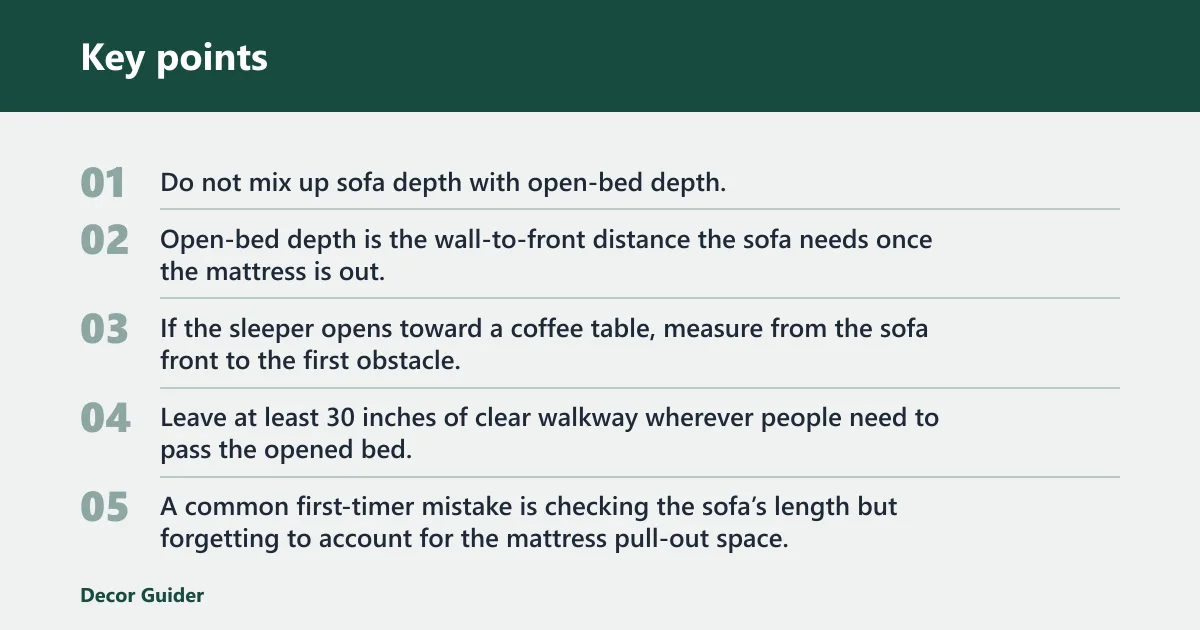
Do not mix up sofa depth with open-bed depth. Closed depth measures the sofa footprint; open-bed depth measures how far the sleeper extends into the room once the mattress is pulled out.
Open-bed depth
Open-bed depth is the wall-to-front distance the sofa needs once the mattress is out. For many queen sleepers, that can mean a room needs about 9 to 10 feet of open space in front of the sofa, depending on the frame and arm style.
If the sleeper opens toward a coffee table, measure from the sofa front to the first obstacle. That distance must clear the mattress length plus a walking lane, or the room will feel blocked even if the sofa itself fits the wall.
Walkway clearance
Leave at least 30 inches of clear walkway wherever people need to pass the opened bed. If the sleeper sits in a main path to the kitchen, bath, or balcony, add more space so the room still functions when the bed is in use.
A common first-timer mistake is checking the sofa’s length but forgetting to account for the mattress pull-out space. Suppose a queen sleeper fits an 8-foot wall, but the open bed leaves only 18 inches to the opposite chair. The sofa may close fine, yet the room becomes unusable at night.
Front extension space and doorways
Front extension space is the distance the mattress needs to pull forward and down without hitting a rug, table, or cabinet. Doorway fit matters before delivery, because the sofa frame must pass through the entry, hall turns, and any tight corners.
Do not subtract outlet boxes from usable wall width. Outlets usually do not reduce the wall span you can use for the sofa frame, but baseboards, vents, and protruding trim can change the usable depth and should be measured separately.
How do you measure before you buy?
Measure the room in three stages: wall width, open-bed depth, and delivery path. Then compare those numbers to the sofa’s frame length and the mattress size, because a sleeper that fits the wall can still fail at the doorway or when fully opened.
-
Measure the wall span.
Record the exact wall-to-wall width where the sofa will sit, then subtract only fixed obstacles such as built-ins or radiator covers. Keep the number in inches so you can compare it directly with the listed sofa frame length. -
Measure the open zone.
Pull the tape from the sofa wall out into the room to the first obstacle, then add the mattress depth and at least 30 inches of walking clearance. This tells you whether the room can function when the bed is open. -
Measure the delivery path.
Check the front door, hallway, stair turns, and elevator opening if needed. Write down each narrowest point, because the sofa must pass every turn on the way in, not just the living-room wall where it will land.
Say your living room is 11 by 13 feet and you want a queen sleeper. If the open bed needs about 9 feet by 10 feet of clear floor, the room may work only if the remaining circulation path stays open and no large table sits in front of the mattress.
Suppose the sofa must turn through a 31-inch hallway and the delivery path has a tight corner. Even a compact loveseat sleeper can fail the move-in test if its arm width or frame depth is too large for the turn, so the route matters as much as the room itself.
Which sleeper type fits your household?
Match the sleeper to how often it will be used, how many people sleep on it, and how much daytime seating you need. Small spaces usually favor chair or loveseat sleepers, while family use and more frequent guests usually point toward a full, queen, or sectional model.
Small spaces
For a studio or small apartment, a chair sleeper or loveseat sleeper is usually the safest fit. These models preserve floor space for circulation and still give you a guest bed when needed, which matters if the room doubles as your main seating area.
Family use
For family use, look at full or queen sleepers, or a sectional sleeper with a chaise if the room can handle it. IKEA’s FRIHETEN sleeper sectional is a 3-seat model with storage, and IKEA describes sleeper sectionals as offering enough room for the whole family and sleeping space for guests.
IKEA’s FRIHETEN is priced at $989 during the listed promotion, and IKEA’s BÅRSLÖV 3-seat sleeper sofa with chaise is listed at $1,149. Those listings are a reminder that a sectional can add storage and seating, but it also changes the room plan because the chaise length becomes part of the footprint.
Pet-friendly homes
Pet-friendly homes usually benefit from a frame that is easy to clean around and a fabric that can handle daily contact. A sleeper with a simpler silhouette and fewer deep crevices is easier to keep clear of fur, but the exact upholstery choice should still match the room size and open-bed clearance.
Overnight guests
If overnight guests are rare, a twin or full sleeper may be enough. If guests stay for several nights, a queen sleeper is usually the better comfort choice because it matches a standard 60 x 80 mattress size and gives more sleeping room without moving into king-scale floor needs.
What makes a sleeper more comfortable?
Comfort comes from mattress thickness, support level, and how the sleeper feels after the frame opens. Foam mattresses tend to feel lighter and firmer, while memory foam often adds pressure relief. Cooling gel can help reduce trapped heat, especially on a sleeper used for more than one night.
The mattress thickness matters because thin pads can feel fine for one evening and less comfortable after that. A 5-inch memory foam mattress with gel infusion, like the one included with Pottery Barn’s sleeper, gives a useful example of the kind of construction many shoppers compare when they want more guest comfort.
Firmness should match the sleeper’s purpose. Daily seating often benefits from a firmer seat cushion so the sofa does not sag early, while the pull-out mattress should support the body without feeling hard. If comfort is a priority, check the mattress type, thickness, and whether the listing mentions cooling gel or memory foam.
Frequently asked questions
What size is a queen sleeper sofa?
A queen sleeper sofa usually uses a 60 x 80-inch mattress, which matches a standard queen bed size. The closed sofa frame is often about 76 to 90 inches long, but the open-bed depth is what matters most. Plan for roughly 9 to 10 feet of clear floor in front of it.
What is the standard sleeper sofa mattress size?
The standard mattress sizes most shoppers compare against are 38 x 75 inches for twin, 54 x 75 inches for full, 60 x 80 inches for queen, and 76 x 80 inches for king. Sleeper sofas may use these labels, but the exact mattress cut can vary by model.
How do I measure a sleeper sofa before buying?
Measure the wall width, the open-bed depth, and the delivery path. Then compare those numbers with the sofa’s overall length, seat depth, arm width, and any chaise length. If the room works only when the bed stays closed, the sleeper is too large for the space.
Will a sleeper sofa fit in my apartment living room?
It can, if the open bed still leaves a clear walkway and does not block doors or major traffic paths. Apartments often fit a loveseat sleeper, full sleeper, or compact queen sleeper better than a sectional. The room must work in both daytime and overnight layouts.
What are the different sleeper sofa sizes?
The main sizes are chair sleeper, loveseat sleeper, twin, full, queen, king, and sectional sleeper. The labels describe sleeping width and room needs, but not the whole story. Frame length, mattress size, and open-bed clearance all affect whether the sleeper is a practical fit.
How much space do I need to open a pull-out sleeper sofa?
Leave enough room for the mattress to open fully, plus at least 30 inches of walking clearance. For many queen sleepers, that means a clear zone of about 9 to 10 feet in front of the sofa. The exact number depends on the frame and mattress size.
Products related to this article
Sponsored / affiliate links. As an Amazon Associate I earn from qualifying purchases. I may earn additional commission from eligible campaigns.