Sofa Frame Problems: Diagnose and Fix Them
Treat sofa frame problems by finding the failure first: tighten or reinforce minor loose joints, repair small wood splits, and replace the sofa if the frame is cracked, warped, or the mechanism is binding and unsafe. Ignored frame damage can keep worsening, make the sofa unsafe to sit on, and turn a low-cost fix into a replacement. This guide shows how to diagnose wobble, creaks, sagging, loose legs, binding mechanisms, and visible cracks, then decide between DIY repair, pro repair, reinforcement, or replacement.
What you’ll need


- Flashlight or inspection light
- Phillips and flat screwdrivers
- Hex keys or socket set for fasteners and legs
- Pliers
- Wood glue for small joint splits
- Clamps for curing glued joints
- Sister board stock for larger wooden cracks
- Replacement wood section matched to the original dimensions
- Wood screws, brackets, and washers as needed
- Vacuum or brush for clearing dust around joints
- Gloves and eye protection
What sofa frame problems mean

Frame trouble usually starts with movement, noise, or uneven support. Wobbling is a clear warning sign of frame damage, and sagging seats can point to frame damage, not just worn cushions. Small cracks can grow under continued weight and stress, so a visible split needs attention quickly. Safety agencies advise taking unstable furniture seriously because structural failure can lead to sudden collapse or injury risk. CPSC furniture safety guidance
Wood frames commonly fail at joints, legs, arms, rails, and corner blocks. Steel frames can still fail at joints, welds, hinges, or support points, especially in sleepers and recliners. A failed suspension system can mimic frame damage, so check webbing and springs before you buy parts.
Why wobble, creaks, and sagging matter
A wobble often points to loosened fasteners, a split corner block, or a cracked rail. Creaks can come from wood movement, metal rubbing, or a sleeper mechanism that is out of alignment. Sagging may come from webbing or springs, which means the cushions may look tired while the actual fault sits below them.
How damage spreads
Once a frame opens up, nearby parts start carrying extra load. That extra load can loosen screws, bend support bars, and tear webbing. Broken frames can collapse without warning and create injury risk, so treat visible separation as more than a comfort issue. If the sofa becomes unstable under normal sitting weight, stop using it until the load-bearing fault is identified and corrected.
What to inspect first
Start with the parts that carry load and move under stress. A frame inspection should check joints, screws, hinges, support bars, rust, misalignment, discoloration, and hidden movement. If the sofa has a sleeper unit or recliner hardware, inspect those parts too before deciding on a fix.
Joints, rails, legs, arms, and corner blocks
Look where pieces meet. Press down on each arm, rock each leg, and watch for movement at the rail and corner block. In a wood sofa frame, cracks often show first near fasteners or stress points under upholstery, where the load-bearing structure is hidden from casual view. For a loose leg mount, the fastest clue is side-to-side play at the base rather than cushion sag.
Suspension system checks
Reach under the frame and inspect webbing, springs, and their attachment points. Broken webbing can cause one-sided sag, while a broken spring may create a dip that feels like a frame failure. If the suspension shifts when you sit, mark it for repair before any cosmetic work.
Special checks for sleepers, recliners, and sectionals
For a sleeper sofa mechanism, open and close the bed slowly and look for binding at hinges, bent support bars, and loose mounting points. Recliner hardware needs the same check at pivot points and welds. Sectional connectors should lock tightly; if they wiggle, the whole arrangement can feel like a weak frame.
Sofa frame problem triage
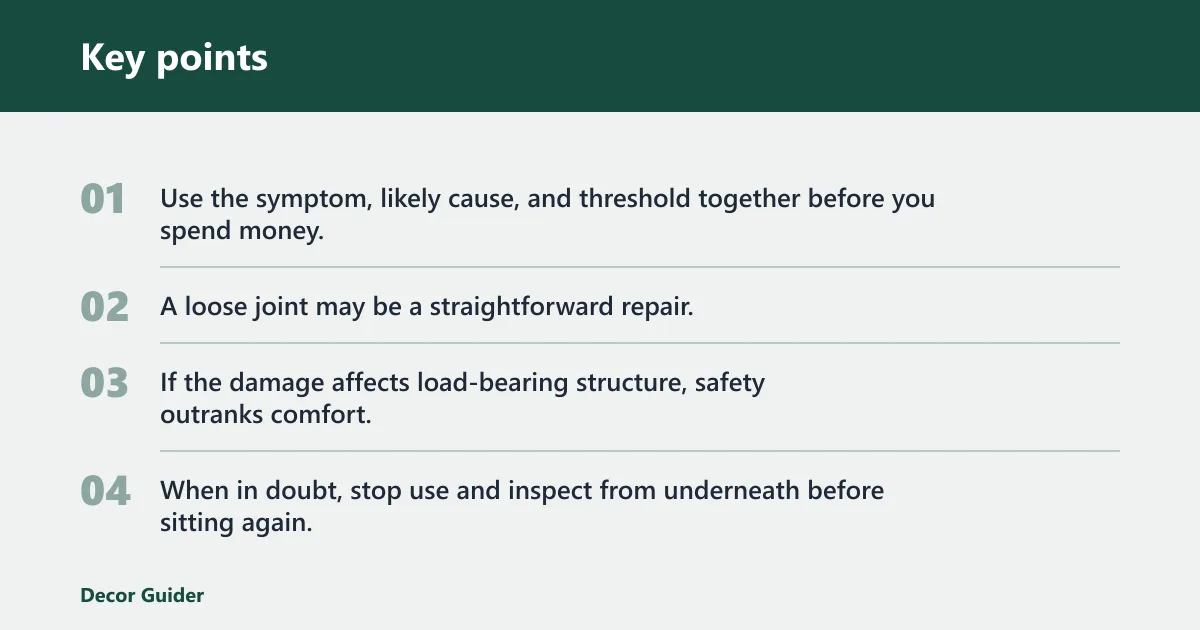
Use the symptom, likely cause, and threshold together before you spend money. A loose joint may be a straightforward repair, while a cracked rail or split corner block can move fast from repair territory to replacement. If the damage affects load-bearing structure, safety outranks comfort. When in doubt, stop use and inspect from underneath before sitting again.
| Symptom | Likely cause | DIY fix | Pro fix | Estimated urgency | Replace-vs-repair threshold |
|---|---|---|---|---|---|
| Wobble | Loose joints or leg mounts | Tighten visible fasteners and recheck movement | Reset joints and reinforce stress points | High | Replace if wobble remains after tightening or the rail is split |
| One-sided sag | Spring or webbing failure, or cracked support rail | Inspect suspension and replace obvious broken webbing | Rebuild suspension and check the frame | High | Replace if the rail is cracked or support points are collapsing |
| Cracked rail | Overload or old wood fatigue | Do not rely on glue alone | Sister board or replace the section | Urgent | Replace if the crack runs through a load-bearing span |
| Loose leg | Stripped threads or split mount | Retighten and inspect the mount | Rebuild the leg block or mounting area | High | Replace if the leg mount is split or unstable after tightening |
| Squeak | Friction at joints, springs, or mechanism points | Locate the contact point and tighten hardware | Replace worn bushings or hardware | Medium | Repair if no structural movement is present |
| Spring failure | Broken spring or loose attachment | Stop use if a spring has popped free | Replace springs and inspect the rail | Urgent | Replace if the frame is also bent or torn |
| Mechanism bind | Misaligned sleeper or recliner hardware | Clear obstructions and check fasteners | Realign or replace mechanism parts | High | Replace if the mechanism twists the frame or will not close safely |
| Split corner block | Stress at a reinforcement point | Do not keep loading the sofa | Replace the block and reinforce the joint | Urgent | Replace if the split reaches the rail or leg mount |
| Visible frame separation | Open joint or broken member | Stop use and inspect from underneath | Disassemble and rebuild the connection | Urgent | Replace if the separation involves a main rail or multiple members |
| Warped side rail | Long-term overload, moisture, or failed support | Do not force alignment if the rail is under load | Replace the rail or have it rebuilt | Urgent | Replace if the rail no longer sits square or drags the frame out of alignment |
| Metal weld crack | Fatigue at a welded joint | Stop use; do not bend it back | Have the weld inspected and repaired | Urgent | Replace if the crack is on a primary support or multiple welds are affected |
| Sleeper bed drags or jams | Bent track, shifted mount, or interference at hinges | Remove obstructions and retest open/close travel | Realign or replace mechanism components | High | Replace if the mechanism twists the frame, tears the mount, or cannot close flat |
| Seat dips after fastener tightening | Hidden rail, spring, or webbing damage | Inspect suspension again before use | Rebuild the support system | High | Replace if the dip persists and the load path is still uneven |
How do you fix a sofa frame?
Start with the least invasive repair that matches the damage. Tighten loose fasteners first, then test movement. Use wood glue and clamping for small cracks or loose joints, add sister board reinforcement for larger cracks, and replace a damaged wood section when the break is complete or load-bearing.
- Flip or tilt the sofa safely and expose the frame.
- Check the joints, screws, hinges, and support bars for movement.
- Tighten loose fasteners and retest the wobble.
- Apply wood glue to a small joint split, then clamp until fully cured.
- Add a sister board when a crack is larger and the member still holds shape.
- Fit a replacement wood section when the original piece is broken through.
Use glue and clamping for small cracks only. That repair can hold a minor split together, but it is a partial fix, not a cure for a broken rail or a loose leg mount. A replacement wood section must be custom-fitted to the existing dimensions, so the repair usually needs careful cutting and alignment.
If the failure is at a leg, corner block, or main rail, the repair must restore the original load path, not just hide the movement. If the sofa is steel-framed, the same principle applies: a bent or cracked support member needs structural correction, not just a tightened screw.
Say your three-seat sofa wobbles on the left arm and the bottom rail shows a hairline split near the corner block. Tighten the leg mount first. If the wobble remains, a glued clamp job may help only if the split is shallow and the rail is still intact.
Should you repair or replace?
Repair makes sense when the damage is local, the model has value, and the frame still carries load without twisting. Replacement is the safer call when a main rail is cracked, the mechanism binds hard, the frame has warped, or the sofa is old enough that one repair will not stop the next failure. If the sofa no longer sits square or stable after a targeted fix, replacement is the better threshold.
When a technician is the better choice
Call a sofa repair service when the frame has hidden damage, the sleeper or recliner hardware is involved, or steel joints and welds need inspection. Professional repair may include wood glue and clamping for small cracks, sister boards for larger breaks, and new wood sections for complete breaks. If the job involves disassembly, pay for the disassembly.
Cost and value guide
Loose joints and minor hardware fixes are usually among the least expensive, while cracked rails, broken legs, and sleeper mechanism repairs often cost more because they take more labor and parts. Full frame replacement is the top-end repair path. A higher-quality sofa with a solid frame may justify repair, while a low-value or badly damaged piece often does not.
Picture a sleeper sofa that opens crooked and scrapes at one hinge. If the frame is still square and the mechanism is the only problem, repair may be sensible. If the fold-out unit has bent the side rail or split the mount, replacement becomes the safer spend.
Are steel frame couches good?
Steel frame couches can be a good choice when the build uses strong joints and sound welds, and many sleeper and recliner designs benefit from the stiffness. They are not immune to failure. Joints, welds, hinges, and support points can still loosen or crack, so inspect the moving parts as carefully as you would wood.
Steel-framed furniture is strongest when the load is carried through intact supports and tight connections. If a weld crack, hinge bind, or bent support is present, the durable option is the one that restores alignment and load-bearing capacity, not the one that simply masks the symptom.
Inspection checklist: wood vs steel vs sleeper
Use this quick decision path to narrow the failure before you buy parts. Start with the material, then follow the symptom to the most likely break point. If you cannot identify the source of movement quickly, stop using the sofa until the underside has been checked.
- Wood sofa frame: check corner blocks, rails, leg mounts, and joint openings first.
- Steel sofa frame: check welds, hinges, bent brackets, and support points first.
- Sleeper sofa mechanism: check the fold-out track, pivots, fasteners, and any point where the mechanism twists the frame.
Decision tree: If the sofa wobbles but the frame is square, look for loose fasteners or a loose leg mount. If one side sags, check webbing or springs before blaming the rail. If the mechanism binds, inspect the sleeper or recliner hardware before replacing the whole sofa. If a main member is cracked, warped, or separated, move from repair to replacement planning.
A 10-year warranty for the mechanism, and a review notes a limited lifetime warranty on the frame. Warranty language can help you judge expected life, but it does not replace inspection. If the mechanism binds or the frame shifts, check the manufacturer’s written warranty terms directly before assuming coverage, and stop using the sofa if the structure is unsafe. FTC warranty basics
Common mistakes
Do not treat every sag as cushion wear. A sagging seat can come from springs or webbing, and those parts need their own check. Do not glue a complete break and call it fixed. Do not keep using a sofa with a loose leg, split corner block, or binding sleeper mechanism.
One common first-timer mistake is tightening visible screws while ignoring the hidden joint that keeps opening under load. Another is forcing a sleeper bed shut when the mechanism is off track. That can bend support bars and turn a repairable issue into a frame replacement.
- Stop loading the sofa if a crack, split, or collapse risk is present.
- Inspect the frame again after any repair and test movement from both sides.
- Check webbing and springs before assuming the wood or metal frame failed.
- Use glue only for small splits, then clamp and wait for full cure time.
- Upgrade to sister board reinforcement if the crack is longer or under load.
- Replace the section or the sofa if structural movement remains after repair.
Prevention is mostly inspection. Check joints, screws, hinges, support bars, rust, and discoloration on a regular schedule, and move the sofa without dragging it across a floor. That habit catches hidden movement before a small defect turns into a larger break.
Frequently asked questions
How to fix a couch frame
Begin by checking the joints, screws, legs, arms, rails, and suspension system. Then repair only the part that failed. A couch that still feels uneven after fastener tightening may have a spring or webbing problem, so inspect those parts before you buy frame materials.
How to fix a sofa support
Check whether the support issue comes from webbing, springs, a cracked rail, or a loose mount. Replace damaged webbing or springs if they have failed on their own. If the support member is split or the joint is open, reinforce or replace the structural piece before the sofa returns to regular use.
When should I call a sofa repair service?
Call a repair service when the frame is cracked through, the sleeper or recliner mechanism binds, the sofa has steel weld damage, or the repair needs disassembly you cannot do safely. Also call when the cost of parts and labor is close to the sofa’s replacement value, or when the damage creates collapse risk.
Products related to this article
Sponsored / affiliate links. As an Amazon Associate I earn from qualifying purchases. I may earn additional commission from eligible campaigns.