Coffee Table Cost / Price / How Much
A basic coffee table costs about $80–$200, midrange models often run about $200–$600, and solid-wood or designer pieces often cost about $600–$1,500+. Buying too low can mean flimsy tops, poor stability, and surprise delivery or assembly fees that push the final price well past the sticker. This guide breaks down price ranges by use case, material, delivery, assembly, and upgrade costs so you can budget accurately.
Coffee table price ranges
At the low end, coffee tables usually land in budget territory with simple materials and light construction. Mid-range pieces add better joinery, sturdier frames, and more finish options. Luxury tables cost more because of material quality, custom dimensions, design complexity, and the labor needed to build them well.
Budget coffee tables: what the low end usually buys
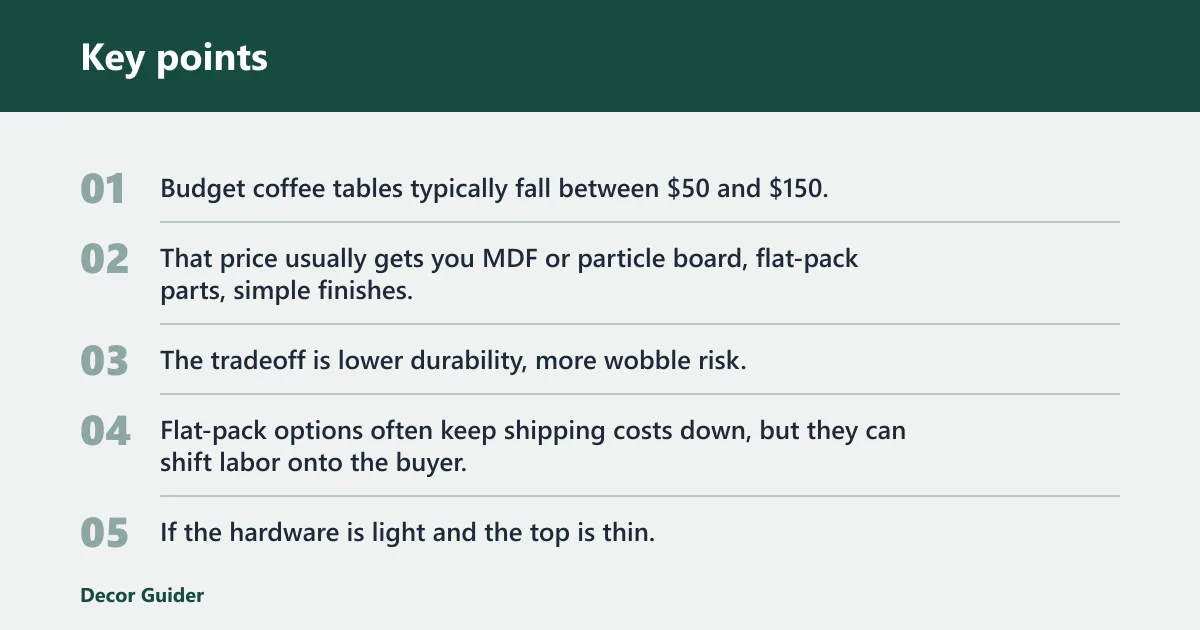
Budget coffee tables typically fall between $50 and $150, and low-end coffee tables usually sit in that same $50 to $150 band. That price usually gets you MDF or particle board, flat-pack parts, simple finishes, and fewer hardware details. The tradeoff is lower durability, more wobble risk, and a shorter service life if the frame or top carries much weight.
Flat-pack options often keep shipping costs down, but they can shift labor onto the buyer. If the hardware is light and the top is thin, the table may look fine on day one and still fail early at the joints or legs.
Mid-range coffee tables: where quality typically improves
Mid-range coffee tables are usually priced from $150 to $600, and many households spend $120 to $500 for common retail or mid-tier options. In this band, you often see better veneer work, stronger frames, more stable legs, and more reliable finishes. Metal-frame designs also live here often, with pricing around $200 to $700.
This is the range where value usually improves most clearly. You are paying for better materials, cleaner assembly, and finish details that do not feel improvised.
Luxury coffee tables: what pushes prices higher
Luxury coffee tables start at $600 and up. At that level, the price can reflect solid hardwoods, designer branding, custom sizing, specialty finishes, and more careful craftsmanship. Upscale custom pieces are listed at $500 low, $1,200 average, and $3,000 high, which shows how fast the total can climb once the piece is made to order.
Luxury pricing is not only about appearance. It often covers labor-intensive joinery, difficult finishing work, and the cost of producing fewer units.
What counts as a good price?
A good price depends on how the table will be used, not just the sticker number. For daily use, a good price is one that buys stability, a finish that can handle cleaning, and a top thick enough to resist flexing. For style-first buyers, a lower-cost table can be fine if the room sees light use.
A good price for daily use
For a family room or daily living space, a good price is often in the mid-range, where stronger joinery and a more durable finish are common. If the table sits in front of a sofa and handles remotes, drinks, books, and feet up regularly, paying a little more usually buys fewer replacement headaches.
A common first-timer mistake is assuming a low-priced coffee table with a glossy top will still hold up to daily use. The table looks right for a week, then starts rocking because the legs, apron, or fasteners were built to a price.
A good price for a small apartment
For a small apartment, a good price often means spending enough to get the right size and shape rather than the largest or heaviest piece. Compact tables with rounded corners, nesting designs, or narrow profiles can stay affordable while fitting tighter walkways and smaller seating layouts.
Say your living room is tight and the sofa sits close to a TV stand. A small-space table may cost less than a larger one, but a better fit can save you from blocking traffic or replacing it later.
A good price when style matters more than storage
If style matters more than storage, a good price can be lower than you might expect. Simple silhouettes, light metal frames, and veneered tops often deliver the look without the cost of drawers, lift-top parts, or thick hardwood slabs. The key is paying for design clarity instead of extra mechanisms.
Coffee table budget calculator
Use this as a shopping budget, not a final invoice. Table price is only part of the total. Delivery, assembly, and common upgrades can move the real budget up fast, especially for heavier, fragile, or custom-made pieces.
| Table type | Likely table price | Typical delivery / assembly add-on | Realistic all-in total range |
|---|---|---|---|
| Budget | $50–$150 | $20–$80 | $70–$230 |
| Small-space | $80–$220 | $20–$60 | $100–$280 |
| Storage / lift-top | $150–$500 | $40–$120 | $190–$620 |
| Solid wood | $150–$600 | $40–$150 | $190–$750 |
| Glass-top | $150–$900 | $50–$150 | $200–$1,050 |
| Custom | $500–$3,000 | $80–$250 | $580–$3,250 |
What drives coffee table prices up?
The biggest price jumps usually come from material, size, and construction complexity. A plain rectangular table is cheaper to make than a custom-size piece with a specialty finish, integrated storage, or delicate surfaces. Brand and shipping method matter too, but the structure of the table usually explains most of the difference.
Material choice: MDF, particleboard, solid wood, glass, and metal
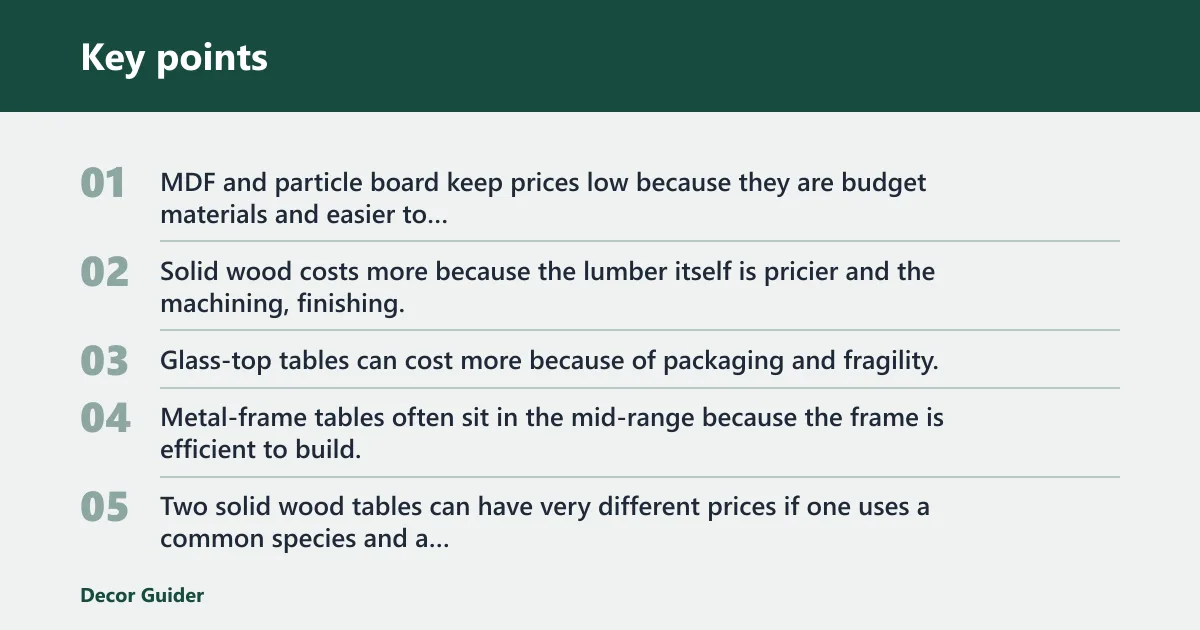
MDF and particle board keep prices low because they are budget materials and easier to produce at scale. Solid wood costs more because the lumber itself is pricier and the machining, finishing, and joinery require more care. Glass-top tables can cost more because of packaging and fragility. Metal-frame tables often sit in the mid-range because the frame is efficient to build, but the finish and hardware still add cost.
Material is not the whole story. Two solid wood tables can have very different prices if one uses a common species and a simple finish while the other uses a premium species with hand-applied coating and tighter joinery.
Size and dimensions
Larger tables usually cost more than smaller ones because they use more material and take more labor to build and finish. Custom dimensions raise the price again, since standard production batches no longer fit. The same design in a longer or wider format can also require stronger support to prevent sagging.
Picture a 36-inch table versus a 54-inch version of the same style. The larger one may look nearly identical in a room, but it can cost more simply because it needs more wood, more metal, and more care during shipping.
Finish, hardware, and build complexity
Finish quality changes both appearance and labor cost. A basic stain or laminate keeps prices lower, while specialty coatings, matched veneer work, or high-gloss finishes add time and skill. Hardware matters too. Soft-close storage, lift-top mechanisms, and hidden casters all increase the total.
Complex curves, mixed materials, and detailed joinery also push the price higher. A table with a simple slab top and straight legs is usually cheaper than one with drawers, shelves, and metal accents.
Material-by-material price guide
Different materials land in different price bands, but the range inside each band still depends on size, finish, and construction. The figures below are useful starting points when you compare listings across retailers or makers.
MDF and particleboard pricing
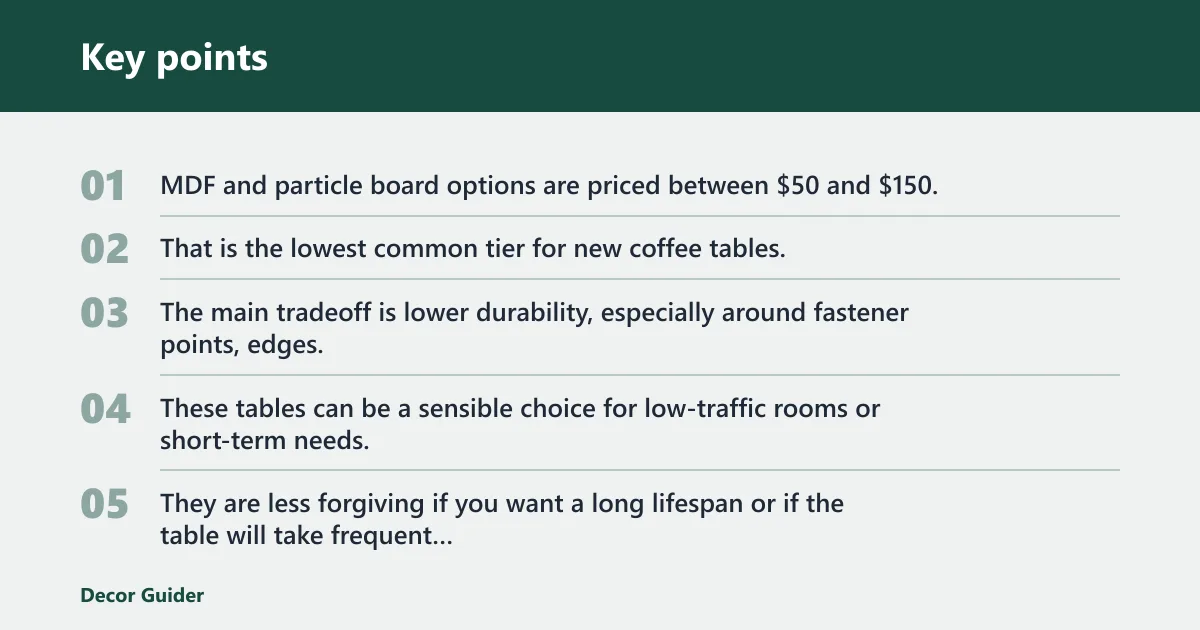
MDF and particle board options are priced between $50 and $150. That is the lowest common tier for new coffee tables, and it is where you will most often find flat-pack pieces. The main tradeoff is lower durability, especially around fastener points, edges, and moisture exposure.
These tables can be a sensible choice for low-traffic rooms or short-term needs. They are less forgiving if you want a long lifespan or if the table will take frequent wear.
Solid wood pricing by species and construction
Solid wood tables can range from $150 to $600 in the guide, with solid wood tables shown at $200 low, $500 average, and $1,600 high. Species, construction method, and finish quality all affect the number. A common hardwood with simple joinery will cost less than a table built from a premium species with a more refined finish.
That premium is usually worth it when you want a longer service life and a table that can be refinished later. It is less compelling if the piece is purely decorative and will not see heavy use.
Glass-top and metal-frame pricing
Glass coffee tables are listed at $150 to $900. They often cost more to pack and ship because of fragility, and replacement parts can be expensive if the top chips or breaks. Metal coffee tables are described as mid-range at $200 to $700, and the finish and hardware strongly affect where a specific model lands inside that range.
Glass works best when you are comfortable with extra shipping risk and careful placement. Metal frames suit buyers who want a cleaner modern look without paying for full solid-wood construction.
Do delivery and assembly change the budget?
Yes. Delivery and assembly can materially change the budget, especially for heavy, fragile, or partially assembled tables. Typical delivery and assembly are listed at $20 low, $80 average, and $250 high. Once you add those charges, a table that looked affordable online may sit in a much higher all-in bracket.
Typical delivery fee ranges
Basic drop-off delivery is usually the lowest add-on. Freight delivery, room-of-choice service, and staircase moves can push the bill up. Larger tables and heavier materials often cost more to handle because carriers need more space, more packing, and more care.
If the seller quotes curbside delivery only, plan for extra effort at home. That matters less for a 30-pound flat-pack table than for a glass-top or solid-wood piece.
Assembly fees and white-glove service
Assembly fees rise when the table arrives in multiple parts, uses specialty hardware, or needs careful alignment. White-glove service costs more because it includes placement, setup, and often debris removal. That premium can make sense for large or fragile tables, but it is not always needed for simple flat-pack models.
When shipping risk adds hidden cost
Glass-top coffee tables can carry higher shipping risk because breakage is expensive to handle. Even when the top arrives intact, the packaging may add weight and cost. Custom and made-to-order pieces can also have hidden cost in longer lead times, because a mistake or damage during transit is harder to resolve quickly.
How size changes the final cost
Size affects both the sticker price and the real budget. Small coffee tables are easier to ship and usually cheaper to build, while large tables need more material and may require higher delivery charges. Custom dimensions push the total upward because the maker cannot rely on standard cuts or repeatable packaging.
Small coffee tables
Small coffee tables are often the cheapest route for apartment living or tight seating plans. Their lower material use keeps the price down, and they can usually ship more cheaply. The downside is limited surface area, which can make the table feel undersized if the sofa is wide.
Large coffee tables
Large coffee tables cost more because they use more material and create more shipping complexity. The added footprint can be useful in bigger living rooms, but it can also require stronger construction to keep the top from flexing. That structural need is part of why size matters so much in pricing.
Custom dimensions and made-to-order pricing
Made-to-order pricing is highest when the buyer wants a specific length, width, height, or finish that standard production does not cover. Custom dimensions often trigger a labor premium, and custom finishing can add more. That is why designer and custom tables usually sit in the top tier.
Suppose you need a 48-inch table that fits between a sectional and a fireplace. A standard table may be cheaper, but a custom piece can avoid awkward gaps, overhang, or traffic problems that a cheaper size would create.
Frequently asked questions
How much does a coffee table cost?
The final total rises once delivery and assembly are included.
What is a good price for a coffee table
A good price depends on use. For everyday family use, the middle of the market often makes the most sense because it usually improves stability, finish quality, and lifespan. For a light-use room, a lower price can be fine if the table is steady, sized well, and free of weak hardware.
How much is a coffee table at the low end?
How much is a coffee table at the low end? Low-end coffee tables typically cost between $50 and $150. That tier usually includes MDF or particle board and simpler flat-pack construction. It can be a fair buy for short-term or low-traffic use, but the lower price often comes with reduced durability.
How much does a solid wood coffee table cost?
How much does a solid wood coffee table cost? Species, construction, and finish quality can move the price meaningfully within that span.
What drives coffee table prices up the most?
Material, size, and build complexity usually drive the biggest jumps. Solid wood costs more than MDF or particleboard, larger tables need more material, and specialty finishes or hardware add labor. Custom dimensions and fragile glass tops can raise the total further, especially when shipping and handling become more difficult.
Are designer coffee tables worth the premium?
Designer coffee tables can be worth the premium when you need a custom size, a distinctive finish, or careful craftsmanship that standard retail pieces rarely offer. They are less compelling if the premium mostly reflects branding. For many buyers, the value is in fit, materials, and build quality rather than the name alone.
How much should I budget for delivery and assembly?
How much should I budget for delivery and assembly? Typical delivery and assembly are listed at $20 low, $80 average, and $250 high. Expect the upper end if the table is heavy, fragile, oversized, or needs white-glove service. The add-on can move a mid-priced table into a much higher all-in budget.
What is the average price of a coffee table
What is the average price of a coffee table? That average sits between budget and mid-range territory, which is why many shoppers find the middle of the market to be the most balanced place to buy.
How much is a table cost?
How much is a table cost? If you mean a coffee table, the cost usually starts around $50 and can reach well past $600, depending on material, size, and design. For many households, the real decision is not the lowest sticker price but the best total budget after shipping and setup.
How much coffee cost
If you mean coffee rather than a coffee table, prices vary by beverage type, café, and location, and they are outside the scope of this furniture guide. For a coffee table budget, the useful number is the all-in total: table price plus delivery, assembly, and any upgrade costs.
How much does a coffee cost?
If you mean a cup of coffee, that depends on the shop, drink size, and market. If you mean a coffee table, the answer is the same as above: budget for the table itself, then add delivery, assembly, and any extras that change the final bill.
How much does the average coffee cost?
If you mean average coffee as a drink, that price is unrelated to furniture shopping. For a coffee table, the cleaner benchmark is the average cost of $250, with delivery and assembly often adding $20 to $250 more depending on the table’s size, material, and shipping method.
Products related to this article
Sponsored / affiliate links. As an Amazon Associate I earn from qualifying purchases. I may earn additional commission from eligible campaigns.