Sofa Recliner Not Working Problems
If your sofa recliner is not working, start with the symptom: no power usually means the outlet, cord, transformer, or fuse; clicks with no movement often point to the motor or lift mechanism; a manual recliner that will not close usually has a jammed release or bent linkage. Checking the wrong part wastes money and can turn a minor fault into a broken frame. This guide shows how to diagnose power, control, mechanism, and motor problems before you buy parts.
What you’ll need


- Flashlight
- Clear floor space around the sofa
- Owner’s manual or model number label
- Phone camera to record cable routing before you move anything
- Basic hand tools only if your model allows user access
Why your sofa recliner stopped working
Start with the symptom, not the part. A dead chair, a chair that moves halfway, a chair that hums or clicks, and a chair with a stuck footrest usually point to different faults, so the fastest fix matches what you see and hear.
Use the symptom to sort the failure into power, control, mechanism, or motor. If the sofa needs to be tipped, opened beyond simple access, or moved without a helper, it is safer to stop and contact the retailer or manufacturer first so you reduce the risk of injury or warranty issues.
Consumer safety guidance from UL and the CPSC is consistent on a basic point: disconnect power before inspection, keep liquids away from powered furniture, and avoid probing energized parts. Replacement-part listings from major suppliers also stress model and connector compatibility before ordering.
Match the symptom to the likely fault
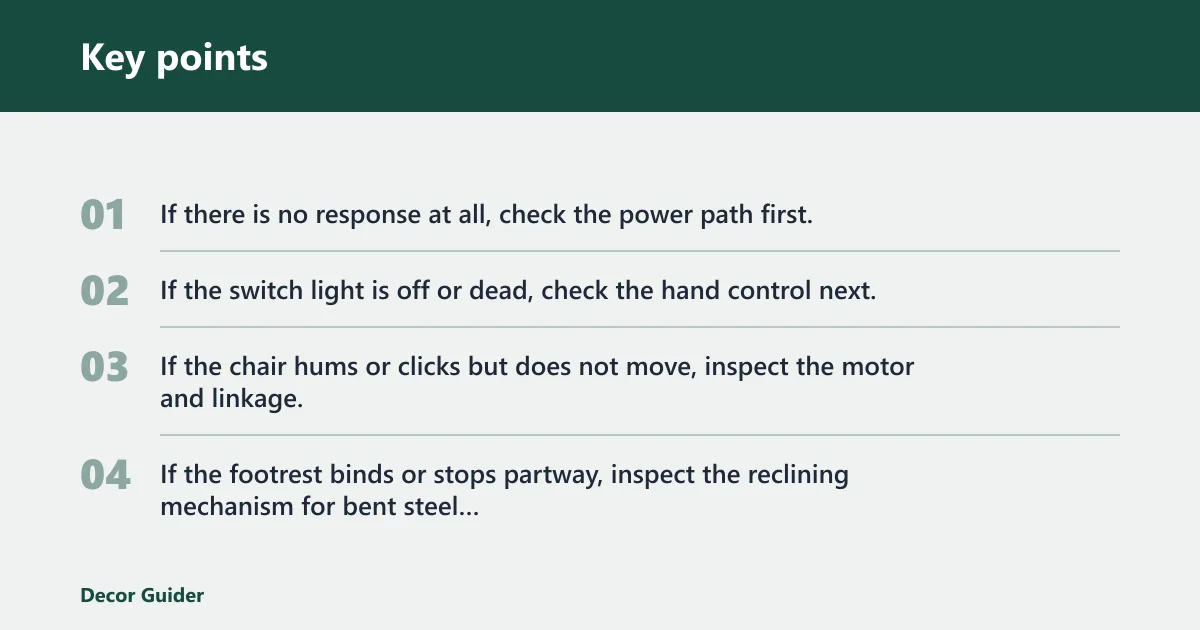
- If there is no response at all, check the power path first.
- If the switch light is off or dead, check the hand control next.
- If the chair hums or clicks but does not move, inspect the motor and linkage.
- If the footrest binds or stops partway, inspect the reclining mechanism for bent steel or obstruction.
Say your two-seat power sofa lights up on one side but the other side stays dead. That split result usually points away from the wall outlet and toward the control, cable, or motor on the dead seat, so test seat by seat instead of assuming one part failed everywhere.
Check the power path first
The first troubleshooting step is checking the power cord. Make sure the plug is fully seated in the wall outlet, then look under the chair for a loosened main connection. A loose main power cord under the chair can cause failure.
If your model has a power supply with an indicator light, check it now. A lit switch light suggests the switch is working; a power supply with the light off is treated as not working. If the chair is fully dead, test the outlet and any GFCI feeding that outlet before opening the recliner.
For safety, use a plug-in outlet tester or a known-good lamp before opening the upholstery or touching under-seat wiring. Powered furniture brands and consumer electrical guidance commonly recommend confirming mains power, GFCI reset, and the adapter light before assuming a motor fault.
- Unplug the recliner before touching any under-seat wiring.
- Check the wall outlet with a lamp or plug-in tester.
- Press any GFCI reset button on the circuit that feeds the chair.
- Inspect the main cord where it enters the sofa and where it joins the power supply.
- Reconnect any obviously loose plug only if it is easy to reach and matches the keyed connector.
How do you know the power supply is bad?
A failed power supply often shows up as no indicator light, intermittent power, or one seat working while another stays dead. Confirm that the outlet is live first, then compare the adapter or transformer light to the working seat. If the adapter is dark and the outlet is good, the supply is a likely suspect.
Is the switch or hand control the problem?
Common signs of switch failure include no light at the handset, dead buttons, or a delayed response after you press a control. Inspect the cable path under the seat for a pinched or loosened connector, because a bad connection can look like a failed switch.
Replacement usually requires connecting under-seat cables, so keep the plugs neat and tidy before reassembly. Major parts suppliers such as Ashley, La-Z-Boy, and Salice-style furniture parts sellers typically require the exact model or connector style because button count, voltage, and plug shape vary by frame.
- Unplug the chair and lay the handset cable where you can see both ends.
- Check for crushed, stretched, or partially seated connectors under the seat.
- Compare the switch part number and plug shape with your model label.
- Replace the switch only if the model, voltage, and connector match.
What if the buttons work but nothing moves?
If the handset lights up and the buttons respond, the fault may be farther down the chain: the cable, connector, transformer, or actuator. That pattern matters because it separates a control issue from a mechanical jam. If the chair is silent and fully dead, return to the power path before replacing the handset.
Inspect the mechanism and motor
Bent steel in the footrest can stop the recliner mechanism. Objects under the chair can keep the recliner stuck. Turn the chair upside down for inspection only if you can do it safely with help, because the weight and tip risk matter more than speed.
If you hear sound but the chair does not move, the motor is likely faulty. That pattern often means power reaches the drive system, but the actuator cannot complete movement. A motor replacement is usually preferred over repair, and the supplier should supply the correct replacement part.
Replacement-part compatibility is the critical detail here. Motor housings, stroke length, connector type, and mounting brackets vary by manufacturer and frame. If the label is missing, photograph the old unit and match the connector, voltage, and bracket layout before buying anything.
- Unplug the chair and remove anything near the footrest path.
- With help, tip the sofa only enough to inspect the underside safely.
- Check footrest steel bars and linkage for bends, twists, or jammed hardware.
- Look for wires routed across moving parts, then keep cables neat and tidy.
- Match the motor label, voltage, and connector before ordering a replacement.
A common first-timer mistake is forcing the footrest closed while the linkage is bound. That can bend the steel farther and turn a simple jam into a replacement frame or actuator job.
Why does a recliner hum or click but not move?
That symptom usually means the motor is trying to run but the drive cannot complete movement. The cause may be a jammed linkage, stripped actuator gear, or a motor that lacks enough torque under load. Start with visible obstructions and bent bars before assuming the motor itself is dead.
Recliner troubleshooting by symptom class
Use the symptom class below to narrow the failure before you order parts. Power faults, control faults, and mechanical faults each have different confirmation checks, part costs, and DIY thresholds. On split-seat sectionals, test each seat independently so one bad side does not hide the working side.
How do you troubleshoot a power recliner that is dead?
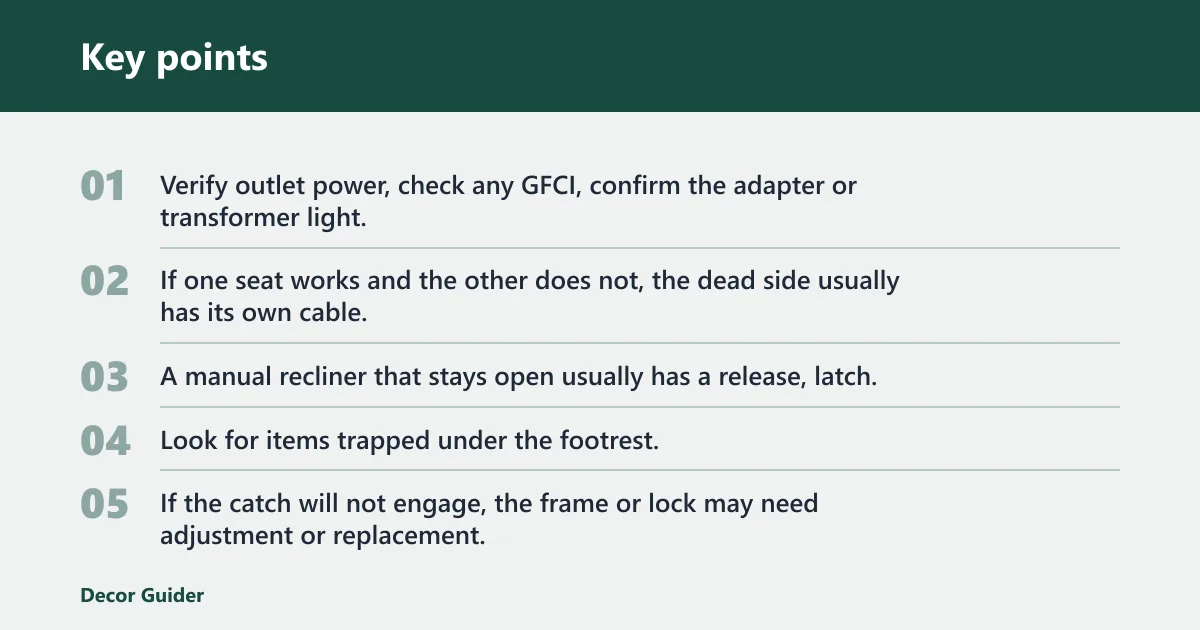
Work from the wall to the seat. Verify outlet power, check any GFCI, confirm the adapter or transformer light, then inspect the under-seat connectors. If one seat works and the other does not, the dead side usually has its own cable, switch, or actuator issue rather than a house power problem.
How do you diagnose a manual recliner that will not close?
A manual recliner that stays open usually has a release, latch, or bent linkage problem rather than an electrical one. Look for items trapped under the footrest, then check whether the release handle fully returns. If the catch will not engage, the frame or lock may need adjustment or replacement.
Why won’t my recliner stay reclined?
A recliner that will not stay reclined usually has a latch, release, or linkage issue rather than a power problem. Check the footrest linkage for bends, then inspect whether the release handle or button returns fully to neutral. If the chair slips back immediately, the catch may need replacement or adjustment.
Why a recliner will not recline?
If a recliner will not recline, start with the power cord, switch light, and under-seat connector on an electric model. On a manual recliner, inspect the release, footrest steel, and obstructions under the chair. A jammed linkage can stop movement even when the handle feels normal.
How to fix couch recliner
Fix the symptom you can confirm, not the one you suspect. Clear any obstruction, reseat obvious loose plugs, and compare part numbers before replacing a switch, motor, or power supply. If the sofa must be tipped or the mechanism opened far beyond easy access, stop and contact the supplier.
Why won’t my recliner close?
A recliner that will not close often has a bent bar, trapped object, or cable routed into the moving linkage. Check the footrest path and under-seat wiring first. If the chair is power operated and still partly open after power is removed, the mechanism may be binding mechanically rather than electrically.
Sofa recliner symptom matrix
Use this matrix before ordering parts to narrow down the likely issue. Match the symptom first, then confirm the likely component with a quick test, the tools needed, an estimated part cost range, and whether DIY or pro repair is safer.
| Symptom | Likely failed component | Quick test | Tools needed | Estimated part cost range | DIY or pro repair safer? |
|---|---|---|---|---|---|
| No power at all | Power cord, outlet, power supply, or fuse | Check outlet power, then the cord under the chair, then the supply light if present | Flashlight, plug tester | Adapter/transformer: about $20-$80; fuse or cord set: about $10-$40; full power supply kits can run about $40-$120 depending on brand | DIY for outlet and cord checks; pro if the supply is buried, the wiring is damaged, or warranty applies |
| Switch light is off | Hand control or switch | Press buttons and inspect the under-seat connector | Flashlight, basic hand tools | Handset/switch: about $15-$60; branded remotes can be higher | DIY if the connector is accessible and labeled; pro if the harness is hidden in the frame |
| Humming or clicking, but no movement | Motor or actuator | Listen for sound while checking for blocked linkage | Flashlight, basic hand tools | Motor/actuator: about $50-$200; some sectional or lifting units can exceed that range | Pro is safer if the motor is enclosed, the frame must be removed, or the wiring is tight |
| Footrest stuck partway | Bent linkage or obstruction | Look for bent steel in the footrest and items under the chair | Flashlight, gloves | Obstruction removal: $0; linkage parts: about $20-$100; frame repairs cost more | DIY for clear obstructions; pro if metal is bent or the mechanism is under spring tension |
| Chair closes but will not recline | Control, linkage, or motor | Check switch light, then inspect movement path and cables | Flashlight, camera | Control parts: about $15-$60; actuator or linkage: about $30-$200 depending on brand | DIY for visible cable or obstruction issues; pro for hidden mechanism faults or split-seat units |
| One seat works, one seat is dead | Seat-specific cable, switch, or actuator | Swap power at the connector if the model allows it, or compare the dead side to the working side | Flashlight, camera, basic hand tools | Seat cable: about $10-$35; switch: about $15-$60; actuator: about $50-$200 | DIY only if connectors are clearly labeled; pro if the section is integrated or tightly wired |
| Recliner will not close after power loss | Mechanical bind, bent bar, or jammed release | Release the load path and inspect for trapped fabric or a twisted linkage | Flashlight, gloves, helper | Linkage parts: about $20-$100; frame work varies widely | Pro safer if the frame is twisted or the unit must be disassembled |
Common mistakes
- Forcing the footrest when it is bound or jammed.
- Tipping or turning the sofa without help and clear space.
- Ordering a switch, motor, or power supply without checking compatibility.
- Skipping warranty or retailer support steps before opening the mechanism.
- Disconnecting more wiring than the model exposes or labels clearly.
Related how-to guides
For model-specific next steps, use the related guides below after you confirm the symptom.
- power recliner reset
- recliner motor replacement
- sectional disassembly
- furniture moving
- replacement parts guides
Frequently asked questions
Can sleeping in a recliner cause problems?
Sleeping in a recliner can leave cushions and mechanisms under longer load than intended, but the bigger concern here is function: blocked movement, twisted fabric, and pressure on the footrest path. If the chair starts sticking, check for obstruction, bent linkage, or cable pinch before assuming the motor failed.
Do recliner sofas come apart?
Many recliner sofas separate into sections, but the connection style varies by model. Check the manufacturer’s listing or owner’s manual before trying to split the sofa, because some models hide connectors and locking hardware that should not be forced. If the sofa must be moved for inspection, get help and protect the mechanism first.
Sources
Consumer Product Safety Commission guidance on unplugging and inspecting electrical products before service; UL safety guidance for powered furniture and electrical components; manufacturer parts catalogs and model labels for connector, voltage, and frame compatibility; and major furniture parts supplier listings that note model-matched switches, actuators, and power supplies. Price ranges reflect common supplier listings for replacement furniture electrical parts and mechanical linkages and vary by brand, voltage, and connector style.
Products related to this article
Sponsored / affiliate links. As an Amazon Associate I earn from qualifying purchases. I may earn additional commission from eligible campaigns.