Sofa Springs Problems: How to Diagnose and Fix Them
Sofa spring problems usually come from broken springs, stretched webbing, loose clips, or a damaged frame; if the frame is warped or the support system is torn in multiple spots, replace the sofa instead of repairing it. Ignoring the wrong fault wastes time and money, and a bad repair can leave the seat sagging, noisy, or unsafe. This guide helps you identify each failure mode, match it to the right fix, and decide when the spring system is worth repairing.
Sofa springs at a glance
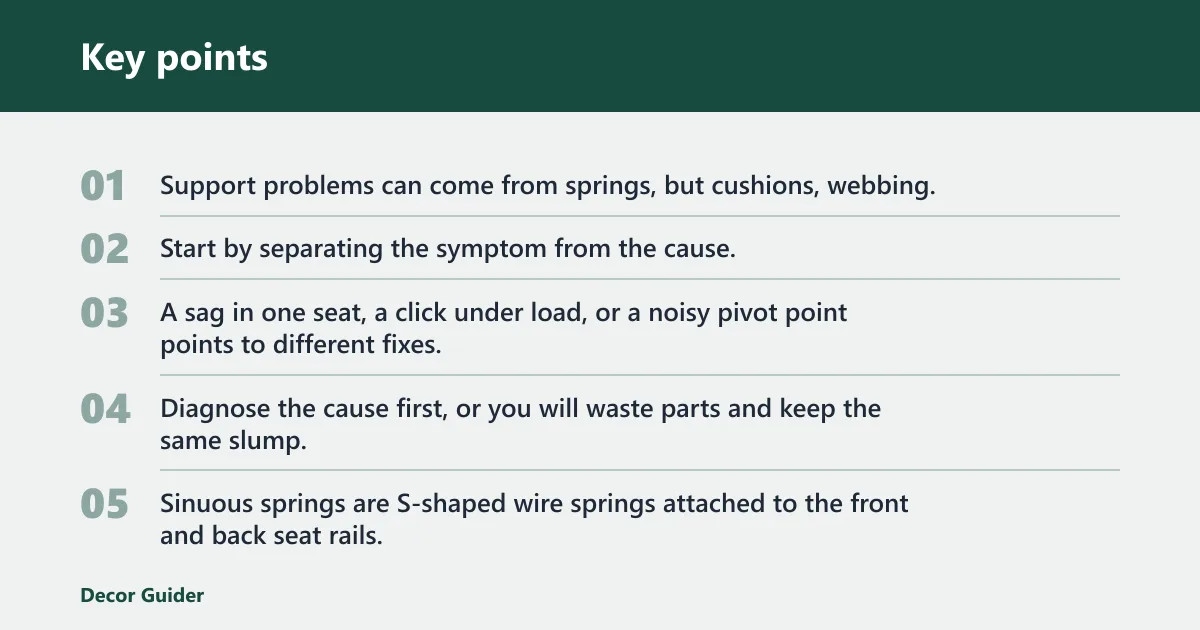


Support problems can come from springs, but cushions, webbing, and the frame can create the same feel. Start by separating the symptom from the cause. A sag in one seat, a click under load, or a noisy pivot point points to different fixes. Diagnose the cause first, or you will waste parts and keep the same slump.
Three support systems show up most often. Sinuous springs are S-shaped wire springs attached to the front and back seat rails, and they are common in many modern residential sofas. Eight-way hand-tied coil springs are a traditional spring system in higher-end furniture, and each coil is tied in eight directions. Webbing support may be jute or polypropylene straps, and webbing can be the only seat support in some furniture. For broader upholstery and seating terminology, see upholstery references from industry suppliers and fabric makers, and for safe underside work use basic PPE such as gloves, eye protection, and a dust mask when debris is present. [Source: Sailrite upholstery education; OSHA PPE guidance; Sunbrella upholstery fabric material guidance]
Symptoms that point to springs
Look for a seat that sinks more under body weight than the others, a center dip in a loveseat, or a section that rebounds unevenly after you stand up. Noise matters too. A click often means a spring end has shifted or a clip is loose. A pop can mean a coil spring has bound or jumped off its tie, or that a sinuous spring end has detached or moved against its clip or bracket. A creak usually comes from metal-to-metal friction at a pivot or spring contact point.
What can mimic spring failure?
Flat cushions can feel like a bad spring, especially if the foam has compressed. Loose webbing can also mimic spring sag. A split rail or crushed corner joint can create a soft seat that keeps returning after repair. Check the support system first, but do not skip the frame just because the noise sounds spring-related.
Repair or replace: the first decision
If the problem is one detached clip, one broken tie, or one stretched sinuous section, repair usually makes sense. If multiple springs are damaged, the frame is split, or the sofa bed mechanism blocks access, replacement may be the better call. Repair difficulty varies from easy to hard depending on access, the number of failed parts, and whether the original support system can be matched cleanly.
What you’ll need
- Needle-nose pliers
- Staple remover
- Heavy-duty staple gun
- Upholstery staples
- Replacement sinuous springs matched to gauge and length
- Spring clips matched to the frame attachment style
- Hog rings
- Replacement webbing in jute or polypropylene
- Webbing stretcher tool for jute webbing
- Heavy upholstery twine or spring tie cord for coil work
- Work gloves and eye protection
- Dust mask for underside work
- Flashlight and tape measure
How do you inspect the underside?
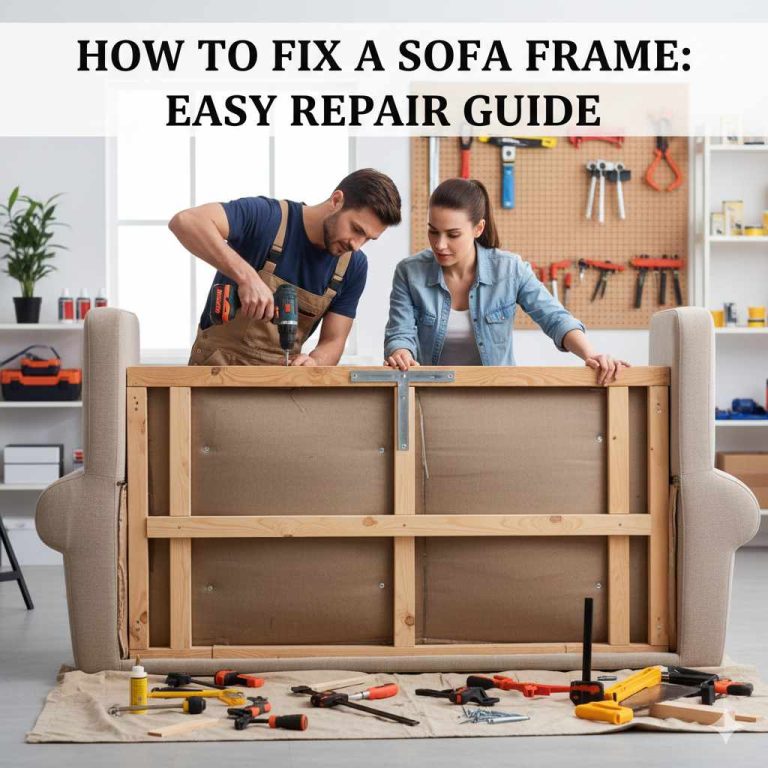
Remove the dust cover or access panel from the underside first, then identify the support system before loosening any fasteners. That opening shows whether you are dealing with sinuous springs, coil springs, webbing, or a frame issue. Check the wood before touching the springs, because loose, split, or crushed rails change the repair plan. Keep your hands clear of loaded spring ends and control spring tension before releasing or reinstalling any spring hardware.
- Flip the sofa on a padded surface and remove the dust cover with a staple remover.
- Inspect the seat rails, corners, and center support for splits, looseness, and crushed wood.
- Trace each support line to identify sinuous springs, coil springs, or webbing.
- Mark any detached ends, missing clips, broken ties, or torn straps with tape.
Picture a three-seat sofa with a dip only in the middle cushion area. If the center rail is split, a spring repair will not hold. A common first-timer mistake is replacing springs before checking the wood that carries them.
How do you read the noise and sag symptoms?
Noise is a clue, not a diagnosis. A click usually points to a loose clip or a spring end that has shifted. A pop usually points to a coil spring that has jumped free or bound against its tie, or to a sinuous spring end that has moved at its clip or bracket. A creak usually points to friction between metal parts or between a spring and its seat point.
One-seat dip versus full-surface sag
A single-seat dip often suggests one spring line, one webbing run, or one rail section has failed. Full-surface sag usually means webbing loss, multiple spring failures, or a weak frame. On a sectional, isolate the dip to one module before assuming the whole piece needs work. On a sofa bed, check whether the mechanism blocks the support system or has damaged the frame around it.
When cushions are the real cause
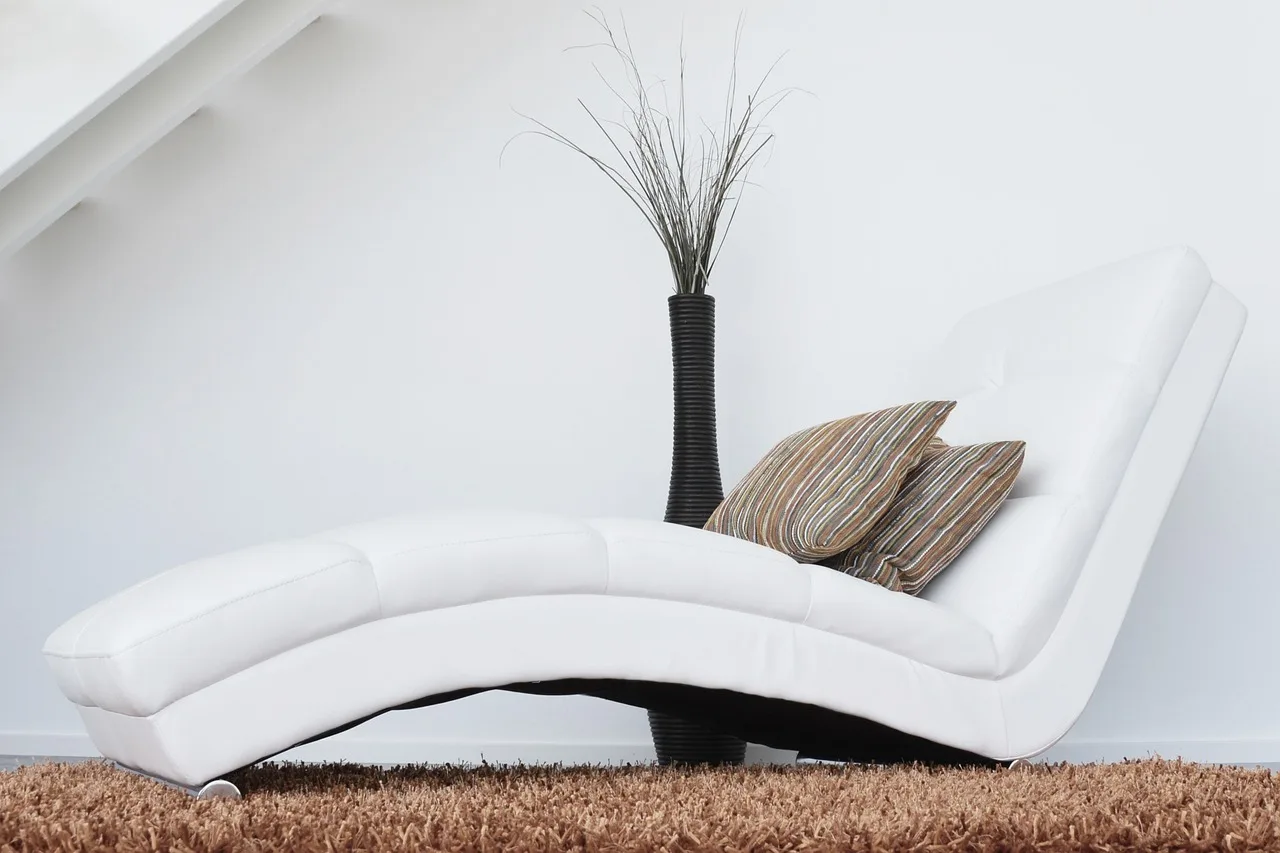
Press the cushion core first. If the foam compresses sharply and does not rebound, the springs may be fine. If the upholstery sits low even with a firm cushion, the support system deserves inspection. Do not mix up foam loss with spring failure; the repair is different, and the cost is too.
Sofa spring troubleshooting matrix
| Symptom | Likely cause | Quick check | Repair difficulty | Parts needed | Stop/replace threshold | Repair vs replace |
|---|---|---|---|---|---|---|
| Center seat sag with a springy frame | Sinuous springs stretched or detached | Check for loose ends, bent sections, or missing clips under the seat | Moderate | Matched spring, clips, hog rings | Replace if several springs are bent or the rail is damaged | Repair if the frame is sound and damage is localized |
| Deep dip in one seat or loveseat center | Webbing sag or tear | Press between straps and look for slack or a torn line | Moderate to hard | Replacement webbing, staples, stretcher tool for jute | Replace if multiple straps fail or the frame rail is split | Repair if the rails hold staples and access is clear |
| Sharp click under load | Loose clip or shifted spring end | Move the seat by hand and listen at the rail contact points | Easy to moderate | Spring clips, hog rings, pliers | Replace if the clip holes are torn out or the rail is crushed | Repair if only the attachment point failed |
| Pop when sitting or standing | Broken ties or coil spring released from its retainer | Look for a coil sitting off-center or a tie cord that snapped | Hard | Tie cord, hog rings, replacement ties, coil retainer parts | Replace if several coils are loose or the deck is failing | Repair only if the failure is isolated and access is good |
| Loose clips visible at the rail | Clip fatigue, bent clip, or worn attachment hole | Check whether the clip still grips the rail and whether the fastening point is ovaled out | Easy | Replacement clips, pliers, hog rings if needed | Replace if the rail is split, crushed, or the new clip cannot bite | Repair if only the clip failed and the rail remains solid |
| Broken tie cord on a coil unit | Eight-way hand-tied tie failure or worn cord | Look for one coil out of alignment or a snapped tie path | Hard | Spring tie cord, hog rings, replacement ties | Replace if multiple ties have failed or the coil deck is distorted | Repair if the break is limited to one or two tie points |
| Coil retainer feels displaced | Retainer clip slipped, bent, or opened | Check whether the coil sits centered in its retainer and returns evenly | Hard | Coil retainer parts, pliers, hog rings | Replace if the retainer system is missing across a wide area | Repair if the retainer damage is isolated and the deck is intact |
| Uneven seating along a rail | Bent sinuous section or detachment at one end | Compare spring height across the row and check end hooks | Moderate | Matched spring, clips, fasteners | Replace if the spring gauge or length cannot be matched | Repair if one section failed and the frame stays true |
| Soft, broad sag with no spring line shape | Frame failure or failed webbing grid | Check for split wood, loose joints, or ripped straps | Hard | Wood repair parts, webbing, staples, brackets | Replace if the frame is warped, split, or crushed | Replace if structure failure exceeds the support repair |
Parts-matching checklist before you buy anything
- For sinuous springs, match the gauge, overall length, and end style so the spring sits at the same height and attachment angle as the original. To identify gauge, compare the wire thickness to the old spring with calipers or a gauge chart, then measure the wire diameter directly before buying replacements.
- For coil springs, match the coil tie pattern and the original spring construction so the replacement lines up with the existing deck and support paths.
- For webbing, match the material type, width, and tension behavior; jute and polypropylene do not install or stretch the same way.
- Confirm the frame attachment point is still sound before buying replacement hardware.
- Bring the old part, or a clear photo with measurements, to avoid mismatched replacements.
How do you fix sinuous springs?
Sinuous springs are the most common repairable spring problem in modern sofas, but only when the frame is sound. The usual failures are stretching, detachment, and bent sections. Detached spring ends are a common sinuous spring failure. Match the replacement to the original gauge, length, and attachment style before you start.
- Expose the spring line by removing the dust cover.
- Replace loose clips first, because a shifted end can sound worse than it is.
- Swap a bent or stretched section with a matched spring of the same gauge and length.
- Use the correct spring clips or brackets to secure the new end to the frame.
If that did not fix the noise or sag, inspect the adjacent spring and the rail. Say your three-seat sofa has one loud click near the right arm. If the clip is intact but the rail hole is enlarged, a new clip will not hold long. The frame needs repair before the spring does.
How do you repair webbing or coil springs?
Webbing repair is straightforward only when the rails are intact and the straps are the only failed part. Jute webbing needs proper stretch tension during installation, so a webbing stretcher tool is commonly used. Eight-way hand-tied coil springs are much more labor-intensive, because each coil is tied in eight directions and one loose tie can throw off the seat height.
- Cut out torn webbing and staple the new strap to clean wood.
- Stretch jute webbing with a webbing stretcher tool before stapling the far end.
- Install new straps at the same spacing as the original grid.
- For coil work, retie the loose coil and secure the ends with matched tie cord or clips used in the original build.
Use a stretcher tool whenever the webbing needs firm tension at installation. Without that tool, the seat may feel soft on day one and worse a month later.
When should you stop repairing?
Stop when the frame is split, the rail is crushed, or the sofa has multiple support failures in different zones. That is the point where spring work becomes a structural rebuild. Also stop when access is poor, such as on some sofa beds or tightly built sectionals, because the labor can outweigh the value of the repair.
- Check whether the damage is isolated to one support point.
- Assess whether a single part matches cleanly to the original system.
- Compare the repair time against the value of the sofa and the extent of the damage.
- Replace the sofa if the frame fails, the support system is torn in multiple spots, or access makes the job unsafe.
Replace rather than repair if the sofa bed mechanism blocks the seat rails or if a sectional has multiple modules with different failure points. In those cases, the labor can spread across the whole piece.
Common mistakes
Skipping the frame check is the biggest error. A weak rail turns a spring fix into a short-lived patch. Another mistake is using the wrong spring part. A spring that is too long, too short, or the wrong gauge can change seat height and stress the frame.
Do not reattach the dust cover until the repaired area has been tested for noise and rebound. If the sofa still clicks or pops, reopen the underside and correct the attachment before closing it. A hidden loose clip is easier to fix now than after the cover is back on.
Another common mistake is treating a sectioned sofa as one unit. One seat may need a spring clip, while the chaise or loveseat return needs new webbing. Keep the repair local to the failed zone.
Frequently asked questions
How to fix sofa springs
Start by removing the dust cover, then identify whether the failure is a detached sinuous end, loose clip, stretched webbing, or a broken coil tie. Match the repair part to the original system, then test the seat before reinstalling the cover. If the frame is split, stop and repair the wood first.
How to repair springs in sofa
Open the underside, mark the failed section, and replace only the damaged attachment or spring line if the rest is sound. Use clips for sinuous springs, hog rings for metal-to-metal attachment points, and tie cord for coil repairs. If several support points failed together, replacement is usually the better call.
How to repair sagging sofa springs
Confirm that the cushions are not the main problem, then check whether the sag comes from webbing, sinuous springs, or a loose center rail. Replace slack webbing with proper tension, swap bent spring sections with matched parts, and stop if the rail is split or crushed.
How to fix couch springs
Flip the couch, remove the underside cover, and inspect the spring system before tightening anything. For a click, replace the loose clip; for a pop, inspect the spring end, clip, or bracket that has shifted; for a broad sag, check webbing and the frame. Choose the part that actually failed, not the symptom.
How to replace springs in a couch
Measure the original spring length, gauge, and attachment style before buying parts. Remove the old spring, install the replacement with the same end orientation, and secure it with the correct clips or brackets. If the couch uses eight-way hand-tied coil springs, replacement is labor-heavy and may justify professional help.
How to fix broken springs in couch
Use the dust cover opening to identify whether the break is a sinuous end, a bent section, or a coil that jumped free. Replace the failed part rather than bending it back into shape. If more than one spring area is damaged, or the rails are loose, replacement is safer than a patch repair.
Products related to this article
Sponsored / affiliate links. As an Amazon Associate I earn from qualifying purchases. I may earn additional commission from eligible campaigns.