Sofa Maintenance Cost
Sofa maintenance cost in India is often about ₹900 to ₹2,000 a year for light upkeep and one basic clean, while family sofas and rental sofas can run higher once add-ons and repair reserves are included; if major parts are failing, replacement or recovery may become the cheaper option. Skip routine care and stains set in, fibers wear faster, and small fixes grow into larger bills. This guide breaks down what maintenance services include, what they typically cost, and when upkeep stops paying off.
What does sofa maintenance cost cover?
Sofa maintenance cost has two parts: routine prevention and service visits. Routine care is the low-cost work you do to slow wear, while service visits are the paid jobs that remove embedded dirt, treat stains, or fix damage. In India, the same sofa can stay affordable for years if care is steady, but cost climbs quickly once issues are ignored.
What is the difference between routine upkeep and service visits?
Routine upkeep includes vacuuming, brushing, plumping cushions, and blotting spills quickly with a clean, dry cloth instead of rubbing. These steps are cheap, but they reduce the need for deeper cleaning and help the filling keep its shape.
Service visits are different. A cleaner may charge by the sofa, by size, or by the job. Repair work is another line entirely, since seam splits, collapsed cushions, loose springs, and broken frames do not fall under cleaning. Upholstery pros commonly separate these jobs because the risk and labor are not the same.
When does maintenance turn into a repair budget?
Once a sofa needs repeated stain treatment, frequent deep cleaning, or structural fixes, you are no longer budgeting for maintenance alone. At that point, the bill starts to look like repair, reupholstery, or replacement. The common failure pattern is simple: a weak seam or cushion core keeps failing after every clean.
How much does sofa cleaning cost in India?
Sofa cleaning cost in India usually depends on pricing model, size, material, and city tier. A small job may be quoted per sofa, while larger or more complex work may be priced as a job total. Final price rises when the cleaner has to move furniture, treat stains, handle pet odor, or extend drying time after wet cleaning.
What are the common pricing models for sofa cleaning?
- Per sofa: useful when you have one or two identical pieces.
- Per size: common when the cleaner prices a single seater, 2-seater, 3+2 seater, or L-shape sofa separately.
- Per job: more likely when stain level, access, and drying conditions drive the quote.
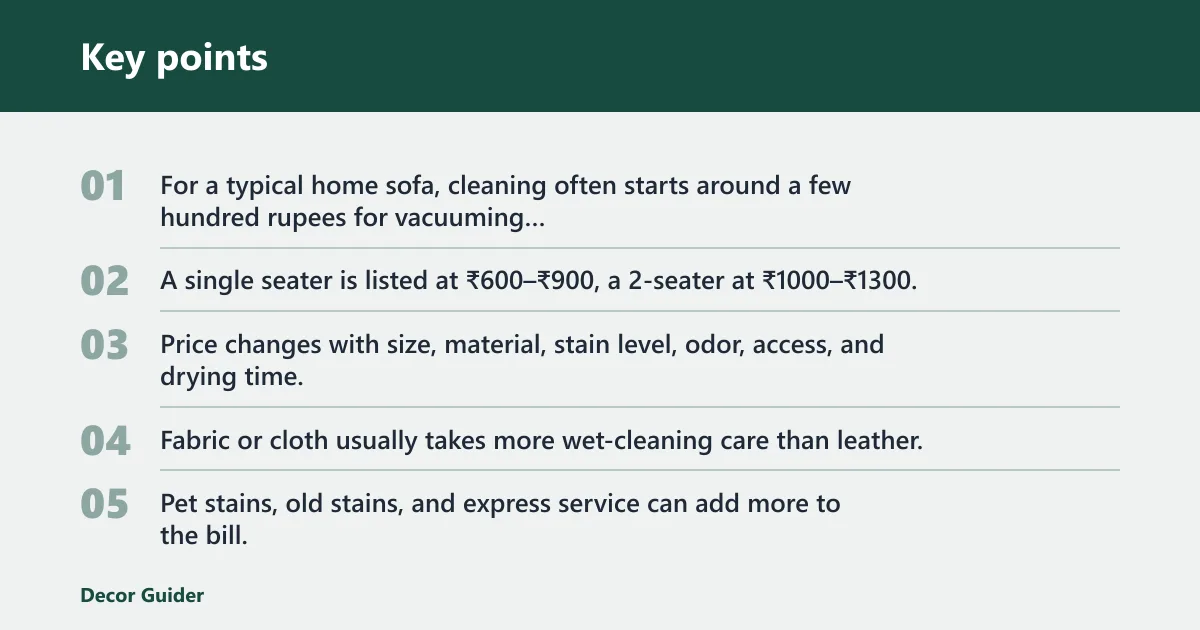
India-local sofa-cleaning listings commonly show single-seater pricing at ₹600–₹900 in smaller cities, a 2-seater at ₹1000–₹1300, a 3+2 seater at ₹1500–₹1800, and a large L-shape sofa at ₹2000–₹2600 (service listings; city-to-city variance applies). Those bands reflect surface area, labor, and time on site.
What changes the final quote for sofa cleaning?
Cleaning method matters. Basic vacuum and surface dust cleaning is priced at ₹300–₹500, while deep foam or shampoo cleaning is priced at ₹1500–₹2600; stain or odor treatment may add ₹300–₹500. These are common marketplace-style bands in India, and cleaners often adjust upward for very dirty upholstery, express visits, or difficult access.
Local variance is normal. A ground-floor flat with easy access is simpler than a top-floor rental with narrow stairs, no lift, and parking limits. Upholstery pros also quote more carefully for delicate fabrics, because a cautious clean can require slower moisture control and a second pass for extraction or drying support.
How do sofa size and material affect cleaning price?

Size and material are the two clearest price drivers. Bigger sofas take longer to clean, and some fabrics need gentler products, lower moisture, or slower drying. Leather, cloth, and velvet do not share the same cleaning risk, so they should not share the same cleaner or method.
How much do single seater, 2-seater, and 3+2 sofas cost to clean?
| Sofa size | Typical cleaning price | Common risk notes |
|---|---|---|
| Single seater | ₹600–₹900 | Lower labor, but stains on armrests can still need add-ons |
| 2-seater | ₹1000–₹1300 | More surface area and longer drying time |
| 3+2 seater | ₹1500–₹1800 | Often priced as a set because labor is spread across multiple sections |
What does an L-shape sofa usually cost to clean?
An L-shape sofa usually costs more because it has more fabric, more seams, and more cushion volume. A large L-shape sofa is listed at ₹2000–₹2600 in India-local service menus. If the cleaner has to treat both the main seat run and the chaise section, the job can also need more suction passes and longer drying time.
How do fabric, leather, and velvet change pricing and risk?
Fabric or cloth usually costs more to wet-clean than a quick vacuum job because it can hold dust deep in the weave. Leather often dries faster than cloth; one service page lists cloth sofa drying at 4–6 hours and leather sofa drying at 2–3 hours. Velvet needs careful product selection because pile flattening and dye transfer are real risks.
Choose the cleaner to match the care code or material type. Water-heavy products can leave rings on some fabrics, and strong solvents can dull leather. If the fabric code is unknown, test a hidden area first, and for delicate or uncertain fabrics, use a professional cleaner instead of DIY testing. One wrong product can create a bigger repair bill than the original clean.
What does a sofa cleaning service include?
A professional sofa cleaning service usually starts with vacuuming, then moves to foam, shampoo, steam, or deep extraction. The exact method changes by soil level and material. Wet cleaning can remove dust and stains, but it also raises drying and over-wetting risk, so the best service is matched to fabric condition.
What happens during vacuuming, foam, shampoo, steam, and deep extraction?
Vacuuming pulls loose dust and grit from the surface and seams. Foam or shampoo cleaning adds detergent action and agitation for embedded soil. Steam and deep extraction are used when the sofa needs a deeper rinse and suction cycle, often with drying support at the end. Each method trades off cleaning strength against moisture load.
Deep foam or shampoo cleaning is more intensive than surface cleaning. It is the better pick for odor, older grime, and heavy traffic, but it is also where moisture control matters most. Over-wetting can leave foam saturation in cushions, slow drying, and in some fabrics cause shrink risk or dye transfer. This is where professional judgment matters most.
How much do stain removal and odor treatment add?
Stain treatment usually costs extra because the cleaner may need a separate chemistry step and longer dwell time. Juice stains and other common spill marks, pet stains, and old stains are common examples. Old stains often fade rather than fully disappear, especially if they have set into the backing or cushion fill, so the charge reflects time, not guaranteed perfection.
Pet stains and odor treatment are among the most common add-ons. The listed surcharge is ₹300–₹500, but the final bill can be higher when the odor has soaked beyond the surface. Pet hair removal may also add labor if fur is packed into seams and zipper edges. In practice, pros treat odor as a separate problem from visible staining.
How long does sofa drying usually take after cleaning?
Drying time after wet cleaning is a budget item, even when no extra fee appears on the invoice. Cloth sofa drying is listed at 4–6 hours, and leather sofa drying is listed at 2–3 hours. Ventilation changes the outcome, so an open room, moving air, and lower humidity help more than a closed space.
- Keep windows open if weather allows.
- Run fans to move air across the sofa, not straight into one wet spot only.
- Avoid sitting on cushions until the fabric feels dry and cool, not damp.
- Do not cover the sofa with plastic while it is still drying.
Suppose a 2-seater fabric sofa gets a spill on one cushion and the cleaner uses foam with light suction. If the room has poor airflow, the drying window can stretch beyond the listed 4–6 hours. That extra downtime matters if the sofa is in daily use, because frequent sit-downs before drying can re-set stains or flatten fibers.
When is deep cleaning worth it for a sofa?
Deep cleaning is worth it when surface vacuuming no longer removes the soil, when odors stay after blotting, or when spills have reached the backing and cushion fill. If the issue is only fresh surface dirt, spot cleaning is cheaper and lower risk. The break point is soil depth, not just appearance.
What are the heavy dirt and odor thresholds for deep cleaning?
Choose deep cleaning when you can smell the sofa after the room is aired out, when pet odors return after drying, or when the arms and seating area look dull even after vacuuming. For everyday accidents and mishaps, a professional upholstery care plan may be the better fit.
When should you spot clean instead of doing a full sofa clean?
Spot cleaning is best for a fresh spill, as long as you blot with a clean, dry cloth and do not rub. Full cleaning is better when the same sofa keeps showing soil in multiple zones, or when the cushion fill has absorbed odor. A common mistake is spending on a pricey upholstery cleaner for a small scuff on the armrest, then paying even more to have the cushion professionally dried and treated.
Cleaning-code mistakes are another failure case. A cleaner who treats every fabric the same can cause dye transfer, shrinkage, or a stiff finish. That risk is higher on velvet and on older upholstery with weakened backing.
What does a sofa maintenance calculator look like?
This calculator treats sofa maintenance cost as an annual budget, not a one-time bill. The totals below combine routine DIY upkeep, a likely professional clean, add-ons if needed, and a small repair reserve. They are planning bands for India-local households, not fixed quotes, and the formula should be adjusted by sofa size and use intensity.
| Scenario | Routine DIY upkeep | Professional cleaning | Add-ons | Repair reserve | Annual total | Clean, repair, replace decision rule |
|---|---|---|---|---|---|---|
| Low-use apartment sofa | ₹300–₹500 | ₹600–₹900 | ₹0–₹300 | ₹0–₹300 | ₹900–₹2,000 | Clean if fabric and frame are sound; repair only if a seam, leg, or cushion issue appears; replace when repeated cleaning no longer helps. |
| Family sofa with kids and pets | ₹500–₹900 | ₹1000–₹1800 | ₹300–₹800 | ₹300–₹700 | ₹2,100–₹4,200 | Clean if stains are still local; repair if odor, cushion sag, or stitching failure is limited to one section; replace if cleaning plus repairs keep climbing. |
| High-traffic rental sofa | ₹600–₹1,000 | ₹1500–₹2600 | ₹500–₹1,000 | ₹500–₹1,200 | ₹3,100–₹5,800 | Clean if turnover value is still higher than service cost; repair if damage is localized; replace when recurring service bills approach the cost of a new or recovered sofa. |
Annual formula by use case: low-use sofa = 1 basic clean + light upkeep + small reserve; family sofa = 1 basic clean or 2 spot/deep interventions + odor/stain add-ons + repair reserve; rental sofa = turnover cleanings + odor treatment + higher reserve. Picture a rental sofa that needs deep cleaning after every tenant change, plus odor treatment twice a year; if the annual service total keeps approaching recovery or replacement, the maintenance plan is no longer efficient.
When should you clean, repair, or replace a sofa?
Clean when the sofa still has a solid frame, stable springs, and fabric that responds to treatment. Repair when damage is localized, such as one torn seam, one loose leg, or one sagging cushion. Replace when the costs keep repeating, the structure is weak, or the upholstery fails faster than it can be restored.
A recover-sofa guide estimates professional recovery at a cost that can be substantial, with labor rates that vary by job. Those numbers matter because a sofa that needs repeated deep cleaning plus major repair can move into recovery territory fast. If the fabric is worn through in several spots, cleaning is only a temporary fix, and the remaining value may not justify more spending.
What is the decision rule by sofa condition?
- Clean: stains, odor, and surface dirt are the main issues, and the sofa still dries normally.
- Repair: the damage is localized and the rest of the sofa is still worth keeping.
- Replace: the frame, springs, or upholstery are failing in more than one place, or the yearly cost keeps rising.
Frequently asked questions
How much does sofa cleaning cost?
For a typical home sofa, cleaning often starts around a few hundred rupees for vacuuming and moves up with size, fabric, and add-ons. City tier and access can change those bands.
What factors change sofa cleaning price?
Price changes with size, material, stain level, odor, access, and drying time. Fabric or cloth usually takes more wet-cleaning care than leather, while velvet needs gentler product selection. Pet stains, old stains, and express service can add more to the bill. The quote is often as much about labor complexity as about square footage.
Is professional sofa cleaning worth it?
It is worth it when vacuuming no longer removes dirt, when odors stay, or when stains are spreading into seams and cushions. It is less worth it if the sofa already needs repeated repairs, because cleaning will not fix a weak frame, broken spring, or failing upholstery. Pros usually judge value by the sofa’s remaining structural life.
How long does a sofa take to dry after cleaning?
Drying depends on material and ventilation. One service page lists cloth sofa drying at 4–6 hours and leather sofa drying at 2–3 hours. Open air movement helps, while closed rooms, heavy humidity, and thick cushions can extend the wait. In practical terms, drying is often the hidden cost of wet cleaning.
Is sofa cleaning different for fabric and leather?
Yes. Fabric can tolerate foam, shampoo, steam, or deep extraction in the right code and with controlled moisture. Leather needs a different cleaner choice and usually dries faster. Using the same method on both can cause damage, so material-specific care matters. A material mismatch is one of the most expensive mistakes in upholstery care.
When should you deep clean a sofa instead of spot cleaning?
Deep clean when the whole seating area looks dull, when odors remain after blotting, or when spills have moved beyond the surface. Spot cleaning is enough for a fresh, small spill. Deep cleaning is for embedded soil, not every mark. The rule of thumb is simple: clean the zone, not the whole sofa, unless the whole sofa is actually dirty.
What extra charges apply for pet stains or odor?
Special stain or odor treatment may add ₹300–₹500. Pet jobs can cost more if hair is trapped in seams or if urine odor has soaked into the cushion fill. Old stains may only fade, so the cleaner may still charge even when the mark does not disappear completely. Odor removal is often a separate chemical and labor step.
How often should you change couches?
Change the couch when repair and cleaning bills keep rising, or when the frame, springs, or upholstery are failing in several areas. Many sofas can last much longer with care, but once recurring costs approach recovery or replacement pricing, it is time to stop pouring money into upkeep. The strongest signal is repeat failure, not age alone.
Products related to this article
Sponsored / affiliate links. As an Amazon Associate I earn from qualifying purchases. I may earn additional commission from eligible campaigns.