Leather Sofa Cleaner Kit Review: Is It Worth It?
A leather sofa cleaner kit is worth it if it lowers your cost per clean below about $3 to $5 and matches your leather type; otherwise, buy the needed cleaner and conditioner separately. The wrong kit can stain finished leather, dry out aniline surfaces, or leave residue that attracts soil. This guide checks cost per use, risk reduction, and leather-type fit so you can decide with confidence.
What makes a leather cleaner kit valuable


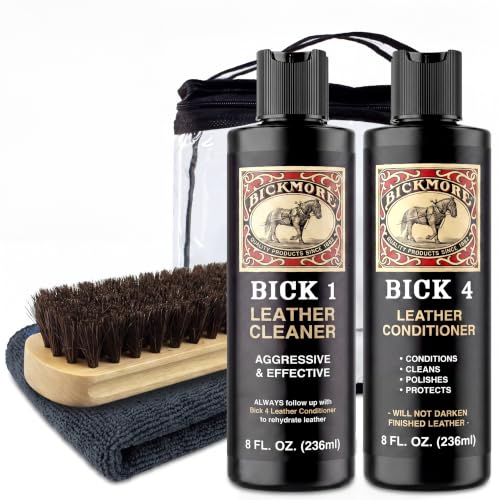
For most sofas, the value comes from safer cleaning, not shine or scent. Most sofas today use pigmented or protected leather, so a finish-safe, pH-balanced formula matters more than a premium label. A kit becomes worth it when it prevents avoidable damage, covers your whole sofa at a reasonable cost per session, and fits the leather type you actually have.
What you are buying
A cleaner kit usually combines a leather cleaner with a microfiber cloth or towel, and sometimes a conditioner or protector. The cleaner removes soil and body oils. The conditioner helps restore moisture and flexibility. Some all-in-one bundles add UV protection, which matters most on sofas near windows.
Where the value comes
The best value is lower maintenance risk. A pH-balanced formula is less likely to strip the finish than harsh household cleaners, and a non-toxic, fragrance-free option is useful in homes with kids, pets, or scent sensitivity. If the kit also includes a leather conditioner and microfiber cloth, you avoid extra purchases.
When a kit is overkill
A kit is usually overkill when the sofa is already in good condition and only needs light wipe-downs. In that case, a cleaner-only bottle may do the job for less money and less time. Buying a two-step kit for every sofa, every month, is often unnecessary.
Quick picks
The best overall buy for most finished-leather sofas is a cleaner-only, pH-balanced bottle with a microfiber cloth, because it keeps cost and residue risk down. Step up to a two-step kit only when the leather looks dry, feels stiff, or sits in strong sun.
- Best for routine maintenance: Cleaner-only bottle for protected leather, especially when the sofa only needs dust, body oil, and light soil removed.
- Best for dry or faded leather: Two-step cleaner-and-conditioner kit, ideally with UV protection if the sofa sits near a bright window.
- Best for sensitive households: Non-toxic, fragrance-free cleaner with a microfiber cloth, so you limit odor and harsh fumes.
- Best for light-colored sofas: Finish-safe cleaner with a strict patch test plan, because discoloration shows faster on white and pale leather.
Leather sofa decision table
Use this table to match sofa condition, leather type, and cost to the right buying choice. The cost figures are decision points, not promises from any one brand. If your actual per-clean cost is above the range shown, the kit is probably too expensive for what it does.
| Sofa condition | Leather type | Kit choice | Estimated cost per cleaning session | Common failure risks |
|---|---|---|---|---|
| Light soil, routine upkeep | Finished / protected leather | Cleaner-only bottle with microfiber cloth | $2 to $4 | Streaking from over-wetting; residue if you skip buffing |
| Dry feel, slight dullness | Finished / protected leather | Two-step cleaner-and-conditioner kit | $3 to $5 | Over-conditioning; tacky finish if too much product stays on the surface |
| Fading near windows | Finished leather in bright rooms | Cleaner plus conditioner with UV protection | $4 to $6 | Extra cost without benefit if the sofa is not in direct sun |
| White or light-colored sofa | Finished leather | Cleaner-only first, conditioner only if needed | $2 to $5 | Visible darkening or uneven sheen; patch-test failure |
| Delicate, more absorbent surface | Aniline or semi-aniline leather | Gentler specialty care, often separate products | $4 to $7 | Darkening, spotting, finish alteration from harsh cleaners |
| Bonded or unknown finish | Bonded or delicate finishes | Minimal cleaning only after patch test | $2 to $4 | Finish lifting, residue buildup, peeling on weak surfaces |
What a cleaner kit does
A leather cleaner kit usually does four things: removes soil, conditions the surface, controls residue, and sometimes adds UV protection. That is why kits are sold as maintenance tools, not just beauty products. The right one keeps finished leather cleaner longer without loading the surface with heavy residue.
Cleaner versus conditioner
The cleaner breaks down dirt, oils, and body transfer. The leather conditioner restores moisture and flexibility after cleaning. Those are different jobs. If your sofa only needs soil removal, a cleaner-only product is enough. If the leather looks dry or stiff, conditioner becomes more useful.
Why finished leather matters
Most sofas today use pigmented or protected leather, which has a surface finish that needs finish-safe cleaning. That finish helps resist spills and daily wear, but it also means harsh solvents can do real damage. A kit marketed as pH-balanced is usually better aligned with that surface than an all-purpose household cleaner.
Where UV protection fits
UV protection matters when the sofa sits near windows and gets regular sun exposure. It is not essential for every home. On bright, sunny seating areas, a 3-in-1 cleaner, conditioner, and protector can reduce fade risk over time. On a sofa far from windows, that extra feature may not justify the added cost.
Which leather type do you have?
Leather type matters more than marketing claims about premium feel. Finished leather is the most common sofa surface and the easiest to maintain with a kit. Aniline, semi-aniline, and delicate finishes need more caution because they can react to moisture, solvents, and heavy conditioning.
Finished and protected leather
Finished leather is the safest match for most cleaner kits. It usually tolerates finish-safe sprays, wipe-on cleaners, and light conditioning better than absorbent leather does. For this group, the main question is whether the sofa needs basic cleaning or a cleaner-plus-conditioner bundle.
Aniline and semi-aniline leather
Aniline leather is more absorbent and more sensitive to harsh products. Semi-aniline sits in between, with some protection but still more vulnerability than pigmented leather. Patch testing matters here, especially on light colors, because darkening or spotting can show quickly. Use gentler products and avoid over-wetting.
Bonded and delicate finishes
Bonded leather and delicate finishes can react badly to aggressive cleaners, extra scrubbing, or repeated residue buildup. These surfaces are where failure risk rises fastest. If the finish is unknown, start with the least aggressive cleaner possible and test a hidden spot first.
Do you need a two-step kit?
You do not always need both products. A cleaner-only bottle is enough for routine maintenance on healthy finished leather. A two-step kit earns its keep when the sofa is dry, dull, or exposed to more wear, because the conditioner can help with flexibility and the finish can look more even after cleaning.
When cleaner-only is enough
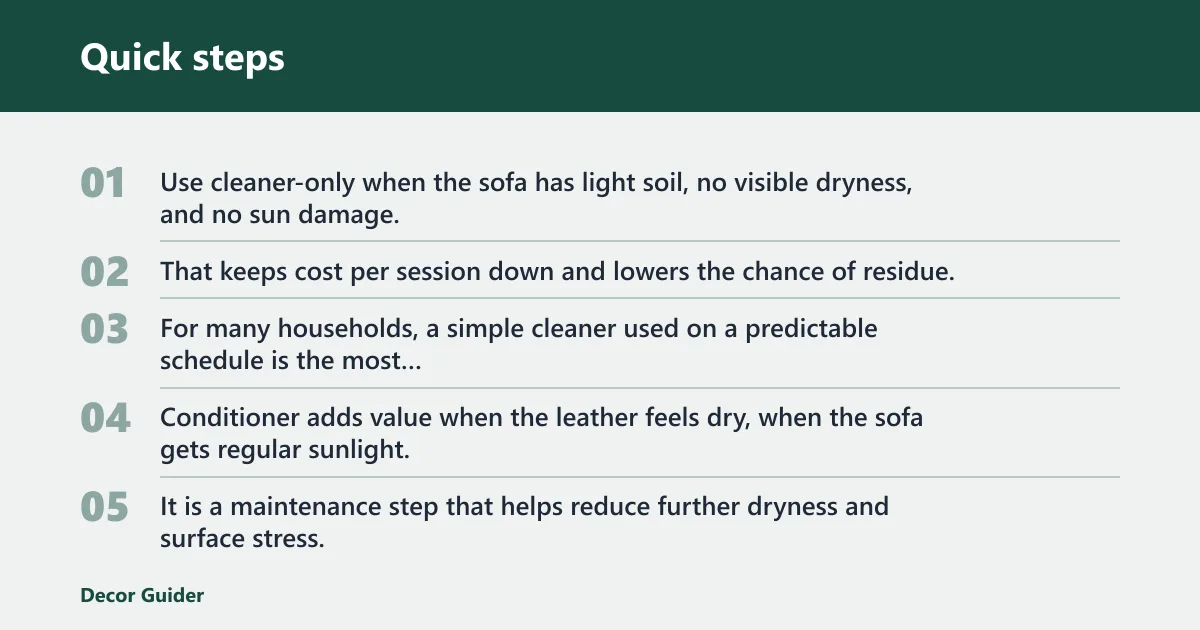
Use cleaner-only when the sofa has light soil, no visible dryness, and no sun damage. That keeps cost per session down and lowers the chance of residue. For many households, a simple cleaner used on a predictable schedule is the most practical choice.
When conditioner adds value
Conditioner adds value when the leather feels dry, when the sofa gets regular sunlight, or when you are maintaining an older but still intact finish. It is not a miracle fix for cracks. It is a maintenance step that helps reduce further dryness and surface stress.
When to skip extra steps
Skip conditioner when the leather already feels supple, the sofa is kept out of direct sun, or the product would add cost without clear benefit. Over-conditioning can leave a tacky film and attract more dust. More product is not better here.
Suppose a 3-seat sofa near a south-facing window looks clean but has a dull armrest. A cleaner-only spray may remove soil, but a cleaner-plus-conditioner kit with UV protection is the better fit if the dullness comes with dryness and repeated sun exposure. The extra step is worth it only because the risk is fading, not because the label sounds premium.
The most useful buying criteria are cost per cleaning session, patch-testing discipline, household exposure, and application format. A kit that looks expensive at checkout can still be cheaper per use if it covers the whole sofa and does not require a second purchase. A cheap kit that streaks or damages the finish is expensive in practice.
Cost per cleaning session
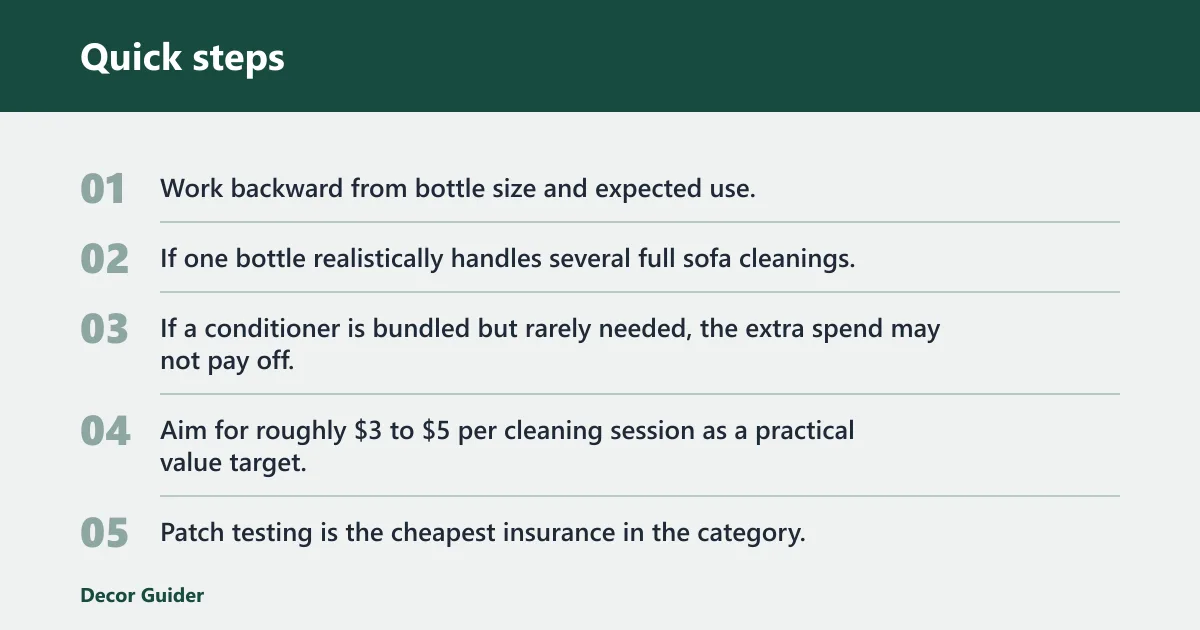
Work backward from bottle size and expected use. If one bottle realistically handles several full sofa cleanings, the per-session cost may be low enough to justify a kit. If a conditioner is bundled but rarely needed, the extra spend may not pay off. Aim for roughly $3 to $5 per cleaning session as a practical value target.
Patch testing
Patch testing is the cheapest insurance in the category. Test a hidden spot, wait for it to dry, and check for darkening, streaking, or a changed sheen before cleaning the visible areas. This matters most on aniline, semi-aniline, white, or light-colored leather.
Families, pets, and sun exposure
Non-toxic and fragrance-free formulas make more sense when children, pets, or scent sensitivity are part of the household. UV protection matters most near windows. If none of those apply, you may not need the safer-choice extras, and a simpler cleaner could be the better buy.
Wipes versus spray kits
Wipes are better for fast touch-ups and small messes. Spray kits are better for full-sofa maintenance because you can control coverage and use a microfiber cloth for buffing. Wipes can leave more residue on larger surfaces, while spray-and-wipe kits usually give more even coverage.
A common first-timer mistake is using too much liquid on a pale finished sofa. A 2-seat couch can look clean for a day, then show streaks once the product dries unevenly. A smaller amount, applied in sections and buffed with a microfiber towel, usually gives better control.
What can go wrong?
The main failure risks are over-conditioning, streaking, residue, darkening, and finish stripping. These are not rare edge cases. They happen when the product does not match the leather type, when too much is applied, or when the user skips a patch test and final buffing.
Over-conditioning
Too much conditioner can leave a greasy or tacky surface. That film can collect dust faster and make the sofa look worse. Conditioner is useful, but only in small amounts and only when the leather actually needs it.
Streaking and residue
Streaking usually comes from uneven application or not wiping the area clean enough. Residue is especially annoying on darker sofas because it can catch light and look blotchy. Microfiber cloths help, but only if you use them to wipe and buff, not just to spread product around.
Darkening or finish stripping
Darkening is the bigger risk on light leather and absorbent finishes. Finish stripping is more likely with harsh solvents or repeated use of the wrong cleaner. If that happens, the sofa may lose its protective top layer and become harder to maintain later.
Frequently asked questions
Is a leather sofa cleaner kit worth it?
Yes, if the kit brings your cost per cleaning session down to about $3 to $5 and matches the leather type. It is less worth it if you only need light cleaning, already own a suitable cleaner, or are dealing with a surface that needs separate, gentler care.
What does a leather cleaner kit do for a sofa?
It removes soil, helps condition the surface, and may reduce residue or add UV protection depending on the bundle. On finished leather, that can improve day-to-day maintenance without relying on harsher cleaners. On delicate leather, the same kit may be too aggressive.
Do I need both a cleaner and conditioner for leather furniture?
Not always. Cleaner alone is enough for routine maintenance on healthy finished leather. Conditioner matters more when the sofa feels dry, looks dull, or sits in sun. If the leather is already supple and protected, a two-step kit may add cost without enough benefit.
How often should I clean a leather sofa with a kit?
For most finished-leather sofas, light cleaning every few weeks and deeper cleaning only as needed is a sensible starting point. High-use homes with kids or pets may need more frequent wipe-downs. Avoid cleaning on a fixed schedule if the sofa still looks and feels clean.
Will a leather cleaner kit damage finished leather?
It can, if the formula is too harsh, if too much product is used, or if you skip the patch test. Most sofas use finished or protected leather, which is more forgiving, but compatibility still matters. A pH-balanced, finish-safe formula lowers the risk.
Can I use a leather cleaner kit on white or light-colored leather?
Yes, but patch testing matters even more because discoloration shows fast. Use the lightest effective application, avoid over-wetting, and buff thoroughly with a microfiber cloth. If the leather is aniline or semi-aniline, choose a gentler product and expect a higher failure risk.
Products related to this article
Sponsored / affiliate links. As an Amazon Associate I earn from qualifying purchases. I may earn additional commission from eligible campaigns.