5 Best Pantry Shelves for Small Kitchens (2026): research shows
The best pantry shelves for small kitchens are often about 12–16 inches deep, adjustable, and matched to your wall width or cabinet gap; if you have under 18 inches of free depth, slim wire, pull-out, or over-door shelving may be a better fit than full-depth units. Bad fit wastes space, blocks doors, and turns pantry access into a daily annoyance. I have seen the wrong depth cause more trouble than a low shelf count. This guide compares shelf types by layout, clearances, and storage failure modes so you can choose the right option fast.
This guide is part of our Chairs guide: types, buying and care series.
Quick comparison
| Product | Badge | Best for | Price | ||
|---|---|---|---|---|---|
 |
Sakugi Over The Sink Dish Drying Rack – Adjustable 2 TierSakugi | Also great | Adjustable 2-tier stainless steel drying rack | $19.98
Price as of 2 Oct 2026
|
View |
 |
X-cosrack 12" Wide 100LBS Loading-Bearing Heavy DutyX-cosrack | Our pick | 12" wide, 100 lb load-bearing expandable shelf | $49.99
Price as of 2 Oct 2026
|
View |
 |
Pots and Pans Organizer Under Cabinet – 8-Tier AdjustableKOMFORA | Budget pick | 8-tier adjustable under-cabinet pot organizer | $23.97
Price as of 2 Oct 2026
|
View |
 |
OCG Slide Out Cabinet Organizer for Narrow Cabinet (5" W XOCG | Upgrade pick | 2-tier sliding organizer for narrow cabinets | $47.25
Price as of 2 Oct 2026
|
View |
 |
CHENGU 3 Pieces Magnetic Spice Rack Stainless Steel WallCHENGU | Our pick | $14.99
Price as of 12 Oct 2026
|
View |
This quick comparison puts fit first: width, depth, height, install type, and renter friendliness. The best pick is the one that clears doors, keeps reach comfortable, and stays stable when jars and bins are full.
Use the table below to rule out the wrong format before you compare finishes or price.
How we chose
The shortlist is built around narrow-gap fit, real reach, stable loading, and install type. We also weighed whether a unit needs wall anchoring, how much adjustment it allows, and what the total installed cost looks like after anchors, bins, liners, and tip-over hardware.
That matters in small kitchens because the usual failure is not “too little storage.” It is storage that fits the wall and fails the task.
X-cosrack 12-inch wide shelf: best for narrow gaps beside a fridge
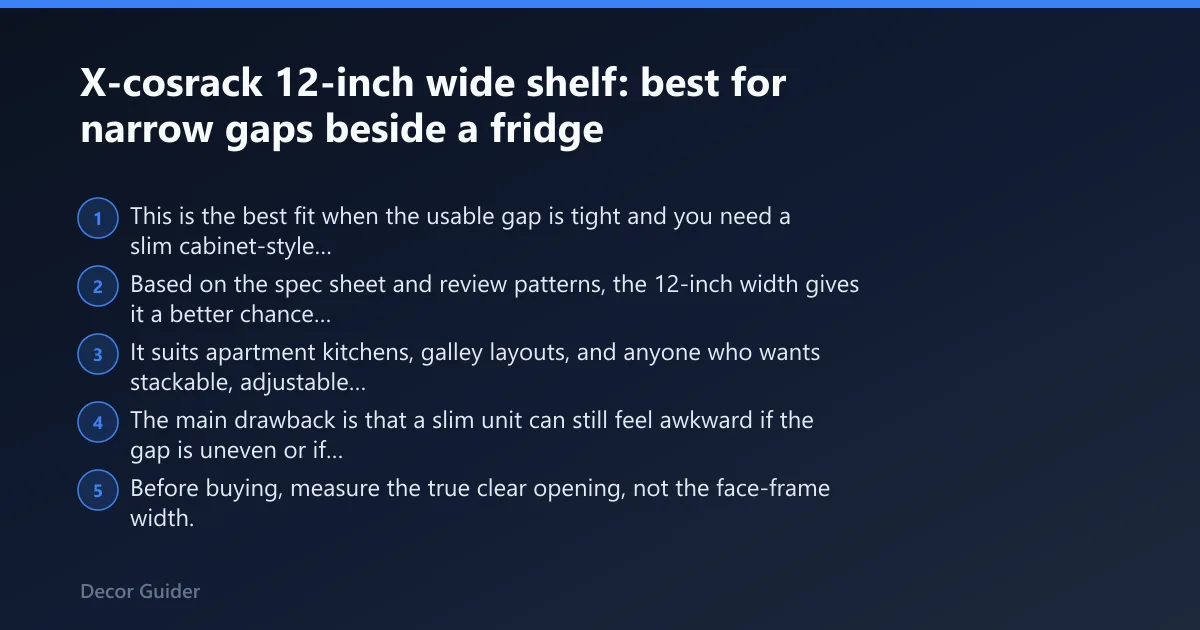
This is the best fit when the usable gap is tight and you need a slim cabinet-style shelf that still carries serious weight. Based on the spec sheet and review patterns, the 12-inch width gives it a better chance of fitting beside a refrigerator or into a shallow pantry bay without eating the walking path.
It suits apartment kitchens, galley layouts, and anyone who wants stackable, adjustable storage for dry goods, cookware, or bins. The main drawback is that a slim unit can still feel awkward if the gap is uneven or if the cabinet area has trim that steals a half inch on both sides.
Before buying, measure the true clear opening, not the face-frame width. I always check the side trim, hinge throw, and door arc too. If the unit lands too close to the door swing, the shelf stops being space-saving and becomes a daily snag point.
OCG slide-out cabinet organizer: best for renters
This is the strongest renter-friendly choice in the set because it is designed as a narrow pull-out organizer rather than a permanent pantry build-out. In smaller rentals, that usually means less wall damage, easier removal, and a better chance of using awkward cabinet depth that would otherwise go dead.
It works well for canned goods, condiment bottles, cleaning supplies, and any items that disappear in the back of a deep lower cabinet. The drawback is capacity: a slim pull-out is excellent for access, but it is not the place for bulky cereal boxes or a heavy stack of bins.
Check the cabinet opening, the side-wall clearance, and whether the mounting surface is solid enough for repeated sliding use. If the cabinet box flexes, the glide system can feel loose long before the storage space is full.
Which shelf size fits your kitchen layout?
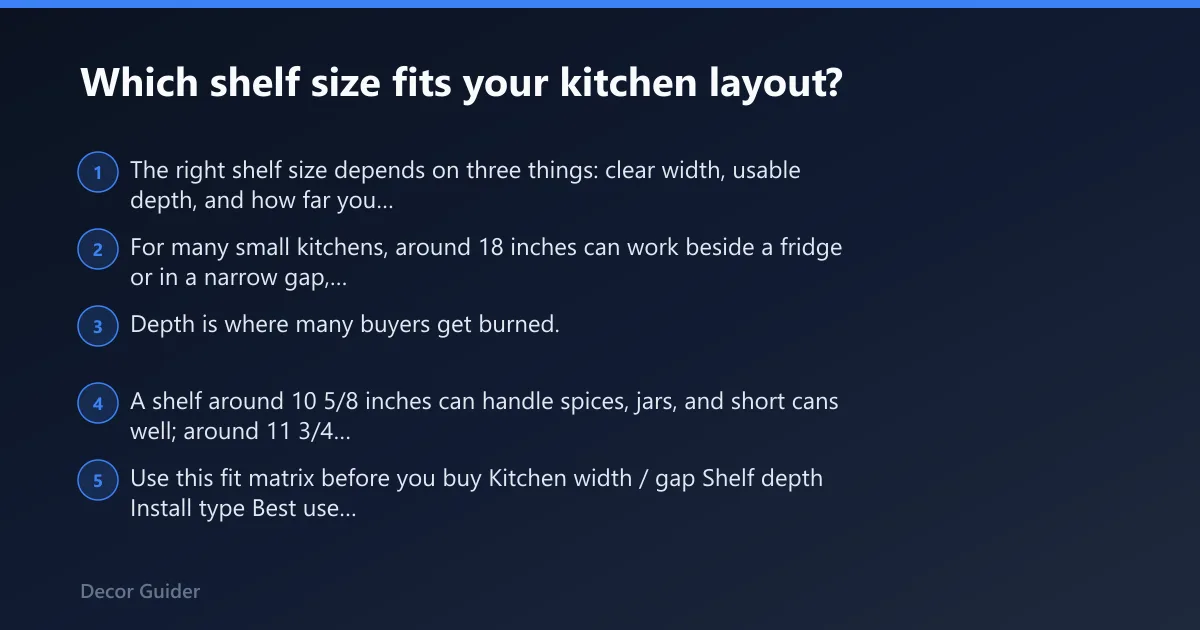
The right shelf size depends on three things: clear width, usable depth, and how far you can reach without bumping a door or stretching past the back wall. For many small kitchens, around 18 inches can work beside a fridge or in a narrow gap, about 16.5 inches can suit very tight cabinet bays, and roughly 23 5/8 inches is more suitable when the space is genuinely open.
Depth is where many buyers get burned. A shelf around 10 5/8 inches can handle spices, jars, and short cans well; around 11 3/4 inches may be a practical all-around pantry depth; around 14 inches can fit more dry goods without going too far back; around 15 3/4 inches can start to suit larger bins; and around 19 5/8 inches may be too deep for a small kitchen because items can disappear behind the front row.
Use this fit matrix before you buy
| Kitchen width / gap | Shelf depth | Install type | Best use case | Failure risk to watch |
|---|---|---|---|---|
| 16.5 inches to 18 1/8 inches beside a fridge | 10 5/8 inches to 11 3/4 inches | Freestanding or wall-mount pull-out | Spices, oils, jars, tea, snack bins | Door swing, overhang, narrow-side wobble |
| 18 1/8 inches to 23 5/8 inches in a pantry nook | 11 3/4 inches to 14 inches | Freestanding or modular sections | Cereal, flour, cans, paper goods | Front-heavy loading, poor reach at the back |
| Wall cavity or built-in cabinet fit | 14 inches to 15 3/4 inches | Built-in cabinet fit or pull-out | Clear bins, tall jars, family pantry storage | Over-depth shelves hide items and waste space |
| Very shallow zone near a walkway | 10 5/8 inches | Over-the-door or wall-mount pull-out | Light items that need easy scanning | Hooks, trim, or hinges can reduce clearance |
For shelf height, plan around 37 inches for low zones, 48 7/8 inches for compact stackers, 55 1/8 inches for mid-height units, 71 1/4 inches for tall pantry frames, and 74 3/4 inches for the tallest options. Tall units demand better anchoring because height magnifies any side-to-side movement.
What matters more: stability, access, or adjustability?
For small kitchens, stability should come first when the unit is tall or carries jars and bins. Access comes next if you are working with deep cabinets, and adjustability matters most when your storage changes often or when the gap is awkward. The best choice balances all three without stealing floor space.
Freestanding vs wall-mounted vs over-the-door
Freestanding shelves are easier to place and move, but they need a stable footprint and often wall anchoring to avoid tipping. Wall-mounted pull-outs keep the floor clear and solve reach issues better, while over-the-door units are useful for renters but can interfere with door closure or hardware.
Fixed shelves vs micro-adjustment vs modular sections
Fixed shelves are simpler and usually cheaper. Micro-adjustment helps when jars, boxes, and bins vary in height, while stackable or modular sections are useful when the kitchen layout is irregular or when you want to grow storage in stages.
When open shelving and clear bins actually help
Open shelving helps when groceries need fast scanning and when the user wants to see what is running low. Clear bins and pull-out baskets reduce the “lost item in back” problem, especially in shallow units where visibility matters more than enclosed storage.
Pantry shelf fit matrix for small kitchens
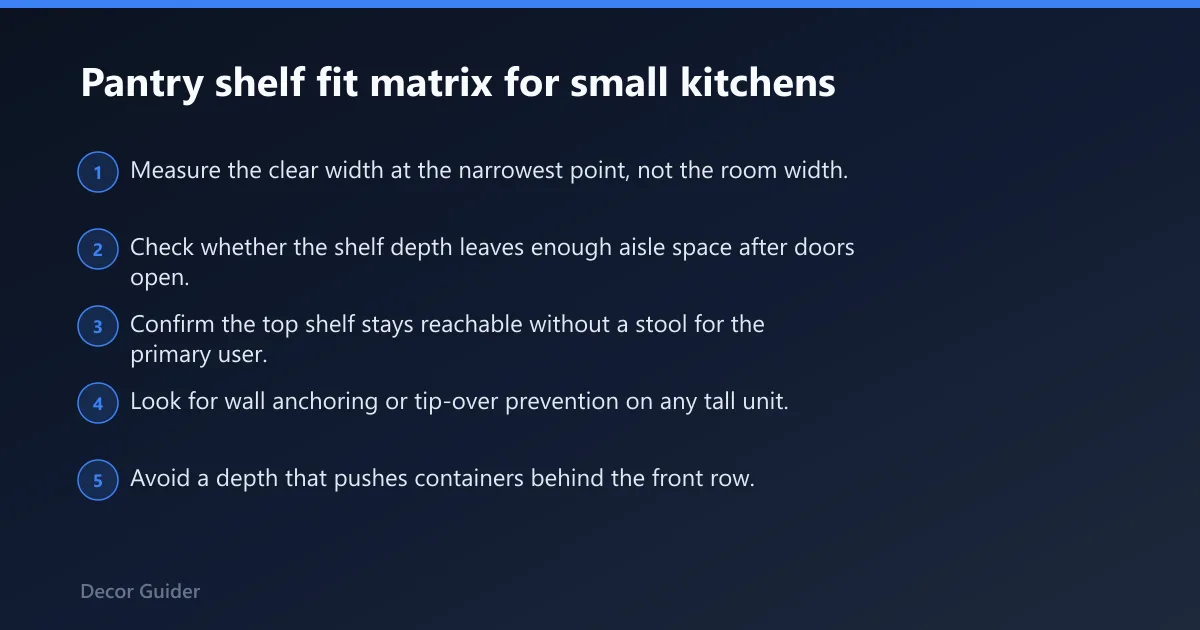
This matrix translates common kitchen dimensions into shelf choices that are less likely to fail. It is meant to prevent wobble, overhang, and the classic mistake of buying a unit that fits the wall but blocks the room.
If a shelf looks good on paper but steals the walk path, it is the wrong shelf.
Common width, depth, and height combinations
| Width | Depth | Height | Best install type | Ideal use case | Failure-case checklist |
|---|---|---|---|---|---|
| 18 1/8 inches | 10 5/8 inches | 37 inches | Over-the-door or wall-mount pull-out | Spices, tins, snack packets | Door swing, shallow bin fit, top shelf reach |
| 18 1/8 inches | 11 3/4 inches | 48 7/8 inches | Freestanding or modular sections | Everyday pantry in a narrow bay | Front loading weight, uneven floor, side wobble |
| 16.5 inches | 11 3/4 inches | 55 1/8 inches | Built-in cabinet fit | Compact dry-goods cabinet | Overhang, poor reach at upper levels |
| 23 5/8 inches | 14 inches | 71 1/4 inches | Freestanding with wall anchoring | Family pantry with boxes and jars | Tip risk, blocked walk path, hidden back row |
| 23 5/8 inches | 15 3/4 inches | 74 3/4 inches | Built-in cabinet fit or anchored unit | Heavy jars, bins, paper goods | Over-depth shelves, hard-to-reach upper zones |
Failure-case checklist for wobble, reach, and overhang
- Measure the clear width at the narrowest point, not the room width.
- Check whether the shelf depth leaves enough aisle space after doors open.
- Confirm the top shelf stays reachable without a stool for the primary user.
- Look for wall anchoring or tip-over prevention on any tall unit.
- Avoid a depth that pushes containers behind the front row.
- Make sure bins do not hang past the front edge.
How much weight can pantry shelves hold?
Weight capacity is only useful if you separate per-shelf load limits from total unit load limits. A shelf that carries jars well on one level may still be unstable as a full frame, especially when the weight sits high or far forward. Stability under bins and glass containers matters as much as the printed limit.
For small kitchens, a safer rule is to favor units with clear load data, anchored tall frames, and a shelf spacing pattern that keeps the heaviest items low. Galvanized steel usually handles heavy pantry loads better than softwood or polypropylene, while pine and other softwood can work well if the unit is not overloaded and the shelves are not too wide.
ASTM F2057 is worth checking whenever a tall freestanding unit could tip toward a child or into the open room. For rentals and families, wall anchoring or a true anti-tip kit is not an add-on; it is part of the buying decision.
What are the best pantry shelves for a small kitchen?
The best pantry shelves for a small kitchen are slim, adjustable units that fit the gap you have, especially beside a fridge or in a shallow pantry nook. For many homes, a practical starting point is around 12–14 inches deep, with anchoring or a pull-out format if access is tight.
In practice, the best choice depends on the failure mode you are trying to avoid. If the problem is wobble, choose an anchored freestanding frame. If the problem is reach, choose pull-out storage. If the problem is wasted vertical space, choose stackable or modular shelves.
Top pick by fit, stability, and access
The strongest all-around choice is a narrow adjustable unit that sits around fridge-side gaps, stays stable when loaded, and keeps the front row visible. The best result comes when width, depth, and height match the room before storage style is even considered.
Who should skip it and choose another type
Skip a freestanding frame if the floor is uneven or if the aisle is so tight that even a slim base blocks the path. Skip over-deep shelves if the user is short, if the pantry has a deep back wall, or if items routinely disappear behind other items.
Are freestanding pantry shelves better than wall-mounted shelves?
Freestanding pantry shelves are better when flexibility matters and the floor area is level enough to keep them steady. Wall-mounted shelves are better when you need to preserve floor space, avoid a bulky base, or pull items out of a deep cabinet without moving the whole unit.
For small kitchens, freestanding wins on simplicity and modularity. Wall-mounted wins on access and footprint control. The better pick is the one that solves the room’s real constraint, not the one that sounds more permanent.
Fixed shelves, micro-adjustment, and modular sections
Fixed shelves keep the build simple. Micro-adjustment works well for mixed-height containers, and modular sections are best when you need to fit around trim, vents, or an odd wall return. Stackable designs help when the kitchen needs storage in phases.
Materials and finish tradeoffs
Galvanized steel is the safest bet for load and cleaning. Pine has a warmer look and works well in lighter-duty pantries. Softwood is usually lighter and easier to move, but it can flex sooner under jars. Polypropylene is useful for light items and easy cleanup, though it is not the right answer for heavy pantry stock.
What pantry shelving works best for renters?
Renters usually do best with over-the-door shelving, modular stackers, and narrow pull-out organizers that leave walls and cabinets easy to return to their original condition. If drilling is allowed, small anchoring points can help, but removable hardware usually keeps the install simpler and less risky for a lease.
Look for units that do not rely on permanent fasteners, and check whether the shelving can move with you. The right renter setup should store dry goods well without forcing a patch-and-paint job later.
What to check before buying in a rental
Confirm door thickness, hinge clearance, and whether the unit will hit baseboards or molding. Also check whether a freestanding piece needs anti-tip hardware even if you do not plan to fasten it, because tall narrow units can shift more than expected once stocked.
Which one should you buy?
Buy the narrowest unit that still gives you clean access. For ultra-narrow galley kitchens, choose a 10 5/8-inch to 11 3/4-inch depth with pull-out or over-the-door access. For families with kids, pick an anchored freestanding or built-in style with heavier items on the lower shelves.
For renters, the OCG pull-out organizer is the safer fit. For heavier loads and jars, choose a steel frame with wall anchoring and a depth around 14 inches or 15 3/4 inches if the aisle still stays clear. For the tightest fridge-side gaps, the X-cosrack 12-inch wide shelf is the most sensible starting point from this group.
The budget choice is usually the smallest organizer that still solves the access problem. The permanent install is the one with the strongest anchoring and the best fit to your wall width, not the highest price tag.
Frequently asked questions
How deep should pantry shelves be in a small kitchen?
Most small kitchens do best with 10 5/8 inches to 14 inches of depth. That range usually fits jars, cereal, and clear bins without making the back row hard to reach. Depths around 19 5/8 inches often create dead space unless the shelves pull out.
Which pantry shelf size fits beside a refrigerator?
For the space beside a refrigerator, 18 1/8 inches wide is often the safest target, and some narrow gaps can work at 16.5 inches if trim and door swing allow it. Keep the depth slim enough that the shelf does not block the refrigerator door or the traffic path.
Do open pantry shelves make it easier to see groceries?
Yes. Open pantry shelves make groceries easier to scan, so duplicates are easier to spot and empty spots are easier to refill. Clear bins and open fronts help reduce over-buying because the food is visible during routine cooking and shopping checks.
Products related to this article
Sponsored / affiliate links. As an Amazon Associate I earn from qualifying purchases. I may earn additional commission from eligible campaigns.