
How Much Does a Dining Chair Cost?
A dining chair usually costs about $50 to $300, with solid wood or upholstered designs often landing around $100 to $250 and custom pieces going higher. Skip repair costs, and you can spend more replacing a chair than fixing a loose joint or worn seat. This guide breaks down new-chair prices, repair and reupholstery costs, and when replacement makes better financial sense.
Dining chair price ranges



Most dining chairs fall into budget, mid-range, and premium bands, but the real cost depends on what you are buying: a basic side chair, an upholstered seat, an armchair, or a larger host chair. For a single chair, about $50 to $150 is common for budget models, $150 to $300 for mid-range, and $300-plus for premium or custom pieces.
Budget, mid-range, and premium price bands
Budget chairs often use engineered wood, MDF, veneer, plastic, or polypropylene. Mid-range chairs usually step up to better wood frames, tighter joints, thicker cushions, or more durable finishes. Premium chairs add stronger hardwoods, tighter joinery, dense foam, higher-grade fabric or leather, and more labor in the frame and upholstery.
How side chairs, armchairs, and host chairs differ
Side chairs usually cost less because they use less material and have simpler frames. Armchairs cost more because arms add wood, metal, upholstery, and labor. Upholstered host chairs or end chairs often cost the most in a set because they are larger, heavier, and more detailed, and they can carry a room’s style direction.
What a set costs versus a single chair
Buying a set can lower the per-chair price, but the total ticket rises quickly. A 4-chair set often lands around $200 to $800 for budget to mid-range options, a 6-chair set around $300 to $1,800, and an 8-chair set around $400 to $2,400 or more, before delivery and assembly.
Shipping matters here. A boxed set may cost less per chair, while freight-delivered or assembled chairs can add a meaningful fee, especially for heavier wood or upholstered models.
What affects dining chair cost

Price moves with material choice, frame construction, finish quality, size, and detailing. Upholstered dining chairs usually cost more than basic wood or plastic chairs because they need more parts and labor. Larger, heavier, or more detailed chairs also tend to cost more, and so do chairs with higher weight ratings.
Material choices: wood, metal, upholstered, and budget composites
Solid wood chairs cost more than plastic or MDF because the material is stronger and more expensive to process. Hardwood species such as oak, maple, and walnut usually cost more than softwood or low-grade composite frames. Metal chairs vary widely too: steel is common for strength, while aluminum is lighter and often pricier.
Upholstered chairs sit higher on the price ladder because you pay for the frame, padding, fabric or leather, and the labor to build the seat. Fabric is usually the least expensive upholstery choice. Leather usually costs more. Performance fabric often falls in between, but it can lower long-term cleaning and stain concerns.
Budget chairs made with engineered wood, MDF, veneer, plastic, or polypropylene can be cost-effective for light use. The wear points are predictable: loose joints, chipped edges, sagging seats, scuffed finishes, and cracked plastic at stress points.
Construction details: joinery, frame strength, and finish quality
Joinery affects both price and lifespan. Screwed or stapled frames cost less than chairs with mortise-and-tenon, dowel, or reinforced corner-block construction. Better joinery usually means less wobble over time and fewer repairs.
Finish quality matters too. A thin sprayed finish may lower the price, but it scratches and wears faster. Better stain, lacquer, or powder coat costs more because it stands up to daily use better, especially around the front rails, seat edge, and legs.
Size, weight capacity, and design detail
Seat height should usually fall around 17 to 19 inches from the floor for standard dining tables, with about 10 to 12 inches of legroom between the seat and the underside of the table. If the chair is too tall, knees hit the apron. If it is too low, eating posture suffers.
Weight capacity is a useful clue. Many residential chairs are commonly listed around 250 to 300 pounds, while more durable or commercial-grade chairs may be rated higher. A higher rating does not guarantee a longer life, but it often signals stronger frame parts, better joinery, or a thicker seat build.
- Measure the table height and check seat-to-table clearance.
- Compare the chair’s seat height to your table apron or stretcher.
- Check the listed weight capacity and frame material.
- Inspect the joinery, especially at the front legs and seat rails.
- Account for shipping, assembly, and any fabric protection or care products.
Dining chair cost breakdown table
This table turns purchase price into a total ownership decision. A low sticker price can still be expensive if the chair fails early, needs reupholstery, or costs more to ship than to buy.
| Price tier | Common material or build | Estimated lifespan | Likely repair cost | Repair-vs-replace rule |
|---|---|---|---|---|
| Budget: $50 to $100 | Plastic, polypropylene, MDF, veneer, light engineered wood | 3 to 5 years in light use | $20 to $80 for screws, glue, seat pads, or surface touch-up | Replace if the frame wobbles, cracks, or the seat shell is split. |
| Lower mid-range: $100 to $180 | Better engineered wood, basic hardwood, simple metal frame, light upholstery | 5 to 8 years | $40 to $150 for joint repair, finish touch-up, or seat replacement | Repair if the damage is limited to a loose joint or worn cushion. |
| Mid-range: $180 to $300 | Solid hardwood, stronger steel frame, performance fabric upholstery | 8 to 12 years | $75 to $250 for refinishing, rewebbing, or partial upholstery work | Repair if the frame is sound and the finish or seat is the main problem. |
| Premium: $300 to $700+ | Hardwood, commercial-grade metal, dense foam, leather, detailed joinery | 12 to 20 years or more | $150 to $500+ depending on fabric and labor | Repair if the chair is structurally strong and the materials justify the labor. |
How much does reupholstery cost?
Dining chair reupholstery usually costs about $100 to $300 per chair, and upholstered host chairs or chairs with more detail can cost higher. Labor is the main cost. Materials add up fast, especially if the seat needs new foam, batting, springs, or trim. Recovery is cheaper when the padding and structure are still usable.
Labor cost versus materials
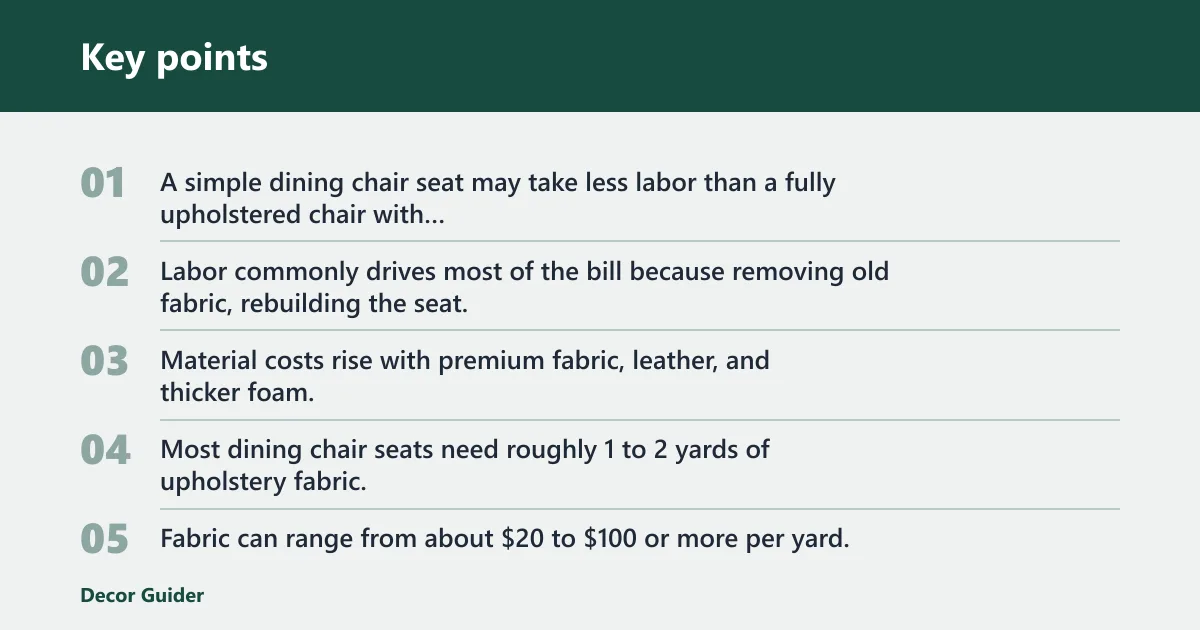
A simple dining chair seat may take less labor than a fully upholstered chair with attached arms or a curved back. Labor commonly drives most of the bill because removing old fabric, rebuilding the seat, and stretching new material takes time. Material costs rise with premium fabric, leather, and thicker foam.
Fabric yardage, foam, batting, staples, and trim
Most dining chair seats need roughly 1 to 2 yards of upholstery fabric, though larger chairs can need more. Fabric can range from about $20 to $100 or more per yard, depending on weave and durability. Foam, batting, staples, webbing, dust cover cloth, and trim can add another $20 to $75 per chair.
Foam density matters. Higher-density foam usually keeps its shape longer and costs more than thin replacement foam. For seats that see daily use, lower-cost foam may flatten faster and turn a cheap repair into a short-lived one.
When recovery is enough and when full reupholstery is needed
Recovery means replacing the visible cover only, or the outer layer and a simple batting wrap, while leaving the seat structure and much of the padding in place. Full reupholstery strips the chair down farther and replaces more of the inner build. Recovery works when the fabric is worn but the foam and frame are still solid.
Suppose a chair has a loose cushion cover but the foam still springs back and the wood frame is tight. Recovery may be enough. If the seat sags, the foam crumbles, or the webbing is stretched, full reupholstery is the safer route.
When should you repair or replace?
Repair makes sense when the frame is sound and the fix stays well below the cost of a similar replacement chair. Replace when the chair has cracked structure, repeated joint failure, major finish loss on a low-cost model, or upholstery damage that would cost nearly as much as a new chair. Age matters less than construction quality and repair scope.
Structural damage, loose joints, and worn finishes
Loose joints, wobbly legs, and worn finish are often repairable. Glue, clamps, screws, touch-up stain, or a new finish coat can extend life. Cracked rails, split seat frames, or bent metal usually point toward replacement unless the chair is high value or part of a matched set worth preserving.
A common first-timer mistake is spending $120 to repair a $90 chair with a damaged frame and failing upholstery. In that case, replacement usually makes more sense unless the chair has a special design match that cannot be replaced easily.
Repair value by chair material
Solid wood chairs are often the best repair candidates because they can be glued, tightened, sanded, and refinished. Metal chairs can be worth repairing if the frame is intact and the finish can be restored. Budget composite chairs often have less repair value because their core materials do not respond well to repeated fixing.
When a low-cost replacement makes more sense
If a chair costs $60 to $80 new and needs $75 in labor plus material to recover, replacement is usually the better financial choice. If a $250 hardwood chair only needs a $50 joint repair or a $90 seat refresh, repair is easier to justify. The break-even point is usually based on the chair’s build, not its age alone.
Buying a dining chair set
Set pricing often lowers the per-chair cost, especially for basic side chairs, but shipping and assembly can change the math. A 4-chair set is usually easier to manage in a small room or apartment, while 6-chair and 8-chair sets better fit larger dining areas and can improve value per chair.
4-chair, 6-chair, and 8-chair scenarios
A 4-chair set can be the most practical choice for a small dining nook. A 6-chair set usually fits standard family dining tables and often offers a better per-chair price than buying individually. An 8-chair set often brings the lowest per-chair price in a series, but the higher total cost and larger footprint matter more.
For apartment buyers, a smaller set can also reduce clutter and make room cleaning easier. Buying fewer chairs with better construction can be a better trade than filling the space with cheaper pieces that wear out early.
Shipping and assembly costs
Shipping can add a flat fee, a per-box charge, or freight costs for larger furniture. Assembly may be included, partly included, or left to the buyer. Heavy chairs, upholstered chairs, and chair sets with multiple cartons often cost more to ship than a single lighter chair, even when the listed price looks attractive.
Check whether feet pads, screws, and tools are included. Small missing parts can delay use and add another trip or order.
How set pricing changes per-chair value
Set pricing can create savings, but only if the chairs fit your table height, room width, and use pattern. A cheaper set with weak frames may cost more over time than a slightly pricier set with stronger joinery and better upholstery. Cost per year is often the better metric than cost per chair.
Frequently asked questions
How much should a dining chair cost?
A dining chair often costs $50 to $300, depending on material, finish, and construction. Budget chairs are common under $100, mid-range chairs often land between $100 and $250, and premium or custom chairs can go higher. Comfort, table fit, and weight capacity matter as much as the sticker price.
How much does a dining room chair cost?
A dining room chair usually falls in the same range as a dining chair: about $50 to $300 for most mass-market options. Upholstered, hardwood, and armchair styles usually cost more than plastic or basic wood side chairs. Buying a set can lower the price per chair, but shipping may offset part of the savings.
Why are dining chairs so expensive?
Dining chairs cost more when they use better wood, stronger joinery, denser foam, or higher-grade upholstery. Labor also matters because upholstered chairs and detailed frames take longer to build. Larger chairs, armchairs, and host chairs use more material and often carry higher weight ratings, which adds cost.
How much does dining chair reupholstery cost?
Dining chair reupholstery usually costs $100 to $300 per chair, though complex chairs can cost more. Labor is the biggest piece of the bill, and material choice changes the total fast. If the frame is sound but the seat is worn, reupholstery can make more sense than replacing a higher-quality chair.
How much does it cost to recover a dining chair?
Recovering a dining chair is often cheaper than full reupholstery because it may replace only the outer cover and a light layer underneath. Costs often start around $50 to $150 for simple seats, but the total depends on labor, fabric choice, and whether the foam, webbing, or batting also needs work.
What affects the price of a dining chair?
Material, joinery, upholstery, finish quality, seat height, size, and weight capacity all affect price. Solid wood and upholstered chairs usually cost more than basic plastic or MDF models. A chair with stronger frame parts, better fabric, or more detailed construction often costs more up front but may last longer.
Products related to this article
Sponsored / affiliate links. As an Amazon Associate I earn from qualifying purchases. I may earn additional commission from eligible campaigns.