Pottery Barn Dining Table Review
Pottery Barn dining tables are a good style-first buy if you choose solid wood and avoid delicate finishes. For everyday use, the safest picks are fully solid-wood models with practical extension leaves. A poor choice can mean scratches, wobble, and a table that resists refinishing when the surface ages. This guide ranks the best Pottery Barn models by scratch resistance, refinishability, and extension practicality.
Verdict
Buy Pottery Barn when you need a specific dining-room look and can verify the build line by line. Full-price value is middling for the construction risk involved, but sale pricing can improve the math. The brand’s service network and delivery setup help, yet the ownership tradeoffs still depend on whether you get solid wood, veneer, or MDF in the parts that matter most.
Specs at a glance
| What to check | What Pottery Barn commonly offers |
|---|---|
| Top material | Solid wood on some models; veneer or veneer-over-engineered components on others |
| Understructure | Often a mix of solid wood, veneer, MDF, or engineered parts depending on the model |
| Formats | Fixed and extendable tables |
| Seating | Ranges from small four-seat layouts to large family tables |
| Price | Typically premium, with sale pricing often making the better value case |
| Care | Use pads, wipe spills quickly, and expect finish wear over time on softer woods |
Pottery Barn dining table decision matrix
| Model | Top material | Understructure material | Refinishable surface | Extension type | Leaf storage | Likely scratch risk | Family-friendliness | Best-fit room size |
|---|---|---|---|---|---|---|---|---|
| Benchwright Dining Table | Solid pine top | Poplar veneer over MDF apron/base | Yes, top only | Extendable version available | Separate storage likely; verify before buying | Moderate to high | Good if you want refinishability and can accept softwood wear | Medium to large rooms |
| Toscana Extendable Dining Table | Sungkai wood and Sungkai veneers | Mixed wood-and-veneer construction | Limited compared with fully solid surfaces | Two removable 12-inch leaves | Separate storage required | Moderate | Strong for larger households that need seating flexibility | Medium to large rooms |
| Reed Dining Table | Contract-grade positioning with model-dependent construction | Sturdier daily-use build than style-led pieces | Depends on finish and surface layer | Often sold in fixed formats | N/A on fixed versions | Lower to moderate | Better for daily use and repeat handling | Small to medium rooms, depending on size |
Are Pottery Barn dining tables good quality?
Yes, but only when you separate the models. Pottery Barn has a style-first reputation, yet the actual quality depends on whether the table uses solid wood where wear happens or veneer and MDF where movement and impact are less visible. That variation matters more than the brand name itself.
Solid wood tops can be sanded and refinished more easily. Veneer over MDF is more limited, because sanding through the veneer can expose the substrate below. That means two tables with similar looks can age very differently once scratches, heat marks, or finish wear show up.
Brand reputation versus build variation
The brand is generally viewed as dependable for showroom appeal and broad room styling, but not every table is built for the same kind of wear. Benchwright, Toscana, and Reed do not share identical construction priorities, so buyers need to read the material callouts instead of assuming one blanket quality level.
Solid wood, veneer, and MDF in plain terms
Solid wood gives you more repair options. Veneer is a thin surface layer over a core material. MDF is a dense manufactured panel that can support shape and stability, but it is not a refinishing surface in the same way a solid wood top is.
Where quality is strongest
Quality is strongest when the tabletop itself is solid wood, the extension mechanism is straightforward, and the base stays stable under load. Quality is weaker when the top looks premium but the apron, base, or support parts rely on veneer-over-MDF construction that cannot be sanded much if the finish fails.
What works
Pottery Barn’s better tables work because they give you recognizable design, usable dimensions, and enough material transparency to judge the risk. The best cases are the ones where the top is refinishable and the extension system is simple enough to live with over time.
Benchwright strengths
The Benchwright’s solid pine top is the clearest advantage. Pine is a softwood, so it is not scratch-proof, but it can be refinished, which matters if you expect finish wear after years of family meals or heavy use. Its 60 to 108 inch size range also gives shoppers room to match the table to the room instead of forcing a one-size compromise.
The farmhouse silhouette is easy to place in transitional rooms. The main upside is ownership flexibility: if the top gets marked up, a refinishing path still exists. The caveat is that the apron and base use poplar veneer over MDF, so repairability is strongest at the top, not everywhere.
Toscana strengths
The Toscana Extendable Dining Table is the more flexible option for seating swings. The Toscana Extendable Dining Table’s 60-84 inch range, two removable 12-inch leaves, published 630-pound capacity, and 159-pound product weight suggest a table suited for large-meal use rather than occasional display.
That makes it appealing if you need a formal table that can still handle holiday overflow. Sungkai wood and Sungkai veneers are a more mixed construction story than a fully solid top, but the sizing and extension range are practical for households that want one table to do several jobs.
Reed strengths
The Reed Dining Table is the safest match for buyers who care more about daily use than statement styling. Its contract-grade positioning suggests a tougher everyday brief, which is useful if the table will see repeated chair movement, lunches, homework, and constant wipe-downs.
That does not automatically make it the prettiest or the best value at every price point, but it usually makes the most sense for shoppers trying to avoid a delicate, showroom-only feel. If online owner feedback leans positive, that usually reflects straightforward utility more than luxury finish.
What does not?
The main weaknesses are softwood wear, unfinished ownership costs, and extension compromises. Pottery Barn tables can look durable in photos and still create problems once scratches, chair arms, leaf storage, or room-clearance math enter the picture.

Softwood scratch and dent risk
Softwood dining-table surfaces dent more easily than harder woods. That does not make them bad, but it does mean you should expect visible wear sooner if the table is used by kids, for craft projects, or as a catchall surface. Finish touchups help, yet they do not make softwood immune.
Leaf storage and alignment issues
Extension leaves are rarely carefree. Some require separate storage, and the more pieces you have to remove, the more likely you are to deal with alignment pins, runner hardware, and a slight shift in how the table seats underneath. Humidity changes can also affect how smoothly the leaves fit.
Say your dining room is 11 by 13 feet and you buy an extendable table that looks perfect on paper. Once the leaves are in, chair pull-back can become awkward, and the room may feel tighter than expected even if the table itself technically fits.
Ownership risks to watch
Delivery and assembly can be part of the real cost. A forum commenter warned, “Prepare for it to take a year to be delivered”, which is the kind of risk that turns a good-looking buy into a planning problem. Large tables also create room-fit mistakes, especially when buyers forget to account for chair clearance and walking space.
Suppose you want an extendable table for eight but plan to use it at six most nights. If the extension leaves need separate storage and the table base spreads wide, the room may feel better at the smaller setting, which is useful, but the “full size” version may become an occasional rather than regular setup.
Can you refinish a Pottery Barn table
Yes, sometimes. A Pottery Barn table with a solid wood top can often be refinished, while veneer tops and veneer-over-MDF parts are much more limited. The rule is simple: the more solid wood you have at the surface, the more repair and sanding options you usually have.
Which tops are refinishable?
Benchwright’s solid pine top is the clearest refinish candidate. If the finish wears, scratches deepen, or the tone no longer works for the room, a solid top can usually be sanded and re-coated within normal furniture limits. That is a real value point for buyers who want a table to age rather than be replaced quickly.
Which substrates limit sanding?
Veneer over MDF limits refinishing because the veneer layer is thin. Once sanding cuts too deeply, the substrate shows through, and the repair can stop being economical. That is why base and apron construction matter, even if most of the visible wear happens on the top.
Care steps that slow wear
Use placemats, trivets, and felt pads. Wipe spills quickly. Keep the table out of avoidable humidity swings and do not drag heavy décor across the surface. These steps will not stop finish wear forever, but they can delay the point where refinishing becomes necessary.
Should you buy it?
Buy a Pottery Barn dining table if you want a design-led piece and you are willing to choose the model carefully. The best everyday pick is the table with the most usable solid wood surface and the least fussy extension hardware. The safest formal-room pick is the one that fits the room with the least crowding, not the one with the biggest headline size.
Who it
This line suits shoppers who want a polished dining room and are comfortable checking materials, not just finish color. It is less suited to buyers who need maximum scratch resistance, the easiest possible refinishing path, or a budget table that can take abuse without much concern.
- Best for everyday use: Benchwright, if you want a refinishable top and a farmhouse look.
- Best for larger gatherings: Toscana, if extension flexibility matters more than simple upkeep.
- Best for daily wear: Reed, if the priority is sturdier use over decorative appeal.
- Skip if: you need a low-cost table, a highly scratch-resistant surface, or a no-maintenance setup.
Best for sale shoppers
The value case improves when Pottery Barn discounting narrows the gap between style and construction quality. At full price, the brand premium is easier to question. On promotion, the same table can become easier to justify, especially if the top is solid wood and the room fit is right.
What materials do Pottery Barn dining tables use?
Pottery Barn uses a mix of solid wood, veneer, MDF, and engineered components depending on the model. That mix is why one table can be refinishable and another can be mostly a visual buy. The materials callout matters more than the logo on the apron.
Benchwright material profile
The Benchwright has a solid pine top, with a poplar veneer over MDF apron and base. That combination gives you a refinishable main surface, but it also means the support structure is not all solid wood. The strength is in the top; the repair limits are in the base.
Toscana material profile
The Toscana uses Sungkai wood and Sungkai veneers. That usually signals a mixed-material build that is designed to balance look, stability, and cost. It can be a practical choice, but buyers should not assume every visible surface behaves like a thick solid-wood slab.
Alternatives
If the Pottery Barn look appeals but the risk profile does not, these two tables show how the market splits between solid-wood simplicity and compact extension convenience. Both are lower-cost than most Pottery Barn dining tables, but they do not give you the same brand styling or distribution experience.

- Solid wood construction with 3 tabletop panels
- Farmhouse style with clean lines and wirebrush finish
- Easy assembly with included hardware and tools
Plank+Beam Classic 72 Inch Dining Table is the better straight-ahead solid-wood option for buyers who want a simpler ownership story. Based on the published details, it uses solid wood construction with three tabletop panels and an easy-assembly setup. The drawback is that it is fixed at 72 inches, so it does not solve extension needs.
- 100% FAS grade rubberwood for durability
- Hidden lift system expands from 4 to 8 seats
- Silent, smooth extension track mechanism
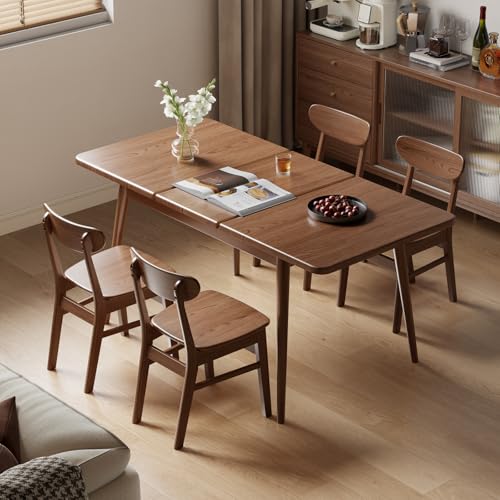
Muwuele 47"-63" Solid Wood Extendable Dining Table fits compact rooms that still need occasional expansion. Its hidden lift system and smooth track mechanism make the extension story easier than many bargain extendable tables, and the 47–63 inch range is practical for apartments. The drawback is clear: the smaller footprint also means you are not getting a large formal dining-table presence.
How do Pottery Barn dining tables compare on quality today?
Today’s comparison comes down to construction transparency rather than a single blanket score. Pottery Barn still has desirable designs, but some models are clearly better engineered for everyday wear than others. Buyers should compare solid wood surfaces, extension hardware, and understructure materials before they compare finishes.
A forum commenter says a Pottery Barn table from 2003 held up well, which suggests some older pieces aged acceptably. That does not guarantee the same result for every current model. Construction details still decide whether a table is repairable, stable, and worth the price.
Frequently asked questions
Are Pottery Barn tables good quality?
Some are, and some are only good-looking. The quality varies by model, with solid-wood tops generally offering better long-term value than veneer-heavy builds. If you want real durability, read the materials line first and judge the surface you will actually use every day.
Do Pottery Barn dining tables scratch easily?
Softwood models can scratch and dent more easily than harder-wood or heavily protected surfaces. That does not mean they fail quickly, but it does mean family use, chair movement, and frequent serving can leave marks sooner. Protective pads help, but they do not erase the risk.
Are Pottery Barn extendable dining tables worth it?
They are worth it if you need flexibility and can live with leaf storage, alignment, and chair-clearance tradeoffs. They are less compelling if you rarely extend the table, because the extra hardware and handling can add cost without much day-to-day benefit.
Do Pottery Barn dining tables have good resale or long-term value?
Long-term value is strongest on refinishable solid-wood models and weaker on tables that rely heavily on veneer or MDF. Resale also depends on finish condition, room size demand, and how common the model is locally. Better materials help, but they do not guarantee a strong secondary market.
Products related to this article
Sponsored / affiliate links. As an Amazon Associate I earn from qualifying purchases. I may earn additional commission from eligible campaigns.