Storage Ottoman vs Bench: Which Fits Your Room Best?
Choose a storage ottoman for one-seat use and a small to moderate amount of storage; choose a storage bench when you need space for more than one person or a longer surface. Pick the wrong one and you waste floor space, block traffic, or end up with storage that cannot hold the items you meant to hide. This guide compares seat size, storage volume, and room clearance so you can measure the better fit fast.
This guide is part of our Chairs guide: types, buying and care series.
| Decision factor | Storage Ottoman | Bench | Winner |
|---|---|---|---|
| Footprint | Compact and often square; also common in round, cube, and specialty shapes | Longer footprint, with common lengths around 40 to 66 inches | Ottoman for tight floors; bench for long walls |
| Seating | One-seat use or a brief perch | Seats two or three people | Bench |
| Storage volume | Usually a single, smaller cavity | Usually a larger cavity with more usable span | Bench |
| Coffee-table use | Works with a tray on a stable top | Less common as a table substitute | Ottoman |
| Bedroom placement | Better only when floor space is limited | Best at the foot of the bed | Bench |
| Entryway seating | Works as a small perch, but limits simultaneous use | Better for shoe removal and multi-person seating | Bench |
Storage ottoman vs bench: the core trade-off


The main split is shape and use: a storage ottoman stays compact and usually works as one seat, while a storage bench is longer and can often fit more than one person. That one difference affects clearance, storage access, and whether the top can pull double duty as a table.
Footprint, seating, and storage at a glance
A storage ottoman usually has a smaller footprint and a single hidden compartment. A storage bench spreads its volume across a longer body, so it usually holds more and sits more people, but it asks for more wall or floor length.
Hidden storage compartments in both styles usually use lid-top access. Common contents include blankets, pillows, magazines, shoes, and toys. A single cavity is convenient, but it also means you may need baskets or bins inside if you want better organization.
What a storage ottoman does better
An ottoman wins when you need a footrest, a spare perch, or a coffee-table substitute with a tray. It also fits rooms where a longer bench would crowd the walking path, especially near a sofa or in a compact apartment.
What a storage bench does better
A bench wins when the room needs length more than depth. It is the more natural choice for foot-of-bed placement and entryway seating, because two people can sit down at once and the lid span usually gives you more hidden storage.
📊 The Mimico Storage Ottoman has an overall height of 16 inches. Source: Dimensions.
Which one fits your room size and layout?
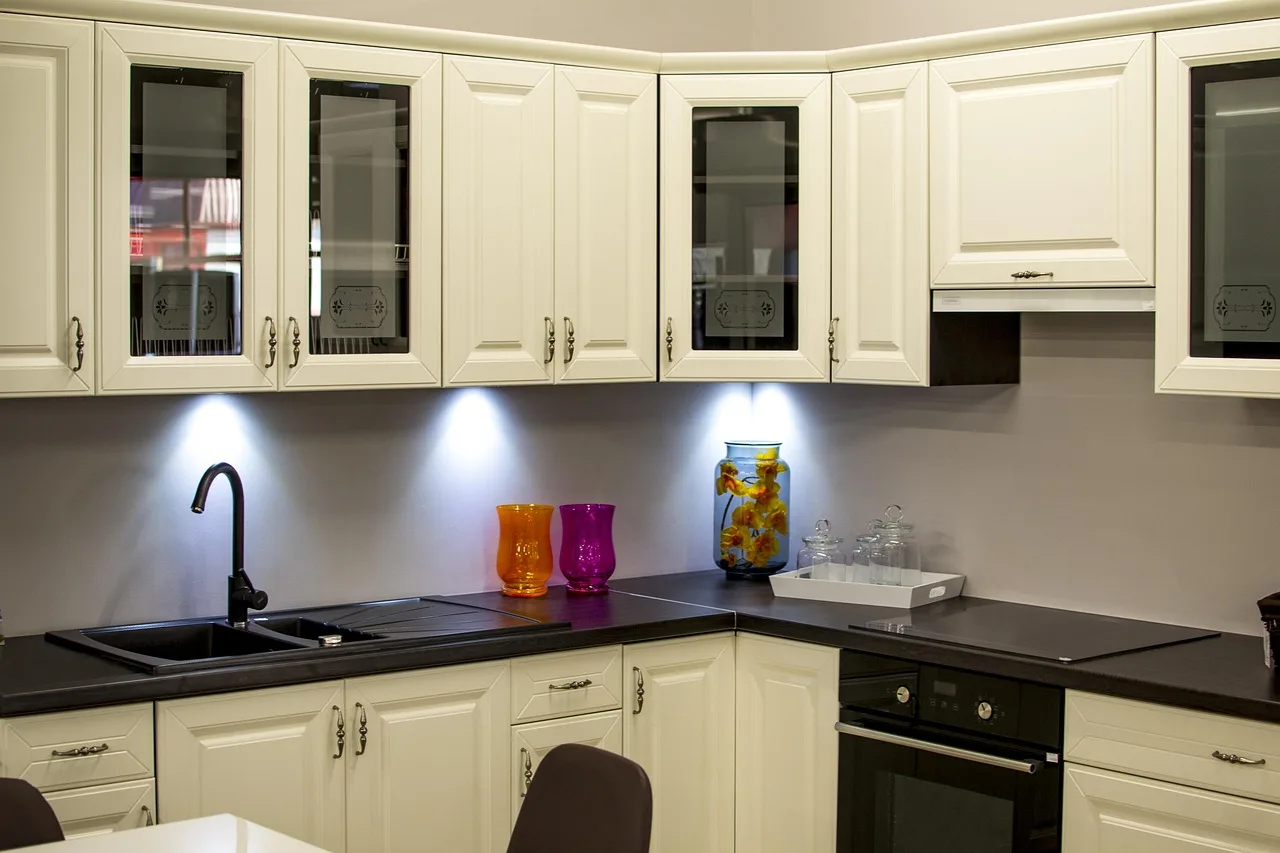
Room fit comes down to three checks: how much length you can spare, how much seating you need, and whether the piece must act as a table or a landing spot. In a tight apartment, the smaller footprint usually matters more than storage volume alone.
Small apartment and tight floor plans
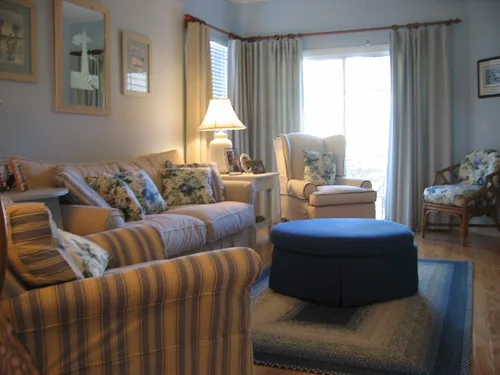
For narrow living rooms, studio corners, or compact bedrooms, the ottoman usually fits better because it leaves more clearance around the piece. A square or cube shape can tuck beside a sofa or at the end of a bed without dominating the room.
Living room use and coffee-table conversion
A storage ottoman can double as a coffee table with a tray, but only if the top is stable enough for cups and plates. Soft upholstery can work poorly here because items tilt or sink, so the ottoman should be treated as a table only when the top is firm and level.
Say your sofa sits 16 to 18 inches from a storage ottoman with a flat top. A tray gives you a usable surface, but a deep cushion top will still feel wobbly. That is why ottomans with a firmer lid are safer for daily table use.
Bedroom end-of-bed placement
For the foot of the bed, the bench usually fits better because the long shape lines up with the mattress edge. It creates a clear landing spot for clothes and shoes, and it looks intentional only when its length matches the bed width instead of stopping short.
How much space do you actually need?
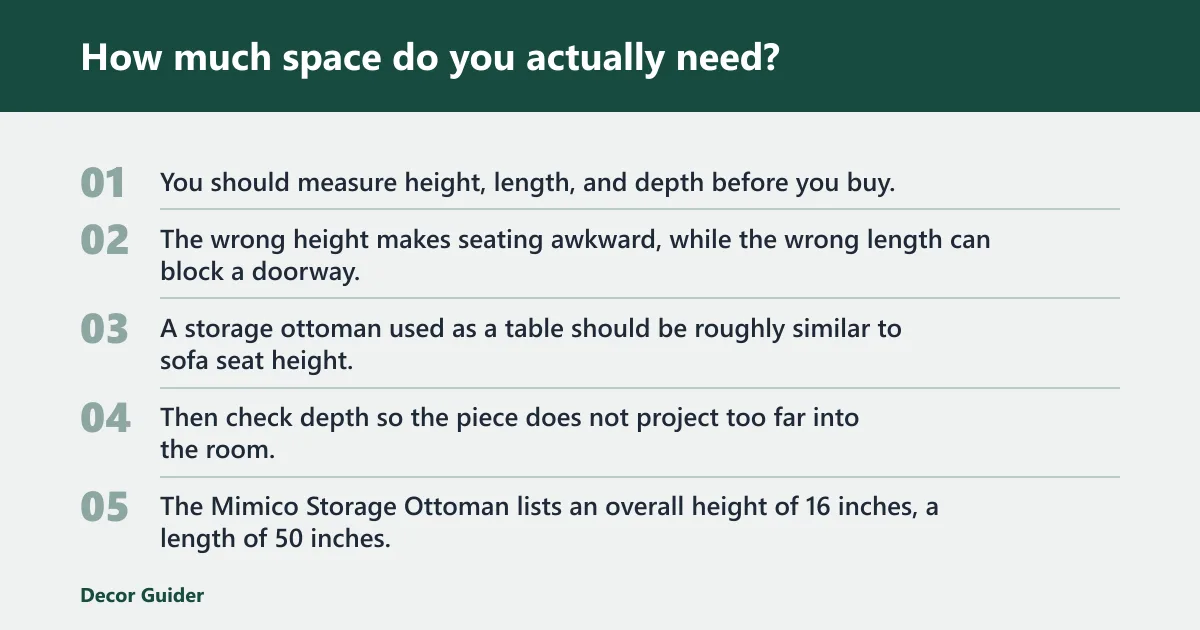
You should measure height, length, and depth before you buy, then compare those numbers to the room and the opening you expect to use. The wrong height makes seating awkward, while the wrong length can block a doorway, bed end, or traffic lane.
Height, length, and depth checks before you buy
Start with overall height. A storage ottoman used as a table should be roughly similar to sofa seat height, while a bench should feel comfortable for sitting down and standing up. Then check depth so the piece does not project too far into the room.
The Mimico Storage Ottoman lists an overall height of 16 inches, a length of 50 inches, a depth of 21 inches, and a table height of 14.5 inches. Those figures show how an ottoman can be long enough for shared surface use while still reading as a low, footrest-friendly piece.
Bed width and foot-of-bed fit by mattress size
For foot-of-bed placement, the bench should not feel longer than the bed wall it faces. As a practical rule, a bench that lands in the 40 to 66 inch range works best when it is visually tied to the bed width and leaves room for walking on both sides.
Picture a queen bed in a room with tight clearance. A bench near the lower end of that range can fit cleanly, while an oversized piece can make the room feel pinched. For a king bed, a longer bench usually reads better because it better matches the wider mattress footprint.
Entryway clearance and wall placement checks
Entryway seating works best when the bench sits against a wall and leaves a clear path for doors to open. You also need enough depth for someone to sit and remove shoes without blocking the door swing or forcing side-stepping in a narrow hall.
For a small entry, an ottoman may fit physically, but it often performs worse because it seats only one person and is easy to move around unintentionally. A bench stays in place more naturally and gives you a dependable spot for shoe removal.
When a storage ottoman wins
A storage ottoman wins when floor space is limited, when you want a footrest, or when the piece needs to do double duty as a coffee table. Its compact footprint makes it the better choice for living rooms that cannot support a longer bench.
Footrest and extra perch seating
Wayfair categorizes storage ottomans by shapes including rectangle, square, round, oval, and specialty, and it also shows them being used as footstools. That flexibility helps in small seating areas where you want a soft landing for your feet and an occasional extra seat.
Coffee-table use with a tray
A storage ottoman can work as a coffee table when you add a tray to stabilize drinks and small items. It is not a perfect substitute for every table, though, because plush tops and rounded edges can make the surface less dependable than a rigid table.
Compact shapes: square, round, and cube
Square and cube styles usually fit best when you need to fill a corner or sit in front of a narrow sofa. Round ottomans can soften a tight layout, but they generally trade away some stackable surface area that a square top can give you.
When a storage bench wins
A storage bench wins when you need longer seating, more hidden storage, or a cleaner fit at the foot of a bed or against an entryway wall. Its longer body makes it the practical answer for spaces where two people will use the seat often.
Two-to-three-person seating
A storage bench seats two or three people, which makes it more useful in family rooms and shared entryways. If the piece needs to handle simultaneous use, a bench is the safer bet because it gives you a longer and more stable place to sit.
Foot of bed use
At the foot of a bed, a bench is usually the better match because it creates a defined end point and gives you a place to set folded clothes or extra bedding. The longer shape also helps the room feel balanced rather than crowded by a single bulky block.
Entryway seating and shoe removal
For an entryway, the bench is usually the better buy because it supports shoe removal and brief waiting without constant repositioning. If the entry sees multiple people at once, the longer seat and larger cavity make day-to-day use easier.
Room-fit decision table: choose by use case
Use the table below after you measure the wall, path, and seating zone. The ranges are practical starting points, not fixed rules, because frame thickness, lid style, and arm clearance can change the final fit.
| Use case | Recommended size range | Fit notes |
|---|---|---|
| Bed foot placement | Bench around 40 to 66 inches long | Best when the bench width visually tracks the bed and leaves walking space at both sides |
| Entryway seating | Bench in the 40 to 50 inch range for smaller entries; longer if wall space allows | Wall-aligned placement works best and keeps the floor path clear |
| Coffee-table use | Ottoman with a stable top and a footprint sized to the sofa zone; the Mimico example is 50 inches by 21 inches by 16 inches | Add a tray and confirm the top does not feel too soft for daily use |
| Small apartment living room | Ottoman with a compact square, round, or cube form | Choose the smallest footprint that still gives usable storage and a sensible perch |
Measurement checklist before you buy
- Measure the length of the wall, bed foot, or open floor area.
- Check the walking path and leave enough clearance for doors and traffic.
- Measure the target height against nearby seating or bed height.
- Confirm depth so the piece does not jut too far into the room.
- Decide whether you need one seat, two seats, or a tray-ready top.
- Check whether the lid uses safety hinges or another lid support system.
Choose Storage Ottoman if… / Choose Bench if…
Choose a storage ottoman if you need a compact footrest, a quick extra seat, or a coffee-table substitute with a tray. Choose a storage bench if you need two-to-three-person seating, more hidden storage, or a better fit at the foot of the bed or along an entryway wall.
Choose storage ottoman if…
- You have a small apartment or a tight seating zone.
- You want footrest use as the primary job.
- You need coffee-table conversion and can add a tray.
- You prefer a square, round, or cube shape that tucks into corners.
Choose storage bench if…
- You need seating for two or three people.
- You want the piece at the foot of a bed.
- You need a wall-aligned entryway seat for shoe removal.
- You want a longer hidden storage cavity for blankets, pillows, magazines, shoes, or toys.
Can you sit on a storage ottoman?
Yes, you can sit on a storage ottoman if the top and frame are built for it, but it usually works as a brief perch rather than a full bench seat. A firmer top is safer and more comfortable than a very soft cushion, especially in a family room or entryway.
What to check before sitting on one
Look for a stable lid, solid base, and safety hinges if the top opens. If the ottoman is mainly sold as a footstool, it may still support sitting, but the shape and cushioning usually make it better for short use than repeated daily seating.
Can a storage ottoman really work as a coffee table?
Yes, a storage ottoman can work as a coffee table when the top is flat, firm, and paired with a tray. It is less suitable if the upholstery is deeply cushioned or rounded, because drinks and plates need a more stable surface than a plush top usually gives.
When this use fails
A soft lid, uneven top stitching, or very small footprint can make the ottoman awkward as a table. In those cases, the piece still works well as storage and a footrest, but it should not be treated as a dependable daily table replacement.
What size storage bench works for a king-size bed?
A king-size bed usually pairs best with a longer storage bench, often in the common 40 to 66 inch span, with the upper end helping the bench feel proportionate to the wider bed. The exact fit still depends on wall space and walking clearance at the foot of the bed.
How to size it correctly
Measure the width of the bed end zone, then leave room on both sides so the bench does not look jammed in place. If the room is narrow, a shorter bench can still work, but it should remain long enough to read as a purposeful foot-of-bed piece.
Should I buy a storage ottoman or bench for an entryway?
Buy a storage bench for most entryways because it gives you better seating for shoe removal and a more dependable wall-aligned landing spot. Choose an ottoman only when the entry is very tight and you need a compact perch more than full multi-person seating.
What to look for in an entryway piece
The key issue is clearance. If the piece interferes with the door swing, coat closet access, or walking path, it is too large, regardless of storage volume. A bench usually handles that space better because it is easier to position flush to the wall.
How to build a storage ottoman bench
To build a storage ottoman bench, you need a rigid frame, a hinged lid with lid support hardware, and upholstery or finish materials that match the room. The basic challenge is balancing a compact ottoman shape with bench-like length, which makes strong internal support important.
Basic build sequence
- Plan the outside dimensions around your target room and use case.
- Build a sturdy rectangular frame sized for a single storage cavity.
- Add a lid that opens with safe, controlled support.
- Cover the frame with padding and upholstery or another finish.
- Check that the finished height works for sitting or tray use.
Why safety hinges matter
Safety hinges help the lid open and close more slowly, which reduces slam risk and protects fingers. They matter more in family homes and in pieces that get frequent daily access, because repeated opening without support can wear down both the hardware and the user experience.
Frequently asked questions
Is a storage ottoman or storage bench better for a small apartment?
A storage ottoman is usually better for a small apartment because it takes up less floor space and can serve as a footrest, spare seat, or coffee-table substitute. If you need to seat two people or place it at the foot of a bed, a bench may still be worth the extra length.
Which holds more storage, an ottoman or a bench?
A storage bench usually holds more storage because it has a longer body and a larger hidden cavity. An ottoman can still be useful for blankets, pillows, magazines, or toys, but its single-cavity format typically gives you less total space.
Can you sit on storage ottoman?
Yes, if the ottoman is built for seating and the top is stable enough to support body weight. It is best for one person at a time and usually works better as a quick perch than as an all-day chair.
Is a storage bench better at the foot of a bed?
Yes, a storage bench is usually better at the foot of a bed because the long shape aligns with the mattress and creates a clear landing spot. It also gives you a place to sit, set clothes, and store extra bedding in one piece.
Can a storage ottoman really work as a coffee table?
Yes, but only when the top is firm enough and you use a tray for stability. A soft or uneven upholstered top can make drinks tilt, so the ottoman should be chosen with table-like use in mind rather than as a pure cushion.
What size storage bench works for a king-size bed?
A bench in the common 40 to 66 inch range usually works best, with longer lengths often feeling more proportionate to a king bed. The right choice depends on the room’s remaining wall space, walkway width, and whether you want the bench to look centered or intentionally shorter.
Products related to this article
Sponsored / affiliate links. As an Amazon Associate I earn from qualifying purchases. I may earn additional commission from eligible campaigns.