Does Baking Soda Remove Sofa Odors?
Baking soda can help reduce light sofa odors by absorbing surface smells, but it will not fix urine, mildew, smoke, or odors that have soaked into cushions or the frame. Used on the wrong problem, it wastes time and leaves the source of the smell untouched. This guide shows when baking soda is enough, how to use it safely, and when you need a deeper clean.
How baking soda neutralizes fabric smells
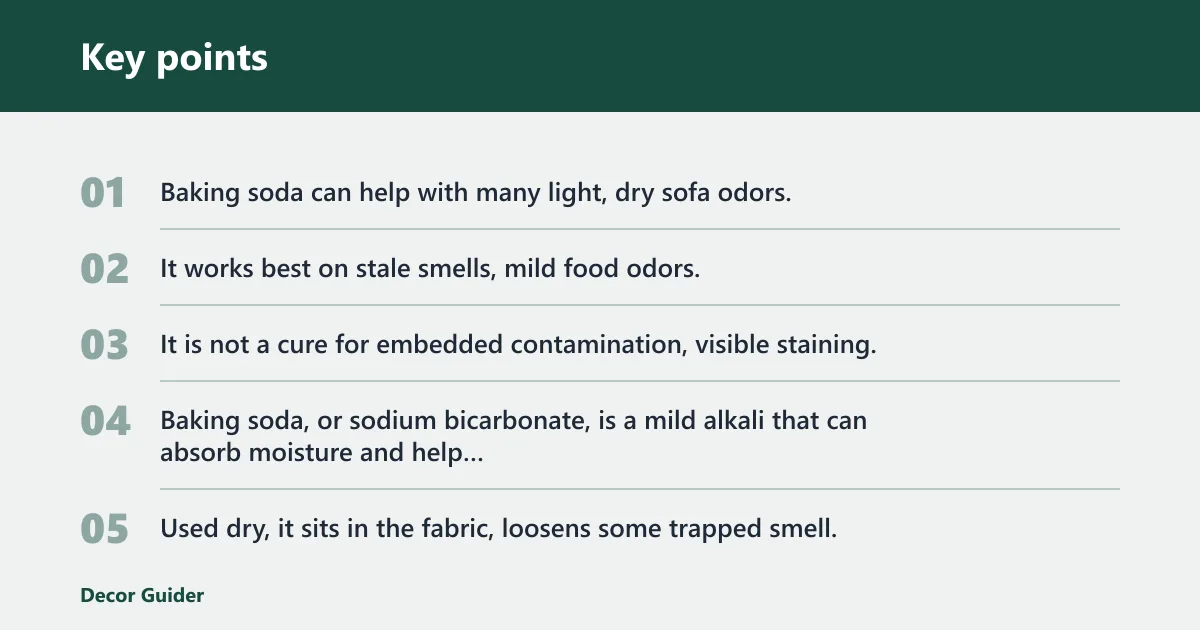

Baking soda can help with many light, dry sofa odors. It works best on stale smells, mild food odors, and other surface-level issues on fabric upholstery that matches the care label. It is not a cure for embedded contamination, visible staining, or moisture that is still active inside the sofa.
What baking soda can do
Baking soda, or sodium bicarbonate, is a mild alkali that can absorb moisture and help neutralize odor-causing substances on the surface of upholstery. Used dry, it sits in the fabric, loosens some trapped smell, and is then vacuumed away after a dwell time. (Wikipedia)
What baking soda cannot do
It does not clean deep contamination. If the odor comes from urine, mildew, smoke residue, or grease that has moved into cushions, the smell may return after the powder is removed. It also does not remove stains by itself, even if the fabric looks cleaner after vacuuming.
When odor severity changes the answer
Light odors are the best match for this method. Stronger odors may need longer dwell time or a second dry treatment, while deep or persistent smells usually need professional cleaning. If the sofa smells worse after a rainstorm, pet accident, or spill, stop treating it as a surface odor.
What you’ll need
- Baking soda
- Vacuum with upholstery attachment
- Soft-bristled upholstery brush
- Clean cloth for spot testing
How to clean couch with baking soda
Check the care label first, then apply baking soda only to fabric that can handle dry deodorizing. Family Handyman recommends waiting 20 minutes to an hour, and Ideal Home says 15-20 minutes can be enough for a light odor. Use the shortest time that fits the smell, then vacuum fully.
- Check the care label and cleaning code under the couch or cushions.
- Vacuum loose dirt and hair first with the upholstery attachment.
- Spot test a hidden area with a dry cloth and a pinch of baking soda.
- Spread a thin, even layer of baking soda over the smelly area.
- Brush it in lightly with the fabric grain, using a soft-bristled upholstery brush.
- Let it sit about 15-20 minutes for a light odor, or up to 1 hour, then vacuum it away completely.
Say your 3-seat fabric sofa has a faint pet smell on one cushion, but no stain and no damp spot. A light pass with baking soda may be enough. Suppose the same sofa has a wet ring under the cushion zipper; the smell source is active moisture, so dry powder alone is unlikely to solve it.
For stronger odors, a second treatment can help after the first vacuuming. Add another thin layer, not a thick pile, then repeat the dwell time and vacuum step. The goal is to treat the fabric, not bury it.
Is baking soda right for this sofa odor?
This table helps you decide whether to use baking soda, skip it, or move to a different cleaner. It separates odor-only problems from stain or moisture problems, which need a different approach.
| Odor type | Sofa fabric/code | Visible staining | Moisture present | Recommended DIY step | When to escalate to professional cleaning |
|---|---|---|---|---|---|
| Light stale smell | W, W/S | No | No | Vacuum, spot test, spread a thin layer, brush lightly, wait 15-20 minutes or up to 1 hour, then vacuum | If odor remains after two dry treatments |
| Pet accident odor | W or W/S only | Often yes | Yes or likely | Do not rely on baking soda alone; address the moisture source first | If the smell returns after drying or reaches the cushion interior |
| Smoke odor | W or W/S | May be hidden | No | Dry deodorizing can help at the surface; repeat only after full vacuuming | If the odor is strong, widespread, or clings to the frame |
| Mildew or musty smell | W, W/S | Sometimes | Often yes | Do not treat as a simple odor problem; dry the source first | Immediately if the smell suggests hidden dampness |
| Food grease odor | W or W/S | Often yes | No | Use baking soda only after the surface is appropriate for dry treatment | If the odor is linked to a visible grease stain |
| Unknown odor on delicate fabric | X, silk, velvet, leather | Any | Any | Stop and check manufacturer guidance | Before any powder is applied |
Which fabrics should you avoid?
Some upholstery should not get baking soda until you check the care label first. A cleaning code tells you whether the fabric can handle dry treatment, water-based cleaning, solvent-based cleaning, or only vacuuming and gentle brushing. Wirecutter says sofas should be identified by cleaning code, and the tag is often under the couch or cushions.
Leather and bonded leather
Leather can dry out, and powder can sit unevenly on the surface. Bonded leather can also react badly if it is already worn or flaking. If the tag does not clearly permit your method, skip the powder and use the manufacturer’s care instructions instead.
Silk, velvet, and other delicate fabrics
Silk and velvet may be damaged by powder, brushing, or rough vacuuming. A stiff-bristled brush can mark the pile, and residue can change the look of the nap. If the fabric is delicate, pause and confirm the safe cleaning method before any deodorizing step.
Unknown or unlabeled upholstery
If the label is missing, treat the sofa as unknown upholstery. Wirecutter advises a pre-test on a hidden area before spot remover use. That same caution applies here, because a hidden test can show color transfer, color change, or fabric damage before you treat the full seat.
Why some odors need more than baking soda
Baking soda can reduce surface odor, but it does not solve every smell source. Smoke, urine, mildew, and grease often move beyond the fabric face and into foam, seams, or the frame. Once that happens, the smell can come back after the powder is vacuumed away.
Smoke and cooking grease
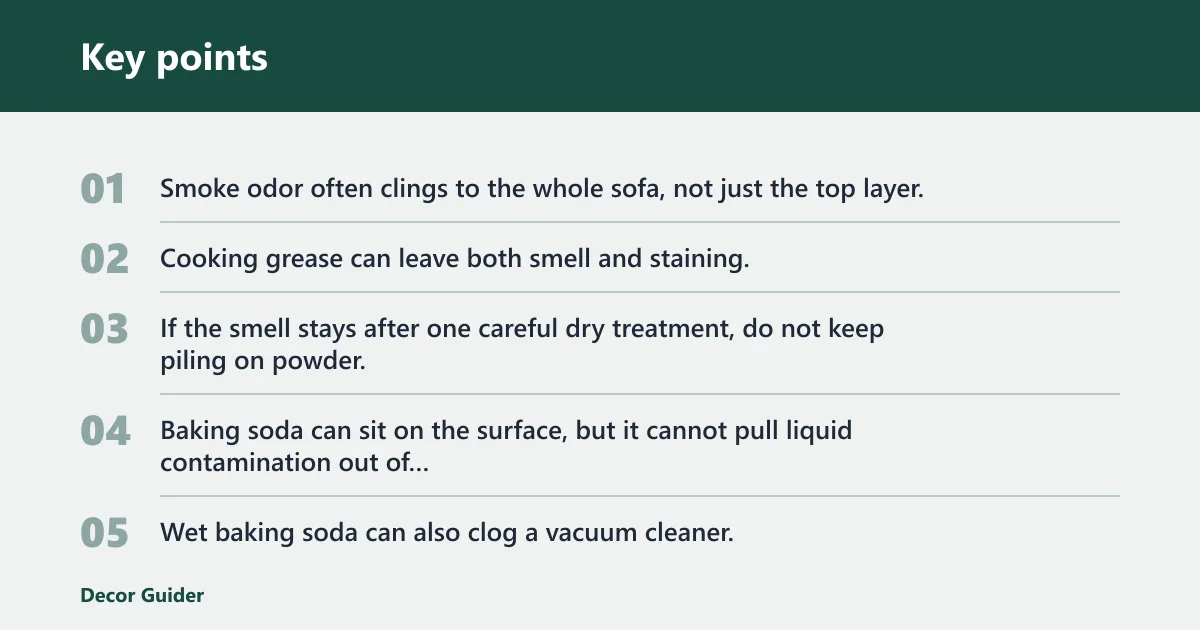
Smoke odor often clings to the whole sofa, not just the top layer. Cooking grease can leave both smell and staining, and the stain may need a different cleaner than the odor. If the smell stays after one careful dry treatment, do not keep piling on powder.
Pet urine and other moisture-related odors
Moisture changes the problem. Baking soda can sit on the surface, but it cannot pull liquid contamination out of cushions that are still damp. Wet baking soda can also clog a vacuum cleaner, so do not apply powder to fabric that is still wet.
Mildew or musty smells
Mildew points to moisture, poor drying, or hidden dampness. If the sofa still smells musty after cleaning the surface, the source may be deeper in the cushion or padding. That is a stop rule, not a cue for more powder.
Why stains often need a different cleaner
A smell can disappear while a stain stays visible, and the reverse is also true. Baking soda is a deodorizer first. If you need stain removal, use the cleaner that matches the fabric code and the type of mark, not the powder alone.
Common mistakes
Most failures come from using baking soda on the wrong problem or leaving too much behind. A thin, even layer is easier to remove and less likely to change the texture of the fabric. The powder should leave the sofa cleaner-smelling, not dusty.
- Using too much powder: thick buildup is harder to vacuum and can leave a chalky finish.
- Leaving residue behind: vacuum the fabric until no visible dust remains.
- Skipping the cleaning code: W, S, W/S, and X change what is safe.
- Treating a wet odor source too soon: dry the source first or the smell may return.
- Using a stiff brush: it can rough up fabric and change the nap.
A common first-timer mistake is trying to fix a sour cushion smell with extra powder after a pet accident. If the fabric still feels cool or damp, the better next step is to dry the source and check the care label before any further treatment.
Frequently asked questions
Does baking soda remove odor?
Yes, for light surface odors on suitable upholstery. Spread it dry, let it sit, then vacuum it away with an upholstery attachment. If the odor comes from moisture, smoke buildup, or deep contamination, baking soda may only mask the smell for a short time.
How to get smell out of sofa
Start with the care label, then vacuum the sofa and spot test a hidden area. If the fabric code allows dry treatment, apply a thin layer of baking soda, brush it in lightly, wait 15-20 minutes or longer for stronger odors, and vacuum completely.
Does baking soda eliminate odors?
It can eliminate many light odors on the surface layer, but not all odors in the sofa structure. For strong smoke, urine, or musty smells, the source is often deeper than the fabric face. In those cases, baking soda is a first step, not the full fix.
Does baking soda absorb smells?
Yes. It can absorb moisture and help neutralize odor-causing substances while it sits on dry upholstery. That effect is strongest on light, fresh odors. Once the smell has soaked into foam or padding, absorption at the surface usually is not enough.
America’s Test Kitchen — Can baking soda really remove unpleasant odors from the refrigerator or freezer?
Baking soda is commonly used as a deodorizer in closed spaces, including kitchens and sofas, because it can help reduce surface smells. The sofa version still depends on the fabric code, the odor source, and full vacuum removal. A refrigerator is a different surface, so the same method does not translate directly.
Products related to this article
Sponsored / affiliate links. As an Amazon Associate I earn from qualifying purchases. I may earn additional commission from eligible campaigns.