5 Best Sofa Cleaning Products for Pet Owners: We Compared
The best sofa cleaning products for pet owners depend on the mess and the fabric code: enzyme cleaners for urine and vomit, oxygen-based stain removers for washable covers, solvent or dry-clean only products for W/S codes, and a fabric-safe hair remover for fur. Using the wrong cleaner can set stains, leave odor behind, or damage upholstery. This guide shows which product type fits each pet mess, how to read sofa cleaning codes, and how to cut cleaning risk.
Quick comparison
| Product | Badge | Best for | Price | ||
|---|---|---|---|---|---|
 |
BISSELL Little Green Multi-Purpose Portable Carpet Cleaner,Bissell | Our pick | Portable · upholstery cleaning · multi-surface | $129.99
Price as of 31 Oct 2026
|
View |
 |
Pet Odor and Stain Eliminator – 32 oz ACTIVE Enzyme CleanerACTIVE | Pair with it | 32 oz · enzyme spray · citrus | $24.95
Price as of 31 Oct 2026
|
View |
 |
FOLEX Instant Carpet Spot Remover 32 oz – Powerful StainFOLEX | Pair with it | 32 oz · spot remover · reusable cloth | $26.99
Price as of 31 Oct 2026
|
View |
 |
Hoover CleanSlate Plus Portable Carpet + Upholstery SpotHoover | Also great | $99.99
Price as of 31 Oct 2026
|
View | |
 |
Rocco & Roxie Enzyme Stain & Odor Eliminator, 32 Fl Oz |Rocco & Roxie Supply Co. | Our pick | $23.92
Price as of 2 Nov 2026
|
View |
Start with the sofa tag, then match the cleaner to the mess. Good Housekeeping tested 11 products in its most recent round, and its top pick was the Bissell Little Green Multi-Purpose Portable Carpet and Upholstery Cleaner.
For fresh spots, a spray can be enough. For larger accidents, a portable extractor is safer than repeated soaking because it pulls out more liquid from the fabric and cushion surface.
How we chose
These picks are based on manufacturer specs, listing details, and published buyer feedback. The main filter was fabric-code compatibility, then mess type, then cleanup risk.
Only products with a clear fit for sofas made the list. That means checking whether a cleaner is meant for W, WS, S, or X care codes, plus whether it is safe for upholstery, upholstery seams, and mixed-material seating.
We also looked for clear use cases: spot spray, enzyme treatment, portable extraction, or hair removal. A product that works on carpets but gives no upholstery guidance was not treated as a sofa pick.
Sofa cleaning decision table
| Mess type | Sofa fabric code | Safest product format | What to avoid |
|---|---|---|---|
| Urine | W or WS, if the tag allows wet cleaning | Enzymatic pet stain remover for spot treatment; portable upholstery cleaner for larger accidents | Dry scrubbing first, heavy saturation, or any cleaner not listed for upholstery |
| Vomit | W or WS, if manufacturer guidance allows | Enzymatic stain-and-odor remover, then blotting; extractor for larger residue | Rubbing the spot deeper into the weave or using a product meant only for hard floors |
| Dander/hair | All codes, with method matched to the tag | Pet hair removal tool before any wet cleaning | Starting with liquid cleaner, which can turn loose hair into paste |
| Muddy paw prints | W or WS for spray-and-blot cleaning | Upholstery cleaning spray, then blot or light extraction | Over-wetting seams or using a harsh solvent on a water-safe fabric |
| Set-in odor | W or WS if the fabric tag allows a wet method | Enzymatic stain-and-odor remover first; portable extractor if the odor has soaked in | Expecting a quick spray to fix odor that has reached the cushion core |
| Microfiber | Usually S or WS, but confirm the tag | Dry-clean suitable solvent cleaner for S codes, or a label-approved spray for WS | Using a water-heavy cleaner on an S-only sofa |
| Cotton blend | Often W or WS, but confirm the label and the manufacturer listing | Upholstery spray for spots; portable cleaner for deeper messes | Skipping a spot test or letting liquid pool in seams |
| Leather | Leather care only, not fabric upholstery codes | Leather-safe cleaner with follow-up conditioning guidance | Using upholstery spray, enzyme spray, or a wet extractor on leather |
| Spray versus extractor cost | W or WS fabrics that allow wet cleaning | Spray: usually lowest cost per clean for small spots; extractor: higher upfront cost, often lower cost per clean for repeated large messes | Buying a machine for a one-time tiny stain, or using sprays for every soaked-through accident |
Enzymatic cleaner: best for pet accidents
An enzymatic pet stain remover is often the first format to check for urine, vomit, and fecal odor on upholstery that allows wet cleaning. This ACTIVE spray is made for upholstery, rugs, and furniture, and its ready-to-use format suits quick spot treatment on fresh accidents.
It stands out when the visible stain is small but the smell keeps returning. Enzyme and probiotic formulas are meant to break down organic residue, which is why they often matter more for odor than a plain fragrance cover-up.
The drawback is fit, not function. It is not the right choice for every sofa, and the label still matters: if the fabric is silk, velvet, vinyl, leather, or another restricted material, stop and follow the care tag instead of spraying first.
When this type makes sense
Use an enzymatic cleaner when the mess is fresh and the sofa tag allows wet cleaning. It is also a strong first step for older urine or vomit smells that return after the fabric dries.
Picture a couch with a small dog urine spot on a W-code cushion. A label-approved enzyme spray can target the residue without turning the whole seat into a wet zone, which keeps the cleanup focused.
What to check before you spray
Confirm the sofa code and the manufacturer’s guidance first. W and WS fabrics are the most likely to allow a liquid cleaner; S and X codes need a different approach, and leather needs leather-specific care.
For deep or recurring urine, do not drown the spot. Saturation can push liquid into the cushion core, seams, and backing, which makes odor harder to remove later.
Portable upholstery cleaner: best for deep cleanups
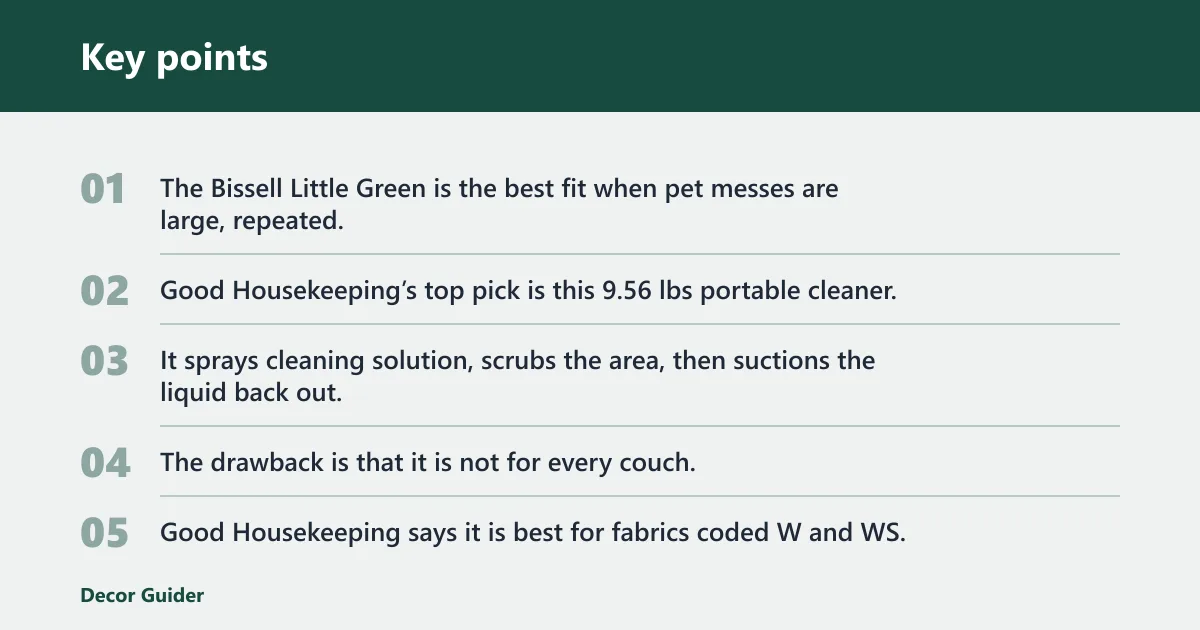
The Bissell Little Green is the best fit when pet messes are large, repeated, or soaked into more than the surface pile. Good Housekeeping’s top pick is this 9.56 lbs portable cleaner, and it works on carpet and upholstery, which makes it useful for sofas, stairs, and car interiors.
Its main advantage is wet extraction. It sprays cleaning solution, scrubs the area, then suctions the liquid back out, which is more useful than a spot spray when the stain has spread or the odor has moved deeper into the fabric.
The drawback is that it is not for every couch. Good Housekeeping says it is best for fabrics coded W and WS, so S-code and X-code sofas need a different method. You also need to control moisture carefully around cushion seams and removable inserts.
When a wet extractor is the safer choice
Use a portable upholstery cleaner when the mess is larger than a palm-sized spot, when odor keeps returning, or when a spray has already failed. It is also a practical choice for repeated accidents in the same area.
Suppose a 3-seat sofa has a urine spot that reached the edge of the cushion seam. A portable cleaner can remove more liquid than blotting alone, but only if the sofa tag allows wet cleaning and the operator avoids flooding the seam line.
How to reduce over-wetting risk
Work in short passes and stop before the fabric gets saturated. Keep the nozzle moving, focus on the marked area, and use suction to pull out as much liquid as possible.
If a cushion cover is removable, check the manufacturer’s listing and care tag before treating the insert. Some sofas allow cover cleaning but not core soaking, and the wrong method can leave the center damp for days.
Upholstery spray: best for quick spot cleaning
A spray-and-blot cleaner is the fastest answer for mud, food spots, and small pet messes on a sofa that allows wet cleaning. FOLEX Instant Carpet Spot Remover is a no-rinse spot cleaner with a reusable cloth, which makes it practical for quick cleanup without pulling out a machine.
It is most useful when the stain is local and the fabric is compatible. A spray is easier to control than a wet extractor on a small mark, and it often fits the first step of a cleaning routine before a deeper treatment.
The drawback is that it is a spot tool, not a cure-all. It is not the right answer for soaked cushions, recurring urine odor, or any sofa that needs a dry-clean only method.
Why blotting matters
Spray cleaners work best when you spray lightly, then blot. Blotting lifts residue from the fabric surface; rubbing pushes the mess deeper and can rough up the weave.
A common mistake is to soak the same spot repeatedly because a pet odor still lingers after the first treatment. That can spread the mark and leave the cushion wetter than needed.
Fabric code matching still matters
Use a spray only when the care tag and listing both support it. W and some WS fabrics are the usual fit; S-only sofas need a solvent or dry-clean method, and X-code sofas should not be cleaned with liquid products.
For microfiber, check the tag before choosing any spray. Microfiber can fall into S or WS care depending on the fiber and construction, so the code matters more than the word “microfiber” on its own.
What cleaner is safe for a couch with cats and dogs?
A safe couch cleaner in a mixed-pet home depends on the fabric code, not the pet species. For W and WS fabrics, a label-approved enzymatic spray or upholstery spot cleaner is often the safest starting point; for S-only fabrics, choose a dry-clean compatible product; for leather, use a leather-safe cleaner only.
W and WS fabrics
W and WS codes usually allow water-based or mixed-method cleaning, but they do not mean “anything goes.” Check the manufacturer listing for the exact product type, then test a hidden area before you treat the visible stain.
S-only fabrics
S-coded sofas need a solvent or dry-clean method. Do not swap in a water-heavy upholstery spray just because the stain is small, because the wrong liquid can leave rings or texture changes.
X-code sofas and dry methods
X-code means vacuum only or dry methods only. That includes pet hair removal tools, gentle brushing where approved, and dry vacuuming with the right upholstery attachment.
Leather and mixed-material seating
Leather should not be treated like fabric upholstery. Do not use enzyme spray, upholstery spray, or a portable extractor on leather unless the manufacturer explicitly allows it; leather-safe cleaner and follow-up conditioning are the safer path.
What removes pet odor from a couch?
Pet odor usually comes out best with an enzymatic cleaner first, then a deeper cleaning method if the smell remains. If the odor is light and the fabric is W or WS, a stain-and-odor remover may be enough; if it keeps coming back, the cushion or seam may need extraction or professional care.
When enzyme formulas should be first
Use an enzymatic formula for urine, vomit, and other organic pet messes. It is designed to target the residue that creates the smell, which is why a perfume-heavy spray often falls short.
When a stain-and-odor remover is enough
For tracked-in dirt, a light food spot, or a fresh surface smell, a stain-and-odor remover can be enough if the fabric code permits it. Good Housekeeping’s quick-clean pick is Woolite Instaclean Permanent Stain and Odor Remover, and it is EPA Safer Choice certified.
Its drawback is important: Good Housekeeping says it is not for silk, velvet, vinyl, or leather upholstery. That makes it a useful quick cleaner, but not a blanket answer for every sofa.
When odor points to deeper contamination
If a couch still smells after a surface clean, the residue may have reached the cushion core, padding, or underside. At that point, a portable extractor may help on W or WS fabrics, but a persistent smell can also mean the safest next step is to stop and check the furniture manufacturer’s guidance.
How do I remove pet hair before using sofa cleaner?
Remove hair first with a roller, silicone tool, or upholstery brush so it does not turn into a muddy smear when liquid hits the fabric. Hair removal is the cleanest first step on every sofa code, including leather, because loose fur can block the cleaner from reaching the stain.
Best tools for the job
A pet hair removal tool is the simplest answer for most couches. A lint roller, silicone bristle tool, or soft brush can lift embedded hair from the surface and keep the wet clean focused on the stain itself.
Where an upholstery brush helps
A soft upholstery brush loosens dirt without scraping delicate weaves. It is especially useful before spot treatment on textured fabric, where hair tends to trap fine dust and dried mud.
Why this step matters
If you skip hair removal, the cleaner can grab the fur and spread the mess. That is how a small paw-print spot becomes a larger smear around the original stain.
Which one should you buy?
Choose the product that matches the mess first, then the fabric code. For most pet owners with W or WS sofas, the best all-around pick is the Bissell Little Green if the cleaning job includes repeated accidents, larger spots, or deeper odor in upholstery.
Best choice for fresh accidents
For fresh urine, vomit, or muddy paw prints on a wet-cleanable sofa, start with an enzymatic spray or a spot cleaner. ACTIVE is the stronger choice when the mess is biological and odor is the main issue; FOLEX is the better quick-clean pick when the spot is surface-level and you want a no-rinse spray.
Best choice for recurring odor
If odor returns after spot cleaning, move to an enzymatic formula first, then use extraction on W or WS fabric if the smell has gone deeper. Rocco & Roxie is a solid option for this lane because it is a bio-enzymatic stain and odor eliminator with a clear pet-odor use case.
Best choice for large or repeated messes
For multiple accidents, soaked spots, or a sofa that needs a fuller reset, the portable cleaner is the better buy. It costs more up front, but it can be cheaper per clean than repeated spray purchases when the messes are frequent.
Best choice if you have leather and fabric in the same home
Split your supplies. Keep a leather-safe cleaner for leather seating and a fabric-specific product for upholstery. Do not use a fabric cleaner on leather just because it works on the nearby fabric chair; mixed households need separate care paths.
How to compare cost per clean
A spray cleaner usually has the lower cost per use for one small spot because you use only a little product. A portable extractor costs more to buy, but it spreads that cost across many deep cleans and larger accidents, which can make it the better long-term value for homes with frequent pet messes.
Say your dog leaves a single muddy paw print every few days. A spray-and-blot cleaner may be the cheapest route. Suppose the couch starts seeing repeated urine spots in the same seat seam; then the extractor becomes the more sensible buy because it handles larger, wetter cleanups better.
Frequently asked questions
What is the best sofa cleaning product for pet stains?
For most pet stains on W or WS upholstery, the best choice depends on size and age. Use an enzymatic cleaner for urine and vomit, a quick spot spray for mud or food, and a portable extractor for larger or repeated messes that need deeper liquid removal.
How do I clean dog pee off a fabric sofa?
First blot the area and remove any loose hair or debris. Then use a label-approved enzymatic cleaner on a W or WS fabric, or a portable upholstery cleaner if the accident is larger; avoid soaking the cushion, and stop if the tag says dry-clean only.
Can I use upholstery cleaner on a microfiber sofa with pets?
Sometimes, but only if the care tag and product listing agree. Microfiber can be W, WS, or S depending on the sofa, so check the code first; a water-based upholstery spray is not safe for every microfiber couch, especially S-only fabric.
What removes pet odor from a couch without damaging fabric?
An enzymatic cleaner is usually the first safe option for organic pet odor on a compatible fabric. If the smell remains, a stain-and-odor remover or a portable extractor may help on W or WS upholstery, but leather and X-code sofas need different care.
How to keep a fabric sofa clean with dogs
Remove hair often, use washable throws or blankets, and clean fresh spots before they dry. Machine-washable covers and blankets can reduce direct wear on the upholstery, and a quick spot cleaner is usually easier than waiting for a larger accident to set.
Products related to this article
Sponsored / affiliate links. As an Amazon Associate I earn from qualifying purchases. I may earn additional commission from eligible campaigns.
 MOROSONO Pet Odor Eliminator Spray, Enzymatic Cleaner for Dog & Cat Urine, Carpet, Furniture & Litter Box, Lavender, 16 oz
 Zorbent Pet Accident Cleanup – Odor Remover for Dog & Cat Messes. Absorbs 1 Gallon. Pet-Safe Cleaner for Urine, Vomit, Poop & Accidents on Hardwood, Tile, Vinyl, Concrete, Short Carpet & Rugs, 5 qt