Cabinet vs Cupboard: The Difference in Plain English
Use cabinet for a fixed or built-in storage unit and cupboard for a freestanding or room-integrated one; in real listings, the installation method usually decides the name. If a label is wrong, shoppers get mixed up, and renovation notes lose precision. This guide shows the cabinet vs cupboard rule for kitchens, pantries, bathrooms, and closets.
This guide is part of our Chairs guide: types, buying and care series.
Cabinet vs cupboard: the real naming rule
The shortest practical rule is simple: fixed, wall-mounted, or fitted into the room = cabinet; movable, furniture-like, or standing on its own = cupboard. That is the naming test I use in most listings, renovation notes, and search queries.
The same storage piece can take either word when it sits on the border. A kitchen dresser with visible finished sides may read as a cupboard, while a built-in pantry tower with scribed panels usually reads as a cabinet.
In plain language, a cabinet is usually a built-in furniture piece with shelves or drawers, often anchored to a wall. A cupboard is typically a freestanding furniture piece, often used for dishes, food, or linens, and sometimes described as a larger cabinet or small storage space that stands on its own.
The one-sentence rule readers can use first
If the unit is attached to the room, plumbed around fixtures, or made to disappear into the wall line, call it a cabinet. If it can be moved, has finished sides, and reads like a separate piece of furniture, call it a cupboard.
📊 Cabinets To Go offers over 270 style options. Source: Houston, TX.
What is the difference between cabinet and cupboard?
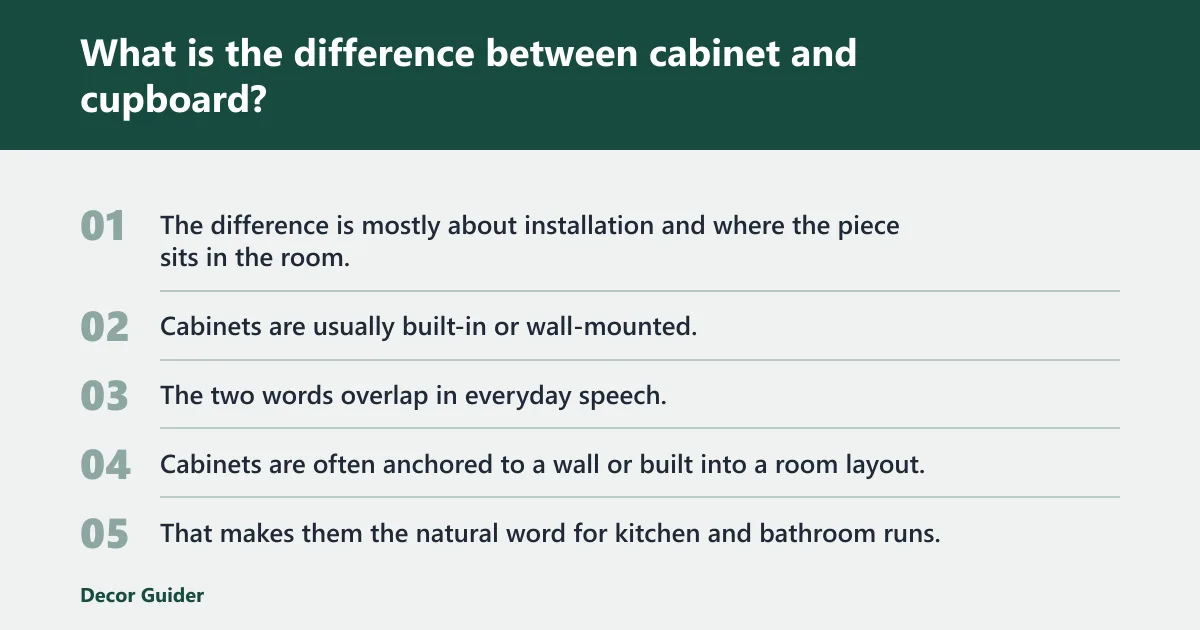
The difference is mostly about installation and where the piece sits in the room. Cabinets are usually built-in or wall-mounted, while cupboards are usually freestanding and more furniture-like. The two words overlap in everyday speech, but the layout usually decides which one fits best.
| Decision factor | Cabinet | Cupboard | Winner |
|---|---|---|---|
| Installation | Usually fixed, built-in, or anchored | Usually movable and self-supporting | Cabinet |
| Room fit | Common in kitchens and bathrooms | Common in dining rooms and living spaces | Depends on room |
| Appearance | Often integrated with counters or walls | Often finished on visible sides like furniture | Cupboard |
| Typical contents | Cookware, toiletries, or utility items | Dishes, food, linens, or mixed household storage | Tie |
Installation is the first clue
Cabinets are often anchored to a wall or built into a room layout. That makes them the natural word for kitchen and bathroom runs, where the storage has to line up with counters, plumbing, and appliances.
Furniture-like shape points to cupboard
Cupboards usually look like stand-alone furniture. They can be tall, and some extend from floor to ceiling, but they still read as separate objects rather than part of the room structure.
Contents do not decide the word by themselves
Both can hold household items. Dishes, food, towels, and linens can live in either one, so the contents matter less than whether the unit is fixed or movable.
What does cabinet mean in kitchen storage?
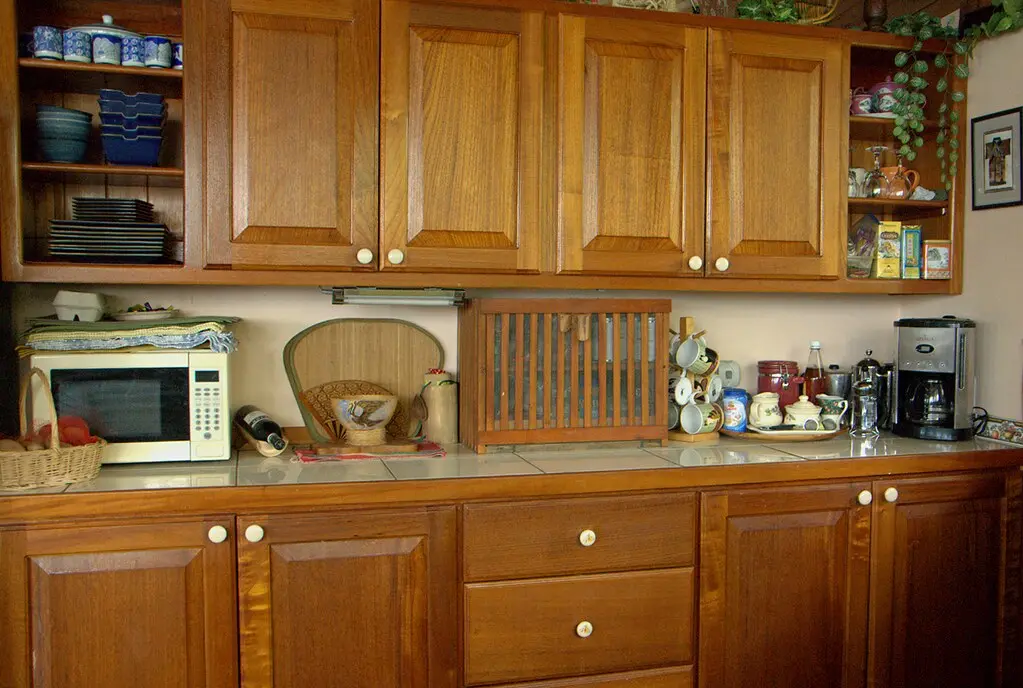
In kitchen storage, cabinet usually means the fitted units around counters and appliances. That includes base cabinets and wall cabinets, plus built-in pantry towers and corner units that are made to stay in place.
Kitchen cabinets are often the standard term because kitchens typically rely on fixed dimensions, appliance clearances, and working surfaces. A freestanding kitchen piece can still be called a cabinet if it is part of the installed layout, especially when it is tied to plumbing, counter height, or a continuous run.
Built-in storage is the kitchen default
Built-in storage is attached to the wall or room layout, often planned around plumbing and counters. That is why kitchen storage almost always leans toward cabinet language, even when the fronts are styled like furniture.
Freestanding kitchen pieces are the exception
A movable kitchen dresser, butcher-block hutch, or island with finished sides may be called a cupboard if it reads like separate furniture. If the piece is integrated into the kitchen plan, cabinet is the safer word.
What does cupboard mean in kitchen storage?
In kitchen storage, cupboard usually means a freestanding storage piece for dishes, food, or linens. It is the better word when the unit stands on its own and looks like furniture rather than part of the room shell.
That includes kitchen dressers, utility cupboards, and some pantry-style pieces that are not fixed to the wall. In older or British usage, cupboard may also cover what an American speaker would call a closet-like storage space, which is why context matters.
Why pantry language gets messy
A pantry can be a cupboard or a cabinet depending on layout. If it is a built-in food-storage run, cabinet fits better; if it is a standing larder or dresser-like piece, cupboard is the more natural word.
Proof asset: decision matrix and room-by-room examples

The easiest way to choose is to run the unit through four checks: fixed vs movable, wall-mounted vs standalone, kitchen or bathroom vs dining or living, and fitted vs furniture-like. When three of the four checks point the same direction, the name is usually clear.
| Check | Cabinet signals | Cupboard signals | How to label it |
|---|---|---|---|
| Fixed vs movable | Attached in place | Can be moved without rebuilding the room | Fixed = cabinet |
| Wall-mounted vs standalone | Hangs on or locks to the wall | Stands on its own feet or base | Wall-mounted = cabinet |
| Kitchen or bathroom vs dining or living | Common in kitchens and bathrooms | Common in dining rooms and living spaces | Kitchen/bathroom = cabinet |
| Fitted vs furniture-like | Matches the room layout | Looks like separate furniture | Fitted = cabinet |
Room-by-room examples
| Room or use | Most natural word | Why it fits |
|---|---|---|
| Kitchen | Cabinet | Usually fixed around counters and appliances |
| Pantry | Cabinet or cupboard | Depends on whether it is built in or stands alone |
| Bathroom | Cabinet | Often wall-mounted or fitted for toiletries |
| Closet or wardrobe | Closet in American usage, cupboard in some British usage | British speakers may use cupboard for an American closet |
| Dining room | Cupboard | Often a freestanding piece for dishes or linens |
| Living space | Cupboard | Usually furniture-like, not built into the wall |
How the room changes the name
Kitchen and bathroom units tend to be cabinets because the room demands fixed storage. Dining and living room pieces tend to be cupboards because they are more often moved, styled as furniture, and finished on all visible sides.
Choose cabinet if… / Choose cupboard if…
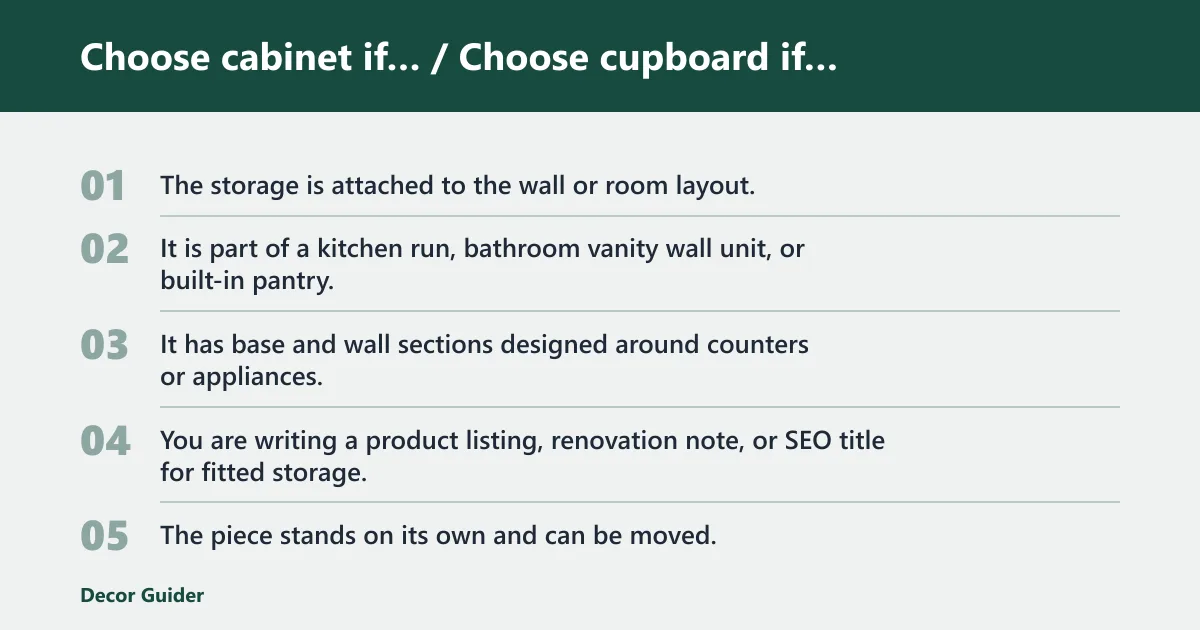
Choose cabinet if the unit is fixed, fitted, wall-mounted, or built around plumbing, counters, or appliance clearances. Choose cupboard if the unit is movable, freestanding, finished like furniture, or mainly used in dining and living spaces.
Choose cabinet if…
- The storage is attached to the wall or room layout.
- It is part of a kitchen run, bathroom vanity wall unit, or built-in pantry.
- It has base and wall sections designed around counters or appliances.
- You are writing a product listing, renovation note, or SEO title for fitted storage.
Choose cupboard if…
- The piece stands on its own and can be moved.
- It looks like furniture with finished visible sides.
- It is used for dishes, food, or linens in a dining room, pantry, or living space.
- You are describing a dresser-like kitchen piece or a British-style closet-like storage term.
Borderline cases that need the layout check
A pantry may be referred to as either a cabinet or a cupboard, depending on whether it is built in or freestanding. A fitted wardrobe behaves like a cabinet in construction, even if the word wardrobe is still the better label for clothing storage. A freestanding kitchen hutch may be called a cupboard even when it sits near the stove.
Cabinet vs cupboard in kitchen
In kitchens, cabinet is the default word for fixed storage around counters and appliances. Cupboard still appears for freestanding kitchen furniture, older dressers, and pantry-style units that stand alone rather than being built into the wall line.
Cabinet vs cupboard vs closet
A closet is usually a built-in clothes-storage space, so it sits closer to cabinet in construction than to cupboard. In American English, closet is often the normal word; in some British usage, cupboard may refer to a similar storage space.
Cabinet vs cupboard vs wardrobe
A wardrobe is a clothes-storage unit, often freestanding, and that makes it closer to cupboard when the focus is furniture shape. If it is fitted into the room, the construction can feel cabinet-like, but wardrobe remains the clearest word for clothing storage in most cases.
Cabinet vs cupboard vs pantry
Pantry is the room or storage zone, while cabinet and cupboard are the structure words. A pantry cupboard is often freestanding; a pantry cabinet is often built in. The room label does not settle the naming on its own, so the installation check still matters.
Cabinet vs closet
A cabinet is a storage unit; a closet is usually a room recess or enclosed storage area. Closet implies a larger built-in opening for clothes, while cabinet usually implies a smaller enclosed unit with doors, shelves, or drawers.
Frequently asked questions
What is the difference between cabinet and cupboard?
The difference is mainly how the unit sits in the room. Cabinets are usually fixed, built-in, or wall-mounted. Cupboards are usually freestanding and furniture-like. Both can store household items, but installation and room context usually decide which word sounds right.
What does cabinet mean in kitchen storage?
In kitchen storage, cabinet means the fitted units around counters and appliances. That includes base cabinets, wall cabinets, and built-in pantry towers. If the storage is part of the kitchen structure rather than a separate piece, cabinet is the safer term.
What does cupboard mean in kitchen storage?
In kitchen storage, cupboard usually means a freestanding piece for dishes, food, or linens. It can be a dresser, hutch, or standing pantry-style unit. If it looks like furniture and can be moved, cupboard is usually the better word.
Is a cabinet the same as a cupboard?
They overlap, but they are not the same in normal use. A cabinet usually points to built-in or wall-mounted storage, while a cupboard usually points to stand-alone furniture. Some speakers use them loosely, yet layout still gives the clearest answer.
cabinet vs cupboard vs closet
Cabinet and cupboard both describe storage units, while closet usually describes a built-in storage space for clothes. In American English, closet is the common clothes-storage word. In British English, cupboard can sometimes cover a closet-like space, which changes the comparison.
cabinet vs cupboard vs drawer
A drawer is a pull-out compartment, not the whole storage unit. A cabinet or cupboard may contain drawers, shelves, or both. If you mean the full unit, choose cabinet or cupboard; if you mean the sliding compartment inside it, drawer is the correct word.
Products related to this article
Sponsored / affiliate links. As an Amazon Associate I earn from qualifying purchases. I may earn additional commission from eligible campaigns.