Drawer Slides vs Drawer Glides: What to Choose First
For modern furniture, choose drawer slides; “glides” often means either low-friction runners or a regional synonym, so match the hardware to load, side clearance, and whether you need side-mount, under-mount, or center-mount. Pick the wrong type, and drawers bind, sag, or give out under load. This guide separates the terms and shows which option fits dressers, cabinets, desks, and retrofit jobs.
This guide is part of our Chairs guide: types, buying and care series.
In home furniture, the two terms often overlap. In older pieces, though, “glide” may mean wooden runners, nylon runners, or a simple track system rather than a telescopic metal slide. That is where many buyers get tripped up.
Drawer slides vs drawer glides: what is the real difference?


| Decision factor | Drawer Slides | Drawer Glides | Winner |
|---|---|---|---|
| Terminology clarity | Modern, specific hardware term | Often a synonym, but also used for wood or nylon runners | Drawer Slides |
| Load handling | Usually better defined by type and mounting | Often vague unless the exact mechanism is named | Drawer Slides |
| Retrofit certainty | Easier to match by mounting style and extension | Older term can hide what is actually installed | Drawer Slides |
| Older furniture repair | May require conversion work | Wood runners or older glide parts may fit original construction | Drawer Glides |
Terminology overlap in home furniture
For cabinet shops and hardware aisles, “drawer slides” is the safer search term because it points to current hardware families. “Glide” can still work in casual conversation, but it is less precise.
That precision matters during replacement. A seller may hear “glide” and assume a wooden runner, while the buyer needs a ball-bearing side-mount with soft-close.
When “glide” means wood runners, rollers, or slides
In regional use, a glide may be a plain runner under a drawer box. In older furniture, it can also mean a roller track or a low-friction strip. The material tells you a lot more than the word does.
Why terminology changes by region and age of the piece
Older dressers, office cases, and shop-built furniture often use the word differently from current catalog listings. That is why matching the existing hardware by photos, mounting position, and drawer weight matters more than relying on the label alone.
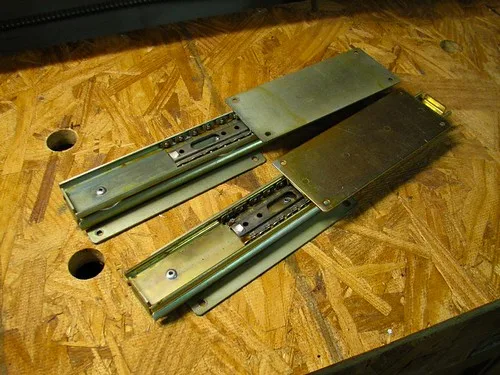
📊 Telescoping ball bearing slides can be 3-section slides. Source: Drawer.
Side-by-side comparison of slide types and guide types
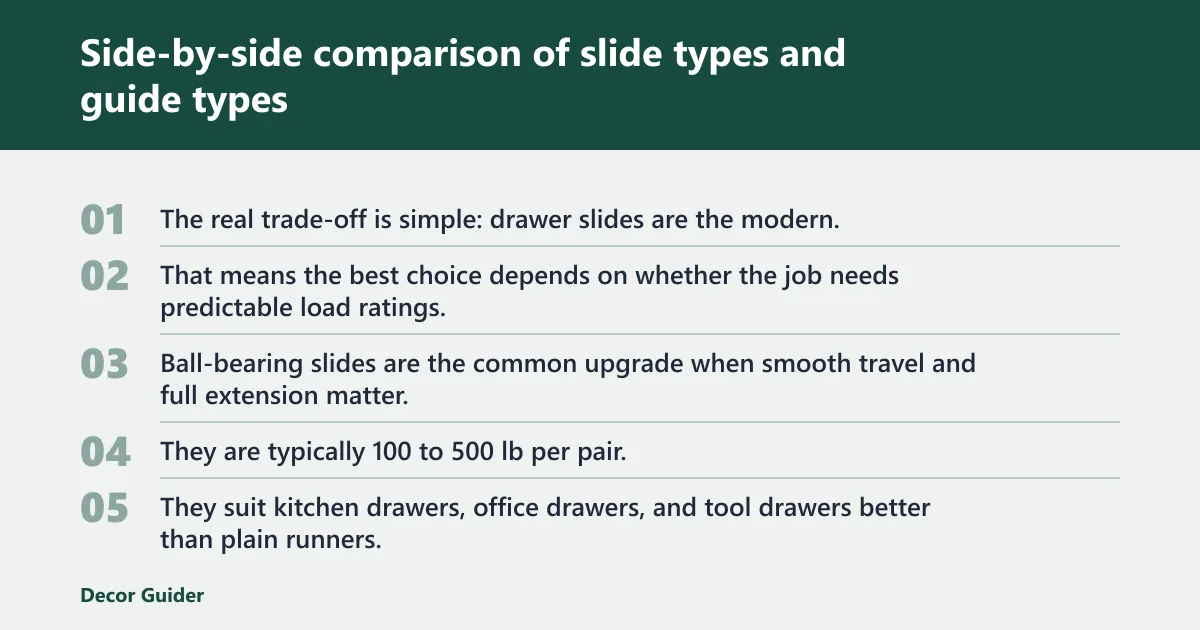
The real trade-off is simple: drawer slides are the modern, defined hardware family for most furniture jobs, while “glide” can mean older runners or a looser regional term. That means the best choice depends on whether the job needs predictable load ratings, full extension, and easier replacement, or a simple runner for a light drawer.
Ball-bearing slides
Ball-bearing slides are the common upgrade when smooth travel and full extension matter. They are typically 100 to 500 lb per pair, and the bearing action helps the drawer move evenly when the load is centered.
They suit kitchen drawers, office drawers, and tool drawers better than plain runners. They also come in side-mounted or concealed forms, which makes them versatile for new builds and replacements.
Roller slides
Roller slides are simpler and lower cost. They are typically under 100 lb per pair, so they fit lighter drawers, small dressers, and budget office pieces better than heavy kitchen storage.
They are less forgiving when the box is wide, loaded unevenly, or installed out of square. If the drawer starts to rack, the rollers usually complain early.
Under-mounted slides
Under-mounted slides hide under the drawer bottom, so the hardware stays out of sight when the drawer opens. That clean look comes with tighter fit requirements and usually higher cost than side-mount hardware.
Soft-close is common here. For furniture where appearance matters and the cabinet has enough clearance, under-mount is often worth the extra planning.
Linear guides
Linear guides are not the same thing as ordinary furniture slides. They use a rail-and-carriage system, carry heavy loads, and resist side, moment, and axial forces.
They belong in precision motion jobs, jigs, machinery, and equipment where the drawer idea is almost secondary. A guide rail must equal or exceed full travel, which makes it a different design problem from a compact telescoping slide.
Which hardware works best for your drawer load and size?
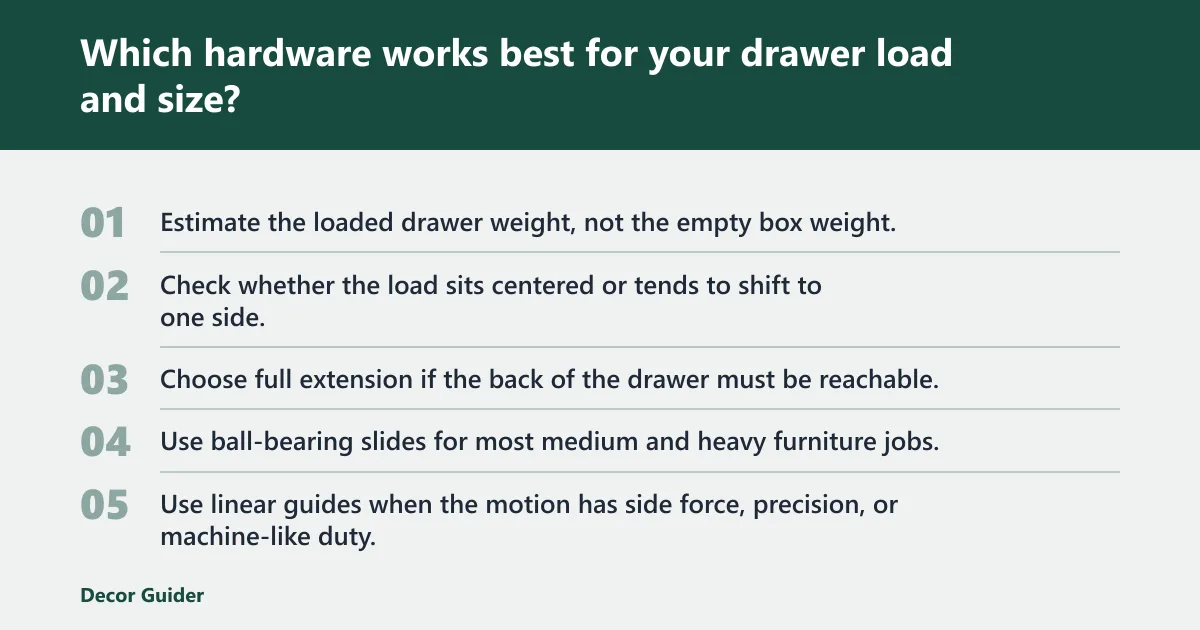
Load rating is the first filter, but drawer width and extension matter too. A light drawer that is very wide can still bind, and a heavy drawer with poor support can sag even if the catalog rating looks generous.
| Drawer weight and size | Mounting location | Extension need | Safest hardware type |
|---|---|---|---|
| Light drawer, narrow box | Center or side | Partial extension acceptable | Roller slide or basic side-mount slide |
| Moderate load, average width | Side-mounted or under-mounted | Full access needed | Ball-bearing telescoping slide |
| Heavy drawer, wide box, dense contents | Side-mounted or under-mounted | Full extension needed | Ball-bearing full-extension slide |
| Very heavy, side-load-heavy, or precision motion | Rail-mounted system | Travel must match full motion | Linear guide |
Load capacity in pounds per pair
Use the rating as a starting point, not the finish line. Roller slides are typically under 100 lb per pair, ball-bearing slides are typically 100 to 500 lb per pair, and heavy-duty industrial slides can exceed 500 lb per pair.
Furniture slides are rated mainly for centered loads perpendicular to the mounting. If the drawer carries a lot of side load from uneven packing or repeated leaning, the practical capacity drops fast.
Drawer width, extension, and side load
Wide drawers pull harder on the hardware when they are loaded off-center. That is why a shallow file drawer and a deep utensil drawer may need different slide families even if their weights look similar.
Extension matters too. Telescoping channel slides allow full extension during normal use, and telescoping ball bearing slides can be 3-section slides. That extra travel helps when the user needs access to the back of the drawer.
Decision rule for buying
- Estimate the loaded drawer weight, not the empty box weight.
- Check whether the load sits centered or tends to shift to one side.
- Choose full extension if the back of the drawer must be reachable.
- Use ball-bearing slides for most medium and heavy furniture jobs.
- Use linear guides when the motion has side force, precision, or machine-like duty.
Mounting styles: side-mounted, center-mounted, or under-mounted?
Mounting style changes clearance, access, and strength. Side-mounted slides are the easiest to understand and replace, under-mounted slides hide better, and center-mounted slides are usually lighter duty.
Side-mounted slides
Drawer slides can be side-mounted and visible when opened. That visible hardware is often a good trade when you want simple installation, easy replacement, and clear inspection later.
Side-mount also handles a broad mix of cabinet and furniture jobs. It is often the best first choice for retrofit work because the geometry is straightforward.
Under-mounted slides
Concealed slides are mounted under the drawer bottom. They are preferred when the builder wants a cleaner look and is willing to spend more time on fit and setup.
The drawer and cabinet clearances must be right. If the box dimensions drift, the slide can bind or fail to close fully.
Center-mounted slides
Center-mounted slides are usually limited to lighter loads. They can work on small drawers, but they are not the first pick for wide or dense storage.
Because one center rail carries the task, any twist in the drawer box shows up quickly as drag or wobble.
When should you use linear guides instead of drawer slides?
Use linear guides when the job needs more than drawer motion. They are better when the load pushes from the side, the motion must stay highly controlled, or the assembly must carry radial, axial, and moment loads that ordinary furniture slides are not meant to handle.
Rail-and-carriage motion versus drawer motion
A drawer slide is built around compact telescoping motion in a cabinet. A linear guide uses a carriage on a rail, and the rail length must equal or exceed full travel.
That requirement makes linear guides less forgiving in tight furniture cavities. They are powerful, but they ask for more design space.
Where precision or side load matters more than furniture convenience
Use a linear guide for shop equipment, moving fixtures, or mechanical assemblies that see twisting force or uneven push. For a kitchen drawer, the extra stiffness is usually unnecessary.
If the drawer is meant for storage and daily hand use, a furniture slide is simpler and cheaper to install and replace.
Choose Drawer Slides if… / Choose Drawer Glides if…
Drawer slides are the better pick for most modern cabinets, dressers, desks, and shop-built storage. Drawer glides make sense when you are repairing older furniture, replacing wood runners, or matching a regional term that already refers to simple glide hardware.
Choose Drawer Slides if…
Choose drawer slides if the drawer is heavy, needs full extension, or must close smoothly under repeat use. They are also the safer choice for kitchen cabinets, office storage, and retrofits where you need defined mounting style and load rating.
Choose Drawer Glides if…
Choose drawer glides if the piece is old, uses wood or nylon runners, or already has a glide-style system that should be repaired in kind. They also fit simple, light-duty drawers where exact slide specifications are less important than a clean, workable replacement.
Can I use drawer slides for kitchen cabinets or dressers?
Yes. Drawer slides are standard for kitchen cabinets and dressers because they handle repeat use, predictable loads, and a range of mounting styles. For kitchens, full-extension and soft-close are especially useful because they make deep storage easier to access.
Dressers often accept side-mounted or under-mounted slides, depending on clearance and the look the builder wants. If the drawer is wide or heavily loaded, ball-bearing hardware is usually the better starting point.
How do I choose the right drawer hardware for full extension?
Pick telescoping drawer slides when you need the drawer to open all the way and expose the back of the box. Telescoping channel slides allow full extension during normal use, and 3-section versions can give more reach without requiring huge cabinet depth.
Match the slide length to the drawer and cabinet depth, then check the mounting clearances before buying. If the drawer must travel farther than ordinary furniture slides allow, linear guides may be the better mechanical fit.
Failure modes to check before you buy
Most slide failures are not mysterious. They come from the wrong load class, bad alignment, or a mounting style that cannot handle how the drawer is used.
Racking and drawer bind
Racking happens when one side of the drawer leads the other. The drawer then drags, sticks, or scrapes the cabinet opening, especially on wide drawers or light center-mounted hardware.
If the slide type is too light for the box width, the drawer can bind even before it reaches full extension.
Sag from weak mounting or overload
A slide can sag when the mounting screws are weak, the panel is thin, or the load is simply too high for the pair. That sag changes the running line and creates more friction with every open and close.
Under-mounted and center-mounted styles are more sensitive to this problem because the support path is less forgiving than a solid side-mount layout.
Premature wear from poor alignment or side load
Side loads are a common cause of early wear. Furniture slides are generally designed for centered loads, so leaning, twisting, or slamming a heavy drawer can shorten their life.
Rollers usually show this first as rough travel. Ball-bearing slides may still move, but the motion becomes noisy or uneven.
Frequently asked questions
What is the difference between drawer slides and drawer glides?
Drawer slides are the modern hardware family used to make drawers move in and out with controlled motion. Drawer glides is a looser term that may mean the same thing, or it may point to wood runners, nylon runners, or older hardware depending on the region and the age of the piece.
Are drawer glides the same as drawer slides?
Sometimes yes, sometimes no. In home-furniture language they are often used as synonyms, but a glide can also mean a plain runner or a simple older track system. The safest move is to identify the mounting position and motion type before ordering replacement parts.
Which is better for heavy drawers: slides or glides?
Drawer slides are usually better for heavy drawers because the ratings are clearer and the hardware families are broader. Ball-bearing slides handle much more load than roller slides, and heavy-duty industrial versions can exceed 500 lb per pair. Plain glides or runners are usually for lighter duty.
Do drawer slides and glides use the same mounting styles?
They can, but not always in the same way. Modern slides commonly come as side-mounted, under-mounted, or center-mounted hardware, while “glide” may describe older wood runners or simple tracks that do not follow the same mounting system. Match the part to the actual cabinet geometry.
How do I choose the right drawer hardware for full extension?
Choose telescoping slides when full access to the drawer interior matters. Telescoping channel slides allow full extension during normal use, and some ball-bearing versions use 3-section construction for extra travel. Check drawer depth, side clearance, and whether soft-close is needed before buying.
When should I use linear guides instead of drawer slides?
Use linear guides when the load is not behaving like a normal drawer. If the motion needs to resist side, moment, or axial forces, or if precision is more important than cabinet convenience, a rail-and-carriage guide is the better tool. For ordinary furniture storage, drawer slides are simpler.
Products related to this article
Sponsored / affiliate links. As an Amazon Associate I earn from qualifying purchases. I may earn additional commission from eligible campaigns.