Drawer Slide Size Chart: How to Match Slides to Your Drawer Box
You bought a 22-inch slide for your 24-inch cabinet, and now the drawer binds halfway out. Or you ordered a 16-inch slide for a 14-inch drawer box, and the whole thing rattles. Most sizing problems don’t come from bad hardware; they come from measuring the wrong part of the cabinet.
This guide walks you through the sizing process like a decision tree. You’ll measure the drawer box first, not the cabinet. That one step eliminates the most common error in every other guide I’ve read. You’ll also learn the clearance rules for side mount and undermount slides, how to handle thick drawer faces, and what to do when your drawer is a weird depth.

baidice
BAIDICE 1 Pair Full Extension Drawer Slides…
- 【Heavy Duty 100 lb Capacity】 BAIDICE full extension drawer slides are built with 1.0mm cold-rolled steel and dual industrial-grade…
- 【Full Extension & Detachable Design】 The 3-section foldable structure allows drawers to open completely for easy access to every c…
- 【Installation Note】 Color: Black; Qty: 1 pair. Length: 10"(254mm), full extension lengths: 20"(508mm), suitable for drawers with i…
As an Amazon Associate I earn from qualifying purchases.
If you’re replacing old slides, a solid pair of cabinet drawer slides makes the job easier. The BAIDICE 10-inch full extension slides come with a detachable buckle and a rubber crash pad, which helps when you’re working alone. They’re rated for 100 pounds, so they handle most kitchen and workshop drawers without issue.
The Golden Rule of Drawer Slide Length
The slide length must match the drawer box depth, not the cabinet depth. The drawer box is the wooden or metal structure that slides in and out. The cabinet is the frame around it. Most people measure the cabinet opening, then order slides that are too long.
Here’s the rule: measure the left-to-right depth of the drawer box from the front face to the back panel. That number, rounded down to the nearest standard size, is your slide length.
Standard slide lengths come in 2-inch increments: 10, 12, 14, 16, 18, 20, 22, and 24 inches. If your drawer box measures 17.5 inches deep, you buy 16-inch slides. If it measures 18.25 inches, you buy 18-inch slides. Always round down, never up.
Why round down? A slide that’s slightly shorter than the box still works fine. A slide that’s longer than the box won’t fit, because the slide needs to attach to the back panel of the drawer. If the slide is too long, it sticks out past the box and hits the back of the cabinet.
Measuring Your Drawer Box (Not the Cabinet)
Grab a tape measure and pull the drawer all the way out. Set it on a flat surface. Measure the depth of the box from the outside of the front panel to the outside of the back panel. Do not include the drawer face if it’s a separate piece attached with screws.
Write down that number. Now measure the width of the drawer box from side to side. This matters for clearance, which we’ll cover in a moment. Finally, measure the height of the drawer box sides. That tells you how much vertical space you have for the slide mechanism.
Here’s a pro tip from years of installing these: measure twice, order once. A drawer box that’s 19.75 inches deep takes 18-inch slides, not 20-inch. The extra 1.75 inches of slide would hit the back of the cabinet when the drawer closes, and you’ll hear it grinding every time.
For a more detailed walkthrough of the full measuring process, check this drawer size guide.
Standard Slide Lengths by Cabinet Depth
Cabinet depths are standardized in most residential construction. Base cabinets are typically 24 inches deep. Upper cabinets run 12 to 18 inches deep. Pantry cabinets go 12 to 24 inches. Your drawer box will always be a few inches shorter than the cabinet, because you need space for the cabinet face frame and the drawer face.
18-Inch, 21-Inch, and 24-Inch Base Cabinets
Here’s the quick reference for common cabinet depths:
- 24-inch cabinet: Drawer box is usually 20 to 22 inches deep. Use 20-inch or 22-inch slides.
- 21-inch cabinet: Drawer box is usually 17 to 19 inches deep. Use 16-inch or 18-inch slides.
- 18-inch cabinet: Drawer box is usually 14 to 16 inches deep. Use 14-inch or 16-inch slides.
Measure the actual box, though. Cabinet manufacturers vary, and a 24-inch cabinet from one brand might yield a 21-inch drawer box while another yields a 19-inch box. Trust the tape measure, not the label.
For non-standard drawers, the logic stays the same. A deep pantry pull with a 30-inch box takes 28-inch or 30-inch slides, if you can find them. A shallow spice rack with a 9-inch box takes 8-inch slides. Heavy-duty tool chests with 28-inch boxes take 26-inch slides with a higher weight rating. The rule never changes: slide length equals box depth, rounded down.
Side Mount vs. Undermount: Clearance and Sizing Differences
Side mount slides attach to the sides of the drawer box and the inside of the cabinet. Undermount slides attach underneath the drawer box, hidden from view. They have different clearance requirements, and getting these wrong causes drawers that wobble or rub.
Side Clearance for Side-Mount (1/2″ Rule)
Side mount slides need 1/2 inch of horizontal clearance on each side of the drawer box. That means the drawer box must be 1 inch narrower than the cabinet opening. If the opening is 14 inches wide, the drawer box should be 13 inches wide, leaving 1/2 inch on each side for the slide.
This rule breaks when your drawer face is thicker than standard. A shaker face with a 3/4-inch thick frame sits proud of the box. That extra thickness takes up space inside the opening. You’ll need to reduce the box width by the difference, or the face will rub against the cabinet frame.
Slab faces are usually 3/4 inch thick too, but they don’t have a frame that extends past the box. Measure the actual face thickness and subtract it from the opening width before calculating box width. This is a subtle detail that most sizing charts skip.
Undermount Sizing and Bottom Recess
Undermount slides need 1 inch of clearance total, not per side. The drawer box sits 1/2 inch above the slide mechanism. You also need a recess in the bottom of the drawer box, typically 5/8 inch deep, so the slide brackets can tuck underneath.
Undermount slides are more forgiving on width, but they’re strict on bottom clearance. If your drawer box bottom is too thick, the slide won’t engage properly. Most undermount slides require a 1/4-inch to 1/2-inch bottom recess. Check the manufacturer’s spec sheet before you build the box.
If you’re switching from side mount to undermount, you’ll likely need to rebuild the drawer box. The clearance and recess requirements are different enough that retrofitting rarely works cleanly.

Full Extension vs. 3/4 Extension: Which Length Do You Need?
Full extension slides let the drawer pull all the way out, giving you access to the entire box. 3/4 extension slides stop short, leaving the back quarter of the drawer hidden inside the cabinet. The slide length measurement stays the same, but the travel distance differs.
For a 20-inch slide, full extension gives you 20 inches of travel. 3/4 extension gives you 15 inches. If you’re storing deep pots or heavy tools, full extension is worth the extra cost. If you’re building a shallow spice rack or a jewelry tray, 3/4 extension saves money and still works fine.
The trade-off is price and strength. Full extension slides cost more and have more moving parts, so they’re slightly less durable under extreme loads. 3/4 extension slides are simpler and often rated for heavier weights at the same length. For most residential use, full extension is the better choice because access matters more than the small weight difference.
Weight Rating and Duty Cycle (Light, Medium, Heavy)
Weight rating tells you how much load the slide can carry. Light duty slides handle 30 to 50 pounds. Medium duty handles 50 to 100 pounds. Heavy duty handles 100 to 200 pounds or more. The rating applies to the pair, not the single slide.
Match the rating to the drawer’s actual use. A kitchen utensil drawer needs light duty. A drawer full of cast iron pans needs heavy duty. A file drawer with hanging folders needs medium duty. Don’t guess; weigh a few items if you’re close to the limit.
The BAIDICE slides mentioned earlier are rated for 100 pounds per pair, which puts them in the medium-to-heavy range. That’s enough for most kitchen drawers, bathroom vanities, and workshop storage. For a tool chest with a 200-pound load, you’d need a dedicated heavy-duty slide.
One honest caveat: the weight rating assumes the slides are mounted level and the drawer box is square. A twisted box puts uneven stress on the slides, and they’ll fail well below the rated weight. Check the box with a square before you mount anything.
Common Sizing Mistakes and How to Fix Them
Here are the three mistakes I see most often, plus the fix for each.
- Buying slides too long for the box. This causes binding, because the slide extends past the back panel and hits the cabinet. Fix: measure the box depth, round down to the nearest standard size, and order that length.
- Ignoring side clearance. A drawer box that’s too wide for the opening will rub on the cabinet frame. Fix: subtract 1 inch from the opening width for side mount slides, then build or adjust the box to that width.
- Forgetting the drawer face thickness. A thick shaker face eats into the opening space. Fix: measure the face thickness and reduce the box width accordingly, or use a thinner face.
Another mistake that’s less obvious: mounting the slides at the wrong height. The slides need to be parallel to each other and level. Use a spacer block to set the height on both sides. A 1/16-inch difference front to back will make the drawer bind.
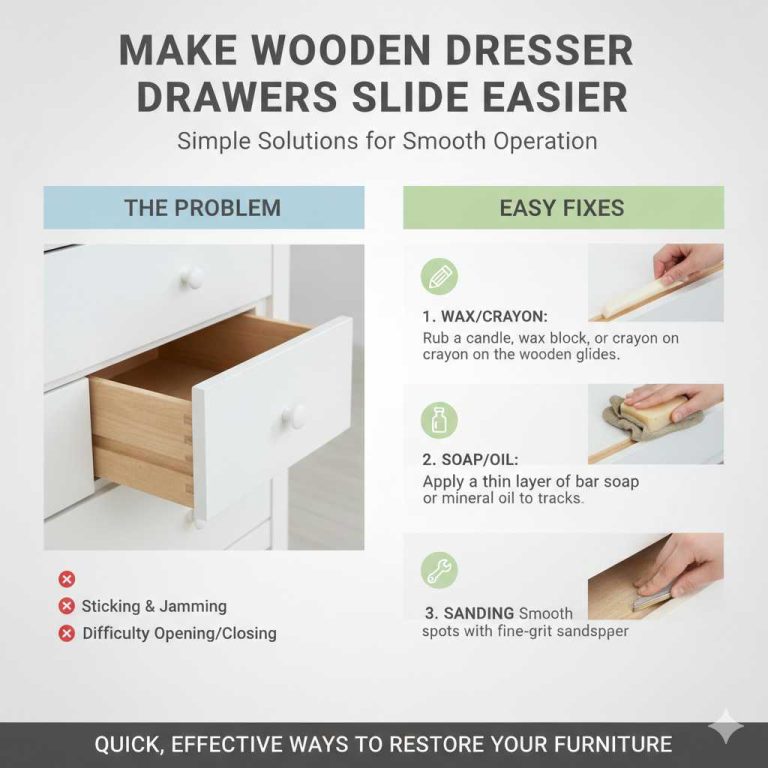
If you’re dealing with sticky or misaligned drawers, a quick fix is often simpler than replacing slides. See this wooden drawer slide fix for common adjustments.
Quick-Reference Sizing Chart
| Cabinet Depth | Typical Drawer Box Depth | Recommended Slide Length | Slide Type |
|---|---|---|---|
| 18 inches | 14 – 16 inches | 14″ or 16″ | Side mount or undermount |
| 21 inches | 17 – 19 inches | 16″ or 18″ | Side mount or undermount |
| 24 inches | 20 – 22 inches | 20″ or 22″ | Side mount or undermount |
| 30 inches (pantry) | 26 – 28 inches | 26″ or 28″ | Heavy duty side mount |
| 12 inches (upper) | 9 – 10 inches | 8″ or 10″ | Light duty side mount |
This chart assumes a standard 3/4-inch drawer face. Adjust the box depth if your face is thicker or thinner. The slide length always tracks the box, not the cabinet.
Frequently Asked Questions
Can slides be shorter than the drawer?
Yes, but only by a little. The slide needs to attach to the back panel of the drawer box, so it must be at least 1 inch shorter than the box depth. A 16-inch slide on a 17-inch box works fine. A 16-inch slide on a 20-inch box will leave the back unsupported and the drawer will sag under load.
What size for a 24-inch deep cabinet?
Measure the drawer box first. Most 24-inch cabinets have boxes that are 20 to 22 inches deep, so you’ll likely need 20-inch or 22-inch slides. If the box measures 21.5 inches, round down to 20-inch slides. If it measures 22 inches even, use 22-inch slides.
What’s the difference between side mount and undermount clearance?
Side mount slides need 1/2 inch of clearance per side, so the box is 1 inch narrower than the opening. Undermount slides need 1 inch total, but they also require a bottom recess in the box. Side mount is easier to retrofit; undermount looks cleaner but requires a specific box design.
Do I need full extension or 3/4 extension?
Full extension gives you complete access to the drawer, which is worth it for deep drawers and heavy items. 3/4 extension is cheaper and slightly more durable, but you lose access to the back quarter of the drawer. Choose based on what you’re storing, not the price difference.
How do I measure for replacement slides?
Pull the drawer out and measure the box depth, width, and height. Then measure the cabinet opening width. Subtract the clearance requirement (1 inch for side mount) from the opening width to confirm the box fits. Order the slide length that matches the box depth, rounded down.
Final Checklist Before You Buy
- Measure the drawer box depth from front to back, not the cabinet.
- Round the box depth down to the nearest standard slide length.
- Confirm the box width leaves 1/2 inch per side for side mount slides.
- Check the drawer face thickness; adjust box width if it’s thicker than 3/4 inch.
- Match the weight rating to the drawer’s heaviest expected load.
- Decide between full extension and 3/4 extension based on access needs.
- Verify the slide length is at least 1 inch shorter than the box depth.
That’s the whole process. Measure the box, round down, check the clearance, and you’ll get the right slides the first time. If you’re still unsure, grab a tape measure and re-check the box depth. It’s the one number that never lies.
Products related to this article
Sponsored / affiliate links. As an Amazon Associate I earn from qualifying purchases. I may earn additional commission from eligible campaigns.