Best Recliner for Small Living Rooms: based on specs and reviews
A wall-hugger or zero-wall recliner about 28–32 inches wide, with roughly 3–6 inches of rear clearance, should still leave around 30–36 inches of walkway space. Pick the wrong one and it pinches door swings, squeezes out side tables, and makes the room read smaller than it is. This guide shows how to measure clearances, compare placement types, and pick a recliner that fits your layout.
This guide is part of our Chairs guide: types, buying and care series.
Quick comparison
| Product | Badge | Best for | Price | ||
|---|---|---|---|---|---|
 |
PELUMY Manual Recliner Chair, 360° Swivel Glider and RockerPELUMY | Budget pick | PELUMY swivel glider with 155° manual recline | $168.99
Price as of 27 Sep 2026
|
View |
 |
Korser Recliner Chair, Wall Hugger Recliners for RV withKorser | Upgrade pick | Korser wall hugger with massage and heating | $279.99
Price as of 27 Sep 2026
|
View |
 |
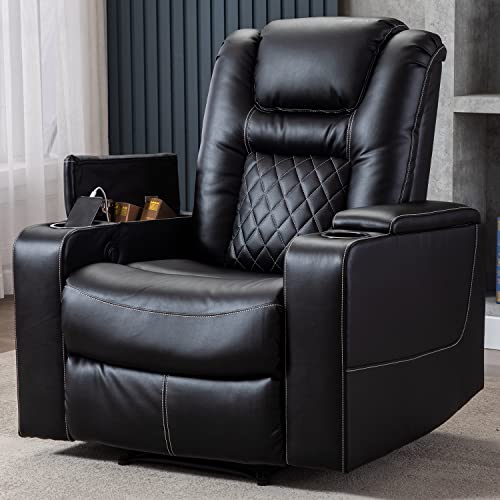
EONIX Dual Motor Zero Clearance Wall Hugger Power ReclinerEONIX | Our pick | EONIX zero-clearance wall hugger with dual motors | $549.99
Price as of 27 Sep 2026
|
View |
 |
CANMOV Electric Power Recliner Chair with USB Ports and CupCANMOV | Also great | CANMOV electric recliner with USB and cup holders | $289.99
Price as of 27 Sep 2026
|
View |
 |
HULALA HOME Printed Fabric Manual Set of 2 Swivel GliderHULALA HOME | Pair with it | HULALA HOME set of 2 floral swivel gliders | $939.99
Price as of 27 Sep 2026
|
View |
Use the table as a fit filter, not a comfort ranking. The right chair is the one whose depth and recline path stay inside your walking lanes and door swings.
When two options fit the room, I choose the one that keeps the path around the coffee table clean and causes the fewest clashes with walls, outlets, or windows.
How we chose
The winners here were compared on five things: overall width, depth at rest, depth when reclined, clearance needed behind the chair, and how much the mechanism affects traffic flow.
Comfort mattered too, but only after fit. I weighed seat depth, seat width, support, weight capacity, and upholstery against the room-use problems that show up in small apartments and tight living rooms.
Room practicality also counted. That means base style, cord management, wall contact, shipping access through narrow doors, and whether the chair still works when it is the only seat in the room.

Wall-hugger recliner: best for tight wall placement
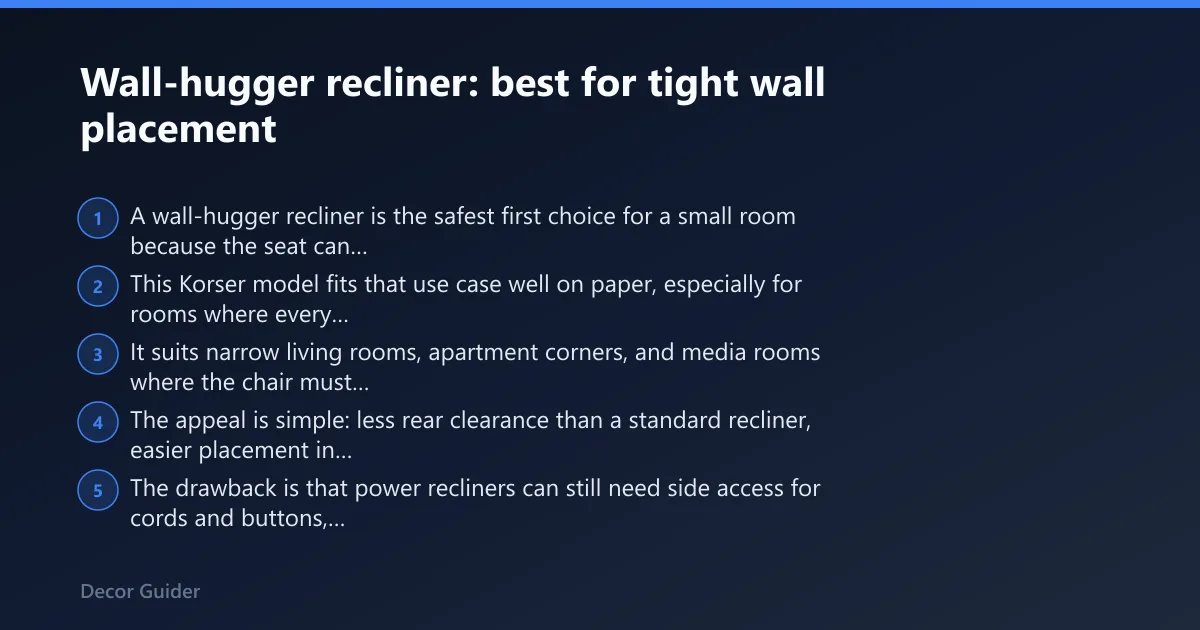
A wall-hugger recliner is the safest first choice for a small room because the seat can move forward as it reclines, so the back stays close to the wall. This Korser model fits that use case well on paper, especially for rooms where every inch behind the chair matters.
It suits narrow living rooms, apartment corners, and media rooms where the chair must sit near a wall or baseboard. The appeal is simple: less rear clearance than a standard recliner, easier placement in front of windows only if the sill is high enough, and a power control that avoids the extra shove needed by some manual designs.
The drawback is that power recliners can still need side access for cords and buttons, and massage or heat features add complexity without solving layout problems. On a small floor plan, the mechanism is only useful if the chair still leaves a clean walking path and does not crowd the coffee table.
Minimum clearance expectations
For a wall-hugger, 3–6 inches behind the back is usually the practical starting point, though the exact number depends on the mechanism and the thickness of the back cushion. Many standard recliners need far more space, often 12–18 inches or more, which is why wall-huggers fit small rooms better.
That reduced rear clearance is not a free pass. The seat still extends forward when open, so the fully reclined depth must stay clear of tables, radiators, and passing legs.
Best placement and common mistakes
Wall placement is usually the best match, but the chair should not press hard against baseboards or window trim. A common mistake is measuring only the wall gap and forgetting the reclined footrest path.
Another miss is parking the chair too close to a doorway. If the recliner edge cuts into the swing path, the room will feel tight even when the chair technically fits.
Swivel recliner: best for awkward layouts
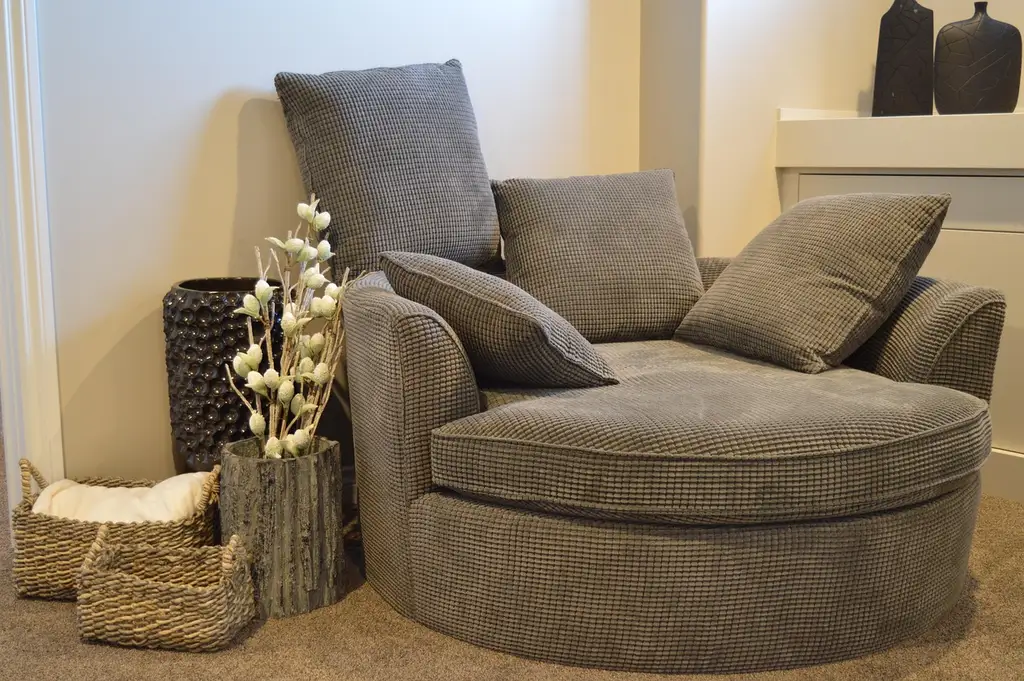
A swivel recliner works well when the room does more than one job, because the 360-degree base can turn toward the sofa, TV, or conversation area without moving the chair itself. This PELUMY model suits compact rooms where a fixed chair would face the wrong direction half the time.
It is a good fit for irregular layouts, diagonal corners, and shared spaces that need one seat to serve several zones. The drawback is that swivel models still need floor room for the base diameter, and the turning motion can feel wasted if the chair sits in a tight lane with no room to rotate.
Swivel chairs also ask more from upholstery. Performance fabric is easier to live with in a multi-use room, while leather or faux leather may feel hotter during long sits and can show wear at the edges where the body turns in and out.
Footprint and turn radius
The important number is not just the width of the seat. The swivel base needs enough open floor around it for a full rotation without hitting a coffee table, plant stand, or another chair.
In practice, this means the chair may fit by width but still fail by turn radius. That is common in small rooms with tight furniture rings.
When swivel works better than a fixed base
Swivel is usually the better choice when the chair must serve as both reading seat and TV seat, or when the room has no single obvious viewing direction. It also helps when the layout changes often for guests or a crib, desk, or pet bed.
If the chair will live in one corner and face one direction all year, a fixed wall-hugger usually wastes less floor space.
Push-back recliner: best for a clean look in compact rooms
A push-back recliner reclines when the sitter leans back and shifts body weight into the backrest, so there is no external lever to catch the eye. The HULALA HOME set is built around that idea, which keeps the profile cleaner for a room that needs the chair to read more like furniture than mechanism.
This style works best in compact layouts where visual bulk matters as much as physical size. The drawback is that push-back models usually need a little more open space behind the chair than many people expect, and the mechanism depends on body movement, so it is less forgiving for users who want exact-position control.
For small living rooms, a push-back chair is strongest in floating layouts and paired seating, where the chair can sit a bit off the wall and still keep the room balanced.
Clearance needs and seat depth
Push-back recliners usually want more rear room than a wall-hugger because the backrest tilts as the body presses into it. Seat depth matters here: too shallow and the chair feels perched; too deep and shorter users lose support behind the knees.
A useful target for compact rooms is a seat depth that supports the thighs without forcing the knees forward. The chair should still let the footrest open without clipping the coffee table.
Best room layouts for push-back models
These chairs work best in rooms with a floating layout, where the seat can sit a short distance off the wall and become part of the seating arrangement. They can also work in symmetrical rooms with two chairs and a small table between them.
They are a weaker choice for tight wall placement, because the mechanism depends on room behind the chair and a bit of body room in front.
Power recliner: best for easy adjustments in apartments
A power recliner is the easiest to fine-tune because buttons control the back and leg rest, and this EONIX model adds dual motors so the leg and back positions can move independently. That matters in a small room where the chair must fit the person as tightly as it fits the floor plan.
It is the best fit for apartment living when comfort matters more than simplicity. The drawback is obvious: motors need power access, cords need routing, and the chair can be heavier and less forgiving if the room layout changes often.
Choose power when the chair will be used daily, the outlet location is workable, and the room can hide the cord without crossing a walkway. Battery packs can help, but they still need charging and do not remove the need for planning.
Outlet, battery pack, and cord management
In apartments, the outlet often decides the placement before the comfort profile does. The chair should sit where the cord can run along the wall, not across an aisle or under a door swing.
If the room lacks a nearby outlet, a battery pack can solve the cord issue for some models, but it adds another item to maintain. Shared outlets are also a problem when lamps, chargers, and the recliner all compete for one socket.
Best fit for shared or multi-use living rooms
Power recliners are useful when one chair must do heavy lifting in a shared room: reading, TV, naps, and occasional guest seating. They are less suited to rooms that are reconfigured often or where the chair must be moved for cleaning.
When the floor plan is fixed and the outlet is nearby, power can be the most comfortable option in a small space.
Small living room recliner fit matrix
This matrix maps room shape to the minimum room dimensions that usually make the chair practical. Use it with the chair’s full reclined depth, not just the box width.
| Layout type | Minimum room width | Minimum room depth | Rear clearance needed | Best recliner type |
|---|---|---|---|---|
| Corner placement | 80 in | 90 in | 3–6 in for wall-hugger | Wall-hugger |
| Wall placement | 84 in | 92 in | 3–6 in for wall-hugger; 8–12 in for push-back | Wall-hugger or push-back |
| Floating layout | 96 in | 108 in | 8–12 in behind chair if not wall-hugger | Push-back or swivel |
| Symmetrical two-seat layout | 110 in | 110 in | 6–10 in behind each chair | Swivel or push-back |
| Apartment with one chair only | 78 in | 84 in | 3–6 in for wall-hugger, plus cord space for power | Wall-hugger or compact power recliner |
Placement checklist for corners, walls, and floating layouts
- Measure the chair’s overall width, overall depth, and fully reclined depth.
- Mark the walking path at 30–36 inches wide where people pass most often.
- Leave 18 inches or more from the coffee table edge to the front of the chair when seated.
- Keep the back of the chair 3–6 inches from the wall for wall-huggers, or more if the mechanism needs it.
- Check doorway, window, baseboard, and radiator clearance before final placement.
- For floating layouts, confirm that the chair does not cut the room in two.
Compact recliner dimensions
Compact recliner dimensions should be read as a full set, not a single width number. The key measures are overall width, overall depth, fully reclined depth, seat width, and seat height, because a chair can be narrow but still too deep for a small room.
For tight spaces, overall width in the 28–32 inch range is a common target, while overall depth must be checked against the room’s traffic lanes. Seat width should fit the body without feeling cramped, and seat height should let feet rest flat and stand up without strain.
What the frame and mechanism should do in tight rooms
The seat-to-floor height changes how easy the chair is to enter and exit. Lower seats can feel loungey, but they may be harder for older adults to use, while taller seats often work better in small rooms because they sit a little more upright.
Arm width matters because thick arms eat floor space fast. A slim arm profile helps, but the frame still needs to feel solid, and the tilt mechanism must move cleanly without wobble or hard stops.
Living room clearance rules
Clearance rules keep a small room livable. A recliner can fit on paper and still fail in use if the walkway is too narrow, the coffee table sits too close, or the chair blocks a door or window.
Walking path width
Plan for a 30–36 inch walking path anywhere people need to pass regularly. Less than that starts to feel tight fast, especially if the room has a second seat, a side table, or a pet bed in the lane.
Distance from coffee table
Keep at least 18 inches between the front edge of the recliner and the coffee table when the chair is in use. That space helps the footrest open without striking the table and gives knees room when standing up.
Distance from wall, doorway, and window
Wall clearance depends on the type of recliner, but the safest plan is to measure from the back of the chair to any wall trim, outlet, sill, or baseboard. Doorways need swing room, and windows need extra caution because a reclined chair can hit the sill or curtain line.
If the chair sits under a window, confirm the headrest and backrest do not collide with the lower sash or treatment hardware when fully open.
Which one should you buy?
Choose the wall-hugger if the room is tight, the chair must sit near a wall, and rear clearance is the main problem. Choose the swivel if the chair must face different parts of the room during the day and the floor has room for rotation.
Choose the push-back model if the room is compact but visually open, and you want the cleanest look with no side lever. Choose the power recliner if daily comfort matters most and the outlet or battery plan is easy to manage.
Choose by room size and clearance
If the room is under about 90 inches deep and one chair must fit without blocking traffic, a wall-hugger usually makes the most sense. If the room is larger but oddly shaped, swivel or push-back can fit better than a fixed recliner that needs a wide open pocket behind it.
Choose by layout type
Corner placement favors wall-huggers. Floating layouts favor push-back or swivel. Symmetrical layouts can handle either a pair of small chairs or one recliner paired with a slim table, as long as the walk path stays open.
Choose by comfort priority
If body fit matters most, check seat depth, seat width, lumbar support, and weight capacity before looking at color or extras. A chair that fits the body poorly will feel wrong no matter how small it is.
Choose by budget and power access
Manual chairs usually cost less and avoid cord issues. Power recliners make sense when the room has easy outlet access and the user wants the least effort each day. If the outlet is awkward or shared, manual often wins by default.
Best recliner for small living rooms: top pick
The top pick is a wall-hugger recliner, because it gives the best balance of comfort, footprint, and placement flexibility in a small living room. It solves the most common failure point: too much rear clearance.
For tight rooms, that one detail matters more than extra features or a larger cushion profile. A chair that fits the wall can still leave a usable path.
Best use case for the top pick
This is the best choice for apartments, narrow living rooms, and rooms where a recliner must sit close to a wall without stealing the aisle. It is especially useful when the chair is the main seat and the sofa is already taking up most of the floor plan.
Who should skip it
Skip a wall-hugger if the room is awkwardly shaped and the chair needs to rotate toward several zones during the day. It is also a weaker pick when the user wants the least effort possible and a nearby outlet already exists for a power recliner.
How much space do you need behind a recliner to recline fully?
The answer depends on the mechanism, but wall-hugger models often need about 3–6 inches, while standard manual and push-back recliners usually need more room, often 8–18 inches or more. Always check the fully reclined depth, because that forward motion matters as much as the wall gap.
When in doubt, measure from the wall to the chair’s farthest point when open, not just the back of the frame. That avoids baseboard hits, window-sill clashes, and blocked outlets.
Where should a recliner be placed in a living room?
The best place for a recliner is wherever it preserves the main walking path and leaves the chair’s full recline arc clear of walls, tables, and door swings. Corner placement works well for wall-huggers, while floating placement often suits push-back and swivel models better.
If the room has one primary traffic lane, keep the recliner outside that lane. A chair can be comfortable and still ruin the room if it splits the path from the doorway to the sofa.
Are wall-hugger recliners better for small spaces?
Yes, for most small rooms they are the easiest fit because they need far less rear clearance than standard recliners. That makes them the safest choice near walls, baseboards, and narrow walkways where every inch counts.
They are not perfect for every room. If the layout needs rotation, shared viewing angles, or a more open furniture group, a swivel or push-back chair can be a better match.
Which recliner style is most comfortable for a compact room?
The most comfortable style is the one that fits the body first and the room second, but in compact rooms a power recliner often feels easiest to fine-tune. For smaller floors, a wall-hugger with good lumbar support is usually the best blend of comfort and fit.
Seat depth, seat width, and support matter more than the recline label alone. A chair that is too deep can feel better for one user and wrong for another, even if it saves space.
Should I choose a swivel, rocker, or push-back recliner for a small living room?
Choose swivel if the chair must serve multiple directions and the room can spare a rotation zone. Choose push-back if you want a cleaner look and can leave some clearance behind the chair. Choose rocker only if the motion fits the room and there is enough space for the swing path.
For most compact living rooms, swivel wins on flexibility, push-back wins on visual simplicity, and wall-hugger wins on pure space control.
How do I measure for a recliner in a tight layout?
Measure the room width, room depth, doorway width, and the path from the entry to the intended chair spot. Then compare those numbers to the recliner’s overall width, overall depth, and fully reclined depth, not just the catalog width.
Mark the chair footprint on the floor with tape and test the walk path at 30–36 inches wide. Add the coffee table distance, wall gap, and any window or outlet clearance before buying.
Can a recliner replace a sofa in a small apartment living room?
Yes, in a one-person apartment or studio, a single recliner can replace a sofa if the room needs one strong seat more than a full seating set. This works best when the chair is compact, the table is small, and the room still keeps a clean path through the space.
The tradeoff is guest seating. If the room regularly hosts more than one person, a recliner-only layout can feel limited unless there is room for a second chair or a floor cushion.
Frequently asked questions
What size recliner works best in a small living room?
A good target is about 28–32 inches wide, with depth that still leaves a 30–36 inch walkway after the chair is placed. Seat width should fit the user without excess bulk, and the fully reclined depth should stay clear of tables and walls.
Products related to this article
Sponsored / affiliate links. As an Amazon Associate I earn from qualifying purchases. I may earn additional commission from eligible campaigns.