How to Repair Loose Sofa Legs
Fix a loose sofa leg by finding the failure point first: tighten a spinning threaded insert, replace a cracked leg, or reinforce stripped wood with a hanger bolt, wood glue, only if the frame still feels solid. Ignoring it can split the frame, damage the floor, and turn a small wobble into a costly structural repair. This guide shows how to diagnose each failure mode and choose the cheapest safe fix by hardware type and damage level.
What causes a sofa leg to loosen?


A loose leg usually comes from one of three points: the bolt connection, the insert in the frame, or the leg itself. Most sofa legs are held by threaded bolts inserted into T-nuts or threaded inserts, so a wobble does not always mean the leg is bad. It can also mean the mounting hardware has started to slip.
Loose fasteners are the easiest fix. If the leg still threads in cleanly and the frame is sound, tightening may solve it. If the insert spins or the leg is cracked, the repair changes.
Loose bolt or worn threads
A hanger bolt can back out of the leg, or the bolt may no longer bite cleanly into the frame insert. A small movement at the joint can rock the whole sofa. Hardware suppliers and furniture-fix guidance commonly note that even a small gap or mismatch at the joint can create a noticeable wobble, which is why the threads and shoulder need to match the original hardware closely.
Stripped insert or T-nut failure
A T-nut is a toothed insert embedded in the frame. If the teeth lose grip, the bolt can spin freely. Furniture hardware guidance emphasizes matching the replacement insert to the original hole size and thread standard so the new part can bite securely without enlarging the opening.
Cracked leg or damaged frame
If the leg is split, crushed, or shattered, glue alone is not enough. Repair is reasonable for a clean split in a wooden leg. If the broken frame rail is broken, stop and call a pro.
What you’ll need
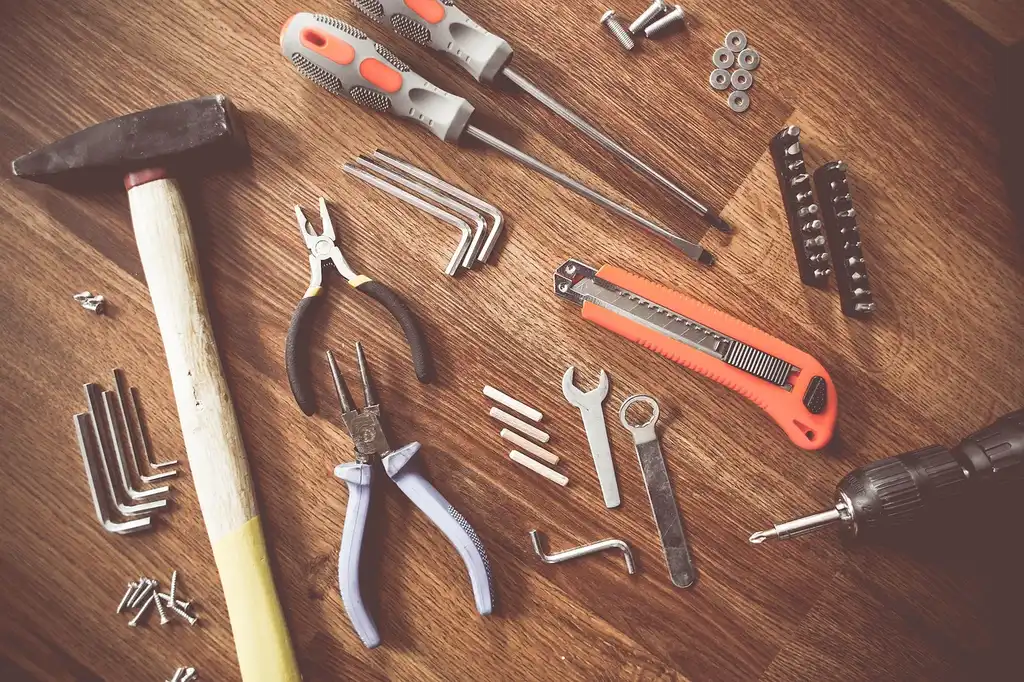
- Phillips screwdriver or square-drive screwdriver, if your leg plate uses screws
- Wrench or socket for the hanger bolt or hex bolt
- Drill with a 3/8-inch drill bit for cracked-leg repair
- 3/8-by-3-inch dowel for reinforcement
- Wood glue
- Clamp
- 100-grit sandpaper
- Blue thread-locking compound
- Replacement sofa leg that matches the thread standard and mounting style
- T-nut or T-plate sofa leg attachment plate, if the insert has failed
- Spirit level for checking whether the wobble is from the leg or the floor
Tools by repair type
| Repair type | Basic tools | Hardware/consumables |
|---|---|---|
| Loose leg or backing-out bolt | Wrench or socket, screwdriver, spirit level | Blue threadlocking compound |
| Stripped insert or T-nut replacement | Screwdriver, wrench, drill if the old insert must be removed | Matching T-nut or T-plate, replacement leg if needed |
| Cracked wooden leg | Clamp, drill, sandpaper | Wood glue, 3/8-inch drill bit, common example dowel such as 3/8-by-3-inch if it matches the leg dimensions |
| Frame reinforcement | Screwdriver, drill, measuring tool | T-plate or repair plate, screws sized for the frame wood |
Use a spirit level to see whether the sofa itself sits level. A bubble difference by itself does not reliably prove the floor is the cause, so check the leg mount and the surrounding frame before deciding what to repair.
Inspect the leg and frame
Tip the sofa onto its back or side so you can inspect the underside safely before buying parts. Then separate the likely causes: a loose fastener, a stripped insert, or a cracked leg. Start with the mounting style, not a wrench.
Identify the thread standard and mounting style
Look at the leg connection. Many sofas use hanger bolts that may be around M8 or 5/16-inch-18, depending on the furniture. These are common examples, not universal sizes, so match the replacement to the actual leg and frame hardware before you buy. If the leg uses a T-nut, the replacement insert must match the original opening. If the original hole is stripped, a common fix is a T-plate sofa leg attachment plate, which uses a square plate with a threaded center and four screws.
Decide whether the frame is still sound
Press on the frame rail near the leg pocket. If the wood flexes, splits, or crumbles, the frame is part of the failure. A leg repair will not hold long if the load path is broken. If the frame feels solid, proceed with the matching hardware repair.
Sofa leg diagnostic table
| Symptom | Likely failure point | Parts needed | Difficulty | Action |
|---|---|---|---|---|
| Leg rocks but threads still catch | Loose hanger bolt | Wrench, blue threadlocker | Easy | Repair |
| Leg spins and never tightens | Stripped T-nut or insert | Replacement T-nut or T-plate | Moderate | Repair if frame is sound |
| Leg leans at the joint | Damaged leg shoulder or worn mounting hole | Replacement sofa leg | Moderate | Replace |
| Visible split in wood leg | Cracked leg | Wood glue, clamp, dowel repair | Moderate | Repair if the split is clean |
| Leg is crushed, broken, or missing a chunk | Shattered leg | Replacement sofa leg | Easy to moderate | Replace |
| One corner still rocks after tightening | Uneven floor or missing glide | Spirit level, shim or glide | Easy | Repair the floor contact first |
| Four screws pull out around the mounting point | Frame wood stripped | T-plate sofa leg attachment plate | Moderate | Repair if the rail is otherwise solid |
| Leg still wobbles after new hardware | Frame damage | None until inspection | High | Stop and call a pro |
How do I fix a loose sofa leg?
Fix a loose sofa leg by tightening the fastener, then locking it so it does not back out again. If the insert or mounting point has stripped, replace the hardware instead of forcing it tighter. Do not tighten past snug; that can widen the hole and make the fit worse.
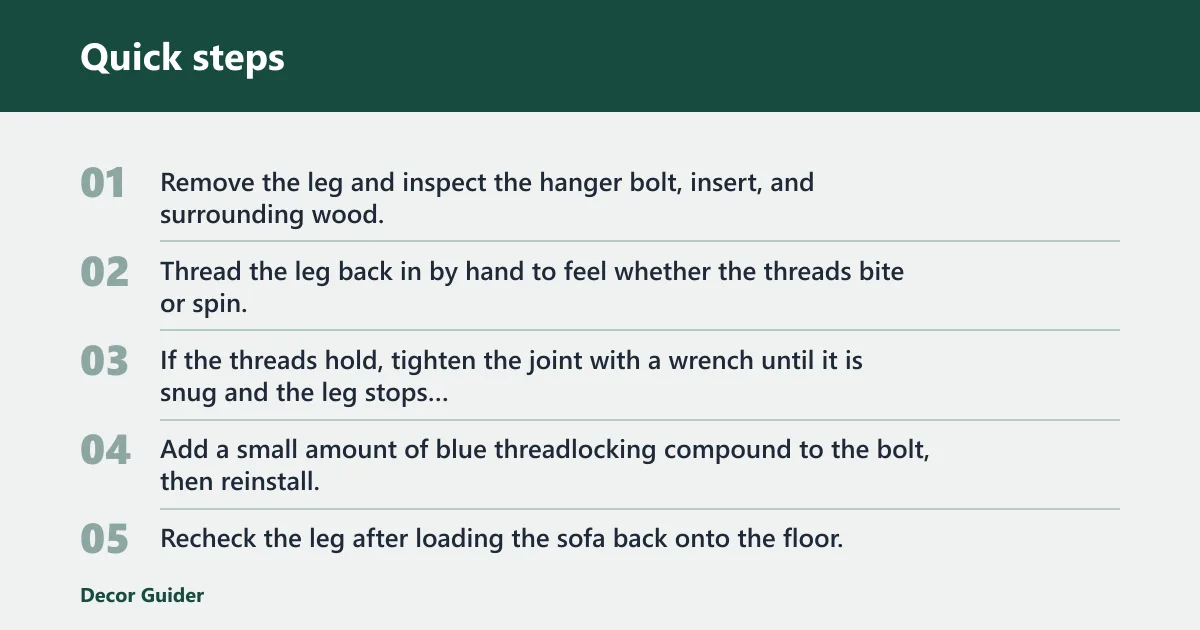
- Remove the leg and inspect the hanger bolt, insert, and surrounding wood.
- Thread the leg back in by hand to feel whether the threads bite or spin.
- If the threads hold, tighten the joint with a wrench until it is snug and the leg stops turning.
- Add a small amount of blue threadlocking compound to the bolt, then reinstall.
- Recheck the leg after loading the sofa back onto the floor.
Use a small amount of threadlocker only if the bolt is otherwise sound. Manufacturer instructions for thread-locking compounds generally call for a light application on clean metal threads, and the compound should be chosen with the sofa hardware in mind so the joint can still be serviced later.
How do I fix a sofa with stripped thread inserts?
If the insert has stripped, the safest fix is to match the replacement insert to the original thread size and the frame hole, then reinstall it in sound wood. If the surrounding wood is still solid, you can often save the leg mount by replacing the T-nut, or by switching to a T-plate when the original opening will no longer hold.
- Remove the leg and inspect the insert from the underside.
- Confirm the thread standard and match it exactly; common examples include M8 and 5/16-inch-18, but the original hardware controls the correct size.
- If the frame wood is still sound and the hole is still tight enough, replace the failed T-nut with the same size.
- If the opening is worn or the insert keeps spinning, use a T-plate sofa leg attachment plate sized for the leg area.
- Reinstall the leg by hand first, then tighten only until snug.
What if the sofa leg keeps spinning and won’t tighten?
If the leg keeps spinning, the insert is likely stripped or the bolt no longer has purchase. Replace the T-nut if the frame hole still fits the original size. If the old hole is worn out, a T-plate sofa leg attachment plate is often the cleaner fix because it gives you a new threaded center and four screw points.
- Remove the leg and inspect the insert from the underside.
- Match the replacement to the original thread standard, such as M8 or 5/16-inch-18.
- Install a new T-nut that matches the original opening, or fit a T-plate over solid wood.
- Reattach the leg and tighten only until snug.
- Add blue threadlocker before the final installation if the bolt tends to loosen.
Suppose the sofa uses a threaded insert and the leg spins as soon as you turn it. That points to the insert, not the leg. Swapping only the leg will not fix it unless the old leg threads are damaged too.
How do I repair a cracked sofa leg?
A cracked wooden leg can often be repaired at home if the split is clean and the leg still has its shape. Use wood glue to close the split, clamp it while curing, then reinforce it with a dowel repair if the crack runs through a stressed section. Follow the adhesive manufacturer’s cure time rather than a fixed rule, because wood glue set times vary by product and humidity.
- Remove the leg and clean dust from the crack.
- Apply wood glue into the split and press the leg closed.
- Clamp the leg until the adhesive sets.
- Drill a 3/8-inch hole perpendicular to the crack, then insert a 3/8-by-3-inch dowel with glue.
- Let the glue cure according to the adhesive manufacturer’s directions, then sand the repaired ends with 100-grit sandpaper.
- Reinstall the leg only after the repair feels firm and dry.
The 3/8-inch bit and 3/8-by-3-inch dowel are common repair examples, not universal dimensions. Match the drill size, dowel diameter, and dowel length to the actual leg thickness and the glue maker’s instructions. If the leg is crushed or missing material, replace it instead. Glue cannot restore load-bearing shape when the wood has broken apart.
How do I know if the problem is the leg or the frame?
Check the joint, then check the surrounding wood. If the leg threads are sound but the sofa still wobbles, the frame insert or rail may be the problem. If the leg itself is split, bent, or shattered, replace the leg. If the frame rail moves when you push on it, stop and inspect the frame before buying parts.
- Tip the sofa and look at the underside around the leg mount.
- Test the leg by hand and note whether it spins, rocks, or binds.
- Check the frame wood for splits, swelling, or stripped screw holes.
- Use a spirit level to rule out floor slope or a missing glide.
Common mistakes
Most bad repairs come from skipping the diagnosis step. A part that fits physically may still have the wrong thread standard or mounting style. Match the replacement sofa leg to the original bolt size, thread type, and base shape before you install it.
- Mixing up M8 and 5/16-inch-18 threads
- Driving hardware deeper after it starts slipping
- Using glue on a shattered or crushed leg
- Replacing the leg when the T-nut is the real failure point
- Ignoring an uneven floor or missing glide
Common first-timer mistake: the leg feels loose, so the bolt gets cranked down harder. If the insert is stripped, that only enlarges the problem and can tear the frame wood.
When should I replace the leg instead of repairing it?
Replace the leg when the wood is cracked through, crushed, or shattered, or when the mounting style no longer holds the fastener securely. A replacement sofa leg must match the thread standard and the way it mounts to the frame. If the frame itself is damaged, stop and call a professional.
A new leg is often the cheapest safe option when the old one is physically broken. It is also the cleanest choice for renters who want a reversible fix, as long as the repair does not require drilling new holes in the frame.
How do I find the right replacement sofa legs?
Match four details before you buy: thread standard, mounting style, leg material, and insert type. A wooden or metal leg may both fit the same sofa, but only if the bolt and base match. If the original used a T-nut, the replacement insert must fit the same opening. If the original mount was a T-plate, keep that style consistent.
- Measure the bolt thread and compare it to the existing hardware, using the old bolt or insert as the reference.
- Check whether the leg screws into a T-nut, a plate, or a direct threaded insert.
- Confirm the leg height and shape so the sofa sits level.
- Choose a leg material that matches the load and appearance you need.
- Keep the old hardware until the new leg is installed and stable.
Frequently asked questions
How do I fix a broken sofa leg?
If the leg is split, glue it, clamp it, and reinforce it with a dowel only if the crack is clean and the wood still has enough strength left. If the leg is crushed, splintered, or missing large pieces, replacement is the safer repair because glue cannot restore the original load path.
How do I change sofa legs?
Tip the sofa over, remove the old leg, and match the new one to the original thread standard and mounting style. Thread it in by hand first so you do not cross-thread the insert. Tighten only until snug, then recheck the sofa for wobble.
Can I repair a cracked sofa leg at home?
Yes, if the crack is clean and the leg still has most of its shape. Use wood glue, a clamp, and a dowel reinforcement. If the wood is shattered, the safer fix is a replacement sofa leg matched to the original mount.
Products related to this article
Sponsored / affiliate links. As an Amazon Associate I earn from qualifying purchases. I may earn additional commission from eligible campaigns.