Is Particle Board Good for Furniture?
Particle board works best for light-duty furniture in dry rooms, with short spans and limited loads; for heavier loads, frequent moves, or moisture-prone rooms, plywood or MDF is the better pick. If you ignore that, shelves sag, screw holes strip, and swollen edges fail early. This guide breaks down where particle board works, where it fails, and how it compares with plywood and MDF.
What particle board


Particle board is engineered wood made by compressing wood chips, sawdust, and resin under heat and pressure. It is usually the cheapest engineered wood option, so it is common where low cost matters more than long service life or high strength.
Standard particle board usually has a density of 600 to 680 kg/m³, based on manufacturer technical sheets and engineered-wood references. That puts it below marine plywood at 700 to 750 kg/m³, and far below HDHMR at 850+ kg/m³. The practical result is simple: it can work in furniture, but it is best when the panel is flat, supported, and lightly loaded.
Why it costs less
Particle board uses smaller wood particles and less refined material than many other sheet goods. That lower processing cost is why it often sells for less than plywood or MDF. The tradeoff is weaker screw holding, weaker edges, and a shorter tolerance for moisture.
It fits budget furniture because it keeps material costs down in large, flat panels. That is useful for low-stress parts such as side panels, cabinet carcasses, and boxed-in storage pieces. It is a poor match for parts that must hold repeated stress or bridge long gaps.
Is particle board good for furniture?
Yes, but only for light-duty furniture in dry rooms with flat, well-supported panels. Particle board works best in light-duty, dry rooms, on flat panels with support under them, and in pieces that do not depend on repeated screw removal or long unsupported spans. It is a poor fit for wet zones, heavy loads, and furniture that gets moved often.
Best-case uses for flat, supported panels
Particle board is a reasonable choice for cabinet carcasses, budget nightstands, short shelves, drawer boxes, and some office furniture. Laminated particle board is especially common for cabinet doors, shelving, and office pieces because the factory finish helps with wear on the face surfaces.
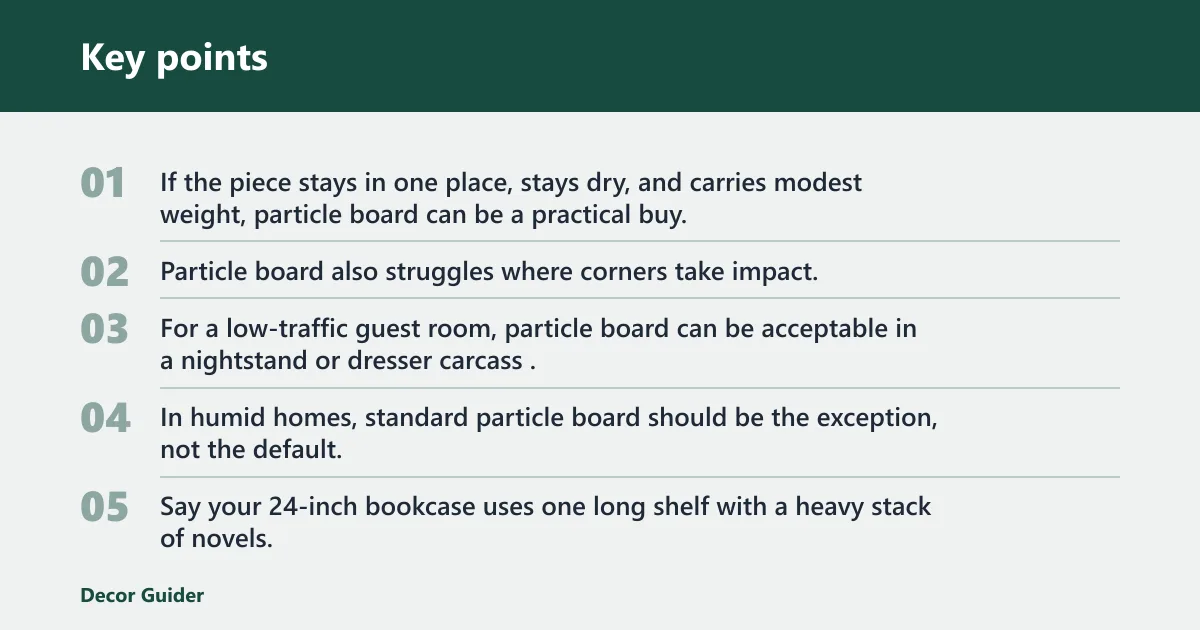
It also makes sense in guest rooms, spare rooms, and low-traffic spaces where furniture sees gentle use. If the piece stays in one place, stays dry, and carries modest weight, particle board can be a practical buy.
Furniture types where it is a poor fit
It is a weak choice for beds, bookcases with long spans, desks that take elbow load, and any shelf that needs to carry books or dishes across a wide opening. Plywood is better than particle board for shelves, cabinets, desks, and beds because it holds screws better and resists bending more effectively.
Particle board also struggles where corners take impact. Doors that slam, shelves that get overloaded, and drawer fronts that are tugged daily often fail first at edges and fastener points.
Quick verdict by room and traffic level
For a low-traffic guest room, particle board can be acceptable in a nightstand or dresser carcass. In a family room, rental kitchen, or hallway storage area, move toward plywood or at least moisture-resistant particle board with sealed edges. In humid homes, standard particle board should be the exception, not the default.
Say your 24-inch bookcase uses one long shelf with a heavy stack of novels. If that shelf spans more than 60 cm, sag becomes a real risk over time under moderate weight, even if the finish still looks fine at first, according to engineered-wood references and manufacturer technical sheets.
Particle board furniture suitability matrix
This matrix gives a practical read on particle board by furniture type. Green means it can work with sensible limits. Yellow means use only with care, better support, or a better grade. Red means the failure risk is high enough that another material is the better buy.
| Furniture piece | Load | Moisture exposure | Screw-holding risk | Edge damage risk | Expected service life | Recommendation |
|---|---|---|---|---|---|---|
| Bed frame parts | High | Low to moderate | High | High | Short | Red |
| Bookcase | Moderate to high | Low | High | Moderate | Short to moderate | Red |
| Nightstand | Low | Low | Moderate | Moderate | Moderate | Green |
| Cabinet carcass | Moderate | Low to moderate | Moderate | Moderate | Moderate | Yellow |
| Desk top | Moderate | Low | High | Moderate | Short to moderate | Yellow |
| Shelf panel | Moderate to high | Low | Moderate | Moderate | Short | Red |
| Drawer box | Low to moderate | Low | Moderate | High | Moderate | Yellow |
How to read the matrix
Use the matrix as a failure-risk guide, not a style guide. A green result means the material can usually do the job if the panel is supported and kept dry. Yellow means it can work only with tighter limits. Red means the part is likely to fail early if the load, span, or hardware stress is significant.
For example, a bed frame part scores high on load, screw-holding risk, and edge damage risk because repeated stress and movement concentrate force at the joints. A nightstand scores better because the loads are smaller and the structure is easier to keep stable.
How durable is particle board furniture?
Particle board furniture is durable enough for light use, but its failure modes are predictable: sagging, screw pull-out, edge blowout, and swelling from moisture. It is not a long-life choice for heavy-duty furniture or for pieces that need repeated assembly, frequent movement, or hard daily use.
Load, sagging, and shelf span
Longer shelves are the biggest structural problem. A load-bearing shelf span longer than 60 cm tends to sag over time under moderate weight, according to engineered-wood references and manufacturer technical sheets, so wide bookcases and media units deserve extra caution. If the shelf must carry books, dishes, or equipment, plywood is usually the better material.
Particle board works best for short, supported spans. Add a center support, reduce span, or choose a thicker panel if you must use it. Without that support, the panel can bow even when the face laminate still looks intact.
Screw holding and assembly stress
Particle board has weaker screw holding than plywood, especially at the edges and in repeated assembly points. Hinges, drawer slides, and knock-down fasteners can loosen over time if the hardware is stressed or removed and reinstalled often.
A common first-timer mistake is over-tightening a cam screw or hinge screw into a corner joint. That can crush the board around the fastener and leave the hole loose the next time the piece is moved.
Edge damage and service life
Edges and corners are usually the first places to fail. Particle board edges are more vulnerable than plywood, and once an edge chips or swells, the damage spreads faster than it would on a layered sheet like plywood.
Service life depends on how much stress the piece takes and whether the edges stay sealed. In a dry, low-traffic room, a nightstand may last well enough. In a busy household or humid room, the same construction can look tired much sooner.
Is particle board furniture safe?
Particle board can be safe for indoor furniture use, but the main issue is indoor air quality, not structural danger. The binder is often reported to use urea-formaldehyde resin.
Urea-formaldehyde resin and indoor air quality
Urea-formaldehyde resin is common in particle board production. That matters because formaldehyde emissions can affect indoor air quality, especially in small rooms or with multiple new furniture pieces at once. EPA, CARB, and TSCA resources point buyers toward lower-emitting engineered wood and compliant products. The concern is exposure, not immediate physical danger from touching the surface.
If you are sensitive to odors or are furnishing a small apartment, a low-emission product is the safer choice. Good ventilation during setup also helps, especially during the first days after unpacking.
What to know about low-emission labels
Look for products that are described as low-emission or compliant with stricter indoor-air standards. That matters more than marketing language. A sealed surface does not erase emissions from poor-grade board, but it can reduce day-to-day exposure from exposed cores and raw edges.
When safety concerns are actually about moisture damage
Many “safety” complaints are really durability problems. If particle board gets wet, it swells because its tiny air pockets absorb water rapidly. That swelling can make a cabinet unstable, jam a drawer, or weaken a shelf long before the piece becomes dangerous in a strict sense.
Moisture-resistant and laminated options
Standard particle board is suitable only for completely dry environments with minimal humidity fluctuation. If the room is damp, or the furniture sits near a sink, washer, or exterior wall, the grade matters. Moisture-resistant and laminated versions improve performance, but neither one makes particle board waterproof.
Moisture-resistant particle board
Moisture-resistant particle board includes water-repellent additives. It is more suitable for humid interiors than standard particle board and is often used for wardrobes and some kitchen applications. Even so, it still needs sealed edges and sensible placement away from standing water.
This grade typically costs about 15 to 25 percent more than standard grades, based on manufacturer technical sheets and market references. That extra cost can be worth it in a humid apartment or a kitchen base cabinet, but it is still not a substitute for plywood in demanding spots.
Laminated particle board
Laminated particle board has a factory-applied decorative surface, so it is common in cabinet doors, shelving, and office furniture. The laminate protects the face, helps with cleaning, and reduces surface wear. The exposed edges still need sealing, though, because the core remains vulnerable there.
Why edge banding matters
Edge banding is critical because raw particle board edges chip easily and take up moisture quickly. A good edge band can slow both problems, especially on drawer fronts, shelf lips, and cabinet doors. If the edge band is lifting, that is a warning sign, not a cosmetic detail.
Inspection checklist
-
Check the edges first. Look for edge banding that sits flat, with no gaps, bubbling, or lifted corners. Exposed or damaged edges are where particle board usually starts to fail.
-
Inspect the screw points. Open doors and drawers, then look closely at hinge plates, cam locks, and slide mounts. Crushed fibers or widening holes mean the board is already losing screw grip.
-
Test for shelf sag. Sight along long shelves and compare the middle to the ends. If the shelf already bows, load will make the problem worse.
-
Look for swelling. Check the underside, corners, and any area near spills or floor contact. Swollen particle board feels soft and looks puffed, especially around seams.
Particle board vs MDF vs plywood
Particle board, MDF, and plywood each solve a different problem. Plywood is the stronger structural pick. MDF is often chosen for a smoother finish and appears often in rental-apartment furniture recommendations. Particle board is the budget option, but it gives up strength and edge durability to get there. For a more direct comparison in a common use case, a dresser carcass is one place MDF often competes with particle board.
When plywood is the better pick
Plywood is better than particle board for shelves, cabinets, desks, and beds because it has stronger screw holding and better bending resistance. Its cross-grain layered construction handles repeated stress more reliably, especially on frames, spans, and joints that must stay tight.
If the furniture will carry weight, get moved often, or live near moisture, plywood is the safer structural choice. That is especially true for bed parts and bookcases.
When MDF makes more sense
MDF is a common alternative in manufactured wood furniture when a smoother, more natural-looking finish matters. It is often chosen for painted surfaces, shaped panels, and some rental-apartment furniture because it machines cleanly and gives a uniform face.
That said, MDF is not a better answer for every piece. It can still dislike moisture, and it is not the right substitute where you need the better screw holding and bending resistance that plywood offers.
Which one to choose for common furniture pieces?
Choose plywood for beds, bookcases, desks, and loaded shelves. Choose MDF for painted furniture and smoother-looking fronts when moisture is low. Choose particle board only for budget pieces with short spans, low loads, and protected edges.
Picture a 36-inch desk used for a laptop and a monitor in a dry bedroom. Particle board can be okay, not great, if the top is well supported and the frame is stiff. Move that same desk into a humid basement or load it with heavy equipment, and plywood becomes the better pick.
Frequently asked questions
Is MDF board good for furniture?
MDF board is good for furniture when you want a smooth finish and stable painted surfaces. It is often used in manufactured furniture and rental-apartment pieces. It is not the best choice for wet rooms or heavy structural parts, where plywood usually performs better.
Is particle board furniture durable?
It can be durable enough for light use, but not for more demanding furniture. Its lifespan depends on load, span length, moisture, and how often hardware is tightened or moved. The most common failure modes are sagging, swelling, screw loosening, and edge blowout.
Is particle board furniture toxic?
“Toxic” is too broad for a simple yes or no. The material itself is not treated as a poison in normal furniture use, but the resin binder can release formaldehyde, especially in lower-grade products. Low-emission labels and ventilation matter most for indoor comfort and air quality.
Is particle board furniture recyclable?
Sometimes, but it depends on local recycling rules and whether the piece is laminated, painted, or contaminated with hardware and glue. Most furniture recycling programs prefer clean, separated material. If the board is swollen, coated, or bonded to mixed materials, reuse or landfill diversion is often more realistic than recycling.
Is particle board furniture heavy?
It can feel surprisingly heavy for its strength because it is a dense engineered panel. That weight is one reason it is popular in budget furniture, but it does not translate into better durability. The mass helps with a solid feel, while the edges and joints remain the weak points.
Is particle board dangerous?
Not in normal furniture use, but it can become a problem when it is overloaded, water-damaged, or built with poor-emission materials. The main risks are structural failure, dust from damaged edges, and formaldehyde exposure from lower-grade boards. Those risks are manageable with dry placement, support, and better-grade products.
Is a particle board bed a bad idea?
Usually yes. Beds put repeated load on joints, fasteners, and side rails, so particle board is a poor match for long-term use. It can work in very light, temporary, or low-cost setups, but plywood or a more robust frame is the safer choice for most bedrooms.
What furniture pieces are particle board actually good for?
It is most useful for nightstands, small cabinets, drawer boxes, and light office furniture with supported panels. It can also work for laminated cabinet doors and shelving when the spans are short and the edges are sealed. It is much less suitable for beds, heavy bookcases, and long shelves.
Products related to this article
Sponsored / affiliate links. As an Amazon Associate I earn from qualifying purchases. I may earn additional commission from eligible campaigns.