MDF Dresser vs Solid Wood Dresser: Which Is Better?
Pick MDF for light to moderate drawer loads, painted finishes, and dry bedrooms where the dresser will not get moved much. Pick solid wood if the dresser will hold heavy clothes, face humidity swings, or get moved often. Ignore that split, and you get swollen bottoms, chipped corners, sagging drawers, or split joints. This guide compares failure points, moisture behavior, repairability, and best room use for both.
This guide is part of our Dresser care and maintenance guide series.
MDF dresser vs solid wood dresser: the real trade-off


| Decision factor | MDF Dresser | Solid Wood Dresser | Winner |
|---|---|---|---|
| Humidity risk | Poor if exposed to spills, leaks, or damp edges | Better once sealed; handles normal bedroom humidity swings better | Solid Wood Dresser |
| Drawer load | Fine for light clothing and shallow drawers; weaker for heavy, deep drawers | Better screw holding and better for heavy contents | Solid Wood Dresser |
| Repairability | Limited; edge chips and swollen spots are hard to restore cleanly | Can be sanded, filled, and refinished after damage | Solid Wood Dresser |
| Move frequency | More likely to loosen or chip after repeated assembly and transport | Tolerates moving and reassembly better | Solid Wood Dresser |
| Finish quality | Smooth, grain-free painted finish | Natural grain may telegraph through paint unless prep is careful | MDF Dresser |
Humidity risk
MDF loses this row because soaked fiberboard swells permanently. That matters at the toe-kick, along edge banding, and where a dresser sits near a bathroom wall, baseboard leak, or humid corner.
Solid wood still needs sealing, but once finished it usually handles normal bedroom humidity swings better. A small spill can often be wiped before damage spreads.
Drawer load
Heavy sweaters, jeans, and bulk storage put real stress on drawer sides and slides. Solid wood usually keeps screws tight longer and handles that load better, especially in deep drawers that get yanked daily.
MDF can work in a dresser, but thin drawer parts, poor slide mounting, and repeated overload often show up as sagging fronts or stripped fasteners.
Repairability
Solid wood is the easier material to save after dents, gouges, or finish wear. Sand it, fill it, and refinish it. That is especially useful on a dresser that takes knocks during moves.
MDF repair is more limited. Surface chips can be patched, but swollen areas, crushed corners, or damaged screw holes often stay visible, and replacement becomes cheaper than a cosmetic rescue.
Move frequency
If a dresser will be moved often, solid wood has the edge. Repeated disassembly and reassembly are hard on MDF fastener holes and corner joints, especially when cam bolts or low-grade slides are involved.
MDF is more likely to chip at corners and loosen at attachment points during transport. That matters in rentals, dorms, and short-term homes.
Finish quality
MDF is the cleaner choice for a smooth painted dresser because it has no grain telegraphing through the topcoat. That is why many white, modern, flat-front dressers use MDF panels or MDF fronts.
Solid wood can still be painted well, but the grain often needs more prep. Without that prep, texture may show through, especially on open-pore species.
📊 MDF panels have a density range between 500 and 1,000 kg/m3. Source: What is MDF? The Pros and Cons of MDF vs Real Wood.
What is MDF, and how is it used in dressers?
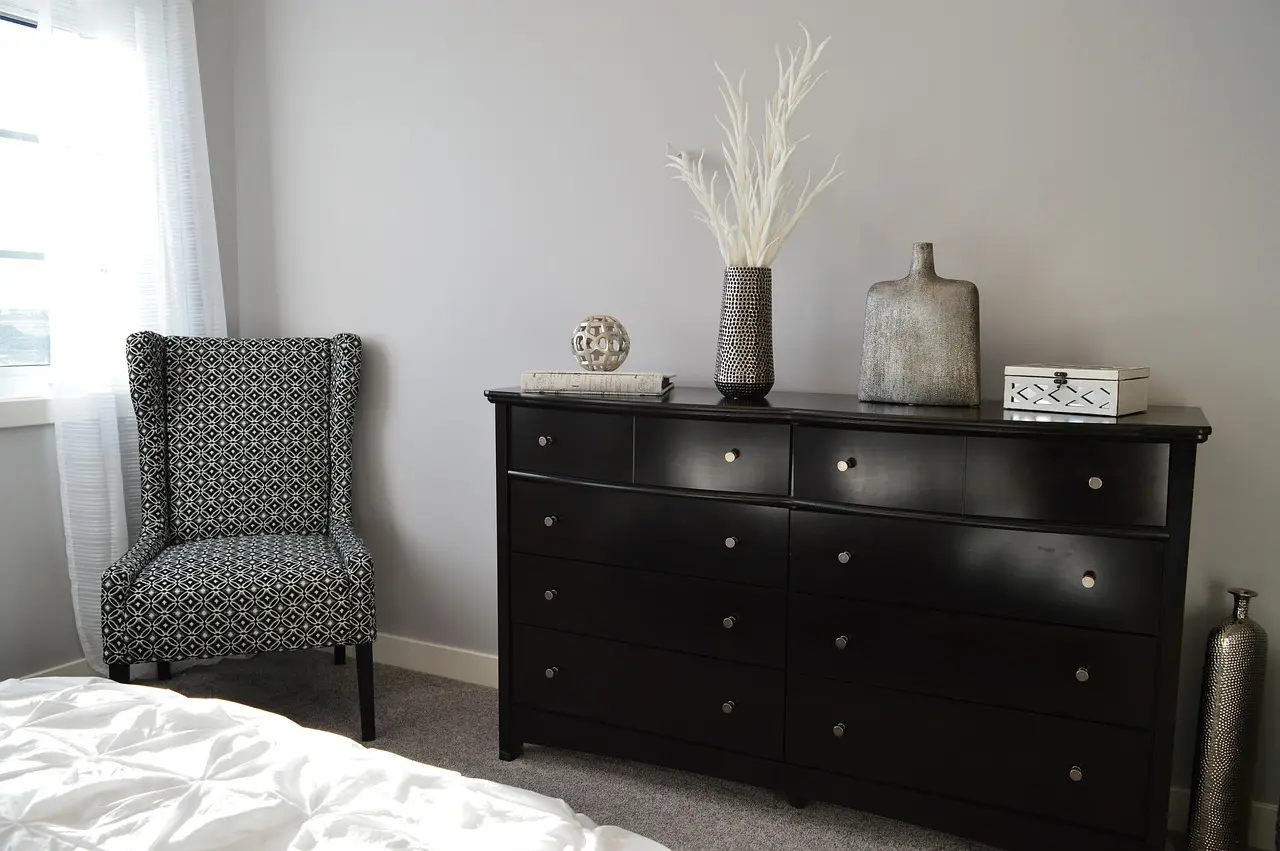
MDF is an engineered wood product made from wood fibers, resin, water, and paraffin wax. In dressers, its dense, uniform panel gives a very flat face, which is useful for painted fronts, side panels, and decorative parts that need a clean surface.
Common MDF variants you will see in furniture listings
Moisture-resistant MDF is made for greater resistance to moisture and humidity and is often green in color. Fire-retardant MDF is often red and shows up in stricter commercial fire-code work. Ultralight MDF is lighter in weight but not as strong as standard MDF.
Veneered MDF keeps the uniform core but adds a thin wood veneer skin, so it can look like solid wood while still behaving like MDF underneath. That hybrid build is common in midrange dressers where the goal is a wood look without full solid-wood cost.
Thickness, sheet sizes, and why build quality changes by manufacturer
Standard MDF thickness can range from 1/8 inch to 1 inch. The most common standard width is 4 feet, and the most common standard length for MDF boards is 8 feet, though actual furniture parts vary by maker and region.
That matters because a dresser built from thin skins over a weak frame is not the same as one using thicker structural panels. In product listings, the words matter less than where the material is used: carcass, drawer box, back panel, front, or leg.

What is solid wood furniture, and where does it hold up better?
Solid wood furniture uses real wood construction, which usually brings better screw holding, easier refinishing, higher resale value, and a longer service life. For a dresser, that means the cabinet, drawer fronts, and sometimes the full frame can be repaired rather than replaced after wear.
Why real wood construction changes screw holding and repair options
Screws bite into wood fibers more reliably than they do into compressed fiberboard, and that helps with drawer slides, hinges, and corner joinery. When a drawer slide loosens in solid wood, the hole can often be reset or plugged and redrilled.
With MDF, repeated reassembly can weaken the same fastener points more quickly. That is why a dresser that gets knocked apart for every move often ages better in solid wood.
Why solid wood usually costs more and resells better
Solid wood dressers often cost more upfront, since the material is denser and the build can take more labor, and the finished piece may last longer before repairs are needed. They also hold value better because buyers expect longer service life and a better repair path. That matters if the dresser may be sold later or passed into another room after its first use.
As a practical matter, the lower resale value of MDF shows up when hardware loosens or edges chip. Buyers rarely pay much for a dresser that already has visible swelling or broken corner patches.
Which dresser material handles humidity and water exposure better?
Solid wood handles humidity swings better once sealed, while MDF swells permanently if soaked. That difference decides a lot of real bedroom failures, especially near windows, bathroom walls, radiators, humidifiers, or floors that sometimes pick up condensation and spills.
What happens when MDF gets wet: swelling, edge failure, and permanent damage
MDF tends to absorb water first at exposed edges. Once that happens, toe-kicks puff up, drawer bottoms distort, and veneer or paint can blister along seams. A short leak can leave a swollen edge that never returns to flat.
That is the failure mode shoppers often miss. A dresser can look fine on the showroom floor and still fail at the weakest exposed edge after one wet mop, one plant spill, or one slow leak from a nearby wall.
How sealed solid wood reacts to humidity swings and minor spills
Solid wood still moves with moisture, but it usually does so without the same permanent swelling pattern. Good finish coverage slows water entry and gives the owner time to wipe minor spills before damage sets in.
In a normal bedroom, that makes solid wood more forgiving. It is not waterproof, but it is less likely to turn one wet event into a ruined panel.
Room-by-room risk: bedrooms near bathrooms, exterior walls, and leak-prone spots
Bedrooms next to baths, laundry rooms, or exterior walls carry more humidity risk. So do rooms where the dresser sits directly against a cold wall or under a window that sweats in winter.
In those spots, moisture-resistant MDF helps more than standard MDF, but solid wood still has the safer track record. For damp rooms, a moisture-resistant substrate is better than standard MDF, yet it is not the same as true water resistance.
Which holds screws, slides, and drawer weight better?
Solid wood generally holds screws and drawer hardware better, especially after repeated assembly. MDF can hold hardware acceptably in a well-built dresser, but deep drawers and heavy contents raise the risk of stripped slides, loose corners, and pull-out around fasteners.
Fastener strength in MDF versus solid wood after repeated assembly
Hardware that is installed once and left alone is one thing. Hardware that gets removed, shifted, and tightened again is another. MDF fastener strength weakens faster after re-assembly, while solid wood gives more room for correction.
This matters most for family dressers, moving-day furniture, and pieces with slide kits mounted into side panels rather than into a stronger internal frame.
Why deep drawers and heavy contents stress low-quality MDF builds
Deep drawers put more load on the slides, and the pull-out force at the front edge can stress weak side panels and bottom panels. Heavy sweaters, jeans, bedding, and bulk storage make that load worse.
If the dresser carries denim, bedding, or bulk storage, inspect the drawer box carefully. Thin bottoms, weak corner joints, and small slide screws are warning signs.
What to inspect in store: slides, corner joints, backs, and bottom panels
- Open each drawer and pull it halfway out to feel for wobble.
- Check whether the slide screws bite into wood or into thin composite material.
- Look at the back panel thickness and how it is attached.
- Tap the toe-kick and top edge for hollow, thin, or hollow-sounding sections.
- Inspect drawer bottoms for sag and the size of the groove or support lip.
Dresser decision table: MDF, moisture-resistant MDF, veneered MDF, and solid wood
The right pick changes with room moisture, load, repair needs, and how often the dresser moves. A scorecard helps because a cheap MDF dresser with shallow drawers is not the same as veneered MDF with a stronger frame, and neither behaves like a full solid-wood build.
| Option | Humidity risk | Drawer load | Repairability | Move frequency | Finish quality | Pick by scenario |
|---|---|---|---|---|---|---|
| MDF | High risk in damp rooms | Light to moderate | Low | Low to moderate | Very good for paint | Best for painted dressers in dry bedrooms with lighter storage |
| Moisture-resistant MDF | Lower risk than standard MDF | Light to moderate | Low to moderate | Low to moderate | Very good for paint | Best for dry-to-mildly humid rooms where a painted finish is wanted |
| Veneered MDF | Moderate risk if edges are exposed | Moderate | Low to moderate | Moderate | Very good for wood-look finishes | Best for a wood look when the piece will not see rough handling |
| Solid wood | Lowest risk in normal bedrooms | Heavy | High | High | Good, though grain may show under paint | Best for heavy storage, frequent moves, and long-term ownership |
How to read the scores without overvaluing one factor
Do not rank a dresser only by finish quality if the room has humidity or the drawers will be packed. A beautiful painted surface does not save a swollen bottom or stripped slide hardware.
Likewise, do not buy solid wood only because it sounds durable. A poorly built solid-wood dresser with weak joinery can still wobble, rack, or split.
Choose MDF Dresser if… choose Solid Wood Dresser if…
Choose MDF dresser if the room stays dry, the drawers will carry lighter clothing, and you want a smooth painted finish with less visible grain. It also fits best when the dresser will not be disassembled often and when replacement costs matter more than restoration value.
Choose solid wood dresser if the piece will hold heavy clothes, sit in a humid or leak-prone bedroom, or move from home to home. It also fits better when repairability, screw holding, and resale matter more than the lower purchase price.
Best-case uses for MDF
MDF works well for painted modern dressers, children’s rooms with lighter loads, and guest rooms where the piece will not face hard daily use. Moisture-resistant MDF is the safer version when humidity is a mild concern, but edge protection still matters.
MDF also makes sense when the buyer wants a flat, uniform finish and is willing to treat it as a service piece rather than a long-term heirloom.
Best-case uses for solid wood
Solid wood is the better call for heavy family storage, deep drawers, and dressers that will be moved more than once. It is also the better repair candidate when dents, scratches, or finish wear are likely.
For long-term ownership, solid wood usually makes more sense because the fasteners hold better, the structure tolerates more use, and the piece can often be refinished instead of replaced.
Frequently asked questions
Is MDF dresser better than solid wood dresser?
MDF is better when the main goal is a smooth painted surface in a dry bedroom with lighter drawer loads. Solid wood is better when the dresser must handle humidity, heavy contents, or frequent moves. For most long-term use cases, solid wood is the safer structural choice.
How long does an MDF dresser last compared with solid wood?
MDF furniture is described as lasting 5 to 10 years, while solid wood dressers are described as lasting 20 to 50+ years. Those ranges depend on moisture exposure, assembly quality, and how much weight the drawers carry. A dry room and light use help both.
Does MDF dresser swell if it gets wet?
Yes. MDF swells permanently if soaked, and the damage often shows first at edges, toe-kicks, and screw holes. A quick spill can be wiped off, but standing water, leaks, or wet mopping around exposed edges can leave visible and lasting damage.
Which dresser material holds screws and drawer hardware better?
Solid wood holds screws and drawer hardware better, especially after repeated assembly. MDF can work for hardware, but the grip weakens faster when screws are removed and reset. Deep drawers and heavy contents expose that weakness sooner.
Is a solid wood dresser worth the extra money?
It is worth the extra money when the dresser will be used hard, moved often, or kept long enough to justify repair and refinishing. The higher upfront cost buys better fastener holding, better repair options, and better resale value when the piece ages.
Which dresser material is better for painted finishes?
MDF is usually better for painted finishes because its surface is smooth and does not telegraph grain the way solid wood can. That makes it a strong choice for white dressers, flat-panel fronts, and other modern styles. Good sealing of the edges still matters.
Products related to this article
Sponsored / affiliate links. As an Amazon Associate I earn from qualifying purchases. I may earn additional commission from eligible campaigns.