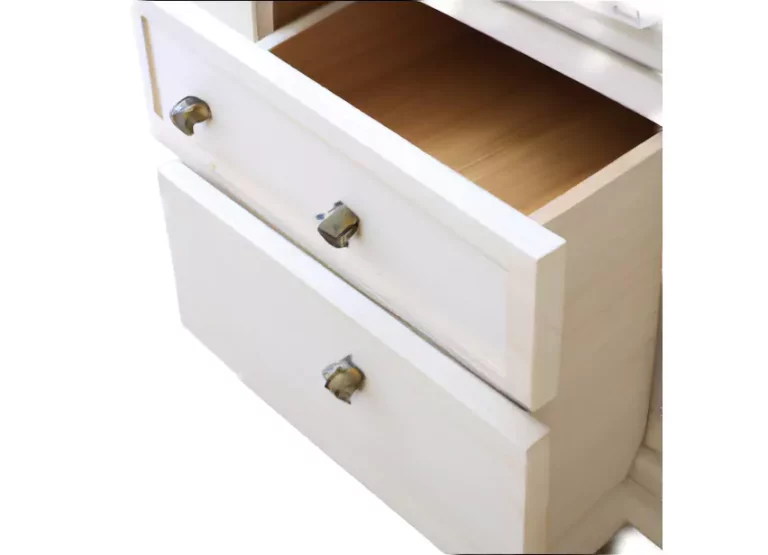
How Much Does a Solid Wood Dresser Cost?
A solid wood dresser typically costs about $800 to $2,500 new, about $4,800 to $16,000 for custom work, and about $150 to $900 used, with price often judged by wood species, joinery, size, and finish. Paying too little can mean veneer, weak hardware, or warped drawers; paying too much can mean you are paying for shipping and branding. This guide breaks down retail, custom, shipped, and used prices so you can judge what a fair solid wood dresser costs.
Solid wood dresser price guide
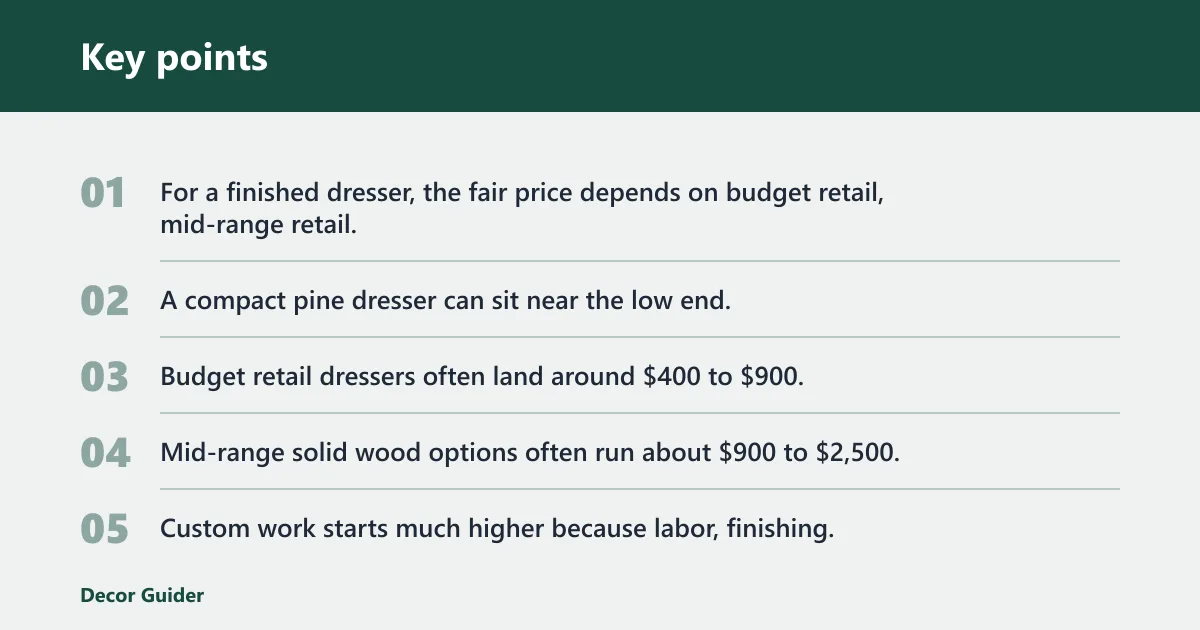


For a finished dresser, the fair price depends on budget retail, mid-range retail, custom work, or a shipped piece with higher freight risk. A compact pine dresser can sit near the low end, while a wide walnut dresser with better slides and joinery can cost several times more.
Quick price bands
Budget retail dressers often land around $400 to $900. Mid-range solid wood options often run about $900 to $2,500. Custom work starts much higher because labor, finishing, and shop overhead are built into the price. Used dressers can be a bargain if the structure is sound and the drawers still track well.
What makes the same size vary so much? Species, drawer count, case width, depth, and hardware all change the bill. A standard six-drawer dresser is described as 60 inches wide and 34 inches tall, but a tall chest of drawers is narrower and 48 to 54 inches tall. The wide version uses more wood and more labor.
What counts as fair pricing
A fair price should match the construction you can verify. Solid drawer fronts, plywood backs, strong joinery, and full-extension slides justify more than basic box construction with thin drawer runners. If the listing is vague about materials, assume the price includes some marketing markup.
Picture a 60-inch dresser labeled “solid wood” with drawer fronts made from oak but sides and back made from plywood. That can still be good furniture, but it is not priced like a fully solid case. The value question is whether the build details support the asking number.
What affects dresser cost
Three factors do most of the work: the wood species, the size and drawer count, and the construction details. A larger dresser is not only wider; it often needs more board footage, more hardware, and more finishing labor. That pushes cost up quickly.
Drawer count, width, and depth
More drawers mean more parts and more hardware. A four-drawer dresser is simpler and cheaper than a six-drawer dresser. A nine-drawer wide dresser is a different class of product because it needs a wider case, more drawer boxes, and more labor to fit and align everything cleanly.
Depth matters too. A deeper case uses more material and may need stronger slides and thicker drawer bottoms. Once the dresser gets taller or wider, shipping also becomes more expensive because packed dimensions and weight rise together.
Finish, hardware, and construction details
Finish quality changes both price and durability. A sprayed finish with careful prep and even coverage costs more than a quick brush coat, but it usually resists wear better. Hardware matters as well. Basic pulls are cheaper than solid metal pulls, and better slides often cost more than simple side runners.
Construction is where many buyers overpay or underbuy. Solid drawer fronts look good, but the back panel, drawer sides, and joinery tell you more about long-term value. Plywood backs are common and practical. Weak corner joints, loose bottoms, or soft hardware can make a dresser feel expensive without lasting like one.
Wood species and price differences

Species changes both price and appearance. Pine sits at the low end, poplar is still budget-friendly but usually better behaved, maple and cherry move into the mid to upper range, and white oak and walnut often command the highest prices. The species choice should match both the room and the use.
Pine and poplar
Pine lumber is listed at $2 to $4 per board foot, which helps explain why pine dressers usually cost less. Pine is lighter, easier to machine, and often used for lower-priced solid wood furniture. It can dent more easily than harder species, so it is often best for guest rooms or lighter use.
Poplar is also a lower-cost choice and is often used when a painter wants a smoother surface under paint. It is not as visually dramatic as cherry or walnut, but it can offer a decent balance of price and stability. For buyers who care more about function than grain figure, poplar can be a solid value.
Maple and cherry
Hard maple is usually a step up in price because it is dense and wear-resistant. Cherry costs more for both material and the warmer color changes it develops over time. These species often appear in better mid-range furniture, where the seller is charging for both materials and a cleaner finish.
Maple suits a lighter, more uniform look. Cherry suits buyers who want a warmer tone and are willing to pay for it. Both are commonly seen in furniture that is meant to last longer than disposable case goods.
White oak and walnut
White oak is a premium durable option with strong resale appeal. Walnut is even more expensive because the lumber itself costs more and the figure is highly valued. Walnut lumber is listed at $10 to $18 per board foot, which helps explain why walnut dressers often sit at the top of the market.
White oak often works well for a broad, sturdy dresser. Walnut is usually chosen for a more refined look and a higher-end finish. If the seller uses walnut only on the visible faces and not the entire carcass, that is a sign to read the construction closely before accepting the price.
Rough lumber cost and retail pricing
Retail pricing is not just lumber cost. A board-foot price is only the starting point. Milling, waste, labor, finishing, hardware, shop overhead, and profit all stack on top. That is why a dresser can cost far more than the wood inside it would suggest on paper.
How much does a custom dresser cost?
A custom dresser usually costs more because the maker builds to order, cuts parts one by one, and absorbs design time, fitting, finishing, and shop overhead. A custom four-drawer dresser in pine or poplar can start around the low thousands, while large walnut pieces can move into five figures.
6-drawer pricing example
A custom six-drawer white oak dresser is priced at $4,800 to $7,800. A custom six-drawer walnut dresser is priced at $6,800 to $11,500. Those ranges fit the labor involved in a furniture piece that is large enough to matter visually and structurally in a bedroom.
For a practical build example, assume a 60-inch-wide, 34-inch-tall dresser with six drawers, solid wood drawer fronts, plywood backs, and quality slides. Once the maker includes surfacing, case joinery, drawer construction, sanding, finish coats, and fitting, the labor total climbs quickly.
9-drawer wide dresser pricing example
A nine-drawer walnut or white oak wide dresser is priced at $9,500 to $16,000. The wider layout adds more drawer boxes, more hardware, more finishing surface, and more fitting time. Even a well-organized shop spends many more hours on a piece of that size than on a basic four-drawer chest.
Suppose the dresser is 72 inches wide instead of 60, with nine drawers and a heavier base. The extra width alone increases material use, but the bigger cost jump comes from labor and assembly time. Large dressers are expensive because they are large and because they are time-intensive.
Labor hours, shop rate, overhead, and profit
A custom price usually reflects labor hours multiplied by a shop rate, then adjusted for overhead and profit. If a build takes 25 to 40 hours and the shop rate is $75 to $100 per hour, labor alone can reach $1,875 to $4,000 before materials. Overhead covers tools, rent, insurance, and waste.
That is why the quote can look high even when the lumber bill is not dramatic. Custom furniture pricing is less about wood alone and more about the total time and risk needed to deliver a straight, durable dresser.
How much does shipping add?
Shipping can add a modest fee for a local ground delivery or a very large fee for freight, liftgate service, or long-distance shipment. A small three- or four-drawer dresser may weigh 50–110 lb packed for shipping, while larger pieces move into freight territory because of size, weight, and packaging volume.
Packed size and packed weight
A packed dresser around 34 × 20 × 32 inches still needs careful shipping, because carriers price by size as well as weight. A compact item can still cost a lot to ship if the box is bulky and awkward to handle.
One route on SMKlog cites a quote of $109.70 for a dresser shipment. That figure shows that shipping can be manageable on some routes, but it can also swing upward when the item is large, remote, or rushed.
Parcel versus freight thresholds
Small dressers may ship by parcel if the packed dimensions stay within carrier limits, but larger cases often need freight. Freight adds handling fees, scheduling complexity, and a higher chance of damage if the packaging is weak. It also increases the need to inspect the dresser on arrival.
Drawer removal can help lower shipping volume and reduce risk. If the seller removes drawers before packing, the case may be easier to move. The buyer should still confirm that drawers are labeled and that hardware is bagged separately.
Ground, expedited, and drawer-removal costs
Ground shipping is usually cheaper than expedited service. Faster delivery raises the price because carriers charge for speed, route priority, and reduced consolidation. For a heavy dresser, rushing delivery can cost enough to change the value judgment entirely.
Hidden ownership costs can include delivery, assembly, tipping kits, and replacement hardware. A dresser that arrives in parts may seem cheaper at checkout, but the full ownership cost is higher once the buyer adds those items.
Solid wood dresser cost calculator
This table gives a simple way to judge price against construction, size, and delivery risk. Use it to compare the asking price with the likely build quality, shipping burden, and resale potential.
| Category | Expected price range | Likely wood species | Drawer count | Weight band | Delivery/shipping risk | Value verdict |
|---|---|---|---|---|---|---|
| Budget retail | $400 to $900 | Pine or poplar | 4 to 6 | 50 to 100 lb packed | Low to moderate; parcel or light freight | Good only if joins, slides, and back panel are sound |
| Mid-range retail | $900 to $2,500 | Maple, cherry, or white oak | 5 to 6 | 90 to 140 lb packed | Moderate; freight more likely | Fair when the finish, slides, and joinery are clearly specified |
| Custom build | $4,800 to $11,500 | White oak or walnut | 6 | 120 to 180 lb packed | High; freight and liftgate often needed | Worth it only when the build details and dimensions are a close match |
| Shipped purchase | Base price plus $100 to several hundred | Any solid wood species | 3 to 9 | 50 to 110 lb packed for small units | Varies widely; packing quality matters | Worth it if shipping does not erase the price advantage |
Is a solid wood dresser worth the price?
A solid wood dresser is worth the price when the materials, joinery, and hardware match the asking number, and when the dresser will stay in service long enough to spread out the cost. The better the construction and repairability, the more likely the piece is to hold value and outlast cheaper alternatives.
Durability and expected lifespan
Solid wood furniture usually costs more than MDF or particle board because it can tolerate more repair, refitting, and refinishing. MDF and particle board are often lighter and cheaper, but they are less forgiving of moisture, edge damage, and repeated screw removal. A dresser built with real wood parts usually has better long-term repair options.
The price premium is not automatic proof of quality. A poorly built solid wood dresser can still sag, rack, or fail at the drawer slides. That is why buyers should inspect the back panel, drawer bottoms, and joinery before paying a premium.
Weight, moving, and family safety
How much does a solid wood dresser weigh? A small three- or four-drawer dresser may weigh 50–110 lb packed for shipping, and larger solid wood dressers can exceed that by a lot. Weight matters because it affects delivery cost, room placement, and the chance of tip-over if it is not anchored properly.
Family and pet safety matter here. A heavier dresser can be more stable, but any tall chest should be secured to the wall if children or pets can pull on drawers. A tipping kit is a small cost compared with the damage a falling dresser can cause.
Resale value and repairability
A solid wood dresser often holds value better than MDF because buyers can sand, refinish, reglue, or replace hardware more easily. Species matters on the used market too. Walnut, white oak, cherry, and maple usually hold appeal better than soft pine when condition is similar.
Brand, condition, and construction also shape resale. A clean finish, straight drawers, and a solid back panel matter more than a trendy silhouette. If the dresser can be repaired instead of discarded, it is easier to resell and more likely to justify a higher purchase price.
A common first-time buyer mistake is assuming a dresser is overpriced just because it has a simple design and no ornate details. A dresser with attractive drawer fronts can hide weak slides, a thin back, or loose joinery. That is where overpaying happens.
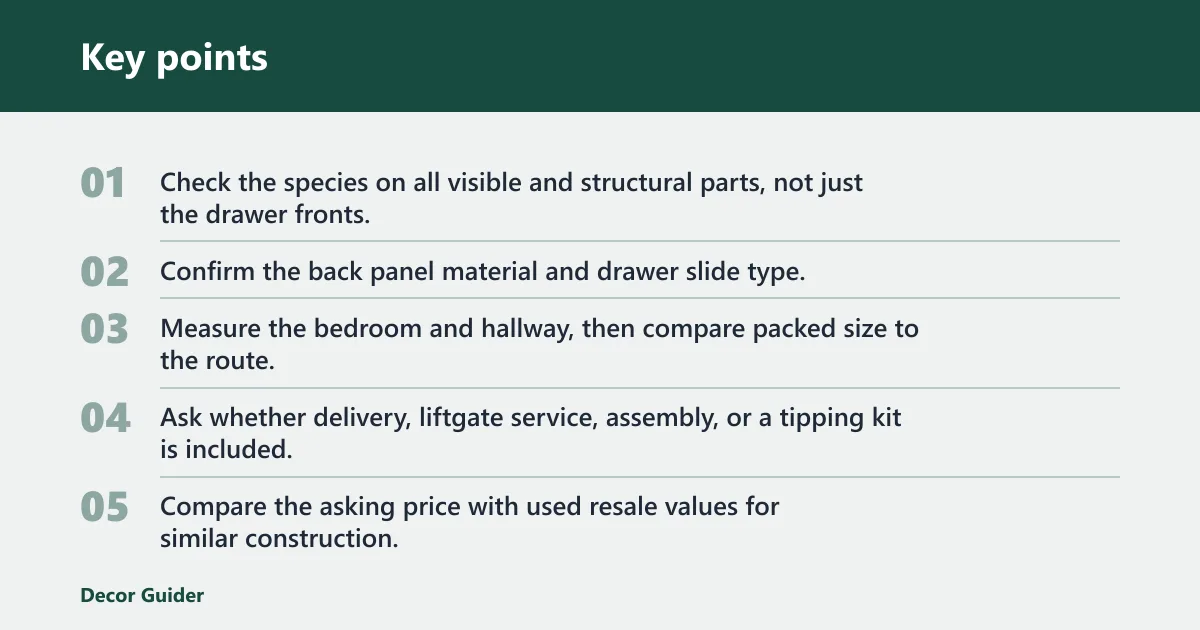
- Check the species on all visible and structural parts, not just the drawer fronts.
- Confirm the back panel material and drawer slide type.
- Measure the bedroom and hallway, then compare packed size to the route.
- Ask whether delivery, liftgate service, assembly, or a tipping kit is included.
- Compare the asking price with used resale values for similar construction.
Frequently asked questions
How much does a solid wood dresser cost?
The price moves with species, drawer count, finish, joinery, and delivery costs. Bigger dressers and harder woods cost more.
How much does a real wood dresser cost?
A real wood dresser usually starts around the low hundreds for simple retail models and rises into the low thousands for better-made pieces. Pine and poplar sit lower; maple, cherry, white oak, and walnut sit higher. Construction quality can matter as much as species.
How much should a solid wood dresser cost?
It should cost enough to match the build. For a good retail piece, $900 to $2,500 is a reasonable range; for custom work, a higher price is normal because labor and finish time are built in. If the details are vague, the price may be inflated.
How much does solid wood furniture cost?
Solid wood furniture costs more than comparable MDF or particle board furniture because the material is heavier, harder to machine, and usually more durable. The premium also reflects labor, finishing, and weight-based shipping. Higher-end species such as walnut raise the price further.
How much is a solid wood dresser worth?
Its worth depends on species, condition, repairability, and brand, but used examples often sell for $150 to $900. White oak, cherry, maple, and walnut usually hold value better than soft pine if the drawers run well and the finish is intact. Broken hardware lowers value fast.
How much extra should I budget for delivery or shipping?
Budget at least $100 to several hundred for delivery or shipping, and more if freight, liftgate service, or expedited timing is involved. A small dresser may stay near parcel pricing, while a large one near 34 × 20 × 32 inches can require more careful handling.
Products related to this article
Sponsored / affiliate links. As an Amazon Associate I earn from qualifying purchases. I may earn additional commission from eligible campaigns.