How to Move a Dresser Up the Stairs
Move a dresser up stairs with at least two people. Use a third helper or a stair-climbing strap system for bulky pieces, and remove drawers first if the dresser may not clear the turn or feels unstable. Bad lifts can tip the dresser, crush fingers, gouge walls, and send the load backward on the stairs. This guide helps you choose the safest method by weight, staircase layout, helper count, and whether disassembly is practical.
Before you start


Confirm the dresser is empty and secured
Take everything out of every drawer before the move. A dresser gets heavy and top-heavy when drawers stay loaded, and shifting weight can throw off balance on stairs. If drawers rattle or slide open, tape them shut or remove them before lifting. If the dresser has an attached mirror, treat it as a separate risk and plan for extra padding or removal.
Remove drawers if the frame will be lighter and easier to angle through a landing or turn. If the drawers cannot come out cleanly, secure them so they cannot open during the lift. A tall dresser with a mirror or a narrow base needs more caution than a short chest with solid footing.
Measure the stair path before any lift
Measure item height, width, and depth, plus stair width and ceiling distance before you choose a route. Also check landing depth, turn radius, and any low ceilings that can change the angle of the dresser mid-carry. Straight stair runs are safer than stairs with turns or tight landings.
Look for narrow passages at the bottom and top of the stairs. If the dresser must be tipped hard to clear a ceiling or banister, the move is already getting risky. A stair that looks wide enough from below can still pinch the dresser at a landing corner.
Check for mirrors, loose feet, and drawer issues
Inspect the dresser for a loose mirror, wobbly legs, cracked back panels, or drawers that sag when opened. These are warning signs that the piece may twist while being carried. If the dresser flexes when lifted a few inches, stop and reassess before putting anyone on the stairs.
What you’ll need
- Moving blankets to protect the dresser, walls, banisters, baseboards, and stair trim
- Stretch wrap to hold blankets in place and keep drawers shut
- Moving straps or forearm straps for a partner carry
- A hand truck or stair-climbing dolly for bulky heavy items
- Work gloves with grip
- Closed-toe shoes with steady soles
- Painters tape for light temporary securing where needed
- Furniture sliders for short level sections before or after the stairs
Dresser stair method table
| Method | Best staircase type | Helpful dresser size | Helper count | Do not attempt if… |
|---|---|---|---|---|
| Two-person carry | Straight run with wide steps and clear landing room | Short to medium dressers with drawers removed or secured | 2 minimum | There are turns, narrow landings, attached mirrors, or overfilled drawers |
| Strap-assisted carry | Straight stairs or one gentle landing, with a clear route | Medium to heavy dressers that need shared load support | 2, with 3 safer for tight corners | The stairs have a tight turn, a low ceiling, or unstable drawers |
| Furniture dolly on level sections only | Flat hallways, entries, or landings only | Dressers that can roll to the stair base or away from the stairs | 2 | You plan to use it on steps, ramps, or uneven stairs |
| Stair-climbing dolly | Stairs with limited turning room, if the route can still accept the load angle | Bulky or heavy dressers that are stable once secured | 2 to 3 | There are narrow turns, narrow landings, attached mirrors, or overfilled drawers |
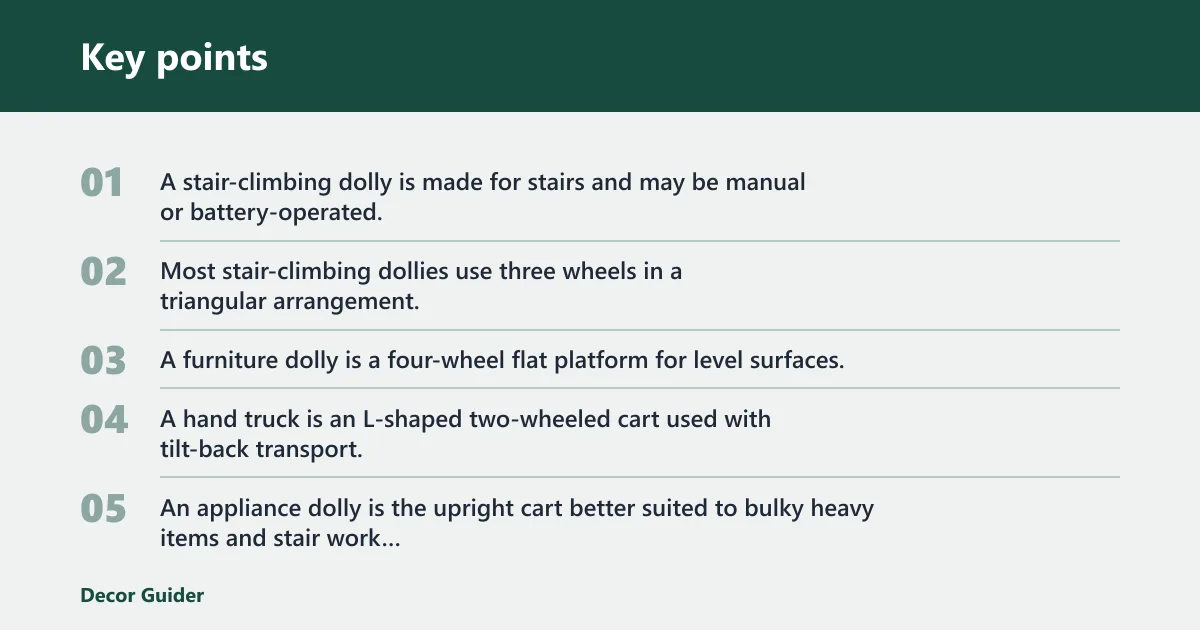
A stair-climbing dolly is made for stairs and may be manual or battery-operated. Most stair-climbing dollies use three wheels in a triangular arrangement. A furniture dolly is a four-wheel flat platform for level surfaces, so it is not ideal for stairs. A hand truck is an L-shaped two-wheeled cart used with tilt-back transport, which is different from a flat furniture dolly. An appliance dolly is the upright cart better suited to bulky heavy items and stair work than a furniture dolly.
How do you move a dresser up the stairs?
Use at least two people, pad the dresser, and move it one step at a time with one person leading and one spotting. For heavier pieces or tight corners, add a third helper or switch to a stair-climbing dolly. If the dresser has drawers or a mirror, secure or remove them before the first lift.
Position and pad the dresser
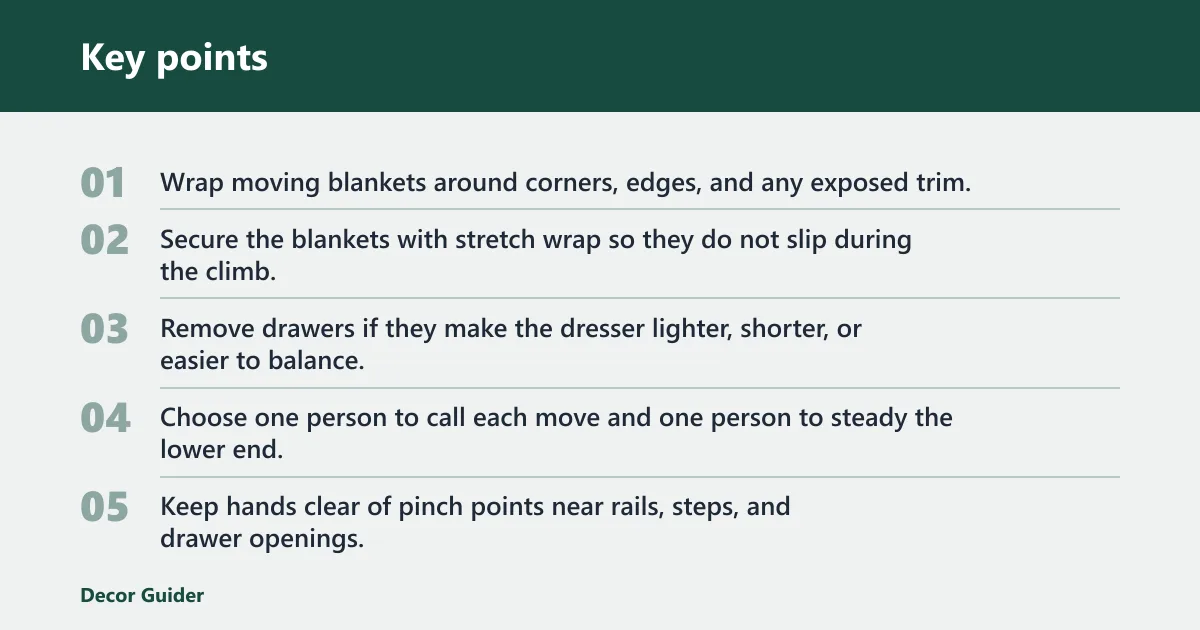
- Wrap moving blankets around corners, edges, and any exposed trim.
- Secure the blankets with stretch wrap so they do not slip during the climb.
- Remove drawers if they make the dresser lighter, shorter, or easier to balance.
Assign the lead mover and spotter
- Choose one person to call each move and one person to steady the lower end.
- Keep hands clear of pinch points near rails, steps, and drawer openings.
- Use short commands such as “lift,” “pause,” and “set” so both movers move together.
Take one step at a time
- Raise the dresser just enough to clear the first step.
- Advance one step, then stop and reset the grip before the next move.
- If the dresser starts to lean outward, stop and lower it back to the last stable step.
Recheck clearance at landings and turns
- Pause before each landing and check the turn radius again.
- Rotate the dresser only after both movers have a stable stance.
- If a mirror, ceiling, or banister blocks the angle, back out and change the route.
Picture a 48-inch-tall dresser with a mirror and full drawers facing a narrow landing. The safest move is usually not a stronger grip. It is a lighter, shorter load with the mirror removed, drawers emptied, and a route that does not force a hard turn.
How do you move a dresser down the stairs?
Move a dresser down stairs with the center of gravity kept close to the stair line, not floating away from it. Use two people at minimum, three if the stairs are tight. Control matters more than speed, because a downhill slip can load the lower helper very fast.
Lower the center of gravity before the first step
- Empty the drawers and secure or remove them.
- Remove the mirror if it adds height or top weight.
- Tilt the dresser just enough to keep its mass close to the stairs.
Use straps and a clear command system
- Fit shoulder or forearm straps only with a partner.
- Agree on one lead voice before the first step down.
- Set the dresser down at any loss of control, then reset the grip.
Keep the dresser tight to the stair line
- Guide the load close to the inner edge of the stairs.
- Protect rail posts and wall corners with blankets before the descent.
- Move in short pauses so the lower helper never has to catch a surprise drop.
Suppose the dresser clears the upstairs doorway but catches the lower landing corner on the way down. That is usually a route problem, not a strength problem. Back up, remeasure the landing depth and turn radius, then choose a different angle or a different method.
Common mistakes
Using a furniture dolly on stairs
A furniture dolly is for level surfaces only. It can roll suddenly on a step edge and put the dresser off balance. Use it to move the dresser across a floor, not up or down the stairs.
Leaving drawers full or unsecured
Full drawers shift the load upward and outward, which makes the dresser harder to control. Secure loose drawers before the move, or remove them if that shortens the profile and improves balance.
Forcing a turn with no landing room
If a landing is too shallow for a rotation, do not twist the dresser in place. That is when veneer gets scraped, railings get hit, and one mover loses footing. A straight stair run is safer than a turn that looks possible but leaves no working space.
Skipping wall and rail protection
Cover corners, baseboards, banisters, and stair trim with moving blankets before the first lift. Hold the blankets in place with stretch wrap so the dresser does not rub bare wood or paint. Protect the landing corners as carefully as the steps.
When should you hire movers?
Hire movers when the dresser is too tall to control, the stairway has a tight turn, or the landing is too narrow to rotate the load safely. Professional help is also the better choice when the dresser has an attached mirror, unstable drawers, or a route that forces awkward overhead lifting.
Red flags that end a DIY attempt
- The dresser cannot be emptied or secured.
- The stairs have narrow passages, low ceilings, or a tight turn radius.
- The landing depth is too short for a safe pivot.
- The dresser shifts, rocks, or flexes when lifted.
- Two people cannot keep the load under control without strain.
A stair-climbing dolly can be a good tool, but it does not fix a bad stair layout. If the piece will not clear the ceiling angle, or if the turn leaves no room for the cart and the dresser together, stop and call movers instead of forcing the issue.
Frequently asked questions
How do you move a dresser up the stairs by yourself?
You should not move a full dresser up stairs alone. Even with a small piece, a single person cannot safely control the tilt, the corners, and the recovery if it slips. Get at least one helper, and use two if the dresser is heavy or top-heavy.
How do you move a heavy dresser up the stairs?
Use two helpers minimum, a strapped or padded carry, and a route that has been measured for width, landing depth, and ceiling clearance. If the dresser is bulky, a stair-climbing dolly is usually better than a hand truck or furniture dolly. Remove drawers first if that improves balance.
How do you move a dresser downstairs alone?
Do not try to move a dresser downstairs alone if it is full size. A downhill slip can pull the piece past the point of control in one step. Wait for help, or hire movers if no helper is available and the staircase is not flat and open.
What is the best way to move a dresser up stairs?
The best method is the one that matches the staircase and the load. For a straight run, two people with straps often work best. For a heavy or awkward piece, a stair-climbing dolly is the better choice. If the stairs have turns or narrow landings, stop and reassess before lifting.
What equipment do you need to move furniture down stairs?
For a dresser, use moving blankets, stretch wrap, gloves, and either moving straps or a stair-climbing dolly, depending on the route. A hand truck can help on flat sections, but a furniture dolly should stay on level surfaces. Protect banisters, baseboards, and landing corners before the descent.
Should you remove drawers before moving a dresser?
Yes, if removing them makes the dresser lighter, shorter, or more stable to carry. At minimum, secure the drawers so they do not slide open. If a drawer cannot be secured and the dresser feels top-heavy, remove it before the stair move.
How many people do you need to move a dresser on stairs?
Two people is a common minimum for a dresser on stairs. Three people is often safer for tight corners, narrow landings, or a taller piece with an attached mirror. If you cannot keep the load balanced with that crew size, the route is too risky for a DIY move.
Can you use a furniture dolly on stairs?
No. A furniture dolly is a four-wheel flat platform for level surfaces, so it is not ideal for stairs. Use it only on flat hallways or landings, then switch to a stair-climbing dolly, hand truck, or a carried move for the steps themselves.
When should you hire movers instead of moving a dresser yourself?
Hire movers when the dresser is oversized, mirrored, unstable, or too heavy for a controlled carry, or when the stairs have narrow turns and low clearance. If the route requires forcing an angle at a landing, the risk of wall damage and injury is high enough to stop the DIY plan.
Products related to this article
Sponsored / affiliate links. As an Amazon Associate I earn from qualifying purchases. I may earn additional commission from eligible campaigns.