Best Dresser Styles for Small Spaces (2026): based on specs and reviews
For small bedrooms, choose a dresser based on the constraint it solves: a roughly 30-36 inch wide piece for tight walls, a tall narrow chest when floor space is limited, or a low wide dresser when wall space matters more than walkway space. Choose wrong and you lose door swing, closet access, or daily walking room. This guide breaks down the best dresser styles for small spaces by room constraint, storage need, and layout.
This guide is part of our Dresser care and maintenance guide series.
Quick picks for small bedrooms
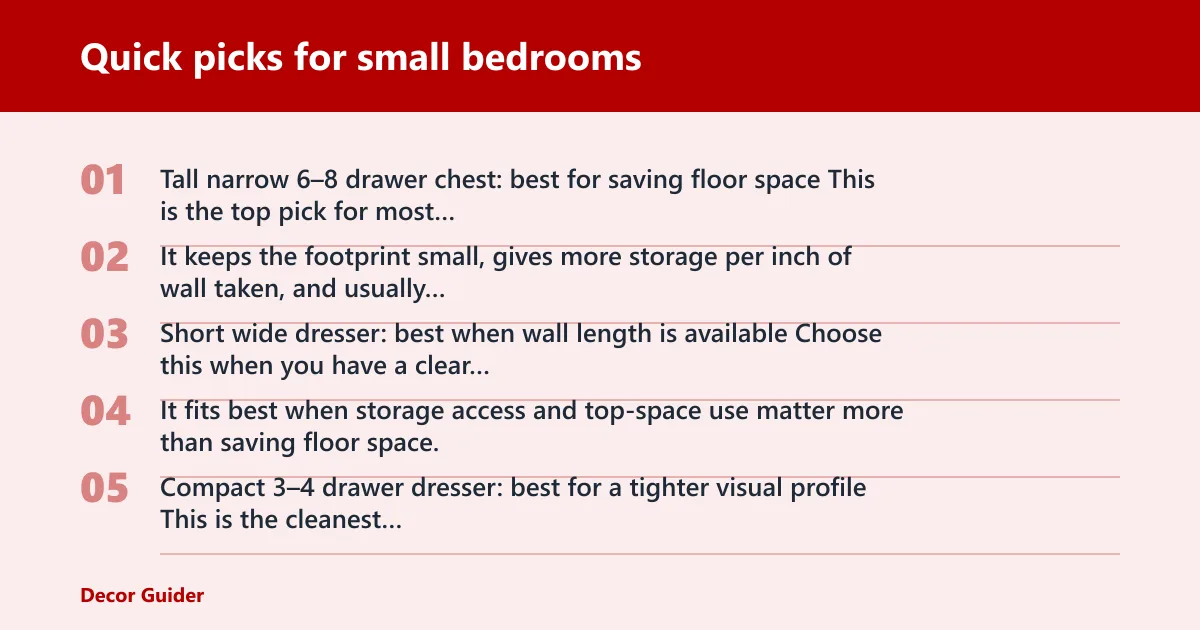
Tall narrow 6–8 drawer chest: best for saving floor space

This is the top pick for most small bedrooms because it uses height instead of floor area. It keeps the footprint small, gives more storage per inch of wall taken, and usually works best when the room has little open floor.
Short wide dresser: best when wall length is available
Choose this when you have a clear wall run and want a usable top surface for a lamp, tray, or mirror. It fits best when storage access and top-space use matter more than saving floor space.
Compact 3–4 drawer dresser: best for a tighter visual profile

This is the cleanest choice for minimalist rooms and guest rooms. It gives enough storage for folded basics without feeling heavy in a small plan, especially when the room also has a bed, desk, or chair.
Shallow depth dresser: best for narrow walkways and door swings
Pick this when the room’s main problem is depth, not width. It is the safest bet beside a bed, near a closet, or in any room where a standard dresser would crowd the walking path.
Quick comparison
| Product | Badge | Best for | Price | ||
|---|---|---|---|---|---|
|
Panana 5-Drawer Chest with 1 Door, Wooden Chest of DrawersPanana | Our pick | 5-Drawer · 1 Door · Wooden · Wheels | $100.99
Price as of 4 Oct 2026
|
View |
 |
FOTOSOK White Dresser, Dresser for Bedroom, Small DresserFOTOSOK | Budget pick | 23.6" L · 4-Drawer · Handleless · Compact | $99.99
Price as of 4 Oct 2026
|
View |
|
Karl home Black 3 Drawer Dresser, Modern Small Chest ofKarl home | Also great | 3-Drawer · Modern · MDF · Smooth Glides | $63.99
Price as of 4 Oct 2026
|
View |
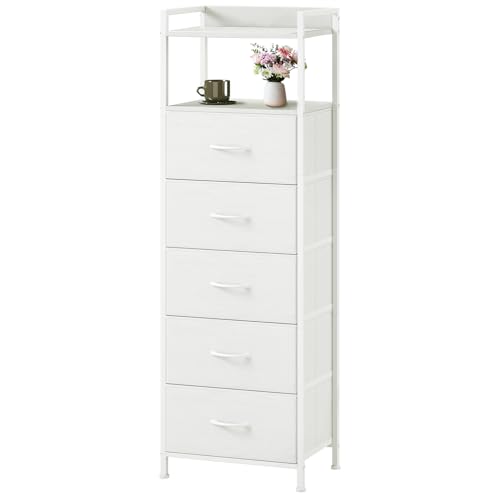 |
Somdot White Tall Dresser for Bedroom with 5 Drawers, TallSomdot | Upgrade pick | 5-Drawer · Tall · Fabric · Steel Frame | $49.99
Price as of 4 Oct 2026
|
View |
Use the comparison table to match the dresser style to the room constraint first. Storage count matters less than depth, wall length, and the swing of nearby doors.

How we chose
This guide weighs four things first: footprint versus storage ratio, fit around beds and doors, drawer glide hardware, and wall anchoring for safety. That is the order that matters in a small room.
It also gives more weight to failure cases than to style talk. A dresser that blocks a closet or crowds a walkway is the wrong dresser, even if the finish looks good.
Finally, the recommendations reflect the room problem each style solves best: floor-space savings, wall-length use, narrow-path clearance, or a low-profile look.
Tall narrow 6–8 drawer chest: best for floor-space savings
The best pick for most small bedrooms is a tall narrow 6–8 drawer chest because it uses floor space well and keeps the footprint small. The 2026 guide says tall narrow chests use height instead of width, which is exactly why they fit tight rooms so often.
This style fits best in rooms where wall length is limited but ceiling height is available. It is also the easiest way to get more storage without pushing a dresser into the bed path.
Why vertical storage works in small rooms
A tall chest gives you more storage per square foot of floor than a low, wide piece. That matters in apartments, shared bedrooms, and kids’ rooms where the open floor has to do more than one job.
Look for models that come with an anti-tip kit, especially in family bedrooms. The guide recommends anti-tip kits for tall narrow dresser options because tall furniture should be anchored when kids, pets, or tight traffic lanes are part of the room.
When drawer glide hardware matters most
Drawer glide hardware matters most when the chest is tall and used daily. Metal slides usually outperform basic wood runners, and that difference shows up in smoother opening, less sticking, and better long-term use.
For a small room, smooth drawers matter more than people expect. A sticky drawer that needs extra pull makes the dresser feel clumsy every day.
What to check for anti-tip kit inclusion
Check whether the dresser includes an anti-tip kit and whether wall anchoring hardware is part of the box. If it does not include one, budget for it before the purchase is complete.
This is not a nice extra. Tall furniture in a bedroom should be anchored when the dresser sits near a bed, crib, or narrow passage.
Short wide dresser: best for top-surface use
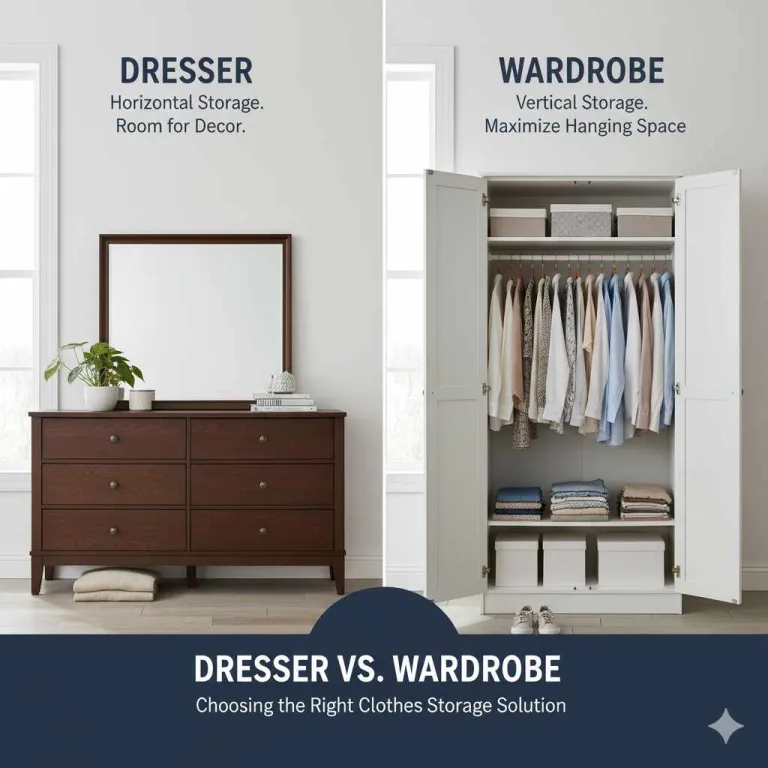
A short wide dresser works best when you have wall length to spend and want a useful top. It fits lamps, baskets, and a mirror well, but it asks more from the room because it takes a longer wall run and can feel bulky if the bed already dominates the space.
This style is often the right answer in master bedrooms and some shared rooms where the dresser is doing double duty as a display and daily-use surface.
When wall length makes this style practical
Measure wall length before choosing a dresser. The guide specifically recommends measuring the wall length first, because a dresser that is too long steals room from the bed, closet access, or walking path.
Featured options in the source set include dressers in a range of lengths, roughly from the high 20s to the upper 50s in inches. Those figures show how much spread there can be across pieces labeled for small spaces.
How deeper drawers change storage capacity
Short wide dressers often use deeper drawers, which can hold bulkier folded items better than very shallow drawers. That can be a real gain if the room needs one dresser to handle sweaters, denim, and bedding.
The tradeoff is visual bulk. A wide dresser can dominate a compact room even when it technically fits, so it works best when the wall is open and the bed side is not already crowded.
Why visual bulk matters in compact rooms
Bulk is not only about style. A long, tall front face can make a small bedroom feel cramped, especially if the dresser sits opposite the bed and reflects the room’s narrowness back at you.
When that happens, a compact dresser or a tall narrow chest is usually the better room-planning choice.
Compact 3–4 drawer dresser: is it enough for a small room?
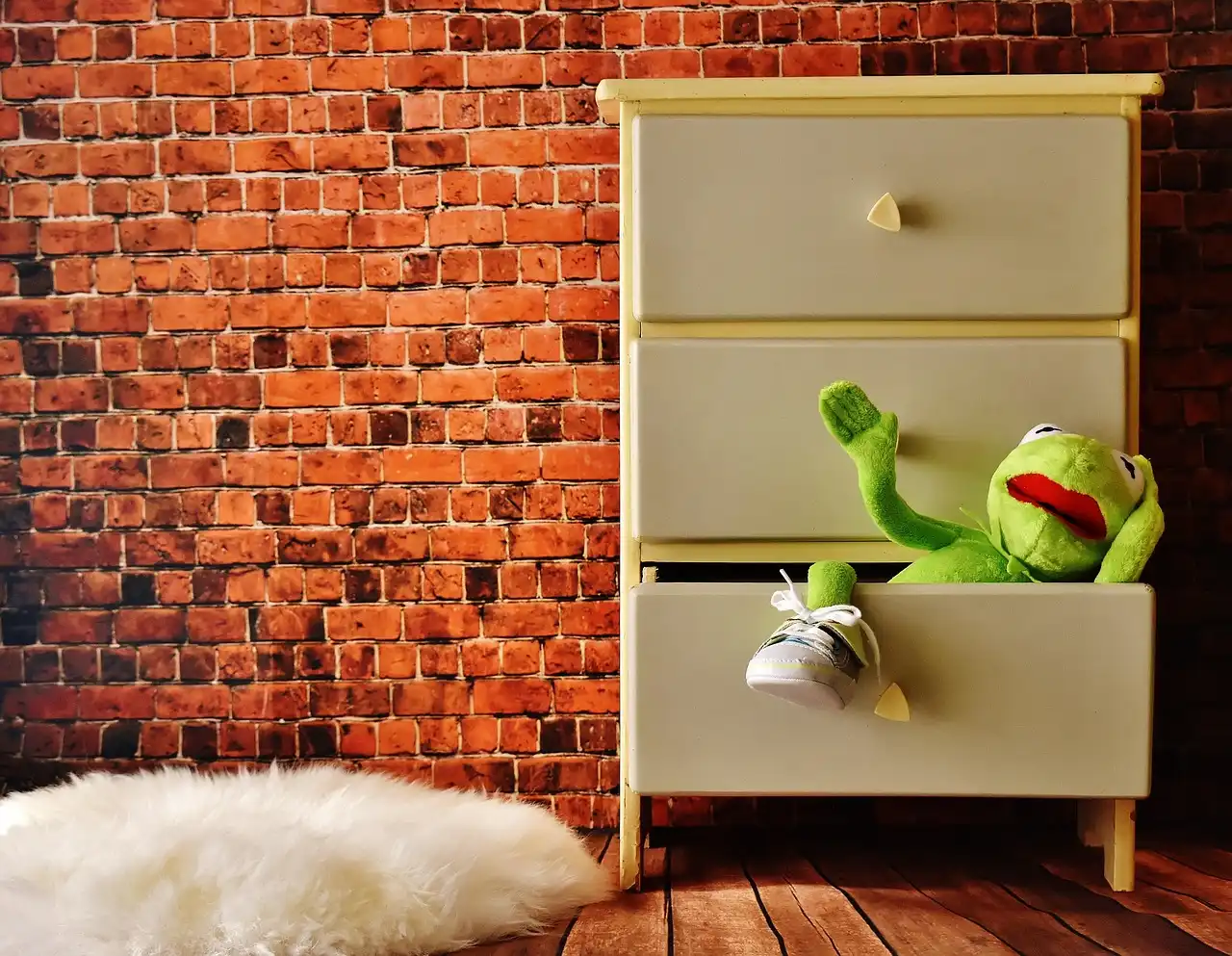
Yes, a compact 3–4 drawer dresser is enough for many small rooms when the storage need is moderate and the bedroom already has a closet. The 2026 guide frames compact 3–4 drawer dressers as a clean look choice for minimalist rooms, which makes them a good fit when the room needs to stay open.
Use this style when you need folded basics, not a full household of storage. It is the middle ground between a tiny chest and a full-size dresser.
Balanced proportions for tighter bedrooms
Compact dressers work because they keep a modest footprint without looking underfurnished. They usually sit well beside a bed or under wall art, and they do not demand the long wall span that a short wide dresser needs.
This makes them useful in rental bedrooms, guest rooms, and rooms that also hold a desk.
Drawer depth mix and real storage capacity
Do not confuse drawer count with usable storage. A compact dresser with a sensible drawer depth mix can store more than a shallow, multi-drawer piece if the drawers actually hold folded clothes well.
Check the drawer depth, not just the count. Shallow drawers can be fine for accessories, but they are weaker for bulkier clothing.
Best uses for a mirror or wall art above it
A compact dresser usually gives enough top height for a mirror or wall art above it without making the wall feel packed. That is one reason it works well in minimalist rooms: it fills the vertical zone without taking over the floor.
If the room already has a tall headboard or crowded wall décor, keep the dresser simple so the wall does not become visually busy.
Shallow depth dresser: when depth matters more than height
A shallow depth dresser is the right choice when the room is tight on depth, not just width. The 2026 guide notes shallow depth as important for clear pathways, and that matters near beds, closet doors, and bedroom doors that swing into the room.
This style often fits where a standard dresser would make the room feel pinched.
Clearance for walkways and bed-side placement
Check the open path beside the bed before buying. If the dresser sits in the same lane you use to reach the door or closet, shallow depth can preserve a usable walkway where a deeper piece would block it.
This is the safest route for very narrow bedrooms, studio corners, and tight kid rooms.
Closet and door swing compatibility
Door swing is where many small-room dresser plans fail. A dresser that fits against the wall can still be wrong if it stops a bedroom door from opening cleanly or clips a closet door when the door moves through its arc.
For that reason, shallow depth matters most when the dresser sits near a door edge or closet opening.
Internal drawer dimensions to verify before buying
A shallow dresser can solve the room problem, but it usually trades away some internal drawer size. That means fewer bulky items per drawer and a stronger need to fold efficiently.
Before buying, check the listed drawer depth and compare it with what you actually store. If winter sweaters or bulk bedding are part of the load, shallow drawers may feel cramped fast.
How do you measure if a dresser will fit?
Measure wall length, depth allowance, and height before buying, then check walkway clearance beside the bed and the swing of every nearby door. The safest dresser is the one that clears the room’s tightest point without crowding daily movement.
This is the part shoppers skip, and it is where the bad fits happen. The right number on paper still fails if the drawer can’t open or the door can’t swing.
One-page fit checklist
- Measure the wall length where the dresser will sit from baseboard to baseboard.
- Measure depth allowance from the wall to the first obstruction, such as bed frame, closet door, or room traffic lane.
- Measure the dresser height limit under windows, art, or sloped ceilings.
- Check bed-side clearance so the drawer can open without hitting the bed frame or nightstand.
- Map bedroom door swing and closet swing so the dresser does not block either arc.
- Compare the dresser’s width, depth, and height against the room’s tightest point.
- Confirm whether the dresser includes an anti-tip kit if it is tall.
- Check drawer glide hardware, with metal slides preferred over basic runners for daily use.
Simple decision matrix
| Room constraint | Best dresser style | What to verify first |
|---|---|---|
| Short on floor space | Tall narrow 6–8 drawer chest | Height, anti-tip kit, drawer glide hardware |
| Long open wall | Short wide dresser | Wall length, top-surface use, drawer depth |
| Narrow walkway | Shallow depth dresser | Depth allowance, door swing, bed-side clearance |
| Minimal visual footprint | Compact 3–4 drawer dresser | Drawer size mix, top height, wall space above |
Which one should you buy?
Choose the tall chest if the room is short on floor space and you need the best storage-to-floor-space ratio. Choose the short wide dresser if you have wall length and want a usable top surface for daily items.
Choose the shallow dresser if doors and walkways are the limiting factor. Choose the compact dresser if you want a smaller visual footprint and do not need a full storage wall.
Room-specific guidance
In a studio apartment, a tall narrow chest or shallow dresser usually wins because the same square footage must handle sleep and circulation. In a rented apartment, fabric drawer dressers can be good because they are light and slim, but they usually trade away durability and firm drawer action.
In a kids’ room, prioritize anti-tip protection and easy drawer operation. In a shared bedroom, pick the style that preserves the main path first, even if that means giving up some drawer count.
How to decorate small spaces
Start with fit, then keep the dresser visually calm. A dresser reads lighter when it sits on an open wall, clears the bed path, and does not crowd the door or closet swing.
Simple top styling works better than crowded décor in a small room. One lamp, one tray, or one mirror is usually enough; more objects can make the dresser feel larger than it is.
Frequently asked questions
What dresser style is best for a small bedroom?
For most small bedrooms, a tall narrow chest is the best starting point because it uses height instead of floor area. If the room is tight beside the bed or near a door, a shallow dresser may fit better. The right choice depends on the room’s tightest clearance.
Is a tall dresser better than a wide dresser in a small space?
Usually yes, if floor space is the main limit. A tall dresser keeps the footprint smaller and frees more floor for walking. A wide dresser wins only when you have enough wall length and need a more usable top surface or easier access to lower drawers.
How wide should a dresser be for a small room?
There is no single correct width, but the dresser must fit the wall without crowding doors or the bed path. Measure the wall first, then leave clearance for nearby swing zones and daily movement. A dresser that fits on paper can still fail if it blocks access.
What dresser works best beside a bed in a tight room?
A shallow depth dresser is often the safest pick beside a bed in a tight room because it protects walking space. If the bed side is generous and the wall is short, a compact dresser can also work. Depth is the key measurement here, not drawer count.
Should I choose a shallow dresser for a narrow bedroom?
Yes, if the main problem is walkway clearance or door swing. A shallow dresser reduces the chance of blocking access and can make a narrow bedroom feel less cramped. The tradeoff is smaller internal drawer size, so check what the drawers will actually hold.
Can a small-space dresser still provide enough storage?
Yes, if the style matches the storage load. Tall narrow chests store a lot without using much floor space, while compact dressers work well for folded basics. The mistake is buying by drawer count alone instead of checking drawer depth and layout.
Products related to this article
Sponsored / affiliate links. As an Amazon Associate I earn from qualifying purchases. I may earn additional commission from eligible campaigns.