How to Fix a Dresser Drawer That Rubs Against the Frame
To fix a dresser drawer that rubs, find the exact contact point first, then correct only that spot: tighten loose slides, remove a high spot with a hand plane or sandpaper, or shim a skewed runner. Ignoring the rub can wear the frame, chip the drawer side, and make the drawer stick harder over time. Wood movement from humidity is a common cause, so diagnose the fit before you sand. Sources commonly cited for this behavior include university extension woodworking guidance and manufacturer notes on wood acclimation and cabinet hardware tolerances.
This guide is part of our Dresser and Drawer Repair: Fixing Sticking Drawers, Slides, Smells and Finishes series.
Drawer rubbing quick check


Start with the drawer fully removed and the opening empty. Look for a front edge that scrapes, a top corner that catches, or a bottom corner that drags. If the drawer only rubs on one side, the problem is usually alignment, not a need for heavy sanding. In many cases, the fix is a small hardware adjustment rather than a broad wood removal step.
Some old dressers have no track system and drawers can slide straight out. Others use side-track hardware with a plastic lever that must be pushed up or down on both sides to release the drawer. Keep the opening supported as you pull it free.
What you’ll need
- Level
- Screwdriver
- Straightedge
- Sandpaper
- Clamp
- White candle, paraffin wax bar, or dry bar soap
- Silicone lubricant
- Wood filler or two-part epoxy such as Bondo
- Replacement screws or hardware, if needed
- Remove the drawer with the release method for its slide type, then set it on a flat surface.
- Inspect the rub point on the drawer front, sides, bottom corner, and rear edge.
- Clean out debris from the frame opening, slide, and runner path.
- Check whether a stop, bumper, or bracket is blocking travel.
- Tighten visible screws before changing wood, then retest the fit.
Why is my dresser drawer rubbing against the frame?
The most common causes are humidity swelling, a loose front screw, a slide that sits out of level, or a worn runner that no longer guides the drawer squarely. The rub point tells you which cause is most likely. Top-edge rubbing usually points to height or square issues. Bottom-corner rubbing usually points to sag, debris, or a bent track. Wood moves across seasons, so a drawer that fit in winter may bind in humid weather.
For a common repair case, a dresser drawer that only rubbed at the front right corner when closing was not fixed by sanding the whole side. The actual correction was a small front-slide adjustment and a tightened screw, which restored clearance without changing the drawer shape. That kind of symptom-specific fix is usually safer than removing wood blindly.
How to tell if the drawer box is swollen or out of square
Measure diagonally from corner to corner on the drawer box. Matching diagonals suggest the box is square; different numbers suggest a twist or racking. If the side panels feel tight against the opening after humid weather, wood expansion is likely. A swollen side usually rubs along a long section, not one tiny spot.
How to tell if the frame opening is out of square
Hold a level or straightedge against the cabinet opening and compare both side gaps. If the opening leans or the rails are not parallel, the drawer may be square but still bind in the frame. Check stop locations too, because a mispositioned stop can mimic a crooked drawer.
How to tell if the slide or runner is bent, loose, or mounted out of level
Look for a slide that bows, a runner that has worn grooves, or a mounting screw that sits proud. A bent or damaged metal slide rail can cause jerky or stuck movement and may need replacement. If the drawer is fine at the rear but rubs near the front, the front mounting point is a prime suspect. Cabinet-hardware manufacturers typically call for level mounting and consistent side clearances because even small misalignment can create binding.
Drawer rubbing matrix
This table helps you match the symptom location to the likely cause, the quickest test, and the safest fix. Stop sanding if the problem shows up in hardware, not wood. Do not sand here: the opposite side, the drawer face, or the whole edge when only one corner rubs. For installation tolerances, follow the slide maker’s instructions; even small side-to-side or vertical errors can cause drag.
| Symptom location | Likely cause | Test to confirm | Safest fix |
|---|---|---|---|
| Top edge | Drawer sits too high, opening is out of square, or finish buildup adds drag | Slide the drawer in slowly and mark the first contact point with chalk | Clean, wax, then lower or realign the slide before any sanding |
| Bottom edge or bottom corner | Bottom panel sag, debris in the path, or a stop rubbing underneath | Lift the front slightly; if the rub stops, the bottom is too low | Remove debris, check the bottom panel, then repair sag or add support |
| Left or right side | Loose front screw, worn runner, or drawer box not centered | Press the drawer face while closing; if the rub changes, alignment is shifting | Tighten screws, then shim or realign the runner |
| Front edge | Drawer face shifted, stop interference, or paint buildup at the opening | Open and close halfway; if the rub starts at the frame lip, inspect the front edge | Adjust the face, trim only the confirmed high spot, and clear the stop |
How do you fix a drawer that sticks on one side?
One-sided sticking usually means the drawer is being pulled out of square by a loose screw, a runner worn on one track, or a slide mounted slightly high on one side. Tighten the front attachment first. If the rub remains on the same side, the hardware or runner is still guiding the drawer off-line. This is the point where many repairs fail: the drawer is treated as a wood problem when the real issue is a shifted guide.
- Close the drawer halfway and tighten the front screws on both sides.
- Use a level to check whether the slide or runner tilts up on one end.
- Wax the wood-on-wood contact, then test again before removing material.
- Shim the low side by about 1/32 inch, then recheck the slide path.
- Replace the runner or slide if the same side still binds after adjustment.
Suppose a 24-inch dresser drawer sticks only on the left near the front. If tightening the left front screw helps for one or two pulls and then the rub returns, the mounting hole may be worn out. That calls for a shim, a moved screw hole, or replacement hardware. It is also a cautionary failure case: if a loose front attachment is ignored, the drawer often comes back out of square even after sanding the side.
How to fix the slide or runner
Side-mount, undermount, and ball-bearing slides all need level mounting and secure front attachment. If the slide is out of level, wax will not solve the problem. Match replacement length and hole spacing before buying new hardware, or the new slide will still bind. Hardware makers generally specify alignment tolerance because the drawer must travel straight, not just move freely by hand.
- Check the slide with a level from front to back and side to side.
- Inspect the front screw attachment for looseness or stripped holes.
- Compare the replacement length and hole spacing to the old hardware.
- Reinstall the slide with the front set first, then the rear, so the line stays true.
- If the wood runner is worn, replace the runner rather than forcing alignment with screws alone.
When do you need to replace the drawer runners instead of adjusting them?
Replace a runner when the guide surface is grooved, split, or worn so unevenly that the drawer rocks in the opening. A wood runner can be waxed if the wear is light. If the drawer still tilts, the runner is no longer giving a square path and should be rebuilt or replaced. Extension guidance on wood repair generally recommends replacement when wear is structural, not cosmetic.
What can I sand or plane on a drawer that rubs?
Only remove material at the confirmed rub point. Sand the high spot on the side edge, bottom corner, or front edge, not the full perimeter. A light pass is enough in many cases. Stop as soon as the drawer clears, because over-sanding weakens the fit and can create a new gap. The safest sequence is always diagnose, mark, then trim.
A common first-timer mistake is trimming the front edge of the drawer because it seems tight, instead of checking the rear corner where the wood is really rubbing on the frame. Mark the contact point first, then use a hand sanding block or plane on that spot only. Avoid power sanding unless the fit has already been proven and the area is broad enough to justify it. One failure pattern to avoid is sanding both sides equally; that can preserve the rub while increasing play.
How do I fix a dresser drawer bottom that rubs?
A rubbing bottom usually means the panel is sagging, the drawer is overloaded, or a stop is contacting the underside. Drawer bottoms can wear through because metal stoppers rub them over time. If the drawer is too heavy, the bottom may not hold without rubbing something below it. Bottom-panel repairs often need support first, then filler or patching if the wear is localized.
- Remove the drawer and check the bottom panel for sag or wear marks.
- Look for metal stoppers, a wood stop block, or a rubber bumper touching the underside.
- Reduce the load, then test whether the drag disappears.
- Repair the bottom support or replace the panel if it is thin or cracked.
- Add felt pads if the drawer needs to sit level and stop tipping forward.
How do I stop a drawer from scraping after painting?
Paint buildup often adds friction at the drawer front, side edges, or frame lip even when the hardware is fine. Scrape or sand only the fresh high spots, then test the fit dry before adding lubricant. If the paint bridged the gap, the drawer will drag at the first closing point. Finish thickness is a frequent cause of a drawer that used to fit but now catches only after refinishing.
- Open the drawer and inspect for drips, ridges, or thick finish at the rub point.
- Lightly remove only the cured buildup at the contact edge.
- Wipe away dust, then close the drawer slowly to confirm clearance.
- Add wax to wood-on-wood contact if the finish is now smooth but still slightly tight.
Common mistakes
Do not sand before you know which surface is rubbing. Do not put silicone or wax on a bent, broken, or out-of-level slide and call it fixed. Do not ignore a loose front screw, because it can shift the drawer face and create a new rub point. Silicone can be useful on some mechanical parts, but on wood contact it is often a poor first choice because it can contaminate surfaces and complicate future finishing.
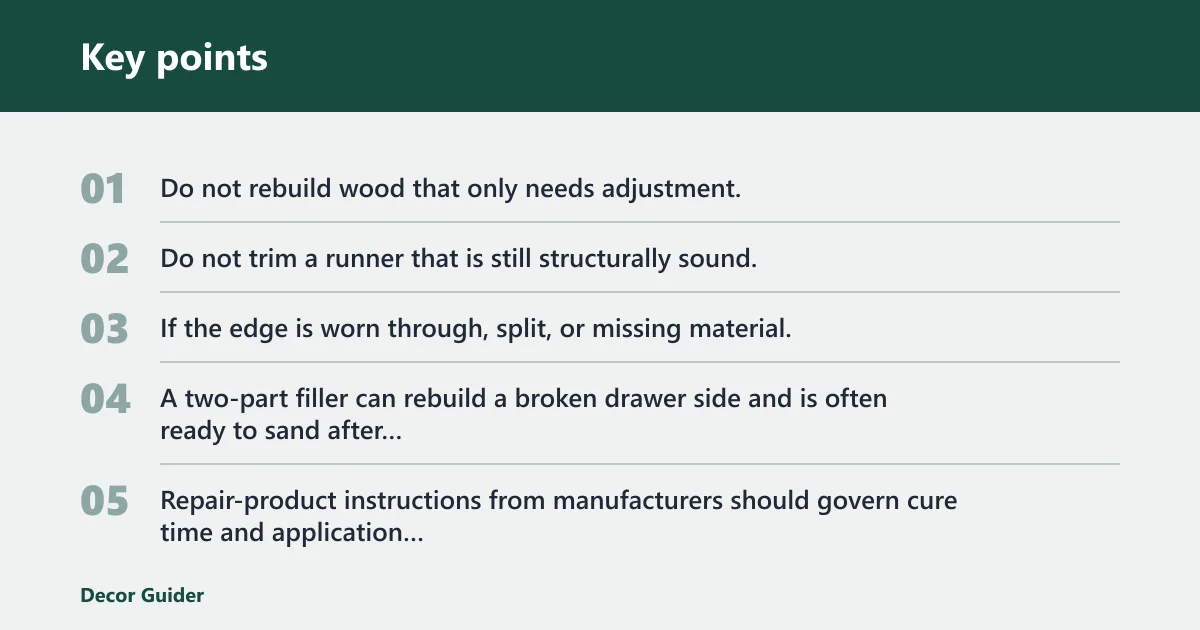
Do not rebuild wood that only needs adjustment. Do not trim a runner that is still structurally sound. If the edge is worn through, split, or missing material, move to repair instead of more sanding. A two-part filler can rebuild a broken drawer side and is often ready to sand after about 30 minutes. Repair-product instructions from manufacturers should govern cure time and application thickness; deep voids usually need layered repair rather than one heavy fill.
Can a loose front screw make a drawer rub the frame?
Yes. A loose front screw can let the drawer shift sideways or tilt at the opening, which can change the clearance at the front edge and one side rail. Tighten the screw first, then retest the drawer before sanding. If the hole is stripped, repair the hole so the screw can hold position again. This is a common cause of recurring rub after a seemingly successful fix.
What tools do I need to repair a rubbing dresser drawer?
Use a screwdriver, level, straightedge, sandpaper, and a clamp first. Add wax for wood contact, and keep wood filler or epoxy available for worn edges. A power sander is optional and should stay off the drawer until the exact rub point is confirmed. Replacement screws help when a front attachment is stripped. For repair products, follow the manufacturer’s labeling on cure time and sandability.
How to Fix Old Dresser Drawers that Stick — Most of the time a simple, strong tug will get the drawers unstuck
A strong tug is only safe after you confirm the drawer style. Some old dressers have no track system and the drawer can slide straight out; others use a release lever on both sides. If the drawer is stuck, pull evenly, clear the track, and then wax the wood contact before reinstalling it. If the drawer is binding because of a swollen side or warped runner, forcing it can split the corner joint.
How to Fix Dresser Drawers Bottom — You’ll be surprised at how simple the fixes are!
Start by checking whether the bottom panel is sagging, rubbing a stop, or overloaded. If the panel is intact, clean the contact area and add support where the wear is happening. A metal stop may be pounded farther into the wood, or a small wood stop can be screwed to the back of the drawer to catch the frame. If the panel is cracked, support alone will not hold the repair.
Frequently asked questions
How do I tell if the drawer is misaligned or swollen?
Compare the diagonals of the drawer box and check whether one side gap is tighter than the other. A swollen drawer usually rubs along a longer stretch after damp weather. A misaligned drawer usually changes sound or drag when you press on the face while closing it.
Should I wax the drawer or adjust the slides first?
Adjust first if the slide is loose, tilted, bent, or mounted out of level. Wax first only when the wood surfaces are sound and the drawer is already square. A make wooden drawers slide easier step is most effective when the drawer is structurally sound and just needs lower friction, not correction.
How do I fix a side-mount drawer slide that is out of level?
Loosen the mounting screws, set the slide level with a small level, and retighten the front attachment before the rear. If the slide remains crooked, check hole spacing and replace damaged hardware. Do not lubricate a slide that is bent or broken; replace it instead. Manufacturer installation sheets typically require level installation because tilt can cause bind even with the correct slide length.
Products related to this article
Sponsored / affiliate links. As an Amazon Associate I earn from qualifying purchases. I may earn additional commission from eligible campaigns.