How to Slide a Dresser on Carpet
To slide a dresser on carpet, empty it first, then use furniture sliders for low-pile carpet, a moving blanket or cardboard for very short repositioning, and for dressers over about 150 pounds, a second person plus a dolly is commonly safer. Dragging it bare can snag carpet, bend legs, and increase back and tip-over risk, especially on thick pile or at thresholds.
What you’ll need


Tools and supplies
- Furniture sliders designed for carpet use, sized for the dresser’s load
- Moving blankets or thick cardboard for short moves and turn points
- A dolly for very heavy dressers or tall wardrobes
- Work gloves with grip
- Painters tape or masking tape for marking a path
- A screwdriver for removing drawers if needed
- A helper, if one is available
Best way to move a dresser on carpet
Quick answer
Match the method to weight, carpet pile, and help. Low-pile carpet usually lets furniture sliders work well because they reduce friction. Plush carpet adds drag and can make a tall dresser tip if one side sinks more than the other. For very heavy pieces, a dolly is usually safer than dragging. The Consumer Product Safety Commission and workplace safety guidance from OSHA both emphasize keeping loads controlled and minimizing tipping hazards when moving bulky furniture.
| Dresser weight band | Carpet type | Number of helpers | Recommended method | Main risk |
|---|---|---|---|---|
| Under 100 lb | Low-pile | 1 | Furniture sliders under the legs or corners | Sliding too fast at turns |
| 100 to 150 lb | Low-pile | 1 to 2 | Furniture sliders, with moving blankets at thresholds | Foot or leg snagging |
| 100 to 150 lb | Plush | 2 | Moving blankets plus a controlled two-person lift | Tipping from uneven pile compression |
| Over 150 lb | Any carpet, especially plush | 2 or more | Dolly with drawers removed first | Back strain and tip-over risk |
| Very heavy or tall wardrobe | Any carpet | 2 or more | Dolly, not sliders | Side load on weak feet or finish scratches |
How to choose between sliders and a dolly
Use sliders when the dresser is light to moderate, the carpet is low-pile, and you can keep the piece level. Use a dolly when the dresser is heavy, tall, fully loaded, solid wood, or set on plush carpet. A dolly usually beats dragging because wheels carry the load instead of carpet fibers and feet. For longer routes, the National Safety Council recommends planning the path and avoiding unnecessary manual lifting.
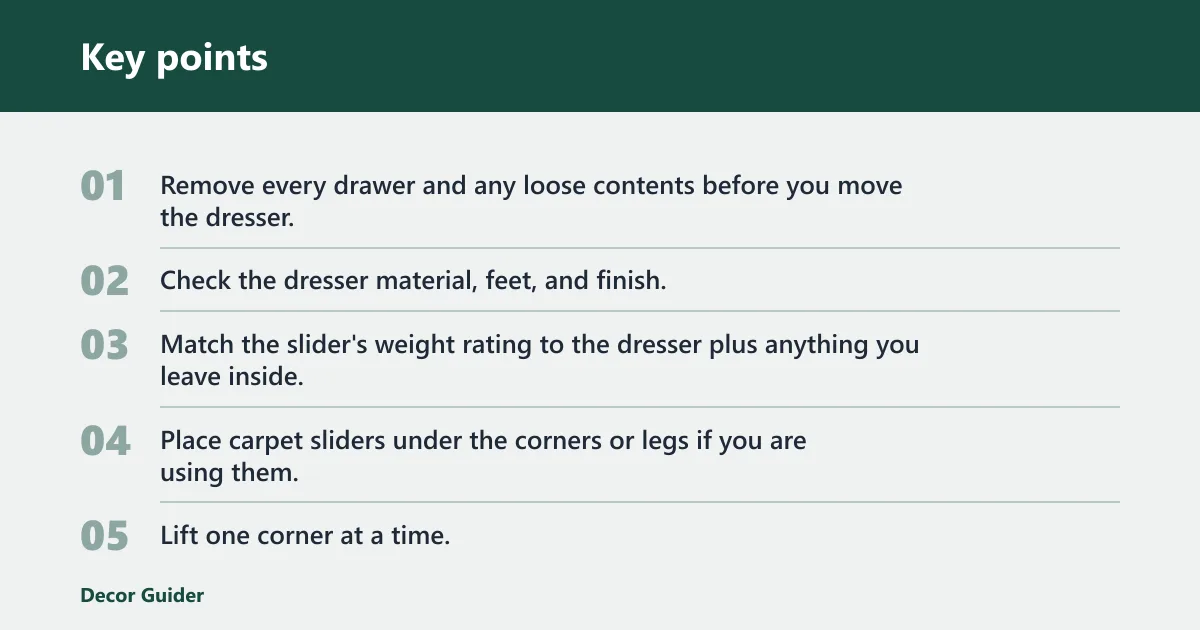
- Remove every drawer and any loose contents before you move the dresser.
- Check the dresser material, feet, and finish. Solid wood is heavier than MDF, and older dressers may have weaker feet or scratch-prone finishes.
- Match the slider’s weight rating to the dresser plus anything you leave inside. The rating should exceed the load, and the surface-specific capacity matters.
- Place carpet sliders under the corners or legs if you are using them. Reusable or disposable styles both work when the load matches the rating.
- Lift one corner at a time. Keep the dresser low, then slide it in short pulls instead of one long drag.
- Lay moving blankets at turns, thresholds, and landing points. They protect carpet from snagging and help spread the weight.
- Stop if one side starts to sink, tilt, or catch. Switch to a dolly if the dresser begins to tip or the carpet resists too much.
- Cross thresholds slowly with floor protection in place. Recheck slider position after each turn, then move again.
How do you move a heavy dresser with help?
Two-person strategy
With two people, stay slow and controlled. One person steadies the dresser while the other guides the path. That lowers tipping risk and helps keep the dresser level over carpet. For solid wood, vintage pieces, or anything over about 150 pounds, a dolly is usually the better option.
Two-person lift and slide
Keep the dresser low from the start. A high lift increases the chance of twisting a foot, stressing a weak leg, or scuffing the finish. Mirror-top dressers are especially unstable when raised too high because the top weight can shift quickly.
- Empty the dresser and remove drawers first.
- Place sliders under the corners or feet if the dresser is staying low to the carpet.
- Have one person lift at the left front corner and the other at the right front corner.
- Move together in one direction, then pause to reset before turning.
- Use a dolly if the dresser must go over thick carpet, a long hallway, or a sharp threshold.
Suppose a tall solid-wood dresser has a top-heavy mirror frame and sits on plush carpet. Two helpers can control the tilt better than one person, but a dolly is still safer because plush pile can compress unevenly and make the dresser lean.
Moving blankets help here too. Place one at the turn point so the legs or feet do not catch the carpet edge, and use another at the landing spot if you need to set the dresser down and reset.
How do carpet type and dresser weight change the method?
Weight, pile, and stability
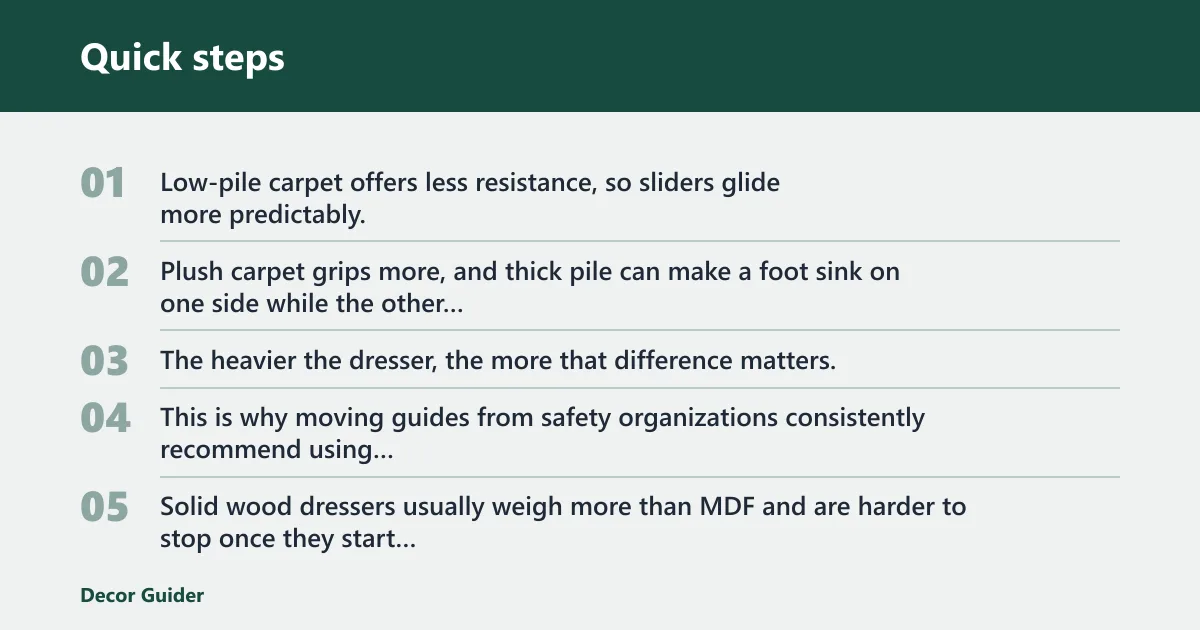
Low-pile carpet offers less resistance, so sliders glide more predictably. Plush carpet grips more, and thick pile can make a foot sink on one side while the other side keeps moving, which raises tipping risk. The heavier the dresser, the more that difference matters. This is why moving guides from safety organizations consistently recommend using mechanical aids when the load becomes awkward or unstable.
Material and construction checks
Solid wood dressers usually weigh more than MDF and are harder to stop once they start moving. Vintage dressers may have weaker feet, so avoid loading weight onto a narrow base. Finish also matters; lacquer, paint, and veneer can scratch when the piece shifts over grit, a raised seam, or a bare threshold. A wobbly leg or loose foot can splay outward during a turn and make the dresser skid sideways.
Furniture sliders work best when their pad size matches the foot size and their rating covers the full load. That includes the dresser itself and any contents left inside. A slider rated for a lighter chair is not enough for a loaded dresser. For example, many consumer sliders are sold in sets with load ratings that assume the full set is used together, not one pad under a single heavy corner.
Slider types and when to use them
Plastic cup sliders are best on carpet because they help heavy legs glide across fibers. Felt-based sliders are generally better for hard floors and can clog or drag on carpet, so they are not the best choice here. If the dresser has narrow feet, use a slider with a larger contact area so the leg does not punch through or sink into the pile.
How to protect carpet while moving
Thresholds and anti-tip precautions
Floor protection matters most at turning points, thresholds, and tight hallways. It protects carpet fibers, prevents drag marks, and helps the dresser glide across the places where snagging usually starts. At thresholds, keep the front edge supported so the dresser does not hang up and pitch forward. If the base catches, stop immediately instead of forcing it through.
Mini-checklist
- Remove drawers before lifting.
- Lay moving blankets at turn points and on threshold edges.
- Check for loose carpet seams, rugs, cords, and nail heads.
- Keep the dresser level while crossing door strips.
- Stop and reset if a slider folds under or a foot catches.
If that didn’t work, try this next
If the dresser will not move smoothly on sliders, switch to a dolly instead of forcing it. If the dolly still bogs down on carpet, shorten the route, remove any remaining load, and use a second person to steady the top while the other controls the wheels. That sequence is safer than adding force. For very short repositioning only, folded cardboard can help under one corner or two, but it should not be treated as a long-distance solution because it can buckle, bunch, or stop suddenly.
Common mistakes
Failure cases to avoid
Dragging a dresser bare across carpet is a common mistake and can snag fibers, leave drag marks, and strain weak feet. The next mistake is using sliders with the wrong load rating, especially when drawers are still inside. Another common error is moving a tall dresser alone on plush carpet. The base can sink unevenly, then the top starts to lean. A final mistake is crossing a threshold without floor protection, which often tears carpet or catches the front feet.
Prevention is simple: clear the drawers first, match the slider rating to the actual load, and use a dolly whenever the dresser is heavy, tall, or on thick carpet. That one choice prevents most damage.
What can be done if the move includes a wardrobe? Use the same rule, but treat it as the heavier and taller case. A wardrobe usually needs a dolly, at least two helpers, and extra floor protection at every threshold.
Frequently asked questions
What can I use to slide furniture on carpet?
Furniture sliders designed for carpet are the main option because they reduce friction under the corners or legs. For very short repositioning only, a moving blanket or cardboard can work as a temporary sliding layer. Make sure the surface can support the full load without folding, bunching, or catching on a threshold.
How to use furniture sliders on carpet
Lift one corner at a time, set the slider under the foot or leg, and repeat for the other corners. Match the slider rating to the dresser load, then move in short controlled pulls. Recheck the sliders after each turn so they do not twist out of place.
How to move a wardrobe on carpet
Treat a wardrobe as a tall, heavy dresser with a higher tipping risk. Remove contents, use a dolly, and keep at least two people on the move. Because the footprint is large, protect thresholds and turns with moving blankets so the base does not snag.
Products related to this article
Sponsored / affiliate links. As an Amazon Associate I earn from qualifying purchases. I may earn additional commission from eligible campaigns.
 Mavaol Heavy Duty Furniture Sliders, Reusable Floor Protectors, Foam and Plastic for Carpet and Hardwood, Easy Installation, Protects Flooring, 8 Pack (5 Inch)
 Furniture Sliders 4 Pack, 3.5 Inch Heavy Duty Reusable Furniture Moving Sliders for Hardwood Floors and Carpet, Beige Floor Protection Pads for Chairs, Sofas, Tables and Home Moving