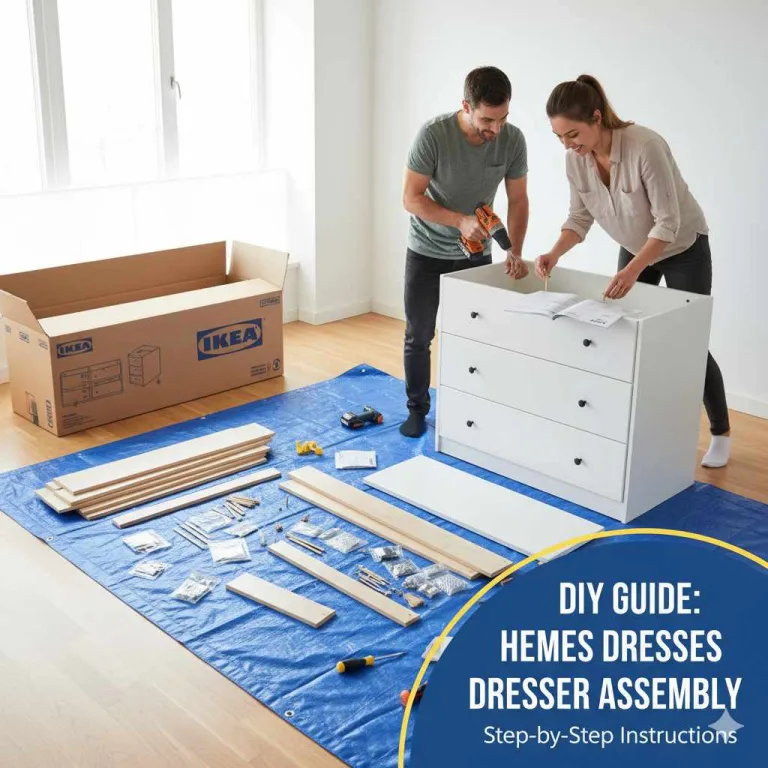
How to Anchor a Dresser on Carpet
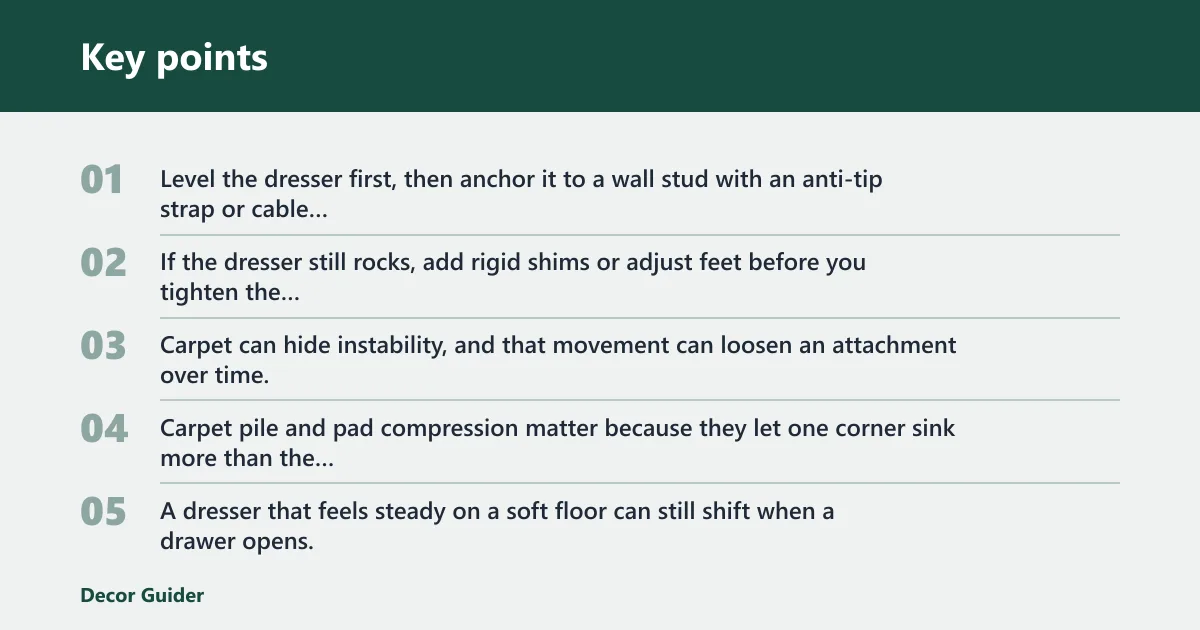
Yes. Level the dresser first, then anchor it to a wall stud with an anti-tip strap or cable long enough to reach solid framing, not drywall. If the dresser still rocks, add rigid shims or adjust feet before you tighten the hardware. Carpet can hide instability, and that movement can loosen an attachment over time.
Carpet pile and pad compression matter because they let one corner sink more than the others. A dresser that feels steady on a soft floor can still shift when a drawer opens, a child climbs, or the unit gets bumped. Wall attachment prevents tip-over, and leveling removes the wobble that makes the strap pull unevenly.
Quick answer


Wirecutter says securing furniture is essential to prevent tip-over accidents, and it ties that advice to the IKEA Malm and other chest recall. The CPSC video is cited as showing catastrophic furniture-tip injuries. That is why the safest plan is to fix the base on carpet first and then add restraint.
What you’ll need
- Anti-tip furniture anchor kit with a cable or strap design
- Metal hardware rather than plastic parts
- Included screws and mounting pieces matched to the kit
- Stud finder
- Drill and bits sized to the kit instructions
- Tape measure
- Level
- Shims or leveling feet if the dresser rocks on carpet
- Stud, drywall, or masonry wall hardware matched to the surface
- Painter’s tape or pencil for marking
Check the manufacturer’s listing or owner’s manual for the dresser’s attachment points before you buy hardware. Some kits include screws, but the screw diameter, length, and anchor type still need to match the wall and the furniture. Do not choose parts by guesswork when the kit specifies its own fasteners.
Dresser carpet decision table
| Carpet and dresser | Wall substrate | Rental or owned home | Safest setup | Leveling needed first? |
|---|---|---|---|---|
| Low-pile carpet, solid wood dresser | Stud | Owned home | Metal anti-tip strap or cable to a stud, using kit hardware | Only if the dresser rocks |
| Low-pile carpet, particleboard dresser | Stud | Rental or owned home | Stud-mounted strap or cable; keep drawers from shifting the load | Often yes, if the base is uneven |
| Plush carpet, solid wood dresser | Stud | Owned home | Level with shims or feet, then mount to a stud with a metal strap | Yes, before anchoring |
| Plush carpet, particleboard dresser | Stud | Rental or owned home | Level first; use the kit’s two-point connection to a stud | Yes |
| Any carpet, dresser near brick or concrete wall | Masonry | Owned home | Masonry anchor only with compatible hardware | Yes if the dresser wobbles |
| Any carpet, no stud available | Drywall only | Rental or owned home | Use a drywall anchor only if the kit and manual allow it; do not treat it as a universal fallback for tip-over restraint | Yes, if movement exists |
Low-pile carpet usually compresses less than plush carpet, so the dresser may be less likely to rock. Particleboard dressers deserve extra caution because fasteners can pull out more easily than from solid wood. In both cases, the wall attachment still does the real tip-over work.
What kind of wall anchor works behind a dresser?
A wall stud is usually the first choice because it is generally the strongest place for screw-mounted hardware. If the dresser is in front of brick or concrete, use a masonry anchor with compatible hardware. Drywall anchors are generally lower-strength and are not a universal fallback for dresser tip-over restraint.
That matters behind a dresser because the fastener has to resist a forward pull when drawers are open. The same source notes ASTM furniture standards test against a 50-pound pulling force, and Wirecutter prefers the Quakehold and Hangman kits because they need no periodic tightening. The wall must hold that load path without relying on the carpet or the dresser’s weight alone.
The Hangman TK-400 Anti-Tip Kit is rated by the maker to support up to 400 pounds, and Wirecutter describes it as all-metal and flexible enough for easy installation. Quakehold 2830 uses overlapping brackets and a through-cable; Wirecutter says the cable can withstand 1,000 pounds of force by company claim.
How do you keep a dresser from tipping on plush carpet?
Start by stopping the wobble. Plush carpet and pad compression can make one front corner settle more than the others, which shifts the dresser every time a drawer opens. Level the base first, then anchor it to the wall so the strap does not pull against a leaning cabinet.
Say your bedroom dresser wobbles when one rear leg sinks slightly into plush carpet. A shim under that corner can remove the movement, while the wall strap prevents tip-over. If you skip the shim, the strap may stay loose on one side and load the hardware unevenly.
Step 1: Find the stud and clear the wall
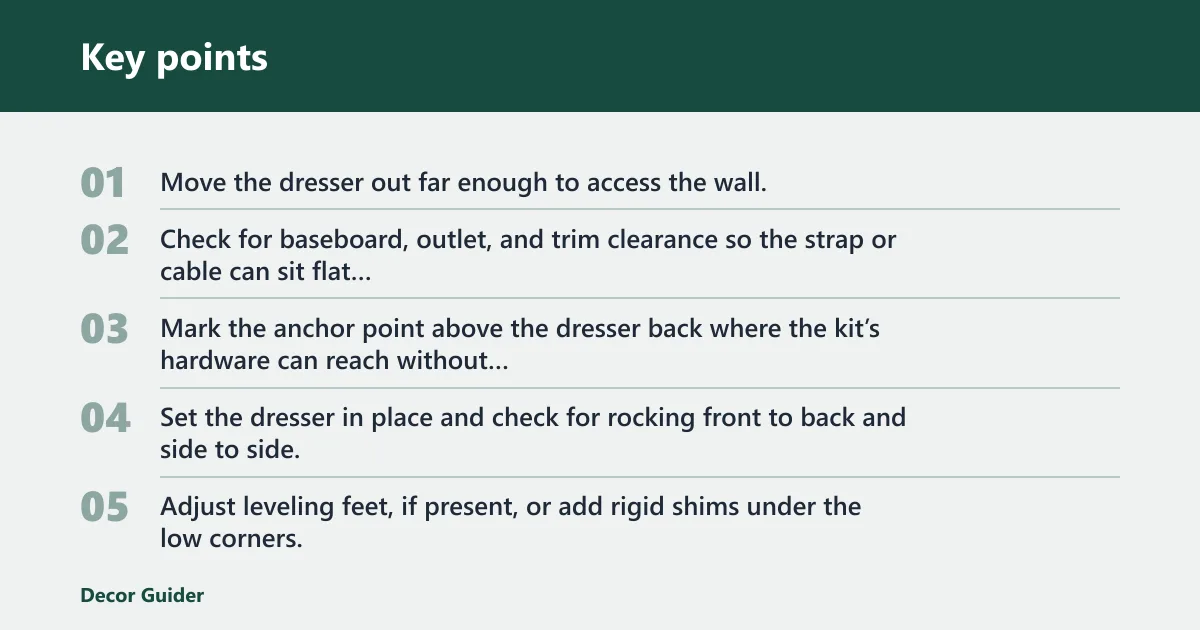
- Move the dresser out far enough to access the wall, then use a stud finder to mark the stud center.
- Check for baseboard, outlet, and trim clearance so the strap or cable can sit flat behind the dresser.
- Mark the anchor point above the dresser back where the kit’s hardware can reach without bending around trim.
If the wall is masonry, mark the anchor location only after confirming the surface is brick or concrete. Do not use a drywall anchor in place of a solid stud when the kit or dresser manual calls for structural attachment.
Step 2: Level the dresser on carpet
- Set the dresser in place and check for rocking front to back and side to side.
- Adjust leveling feet, if present, or add rigid shims under the low corners.
- Add the shim in about 1/8-inch increments, then recheck the drawers and the rocking before adding more.
Leave enough clearance for the strap or cable after leveling. If the dresser sits too close to the wall, the hardware can rub on trim or sit at an angle that weakens the connection.
Step 3: Install the anti-tip strap
- Attach the furniture side first at the manufacturer’s specified points.
- Attach the wall side to the stud, or to masonry hardware if the wall is brick or concrete.
- Tighten the strap or cable so it is snug, then close and open the drawers to confirm nothing binds.
Follow the kit instructions and the dresser manual for the exact attachment points. Some kits use a cable with overlapping brackets; others use a two-point strap that adjusts in length. Metal parts are preferred over plastic for durability, and easy removal by children is part of the design of many anti-tip kits.
How to secure furniture on carpet
Secure furniture on carpet by treating the floor as a stability problem, not an anchor point. Check for wobble, fix height differences with shims or feet, then connect the furniture to a stud with the kit’s wall hardware. Carpet and pad do not replace wall anchoring, and they do not keep a top-heavy dresser from tipping.
Picture a tall dresser on plush bedroom carpet with drawers that glide smoothly but the cabinet still shifts when one bottom drawer is opened. The fix is not a floor tie-down. It is a level base, then a two-point connection from dresser to wall that matches the substrate behind it.
Common mistakes
These errors cause most failures. Avoid them before you tighten the strap.
- Using a hollow-wall anchor where a stud is required. A drywall anchor is not a universal substitute for tip-over restraint. Use one only when the kit and manual allow it.
- Skipping leveling on compressible carpet. If the dresser rocks, the anchor can end up carrying uneven load.
- Mounting too low. Leave room for the strap, cable, and baseboard so the hardware does not bind.
- Ignoring the kit instructions or dresser manual. Use the specified attachment points and included hardware whenever possible.
- Choosing flimsy plastic parts. Wirecutter recommends metal hardware rather than plastic for durability.
If the dresser is in a rental, choose wall-only installation that does not involve the floor. Do not drill into the floor. Use wall attachment, and repair only the wall holes that your lease allows.
If that didn’t work, try this next
If the dresser still shifts after the strap is installed, move to the more secure wall option allowed by the surface. A stud is still the preferred point. If you only have drywall, check the kit manual for a permitted drywall anchor and match the screw diameter and load to that anchor exactly.
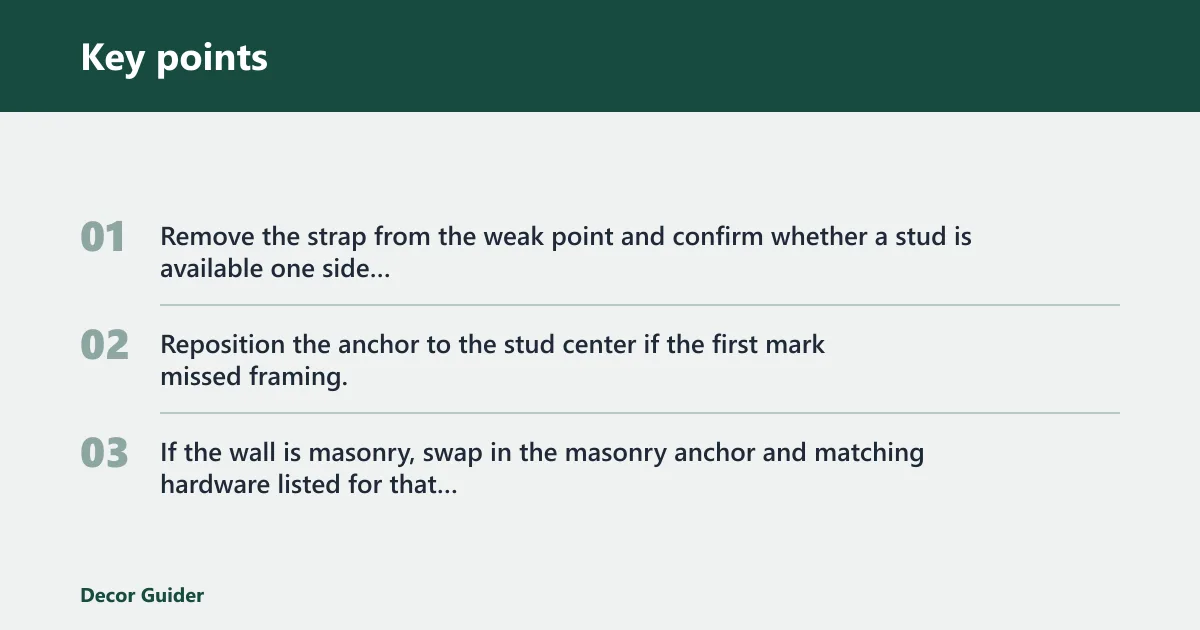
- Remove the strap from the weak point and confirm whether a stud is available one side over.
- Reposition the anchor to the stud center if the first mark missed framing.
- If the wall is masonry, swap in the masonry anchor and matching hardware listed for that surface.
Drywall anchors are lower-strength than studs, so they belong only in the limited cases allowed by the kit or furniture maker. A common first-timer mistake is assuming any toggle or expansion anchor is good enough. It is not unless the product documentation says so.
Frequently asked questions
Do I need to anchor a dresser if it sits on carpet?
Yes. Carpet can hide wobble, but it does not stop a top-heavy dresser from tipping when drawers open or when the unit is bumped. Anchor it to a stud whenever possible, and level the base first so the strap does not fight a rocking cabinet.
Can I anchor a dresser without drilling into the floor?
Yes. Anchor it to the wall, not the floor. A wall stud is the preferred point, and a masonry wall needs masonry hardware. Carpet, pad, and the floor under the dresser are not substitutes for wall attachment.
What hardware is best for an anti-tip dresser on carpet?
Choose a metal anti-tip furniture anchor kit with a strap or cable, included screws, and hardware matched to the wall substrate. Wirecutter prefers the Quakehold and Hangman kits because they need no periodic tightening, and metal hardware is more durable than plastic.
How to anchor a dresser to wall if the dresser is heavy
Use the dresser’s specified attachment points, then fasten the wall side into a stud or approved masonry point. Heavy does not mean safe on its own. Check the owner’s manual for the correct spots, because the furniture frame must accept the load without splitting or pulling out.
Products related to this article
Sponsored / affiliate links. As an Amazon Associate I earn from qualifying purchases. I may earn additional commission from eligible campaigns.