How Deep Is a Standard Dresser?
A standard dresser is usually 18 to 20 inches deep overall, though compact styles can be about 16 inches and larger pieces can reach 22 to 24 inches. If you guess wrong on depth, you can block walking space, crowd a bed, or leave drawers stuck before they open fully. This guide breaks down overall dresser depth, usable drawer depth, and the clearance you need in a bedroom. Common furniture specs from brands such as IKEA, Wayfair, and Pottery Barn generally place full-size dressers in that band, and space-planning guidance from sources such as the NKBA and Furniture Today commonly calls for about 30 to 36 inches of front clearance for comfortable use.
Standard dresser depth
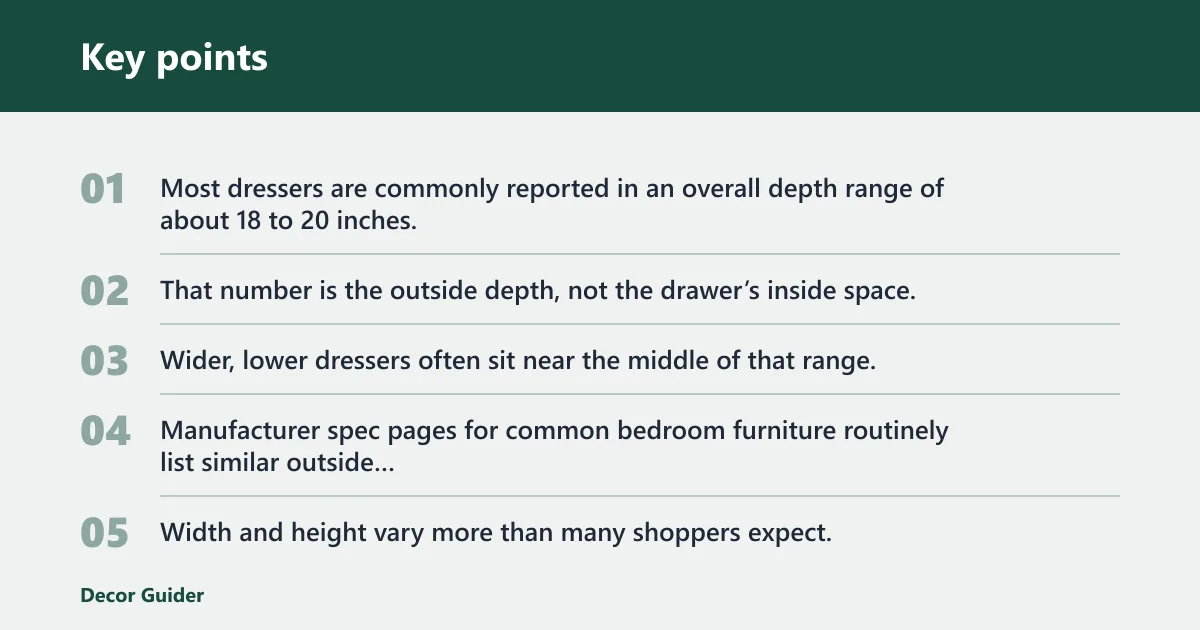


Most dressers are commonly reported in an overall depth range of about 18 to 20 inches, measured from the front face to the farthest back point. That number is the outside depth, not the drawer’s inside space. Wider, lower dressers often sit near the middle of that range, while taller chests can be slightly shallower to save floor space. Manufacturer spec pages for common bedroom furniture routinely list similar outside depths, especially for low dressers and double dressers.
Width and height vary more than many shoppers expect. A common dresser may be 48 to 60 inches wide and 30 to 36 inches high, while a taller chest can be 30 to 40 inches wide and 45 to 60 inches high. The depth changes with style, drawer layout, and hardware, but the overall footprint is usually driven by how much front-to-back room the drawer boxes and slides need.
Say your wall space allows only 19 inches of depth. A dresser listed at 18.5 inches deep may fit on paper, but drawer handles, base molding, or a nearby door swing can still create trouble. Measure the full path from wall to room traffic, not only the wall. That is especially important when a room also has a bed corner, closet door, or an outlet that projects into the same zone.
How deep is a standard dresser?
“Standard” usually means common retail sizing, not one fixed dimension. In product listings, a standard dresser is often listed as a 6-drawer low dresser around 18 to 20 inches deep, 30 to 36 inches tall, and 48 to 60 inches wide. A 9-drawer version is often wider and may be built for the same or slightly greater depth. That matches the way many manufacturers publish bedroom storage dimensions in their spec sheets.
Drawer count changes proportions. A 6-drawer dresser usually spreads drawers across two columns and tends to be lower and wider. A 9-drawer dresser often uses three columns and needs more width, but depth often stays in the same general band because the front-to-back footprint is driven more by drawer construction than by drawer count.
Tall chests are different. They usually trade width for height, so you may see a chest that is 30 to 40 inches wide, 18 to 20 inches deep, and 45 to 60 inches high. Deep, low double dressers can feel bulky because they combine a long front with the same 18 to 20 inch depth.
How deep is a standard dresser drawer?
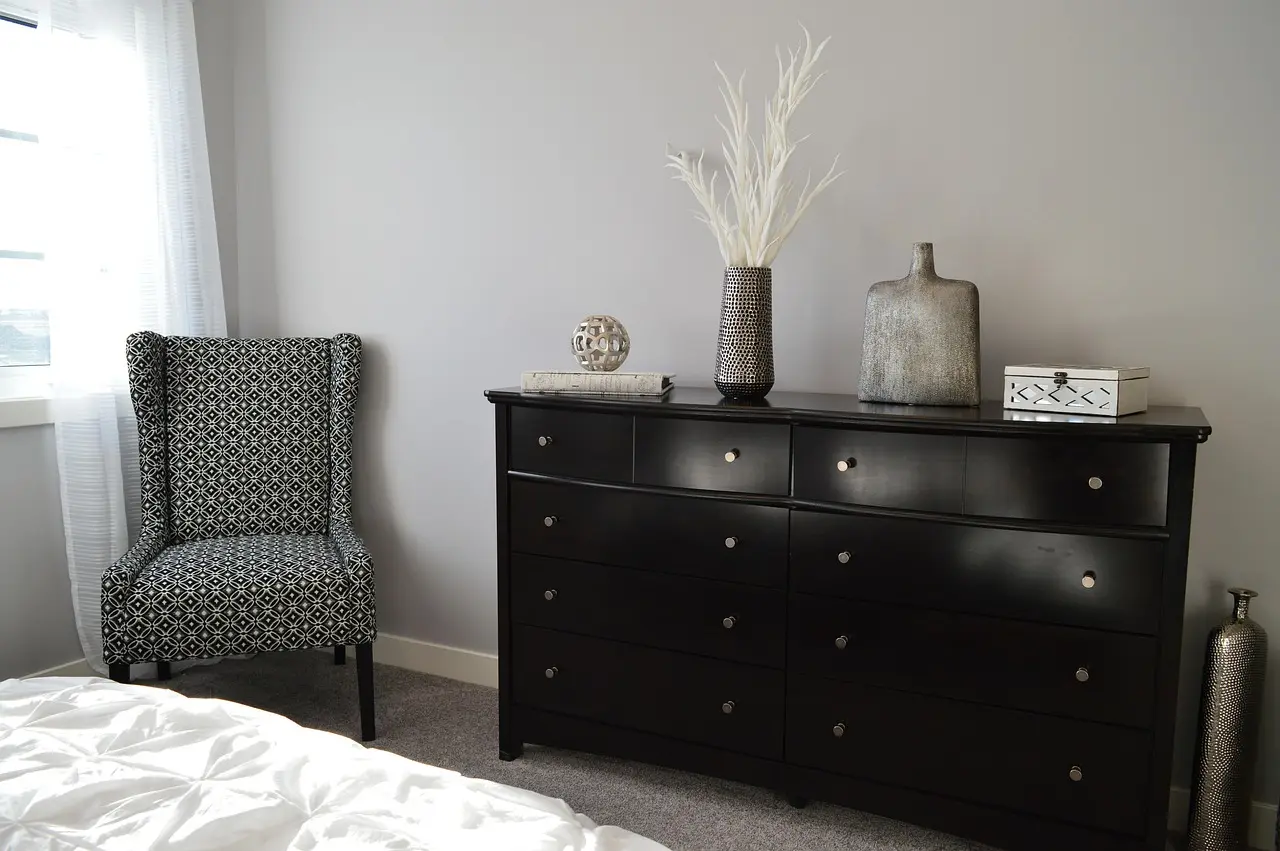
A standard dresser drawer is usually shallower than the dresser body. Usable drawer depth is often around 13 to 18 inches front to back, depending on the slide system, drawer-box design, and back-panel construction. The exterior dresser depth includes the front frame, cabinet back, and any rear clearance the drawer needs to move. Interior depth explanations on the usable drawer depth page help separate the outside cabinet measurement from the storage space you can actually use.
Drawer slides matter. Side-mount slides commonly come in lengths such as 10, 12, 14, 16, 18, and 20 inches, and the drawer box usually needs to match the slide length or stay within its travel limits. Undermount slides are also sold in common lengths, and full-extension hardware lets the drawer travel close to its full slide length. Those lengths are consistent with hardware catalogs from makers such as Accuride, Blum, and Knape & Vogt.
The usable space inside a drawer is not the same as the outer cabinet depth. A dresser carcass may be 19 inches deep, but the drawer’s clear interior depth can be several inches less after you subtract the front panel, the back panel, and hardware clearance. Back panels and drawer stops trim space quickly, which is why spec sheets often distinguish between cabinet depth and interior drawer depth.
Picture a dresser that is 19 inches deep overall with 16-inch slides. The drawer may open fully, but the usable inside depth may still land near 14 to 15 inches once panel thickness and fitting clearance are counted. That difference matters if you store folded shirts, sweaters, or dividers that need a fixed inside length.
Dresser drawer size table
This table compares common dresser types by overall size, the space you can typically use inside the drawer, and the front clearance needed for comfortable drawer use. The clearance figures assume you want enough room to open drawers without forcing them against a bed, wall, or door. Furniture and space-planning guidance commonly places usable front clearance at 30 to 36 inches for dresser access.
| Common dresser type | Typical width | Typical depth | Typical usable drawer depth | Typical height | Drawer count | Minimum front clearance | Best room/use case |
|---|---|---|---|---|---|---|---|
| Low dresser | 48-60 in / 122-152 cm | 18-20 in / 46-51 cm | 13-18 in / 33-46 cm | 30-36 in / 76-91 cm | 6 | 30 in / 76 cm | Main bedroom storage when wall width is available and you want a surface for a mirror or decor |
| Double dresser | 60-72 in / 152-183 cm | 18-20 in / 46-51 cm | 13-18 in / 33-46 cm | 30-36 in / 76-91 cm | 6-9 | 30-36 in / 76-91 cm | Shared bedroom storage or a larger wall where you need maximum drawer count in a low profile |
| Tall chest | 30-40 in / 76-102 cm | 18-20 in / 46-51 cm | 13-18 in / 33-46 cm | 45-60 in / 114-152 cm | 5-7 | 30 in / 76 cm | Tight bedrooms, small apartments, or rooms where floor space matters more than top surface area |
| Wide chest | 36-48 in / 91-122 cm | 18-22 in / 46-56 cm | 13-18 in / 33-46 cm | 48-60 in / 122-152 cm | 6-8 | 30-36 in / 76-91 cm | Rooms that need vertical storage with a narrower footprint than a long dresser |
| Compact dresser | 30-42 in / 76-107 cm | 16-18 in / 41-46 cm | 11-15 in / 28-38 cm | 28-34 in / 71-86 cm | 3-5 | 28-30 in / 71-76 cm | Small bedrooms, guest rooms, and narrow walkways where a full-size dresser would crowd circulation |
How do you measure dresser depth?
Measure dresser depth from the very front to the farthest back point on the outside. Use a tape measure at floor level, then repeat near the top if the back panel or trim projects differently. That outside measurement is what most spec sheets mean when they list depth.
Then check whether the listing also gives internal drawer dimensions. Manufacturers may use terms such as overall dimensions, product dimensions, or interior drawer dimensions. Those numbers are not interchangeable, and a product sheet that lists only outside size does not tell you how much usable drawer space you get. If a product page includes interior measurements, compare those with the usable drawer depth page before you assume bins or folded clothing will fit.
- Measure the wall space where the dresser will sit.
- Measure the full front-to-back outside depth of the dresser spot.
- Check the drawer pull path in front of the dresser.
- Compare the listing’s exterior dimensions with any interior drawer dimensions.
- Confirm the room still leaves walkway space after the drawers open.
Use inches and centimeters if you compare listings from different retailers. A quick conversion helps avoid mistakes: 18 inches is about 46 cm, 20 inches is about 51 cm, and 24 inches is about 61 cm. If a spec sheet gives only centimeters, convert before you order.
What clearance does a dresser need?
A dresser usually needs about 30 inches, or roughly 76 cm, of clear space in front of it so drawers can open comfortably. For larger drawers, 36 inches, or about 91 cm, is safer. The exact amount depends on drawer depth, slide extension, and whether the room has a door, bed, or traffic path nearby. Space-planning guides commonly use 30 to 36 inches as a practical minimum for access in front of storage furniture.
Door swing matters too. If a closet door or bedroom door opens toward the dresser, you need enough room for both the door arc and the drawer pull-out space. In a narrow room, that can be the difference between a practical layout and one that keeps catching on the same corner.
A common first-timer mistake is measuring only the wall where the dresser sits and ignoring the open floor in front of it. A 19-inch-deep dresser with a 16-inch drawer pull can still feel tight if the bed edge leaves only 24 inches in front. That setup may technically fit and still feel awkward every day.
For rentals or narrow rooms, plan the route before buying. Leave enough room to stand in front of the dresser, open the top drawers, and still pass by without turning sideways. If the room is tight, a shallower compact dresser or a taller chest may work better than a wide low piece.
How to choose the right dresser depth for your room
Use this quick checklist when deciding between a standard dresser, a compact dresser, or a taller chest:
- If the room is tight or the dresser sits near a bed corner, lean toward 16 to 18 inches deep.
- If you need a comfortable walkway in front, target at least 30 inches of clear space; choose 36 inches if drawers are large or the room is high-traffic.
- If a door swings toward the dresser, check the door arc first and avoid a depth that forces the door to stop short.
- If the room is narrow but you still need storage, choose a tall chest instead of a wide low dresser.
- If you want a surface for a mirror, lamp, or daily-use items, a low dresser usually works better than a chest.
What affects dresser depth?
Slide hardware, back-panel construction, and style all affect the final depth. Side-mount slides usually need lateral room inside the cabinet, while undermount hardware can alter how the drawer box sits and how much of the cabinet depth becomes usable storage. The slide length also limits how far the drawer can travel, which is why hardware catalogs matter when you compare product listings.
Manufacturers often build in rear space for clearance, stop blocks, and structural backing. That means a dresser can be 19 inches deep outside even if the drawer box inside is only 14 to 16 inches deep. The gap is not wasted space; it often exists so the drawer opens and closes correctly.
Style changes the footprint too. Low dressers and double dressers tend to use more width with similar depth. Tall chests keep the same general depth but stack storage vertically. Compact styles can drop to 16 inches deep, while larger statement pieces may reach 22 to 24 inches deep.
Suppose a 9-drawer dresser is listed at 22 inches deep and 72 inches wide. That extra depth may support larger drawers or a heavier frame, but it also needs more room in front of the dresser and more clearance along the sides if the room is narrow. Bigger furniture can solve storage and create a traffic problem at the same time.
Frequently asked questions
How deep is a typical dresser?
A typical dresser is generally 18 to 20 inches deep, 48 to 60 inches wide, and 30 to 36 inches high. That range covers many low dressers and double dressers, but tall chests may be narrower and sometimes slightly shallower to fit smaller bedrooms. When in doubt, compare the dresser to your clearance and walkway needs, not just the catalog photo.
How long is a standard dresser?
A standard dresser is usually 48 to 60 inches long, or wide from left to right, for a common low dresser. Double dressers can stretch to 72 inches or more. The width changes more than the depth, so room planning should always account for both measurements. A long dresser can fit the wall but still fail the walkway test.
How big is a standard dresser?
A standard dresser is often around 48 to 60 inches wide, 18 to 20 inches deep, and 30 to 36 inches high. That is only a common retail range, not a fixed size. Drawer count, style, and manufacturer choices can shift every dimension. The safest approach is to match the dresser to the exact floor space you have available.
How deep should a dresser be?
A dresser should be deep enough to fit the items you plan to store and shallow enough to leave safe walking room in the bedroom. For many rooms, 18 to 20 inches is the most practical range. If the room is tight, a 16-inch-deep dresser may be easier to live with, especially when paired with at least 30 inches of front clearance.
Products related to this article
Sponsored / affiliate links. As an Amazon Associate I earn from qualifying purchases. I may earn additional commission from eligible campaigns.