How to Measure Dresser Pulls for Replacement Hardware
Measure dresser pulls by center-to-center hole spacing on two-screw hardware. For knobs and single-screw pulls, use the existing hole location, drawer-front thickness, and the required screw diameter/thread to choose a replacement; use overall diameter and projection only for clearance, coverage, and style fit. The wrong size can leave holes exposed or force new drilling. This guide shows how to identify the pull type, measure the correct dimension, and buy a replacement that fits.
Identify pull type and measure center-to-center spacing


Identify the hardware type first
Start by determining whether you are replacing a two-hole pull, a single-hole pull, or a knob. Two-hole pulls are matched by center-to-center spacing. Single-hole hardware is matched by the mounting point and screw requirements. Knobs are usually chosen for coverage and fit, especially when old spacing is odd or discontinued.
What you’ll need
- Ruler or tape measure
- Screwdriver
- Cabinet hardware jig
- Wood filler
- Bondo
- Wood epoxy such as KwikWood
- Sandpaper
- Primer
Measure the existing pull
- Remove the pull and clean the area so painted edges or grime do not hide the hole centers.
- Measure two-hole pulls from the center of one hole to the center of the other. That center-to-center measurement is the spec to buy against.
- For knobs and single-screw pulls, measure the existing hole location, the drawer-front thickness, and the required screw diameter/thread; check overall diameter and projection only for fit and coverage.
- Record the size before you shop, and note whether the old screws are missing, bent, painted over, or partly damaged.
Suppose a dresser has two holes that measure 3 inches center to center. A 3-inch pull should line up without redrilling, even if the old handle looks longer from edge to edge. The outside shape does not tell you whether the screws will land in the same spots.
If the old pull is missing screws or has damaged ends, measure the hole centers on the drawer front instead of the hardware body. The holes in the wood are the reference point. For knobs and single-screw pulls, the hole location and screw specification matter more than the decorative diameter.
Check whether the replacement size is still sold
Compare the measured spacing against the replacement listing before you buy. Some old dresser hardware uses odd or large sizes that are hard to replace, so a direct swap may not exist. If the size is discontinued, move to the repair and redrill decision instead of forcing a mismatch.
What if the old pull has odd spacing?
Decide whether the old holes can be reused
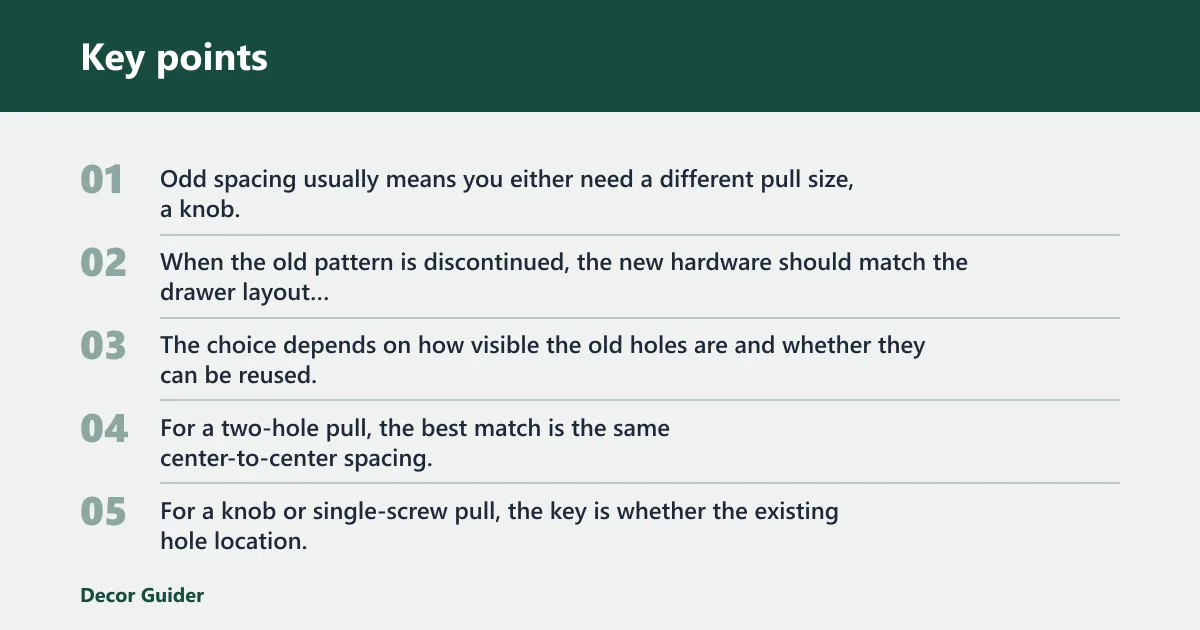
Odd spacing usually means you either need a different pull size, a knob, or a repair before drilling new holes. When the old pattern is discontinued, the new hardware should match the drawer layout you want, not the broken spacing left behind. The choice depends on how visible the old holes are and whether they can be reused.
Choose the match strategy by hardware type
For a two-hole pull, the best match is the same center-to-center spacing. For a knob or single-screw pull, the key is whether the existing hole location, screw size, and drawer thickness work together cleanly. For a damaged front, a repair-first approach often gives the cleanest result.
Decide whether to reuse the old holes
Reuse the old holes only when the new pull matches the existing center-to-center spacing and the holes are not damaged. If the spacing is close but not exact, do not force the screws. That can split the drawer front or tilt the pull.
Choose a knob if the pattern will not match
A knob can be the simplest replacement when the old pull spacing is odd or discontinued. Because a knob uses one point instead of two, it can avoid exposed holes if the old pair is filled first. This is common on dressers with unusual vintage spacing.
Say your dresser has 5-inch hole spacing, but the replacement line only sells 4-inch and 6-inch pulls. A knob lets you cover the old layout without chasing an exact match. If the drawer front already has visible damage, a repair may still be needed around the original holes.
Measure and match worksheet
| Pull type | What to measure | What to buy |
|---|---|---|
| Two-hole drawer pull | Center-to-center distance between screw holes | Replacement pull with the same center spacing |
| Single-hole pull | Hole diameter and center point location | Single-hole pull or knob that fits the existing opening |
| Knob replacement | One center point and visible old-hole coverage | Knob plus hole-filling material if the old pull had two holes |
| Redrill decision | Old spacing, damage, and whether the size is still sold | New hardware plus a cabinet hardware jig |
Common pull spacing conversions
| Inches | Millimeters | Typical use |
|---|---|---|
| 3 in. | 76 mm | Common smaller drawer pull spacing |
| 3 3/4 in. | 96 mm | Very common replacement size |
| 5 in. | 128 mm | Common medium spacing |
| 6 1/4 in. | 160 mm | Common larger drawer pull spacing |
| 7 9/16 in. | 192 mm | Often seen on larger drawers |
| 8 13/16 in. | 224 mm | Less common but still sold by some lines |
Redrill decision matrix
| Scenario | Best action | Why |
|---|---|---|
| Exact match | Reuse the holes | The screws should line up without repair work |
| Near miss | Do not force it; compare adjacent sizes or switch to a knob | Forcing screws can split wood or tilt the pull |
| Discontinued size | Fill old holes and drill new ones, or change to a knob | There may be no direct replacement |
| Damaged holes | Repair first, then redrill with a jig if needed | Loose or oversized openings will not hold hardware well |
| Knob switch | Fill the old pair, then install a centered knob | A knob can cover old spacing with one mounting point |
Can I reuse the old holes?
Reuse holes only when the match is exact
Yes, but only when the new hardware matches the old spacing and the holes are sound. Reuse is the cleanest option for a dresser because it avoids extra repair work. If the spacing is off, damaged, or discontinued, fill the old holes first and drill fresh locations with a jig.
Fill damaged holes before drilling again
Wood filler works for shallow repairs, but it can shrink and may need more than one coat before it is flush. Sand between coats and let the repair dry fully before priming or drilling again. Bondo dries faster, often in about 20 to 30 minutes depending on the product and conditions, but its stronger fumes and flammability make it a poor fit for poorly ventilated indoor use.
Wood epoxy such as KwikWood is a strong choice for old hardware holes. It comes in a tube, is kneaded by hand, and cures in roughly an hour under typical product directions without the shrinkage common to filler. That makes it useful when you need a firmer repair around a screw hole before repainting or redrilling.
Use a jig when the new spacing is different
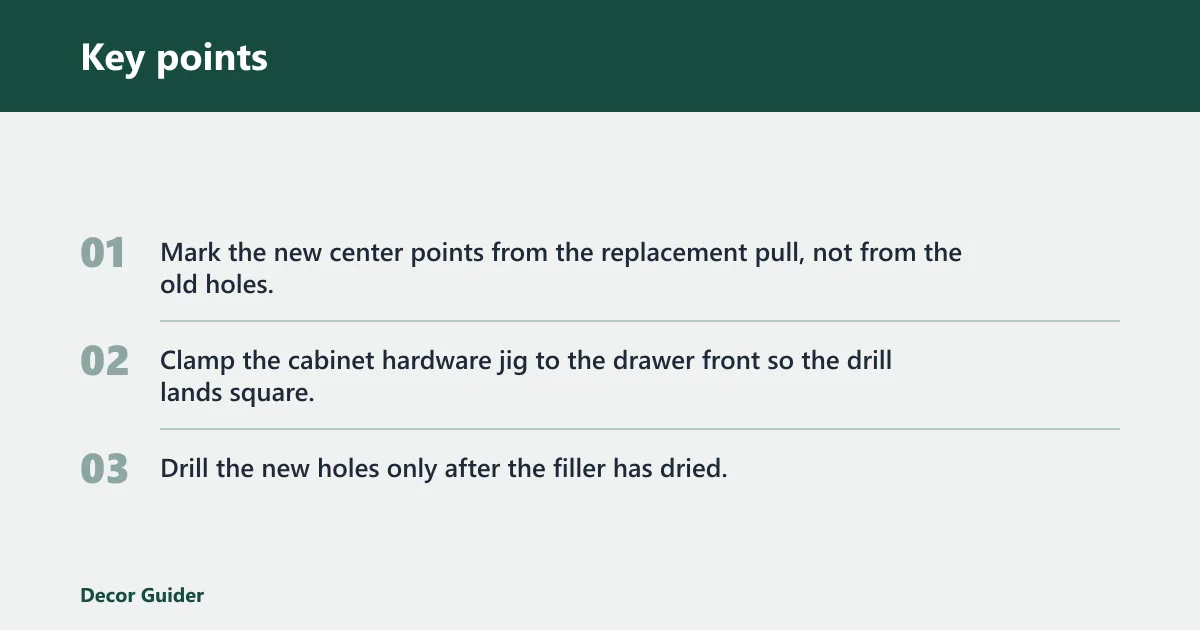
- Mark the new center points from the replacement pull, not from the old holes.
- Clamp the cabinet hardware jig to the drawer front so the drill lands square.
- Drill the new holes only after the filler has dried, then test-fit the pull before tightening the screws.
Drawer slide length can matter in mixed repair projects, especially when you are comparing a dresser layout with other cabinet parts. Slides commonly come in a range of lengths sold in inch increments, so do not mix up slide length with pull spacing. They are separate measurements with separate jobs.
Common mistakes
Measure the right dimension
The most common errors come from measuring the wrong part of the hardware. Overall length is not the same as center-to-center spacing on a two-hole pull, and a painted-over pull can hide the real center points. Fix those problems before you buy anything.
- Measuring edge to edge: Use screw centers, not the outside ends.
- Buying before checking spacing: Record the hole pattern first, then shop.
- Skipping repair work: Let filler dry, sand it smooth, and prime before installation.
- Drilling without a jig: Use a cabinet hardware jig when the new spacing is different.
A common first-timer mistake is to keep the old pull on the dresser and measure the decorative body instead of the holes. That can lead to a mismatch even when the new hardware is sold as the “same size.” Remove the pull, expose the holes, and measure from center to center.
If that didn’t work, try this next
- Recheck the drawer front for hidden paint buildup or split wood around the holes.
- Compare the old spacing against a different pull size or switch to a knob if the exact pull is discontinued.
- Fill the old holes with wood filler, Bondo, or wood epoxy, then drill new points with a jig.
Prevention: Write the hole spacing on painter’s tape and stick it inside the drawer before you leave the work area. That keeps the measurement with the dresser until you are ready to buy.
How do I measure dresser pulls for replacement hardware?
Remove the pull, expose the holes, and measure from the center of one hole to the center of the other if it has two screws. If it has one screw, measure the hole diameter, check the drawer-front thickness, and confirm the screw size/thread before ordering. Then compare that number to the replacement listing before you order.
Do I measure drawer pulls center to center or overall length?
For two-hole hardware, measure center to center. Overall length is useful for appearance, but it does not tell you whether the screws will line up. If the pull has one hole, overall length is secondary to the hole diameter and mounting point.
What if my old pull has one hole, two holes, or an odd spacing?
One-hole hardware can usually be replaced with a knob or a single-hole pull that fits the opening. Two-hole pulls should match the center-to-center spacing as closely as possible. Odd spacing is the warning sign that you may need a different size, a knob, or a repair before redrilling.
How do I choose a replacement pull if the old size is discontinued?
Pick the closest new hardware only if it matches the old holes or if you are prepared to fill and redrill. If the exact spacing is not sold anymore, a knob can avoid a mismatch. For a pull replacement, use a cabinet hardware jig after repairing the old holes.
What tools do I need to measure and install new dresser pulls?
You need a ruler or tape measure, a screwdriver, and a cabinet hardware jig for new drilling. For hole repair, keep wood filler, Bondo, or wood epoxy on hand, plus sandpaper and primer. The repair material should match the amount of damage, the drying time you can wait, and the room you are working in.
How do I tell if I need knobs instead of pulls?
Choose a knob when the existing pull spacing is odd, discontinued, or too damaged to reuse cleanly. A knob uses one mounting point, so it can simplify a repair on a dresser front with mismatched holes. If the old two-hole spacing is available and sound, a pull usually keeps the original look.
Can I reuse the old holes when replacing dresser hardware?
Yes, if the new piece matches the old center-to-center spacing and the holes are still solid. If the old holes are oversized, chipped, or painted shut, fill them first. Then sand, prime, and drill only after the repair has dried enough to hold the new screws securely.
How do I fill old holes if the new pull spacing is different?
Start with wood filler for a basic repair, but expect shrinkage and repeated applications. Bondo dries faster, often in 20 to 30 minutes depending on product and conditions, but it smells strong and is flammable. Wood epoxy such as KwikWood comes in a tube, is kneaded by hand, and cures in about an hour without shrinking.
What sizes do dresser pulls commonly come in?
Common retail sizes vary by line, so the safer approach is to shop by the measured center-to-center spacing rather than assume a standard. Common spacing in current catalogs often includes 3-inch, 3 3/4-inch, 5-inch, 6 1/4-inch, 7 9/16-inch, and 8 13/16-inch patterns, but older and odd sizes do exist. If your measurement does not match current offerings, plan for a knob or a redrill.
How do I measure a pull so the screws line up correctly?
Measure the actual hole centers, not the decorative ends of the pull. For a two-hole pull, that number is the exact buy size. For a one-hole pull, use the hole diameter, screw size/thread, and mounting point, then verify the screw length and alignment before tightening.
Products related to this article
Sponsored / affiliate links. As an Amazon Associate I earn from qualifying purchases. I may earn additional commission from eligible campaigns.