
How to Fix Stripped Screw Holes in Drawer Slides
Fix stripped drawer-slide holes by matching the repair to the substrate and slide type: in solid wood, plug the hole with hardwood dowel or glued toothpicks; in MDF or particleboard, use a stronger rebuild or move the slide to fresh material before reinstalling. A weak patch lets the slide sag, bind, or tear out again.
For related help, see drawer slide replacement, repair stripped wood screw holes, and cabinet repair.
Assess the drawer material before repairing
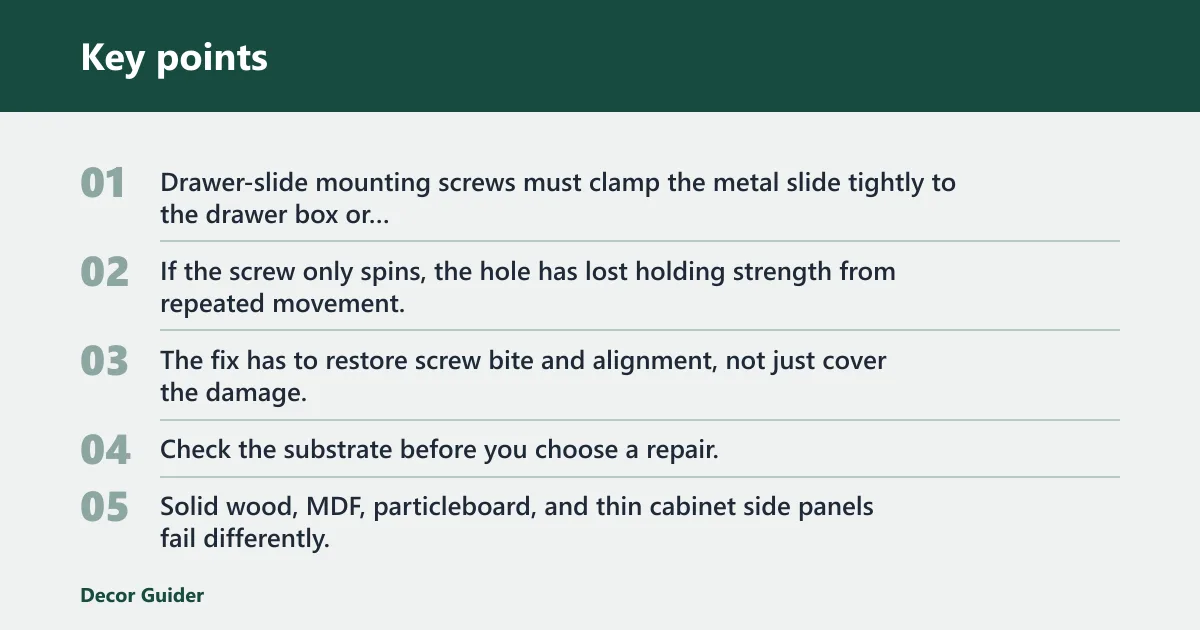


Drawer-slide mounting screws must clamp the metal slide tightly to the drawer box or cabinet. If the screw only spins, the hole has lost holding strength from repeated movement, side load, or overuse around a thin edge. The fix has to restore screw bite and alignment, not just cover the damage.
Check the substrate before you choose a repair. Solid wood, MDF, particleboard, and thin cabinet side panels fail differently, and a slide that sees repeated opening torque can pull a marginal repair apart even if it feels tight on the bench.
Manufacturers generally want the slide mounted square, with fasteners seated flush and sized to the slide slot; the Woodsmith/extension guidance on wood screw holding also notes that soft sheet goods need more bite than solid lumber, which is why the same repair does not work everywhere. For exact installation requirements, follow the slide maker’s hole pattern and screw guidance from Blum drawer runners, Hettich drawer systems, and McMaster-Carr drawer slides.
What you’ll need
- Drill and small bits for cleaning, pilot holes, or redrilling
- Replacement screws that match the slide slot and existing hole size
- Wood glue
- Wood toothpicks for a quick hole filler
- Hardwood dowel, plug, or similar insert for larger repairs
- Plastic anchor only for the specific thin-wood case it fits
- Counter-sink bit if the chosen repair needs a flush seat
- Auto body filler and hardener are a last-resort rebuild for very oversized holes that will be redrilled.
- Sandpaper or a chisel for trimming filler flush
Longer screws are appropriate only when the slide and cabinet allow more embedment without breaking through or hitting hardware behind the panel. Keep the screw diameter matched to the slide slot unless the slide maker explicitly allows a different size; oversizing the screw can split wood or prevent the slide from moving as designed.
Which repair fits your drawer slide?
A slightly stripped hole often can take the least invasive repair that still holds under drawer load, such as a longer screw or glued toothpicks. A spun particleboard hole usually needs a rebuild or a new mounting point. If the same hole has failed more than once, it is often better to relocate the slide than to rely on a weak patch again.
Use the lightest repair that still gives firm bite, but escalate fast when the substrate is soft, swollen, or crumbly. If the slide hole is near the cabinet edge, if the screw has nothing solid to bite into, or if the drawer already sits low on that side, relocate the mount now rather than after the next failure.
Drawer slide decision table
| Failure case | Best repair | Required tools | Ideal substrate | Red flags | Relocate now threshold |
|---|---|---|---|---|---|
| Slightly stripped hole | Wood toothpicks with wood glue, or a slightly longer screw if diameter stays the same | Glue, toothpicks, drill, replacement screw | Solid wood with intact fibers | Screw still spins, fibers crumble, or the hole is enlarged at the face | Move the slide if the repair fails a second time or the hole is at an edge |
| Spun particleboard hole | Rebuild with a hardwood plug, dowel, or insert that gives real wood to bite | Drill, plug or insert, glue, replacement screw | Particleboard with enough thickness to accept a new solid insert | Swelling, flaking, crushed fibers, or a hole that breaks into the face | Relocate immediately if the board is swollen, thin, or the insert would leave too little edge distance |
| Oversized screw hole | Fill, redrill, and use the correct screw size for the slide | Plug material or filler, drill, bit set | Solid wood or stable composite with enough depth for a pilot | Breakout to the edge, elongated slot, or repeated loosening after tightening | Relocate if the damaged area is larger than the screw head footprint or keeps elongating |
| Thin side panel | Conditional plastic anchor only if the panel and anchor design allow it, with the exact hole size from the maker | Anchor, drill bit matched to anchor spec, countersink bit only if the anchor design needs a flush flange | Thin cabinet side panels that can accept a purpose-made anchor and still stay flat | Panel flex, split grain, crushed laminate, or a load path that is too close to the panel edge | Relocate now if the panel flexes or the anchor would sit too close to the edge for repeated drawer load |
| Repeated re-strip | Rebuild the hole elsewhere, or add a backing block and move the mount point | Drill, plug or filler, wood glue, new screw location | Any substrate with a fresh, thicker area nearby | The same screw hole strips more than once, even after a proper rebuild | Immediately, if the same hole has failed more than once |
How do you fix a slightly stripped hole?
For a hole that still has some wood left, clean out loose fibers, pack in glued toothpicks, trim them flush, then reinstall the screw with a fresh pilot. A slightly longer screw can also restore grip without changing diameter. This works best when the surrounding wood is still sound.
- Remove the slide and clear dust, loose fibers, and broken chips from the hole.
- Coat one or more toothpicks with wood glue; a drop of glue on each toothpick is enough.
- Push the toothpicks into the hole until they pack tightly; three toothpicks may be enough for a small hole, and add more if the gap is larger.
- Trim the filler flush with the surface after the glue grabs.
- Redrill a tight pilot hole and reinstall the screw, or switch to a slightly longer screw if the slide and wood thickness allow it.
Predrilling helps when the repaired area is dense enough to split or when the slide slot gives little room to adjust. Use a pilot that follows the screw core, not the threads, so the screw can clamp without wedging the repair apart. Countersinking helps only when the screw head must sit flush and the slide design allows it; it hurts if it removes too much face material in a thin panel.
How do you fix a spun particleboard hole?
A spun particleboard hole has usually lost more structure than a small wood-chip repair can restore. Use a repair that creates real material for the screw to bite, or move the slide to fresh board. Plastic anchors are only a conditional option, and they are not a universal answer for damaged particleboard under drawer load.
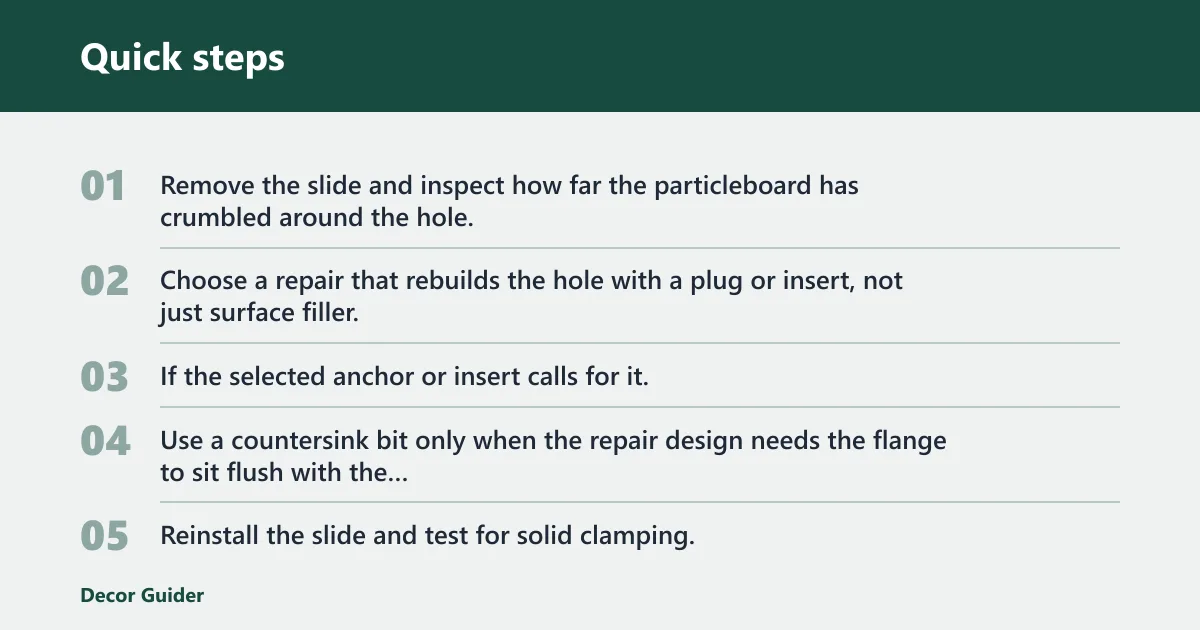
Particleboard holds screws poorly at the surface once it crumbles, so a repair should restore a dense core or shift the fastener into stronger material. If the board is swollen from moisture, the edge is crushed, or the hole is close to the panel edge, relocation usually outperforms any patch.
- Remove the slide and inspect how far the particleboard has crumbled around the hole.
- Choose a repair that rebuilds the hole with a plug or insert, not just surface filler.
- If the selected anchor or insert calls for it, drill to the exact diameter from the manufacturer’s spec.
- Use a countersink bit only when the repair design needs the flange to sit flush with the surface.
- Reinstall the slide and test for solid clamping; if the board flexes or the hole loosens again, move the mount.
Bottom-mount slides
Bottom-mount slides usually rely on more than one attachment plane, so a stripped hole matters most when it breaks the slide’s squareness or allows the drawer box to sag. Repair the mount only if the panel is still stiff; if the bottom panel is thin or the front mount has failed, relocate to stronger wood or replace the damaged member.
Wooden and wood-on-wood drawer slides
Wooden slides and wood-on-wood runners depend on smooth bearing surfaces as much as fasteners. If a screw hole strips in solid wood, a glued dowel or toothpick repair often holds well. If the runner itself is worn, warped, or misaligned, replace or reface the sliding surface rather than relying only on the screw fix.
How do you fix oversized or repeated failures?
When a hole is very oversized or has failed more than once, rebuild it or move the mount instead of relying on soft filler alone. Auto body filler is a last-resort rebuild for very oversized holes that will be redrilled, not a final screw-bite surface. If the same point keeps stripping, a new location is the safer fix.
This is the point where substrate thickness matters most. If you do not have enough wood around the hole to support a new pilot and keep the screw away from the edge, the repair may hold briefly but fail under regular drawer motion. Move it now rather than chase the same failure.
- Remove the slide and confirm that the existing hole no longer holds a screw under load.
- For a very oversized hole, rebuild the area with a stronger insert or filler and let it set before redrilling.
- If the repair calls for it, use a larger drill bit, up to nearly 3/8 inch for a large rebuild, and then redrill the pilot to match the final screw.
- Use a slightly longer screw only if the slide and wood thickness still allow full engagement.
- Move the slide mount to fresh wood if the hole has stripped again or the rebuilt area feels weak.
Thin cabinet side panels
Thin cabinet side panels are a special case because screw depth and edge distance are both limited. A plastic anchor can work only when the maker’s diameter, depth, and flush-seat instructions match the panel. If the panel flexes, the safest answer is usually a backing block or a new mount point, not a stronger screw alone.
Common mistakes
Using the wrong fastener name or size leads to a weak hold. Typical drawer-slide mounting screws are usually not lag screws, and the hole should match the screw and the slide rather than being guessed.
Relying on filler alone is another problem. Filler can help a rebuild, but a slide still needs solid material to clamp against. If the repair stays soft, the hole will strip again when the drawer opens and closes under load.
Do not countersink every repair. A flush seat matters for some anchor designs, but other repairs should stay flat. Also avoid keeping the slide in the same weak spot after repeated failure. Move it, or add a backing block where the cabinet or drawer box allows it.
How do you fix drawer slides that stick?
Sticking often means the slide is out of alignment, not just loose. After the hole repair, tighten the fasteners, then check that the slide runs about parallel and sits square to the drawer box or cabinet opening. If one mount point failed, the slide may have shifted just enough to bind.
A common first-timer mistake is fixing the loose screw and skipping alignment. The drawer may feel better for one or two pulls, then drag again because the repaired hole is holding the slide at a slight angle.
How to prevent stripped slide holes from coming back
Use the lightest repair that still gives firm bite, then reduce stress on the same hole. A backing block helps thin side panels, and a slightly longer or wider screw can help if the slide maker allows it. Check that the slide is straight before you call the job done.
If a drawer sees repeated side load, the hardware and hole take that force over and over. Fresh wood, better alignment, and a stronger mounting point prevent the next failure better than patching the same hole again.
Manufacturer instructions for drawer runners also stress using the supplied hole pattern and fastener size, which is why a repaired hole should still place the screw where the slide expects it. For exact mounting details, see Rockler drawer slides and Rev-A-Shelf.
Sources
- Blum, drawer runner installation and mounting guidance: https://www.blum.com/us/en/products/drawer-runners/
- Hettich, drawer system installation and fastening guidance: https://www.hettich.com/us-en/products/drawer-systems/
- McMaster-Carr, drawer slides and hardware specifications: https://www.mcmaster.com/products/drawer-slides/
- Rockler, drawer slide product and mounting guidance: https://www.rockler.com/drawer-slides
- Rev-A-Shelf, drawer hardware specifications and installation resources: https://www.rev-a-shelf.com/
Products related to this article
Sponsored / affiliate links. As an Amazon Associate I earn from qualifying purchases. I may earn additional commission from eligible campaigns.