Dresser Drawer Keeps Falling Out: Troubleshooting Guide
A dresser drawer often falls out because its stop, slide, or mounting hardware has failed. The fastest fix is to identify the drawer type, then repair the stop or slide that is letting it clear the track. If you ignore the cause, the drawer can drop to the floor, damage the box, or strain the cabinet opening. This guide shows how to identify the drawer system and match the fix, from bent slides to missing stops.
Identify failure modes and drawer system type


Most drawers use a stop to keep them from sliding out unexpectedly. The problem usually starts with a missing stop, a misaligned runner or slide, or damaged mounting hardware that no longer keeps the drawer centered. Start by identifying the drawer system, because the right repair depends on whether it uses wood-glide, free-rolling, or metal-glide construction.
Spot the failure mode first
If the drawer comes out too far, look for the stop or stopper that limits travel. In free-rolling drawers, the stop is often a small raised lip on the front side of the interior track. Wood-glide drawers can feel sticky even when no separate stopper is installed, so sticking alone does not mean the track is blocked. (Wikihow)
Check for structural damage
Inspect the drawer sides, bottom, and cabinet opening for broken frames, cracks, holes, and rotting wood. Structural damage weakens alignment and fasteners, so a drawer can drift off track even after cleaning. Rotten or softened wood should be repaired before reuse because it may not hold screws or keep the slide square.
Look for the drawer type
Wood-glide drawers slide on wooden runners and often come out by tugging and tilting. Free-rolling drawers may move on wheels and can often come straight out, though the front may need to tilt downward to clear the stop. Metal-glide drawers often use a lever or latch mechanism and are commonly found in modern case goods.
What you’ll need
- Flashlight or work light
- Vacuum with crevice tool
- Phillips and flat screwdrivers
- Putty knife or thin pry tool for gentle inspection
- Tape measure for verifying slide length
- Replacement screws that fit the existing holes
- Wood glue and dowels or toothpicks for stripped holes, if needed
- Replacement drawer stop or stopper
- Replacement slide or runner, if the track is bent or worn
- Safety glasses
Keep the drawer unloaded before you pull, tilt, or lift it free. A full drawer is harder to control, and extra weight can bend a weak slide, strip a mount, or force a cracked runner farther out of alignment.
Drawer stop troubleshooting matrix
| Symptom | Likely cause | Test | Quick fix | Replacement part | When to stop DIY |
|---|---|---|---|---|---|
| Wood-glide drawer sticks, then drops free | Runner wear, loose stop block, or a worn glide surface | Check whether the drawer rocks side to side on the wooden runners and whether the front edge sits square | Clean the runner, wax the glide surface, and confirm the drawer rides evenly on both sides | Wood runner, stop block, or runner insert | Stop if the runner is split, warped, rotting, or too loose to hold fasteners |
| Free-rolling drawer comes out too far | Raised lip on the interior track is damaged, missing, or worn low | Look for the small lip on the front side of the track and check for missing wheel retainers | Lower the front only enough to clear the stop, then reinstall or replace loose retainers | Track stopper, wheel assembly, or front stop clip | Stop if the track is bent, the wheel mount is pulling away, or the cabinet opening is distorted |
| Metal-glide drawer will not release cleanly | Lever release is not engaged, a stabilizer screw is still installed, or the slide is bent | Check both slide sides for a release tab, latch, or retaining screw before pulling harder | Release the latch fully, remove any stabilizer screws, and realign the slide before reinserting | Metal slide pair, release lever, or replacement mounting screw set | Stop if the rail is kinked, cracked, or pulling out of particleboard or damaged frame material |
| Drawer seems blocked by safety hardware | Anti-tip system, wall anchor, or retention strap is still in place | Look for a wall anchor, strap, bracket, or rear retaining screw set at the cabinet back | Follow the model manual for removal order before forcing the drawer or disconnecting rear hardware | Retaining screw kit, anti-tip strap, or wall anchor hardware | Stop if the dresser is unstable, the anti-tip setup cannot be safely supported, or removal requires cabinet tipping |
How do I remove the drawer safely?
Remove the drawer only after you identify the slide type. Wood-glide drawers usually need a tug and a slight tilt, free-rolling drawers may come straight out or need the front lowered, and metal-glide drawers often need a lever released first. Some drawers also require removing stabilizer screws or anti-tip retention hardware before they can be fully removed.
- Empty the drawer completely and pull it open until you can see the track.
- Check the sides for a lever, latch, retaining screw, or anti-tip connection.
- For wood-glide drawers, lift the front slightly while tugging until the back clears the runner.
- For free-rolling drawers, pull straight out; if needed, tilt the front downward so the back edge passes the stopper.
- For metal-glide drawers, release both levers or latches, then slide the drawer straight free.
- If you find stabilizer screws, remove them before forcing the drawer farther.
Once the wheels or back edge pass the stopper, the drawer can slide off the track. A common mistake is yanking harder after the drawer hits resistance, which can split a side panel, damage a stop, or bend the track lip. If the drawer still binds, stop and recheck the release points.
How do I fix the track or stop?
Start with cleaning and alignment. A dirty drawer track or a runner that sits out of square can make the drawer slip, bind, or miss the stop altogether. If the stop is only loose, reinstalling it may be enough. If the slide, lip, or runner is bent or worn through, replacement is the safer repair.
- Vacuum the track, runner, and drawer bottom edge.
- Wipe away dust, sticky residue, or fragments that can block travel.
- Check that both sides of the drawer sit parallel to the cabinet opening.
- Reinstall a loose stop if the mounting hole still holds screws firmly.
- If screw holes are stripped, repair them with glue and dowels or toothpicks, or move to a new mounting location.
- Replace a bent or cracked stop, track, or slide if it will not stay aligned after tightening.
If a side-mount slide keeps sagging after you tighten the screws, that usually points to worn mounting holes, damaged particleboard, or a warped slide, not a simple adjustment problem. In that case, verify slide length, mount type, load rating, and hole pattern before buying a replacement. For related guidance, see drawer slide replacement and stripped screw hole repair.
When should I replace hardware?
Replace hardware when the drawer stop is missing, the slide is bent, or the track no longer holds a straight line. A stop can be reinstalled if the mounting surface is solid. A slide or runner should be replaced when repeated tightening does not hold alignment, or when cracks and holes have weakened the cabinet face.
Match the new part to the existing setup by checking slide length, mount type, extension style, and hole pattern. Do not assume every dresser uses the same hardware. Antique dressers, particleboard dressers, and heavy fully loaded drawers are especially sensitive to size and mounting differences. If the cabinet shows rot, see wood rot repair before reinstalling hardware.
Stop DIY if the frame is split, the wood is rotten, or the cabinet cannot hold a secure mount. Damaged particleboard and softened wood often need reinforcement or replacement panels instead of a simple fastener swap. If the dresser will not stay stable, review when to repair vs replace furniture.
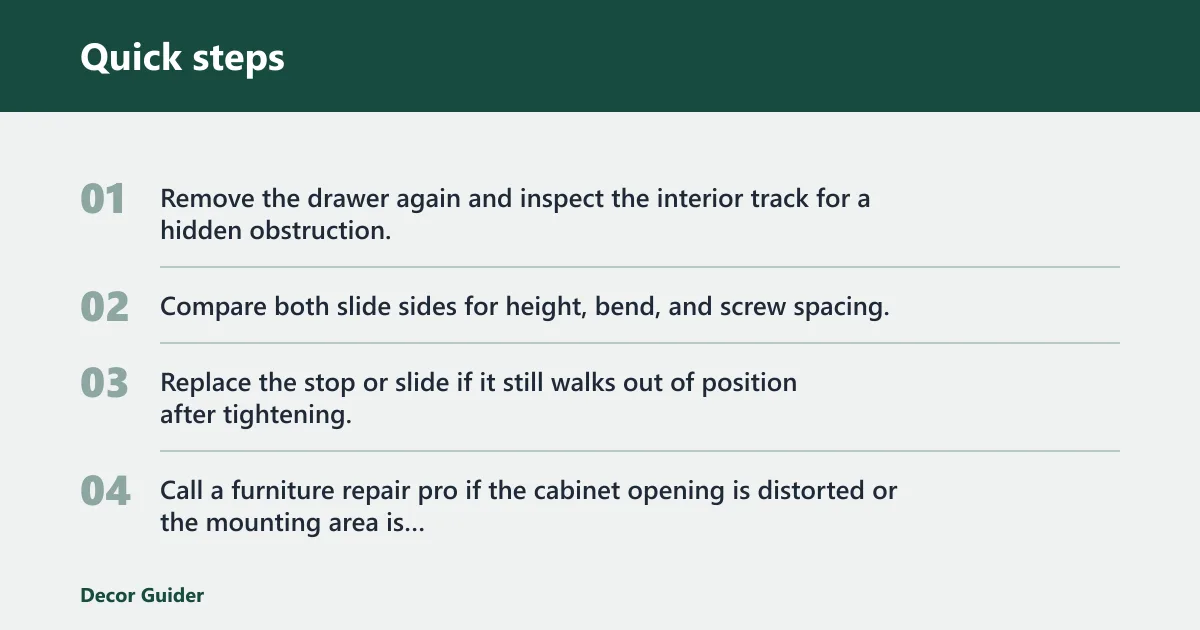
If that didn’t work, try this next
- Remove the drawer again and inspect the interior track for a hidden obstruction.
- Compare both slide sides for height, bend, and screw spacing.
- Replace the stop or slide if it still walks out of position after tightening.
- Call a furniture repair pro if the cabinet opening is distorted or the mounting area is crumbling.
Common mistakes
- Forcing the drawer past resistance instead of checking for a stop or release lever.
- Assuming every dresser uses the same drawer system.
- Ignoring a loose track lip, then blaming the drawer box.
- Relying on filler alone for stripped mounting holes.
- Reinstalling a drawer before fixing cracks, holes, or rotting wood.
- Leaving the drawer overloaded after repair.
Regular dust removal helps keep tracks and runners moving smoothly, but the key is to clean when debris causes sticking or misalignment rather than following a rigid schedule. Pull everything out of drawers and reset the load if the drawer is sagging or overfilled. Keeping weight lower reduces stress on stops, slides, and runners.
How do I tell if my drawer has anti-tip hardware?
Look for safety hardware that secures the dresser to the wall, such as a strap, bracket, or anchor at the rear of the cabinet. Anti-tip systems do not block the drawer itself, but some models require specific disassembly before drawer removal can be completed. For safer setup and anchoring basics, see anti-tip furniture safety.
Do not confuse anti-tip hardware with a drawer stop. The stop is part of the drawer travel path, while anti-tip hardware stabilizes the furniture unit. If the dresser is wall-anchored, keep the cabinet supported before you remove or reattach any rear hardware, and do not remove retention parts in a way that destabilizes the unit.
Can I repair a drawer without replacing the whole dresser?
Yes, if the damage is limited to the stop, runner, or slide and the cabinet frame is still sound. Reinstalling a missing stop, realigning a runner, or replacing a bent slide is often enough. If the wood is rotten, the frame is split, or the mounting area will not hold screws, the repair may need cabinet work instead.
Say your top drawer is a free-rolling type with a small raised lip on the interior track. If that lip is missing, the drawer may keep clearing the track. Replacing the stop is the right repair there; swapping the whole dresser is not necessary unless the cabinet opening is also damaged.
When should I call a furniture repair pro for a dresser drawer?
Call a furniture repair pro when the frame is split, the slide mount is pulling out, the wood is rotten, or the drawer system needs more than a stop or slide replacement. Deep cracks, missing wood around screw holes, and badly bent rails usually need a stronger structural repair than a basic home fix.
Get help sooner if the dresser is antique, unusually heavy, or made from brittle particleboard. Those builds can fail fast when a drawer is over-tightened or forced. If the cabinet cannot hold a secure mount after a proper repair, a professional should evaluate the frame before the drawer goes back in.
Frequently asked questions
Why does my dresser drawer keep falling out?
It usually means the stop, runner, or slide is not holding the drawer in line. Check whether the drawer is wood-glide, free-rolling, or metal-glide, then inspect the track for a missing lip, bent rail, loose mounting screw, or damaged mount. Structural damage can also let the drawer slip free.
How do I stop a dresser drawer from coming all the way out?
Clean the track, confirm the drawer sits square, and reinstall or replace the stop if the mounting point is still solid. If the slide is bent or the track lip is missing, replace that hardware instead of trying to make the drawer fit by force.
What are drawer stops and how do they work?
A drawer stop is the feature that prevents accidental full removal. On free-rolling drawers, it is often a small raised lip on the front side of the interior track. Once the wheels or back edge pass that point, the drawer can slide free.
What tools do I need to reattach a loose dresser drawer?
Use a flashlight, screwdriver set, vacuum, and a tape measure. If holes are stripped, keep wood glue and dowels or toothpicks nearby. For replacement parts, verify slide length, mount type, and hole pattern in the model listing or manual before you buy anything.
Products related to this article
Sponsored / affiliate links. As an Amazon Associate I earn from qualifying purchases. I may earn additional commission from eligible campaigns.