Does Paraffin Wax or Candle Wax Work on Wooden Drawer Slides?
Paraffin wax is commonly used on wooden drawer slides, and plain candle wax can help in a pinch, but only as a temporary friction fix for a drawer that is already fitted and aligned. Used on the wrong problem, wax masks binding and can lead to worn edges, stuck drawers, or damaged runners. This guide shows when wax helps, when it fails, and how to tell the difference between friction, alignment, and repair issues.
This guide is part of our Dresser and Drawer Repair: Fixing Sticking Drawers, Slides, Smells and Finishes series.
How wax fits into fixing drawer slide friction
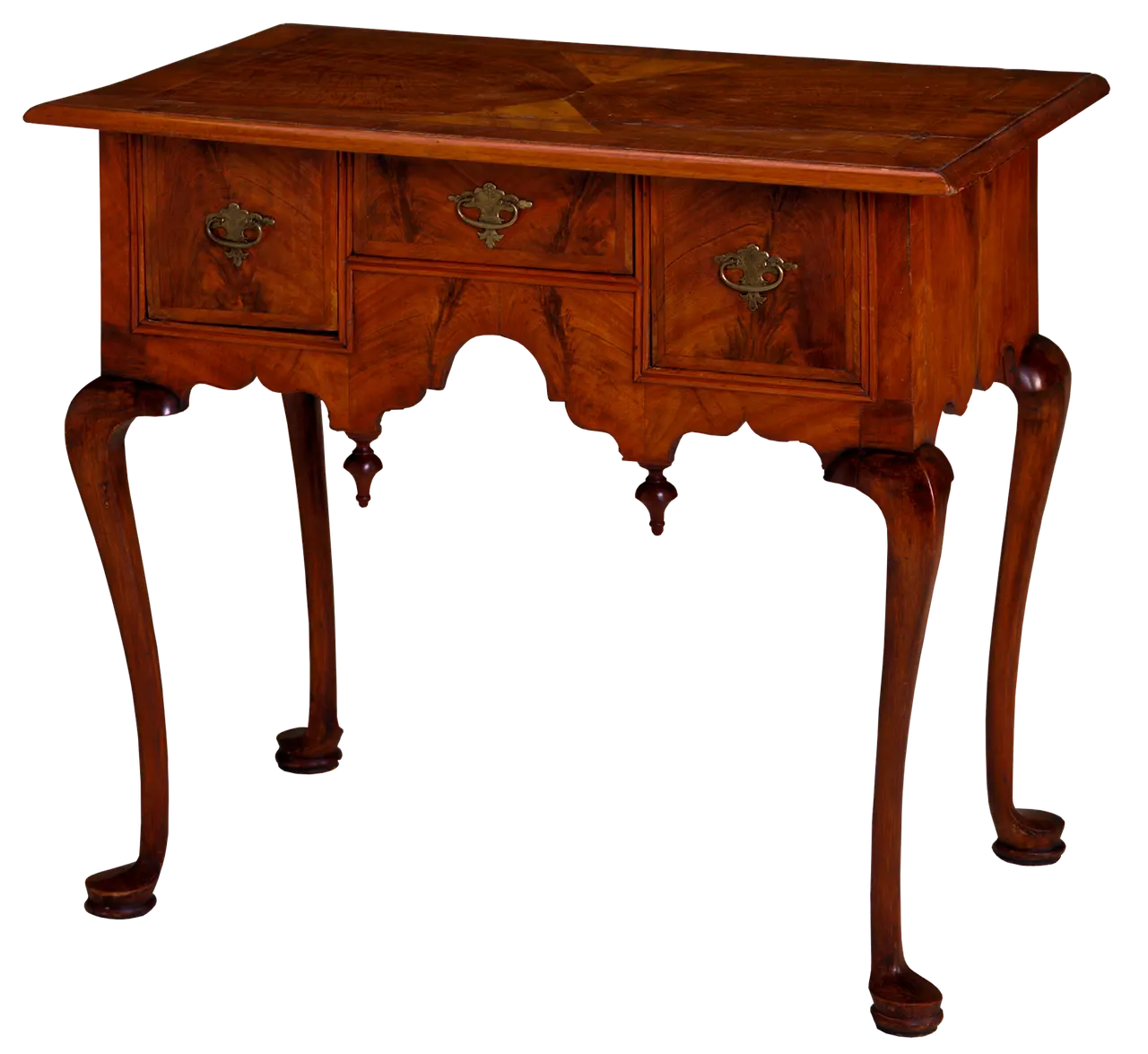


Wooden drawer slides move on wood-to-wood contact surfaces, often as part of the drawer or the case itself. The best sliding and most durable slides are hardwood on hardwood, with dense, close-grained hardwood such as maple preferred. A hardwood rail can slide in a hardwood channel in the furniture case, and many systems use both a bottom guide and a top guide.
That top guide matters. It keeps the back of the drawer from tipping out, while a shortened front top rail can let the drawer fall out near full extension. Friction rises when the rail width, thickness, or clearance is off, and humidity movement can make a drawer bind even if it worked well in a drier season.
Wax belongs in the repair order after you confirm that the drawer is basically straight, square, and close to the right fit. It can reduce friction at wear points, but it cannot correct warped runners, broken joints, or a channel that is too tight.
What you’ll need
- Paraffin wax or a plain, hard candle
- Soft cloth or paper towel
- Clean brush or vacuum
- Optional: paste wax
- Optional: beeswax
- Optional: soap bar or dry bar lubricant
- Optional: graphite for a mechanism that calls for it
Can paraffin wax or candle wax work?
Paraffin wax can work well on wooden drawer slides when the problem is surface friction, not fit. Paraffins are solid at ambient temperature, and refined paraffin wax is preferred for candle-making. Candle wax may work too, but only if it is mostly plain wax and not a soft, blended, or heavily additive-filled candle.
Use paraffin when the drawer is close-fitting and drags at the same contact points each time. Use plain candle wax only as a fallback if it is hard, clean, and unscented. Do not expect either one to solve a drawer that sticks on one side, binds at the front edge, or tips when extended.
For furniture, wax is a dry lubricant, not a structural repair. It helps on hardwood-on-hardwood and can also help on lighter hardwood-on-softwood slides, but the slide still has to be aligned and supported correctly.
Wax versus repair guide
Wax helps when the drawer feels dry, rough, or noisy at the same wood contact points, especially during seasonal humidity changes. Repair helps when the drawer is rubbing because the runner is warped, the channel is out of parallel, the joint is loose, or the clearance is wrong. If the geometry is off, wax only delays the real fix.
| Symptom | Likely cause | May paraffin or candle wax help? | Next repair step |
|---|---|---|---|
| Drawer drags lightly but closes fully | Surface friction at wear points | Pass | Clean and wax the rail, then retest |
| Sticking on one side only | Misalignment or twisted runner | Fail | Check rail width, squareness, and channel parallelism |
| Binding at the front edge | Front clearance too tight or swollen wood | Fail | Plane or fit the front edge before waxing |
| Rough or noisy travel | Dry contact or debris in the channel | Pass | Clean the slot and apply a thin wax coat |
| Drawer tips when pulled out | Top guide missing or worn | Fail | Repair the top guide and check drawer balance |
| Drawer can be pulled too far and drops | Shortened front top rail or bad stop geometry | Fail | Restore the stop or front rail support |
| Seasonal swelling in humid weather | Wood movement in the channel | Pass, temporarily | Increase clearance or re-fit the affected surface |
| Loose, wobbling drawer front | Worn joints or rail wear | Fail | Repair the joints before any lubricant is added |
| Drawer falls out too easily after waxing | Too much wax or marginal stop geometry | Fail | Clean off excess wax and restore the stop |
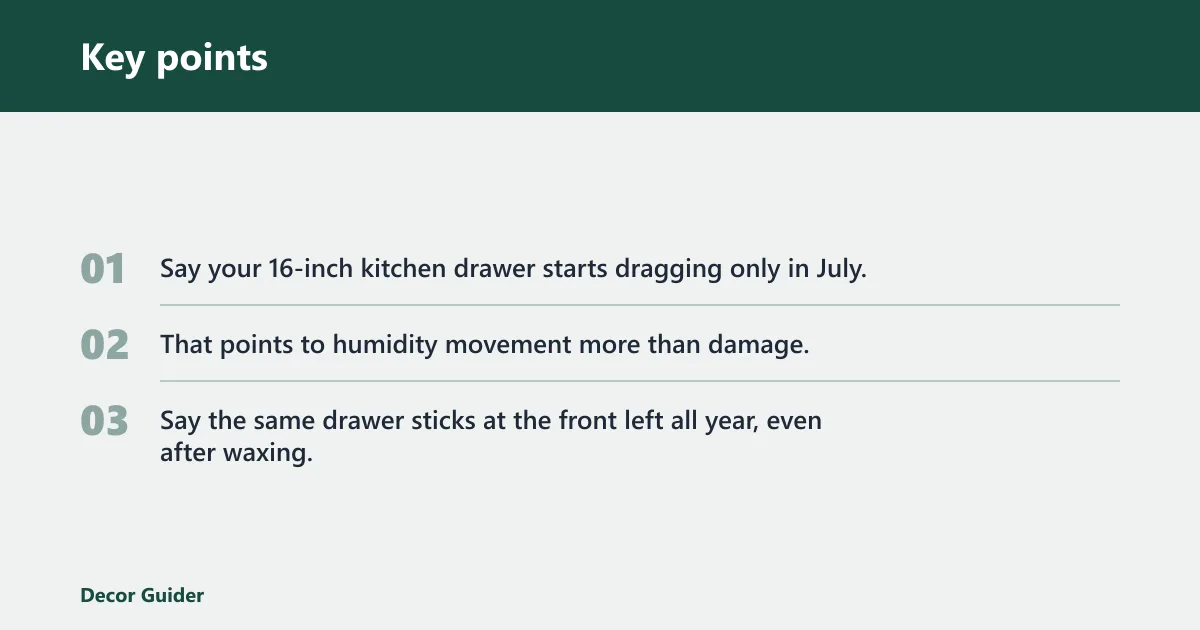
Say your 16-inch kitchen drawer starts dragging only in July, but closes smoothly the rest of the year. That points to humidity movement more than damage, so wax may buy time while you monitor the fit. Say the same drawer sticks at the front left all year, even after waxing; that points to a geometry problem, not friction alone.
Clean the runners and channel first. Apply a thin wax coat only to the wear points, then work the drawer several times and check whether the drag is gone. If the drawer still rubs in the same spot, stop adding wax and look for fit problems.
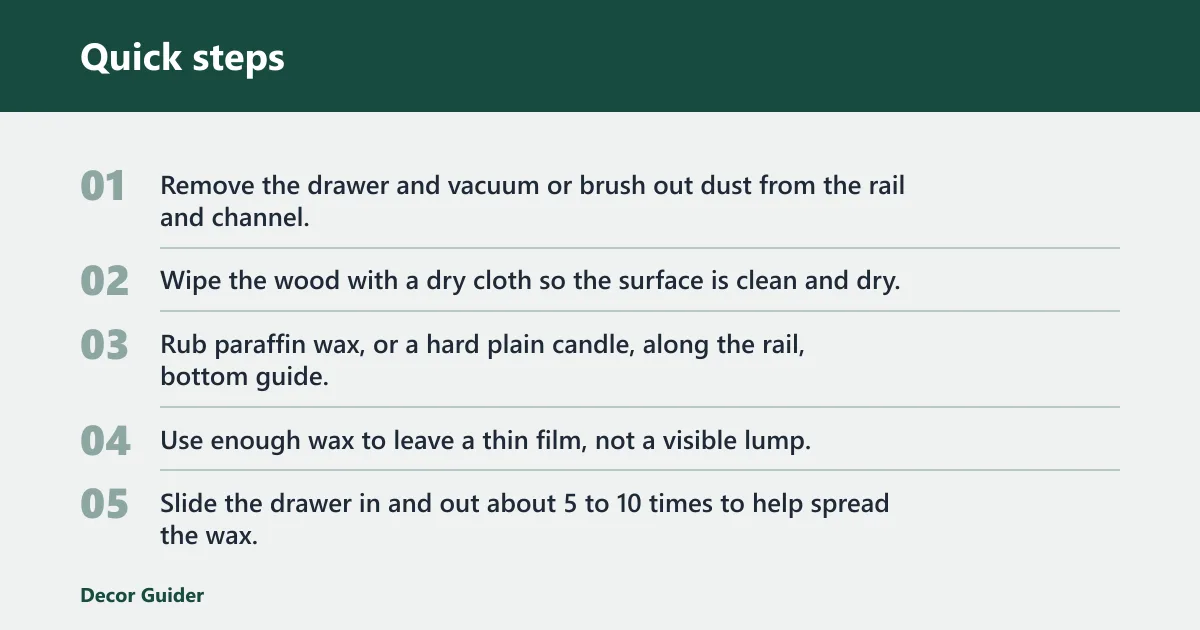
- Remove the drawer and vacuum or brush out dust from the rail and channel.
- Wipe the wood with a dry cloth so the surface is clean and dry.
- Rub paraffin wax, or a hard plain candle, along the rail, bottom guide, and top guide contact points.
- Use enough wax to leave a thin film, not a visible lump.
- Slide the drawer in and out about 5 to 10 times to help spread the wax.
- Check the front edge, side walls, and rear guide for fresh rubbing marks.
- If a spot still drags, add one more light pass at that location and retest.
A practical top-up is one light pass per problem area, then a retest. Do not keep building layers. Thick wax coats collect dust and turn gummy later, especially in a dusty room or on a drawer that gets used every day.
Suppose a bedroom dresser drawer moves smoothly after one pass of wax but starts to resist again near full extension. That usually means the contact point is near the front or the top guide, not that the whole drawer needs more lubricant. A focused touch-up is better than coating every surface.
Best wax choice for drawer runners
Paraffin wax is usually the best choice for old wooden drawer runners because it is a petroleum-derived wax, solid at room temperature, and commonly sold for candle-making. For furniture use, it gives a hard, dry film that lowers friction without leaving a greasy surface. Candle wax may work, but only when you know what is in it. (Wikipedia)
Beeswax is softer and can work on wood slides, but it tends to feel tackier than paraffin. Paste wax is often the more furniture-friendly option when you want a controlled application and a finish-safe surface, because it is made for wood rather than burning. Soap or dry bar lubricant can help on some old wood slides, and graphite is better reserved for certain mechanisms where a dry powder makes sense.
Candle wax is not one thing. Some candles are paraffin-based, while others are blends with fragrance and dye additives that can change hardness and slip. A scented, soft candle is not the same as plain refined paraffin, and a soft wax can leave residue faster than a harder one.
Common mistakes
The biggest mistake is using wax to hide a fit problem. If the drawer binds because the runner is warped, the rails are out of parallel, or the clearance is too tight, wax only postpones the repair. Another mistake is overapplying wax, which can make a drawer feel too slippery or let it move farther than intended.
Skipping alignment checks is another failure point. Wooden drawer systems rely on the top guide and bottom guide working together, so a worn top guide can cause tipping even when the rails are slick. Finish-sensitive pieces need caution with silicone spray, because overspray can contaminate surfaces and complicate later finishing.
A common first-timer mistake is choosing a wax candle that smells pleasant but is soft and blended. On a maple runner, that can leave a gummy film that picks up dust faster than a plain hard wax.
Frequently asked questions
Can I use paraffin wax on wooden drawer slides?
Yes. Paraffin wax is a sensible dry lubricant for wood-to-wood drawer contact surfaces when the drawer already fits reasonably well. Use a thin coat on the rails and guides, then retest. If the drawer still binds in one spot, the fix is geometry work, not more wax.
Will candle wax work on wooden drawer slides?
Sometimes. Candle wax works only if it is hard, plain, and close to paraffin in feel. Many candles include fragrance, dye, or blended waxes that change performance. If the candle feels soft at room temperature or leaves residue, it is a poor choice for drawer runners.
What is the best wax for old wooden drawer runners?
Refined paraffin wax is the strongest starting point for old wood runners because it is hard, dry, and easy to apply in a thin film. Paste wax is a good furniture-specific alternative. Beeswax can help, but it is usually softer and less predictable on drawers that already run tight.
How often should I wax wooden drawer slides?
There is no fixed schedule for every drawer. Reapply only when the drawer starts to drag again, often after seasonal humidity movement or normal wear. For many household drawers, that means occasional maintenance rather than constant treatment, with a retest after each light application.
Should I use paraffin wax, beeswax, or paste wax on wood slides?
Start with paraffin wax if you want the driest, hardest option. Choose paste wax if you want a product made for furniture surfaces and controlled application. Beeswax is usable, but it is softer and can feel tackier, so it is usually the least predictable of the three on tight runners.
What should I do if waxing doesn’t stop a drawer from sticking?
Stop adding more wax and check the fit. Look for a warped runner, loose joints, swollen wood, or clearance that is too tight at the front edge or top guide. If the drawer still sticks on one side after cleaning and one light wax pass, planing or re-fitting is the next step.
Does wax help more on hardwood-on-hardwood or softwood-on-hardwood slides?
Wax is usually most effective on hardwood-on-hardwood slides because those surfaces are denser, more durable, and better suited to close tolerances. It can still help on hardwood-on-softwood slides for lighter drawers, but softwood wears sooner and is more likely to show drag from humidity or edge damage.
Can wax make a drawer slide too slippery or fall out?
Yes, if you apply too much or the stop geometry is already marginal. Excess wax can reduce resistance enough that the drawer moves farther than intended, especially near full extension. If that happens, clean off the excess and inspect the front top rail and top guide for proper retention.
Products related to this article
Sponsored / affiliate links. As an Amazon Associate I earn from qualifying purchases. I may earn additional commission from eligible campaigns.