Side Mount vs Undermount Drawer Slides
Side-mount slides bolt to the drawer and cabinet sides, so they are usually the easiest retrofit for dresser repair. Undermount slides need a specific drawer-box shape and matching cabinet hardware, so use them only when the measurements and parts system line up. The wrong slide choice can leave drawers crooked, sticky, or unable to close. For manufacturer examples of side-mount and undermount requirements, see Accuride’s side-mount installation guidance and Blum’s TANDEM/LEGRABOX technical pages, which show how clearance, locking devices, and drawer geometry drive compatibility.
What is the difference between side mount and undermount drawer slides?

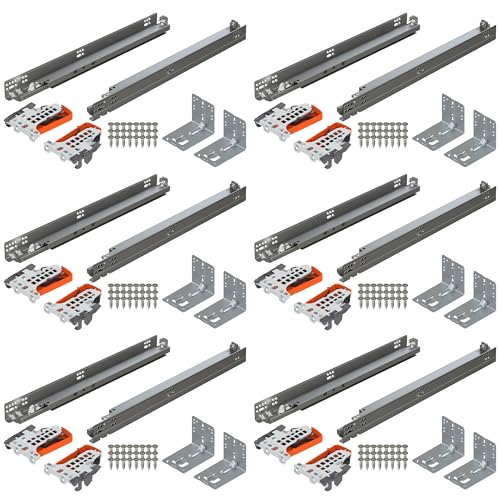
Side-mount slides attach to the sides of the drawer and cabinet, and they stay visible when the drawer is open. Undermount slides sit beneath the drawer, out of view. That mounting change affects clearance, installation tolerance, weight capacity, and whether the drawer box already matches the hardware system. In manufacturer documentation, side-mount products are commonly offered in a broad load range, while undermount systems are more dependent on drawer-box dimensions and proprietary hardware.
Side mount vs undermount at a glance
Side-mount hardware is a traditional, versatile, inexpensive option that works well for dresser repair, general cabinetry, and many retrofits. Undermount hardware gives a cleaner look and is common in premium kitchens, vanities, and custom built-ins, but it depends on a more exact drawer box and cabinet setup. For example, Accuride’s side-mount ball-bearing slides include models rated from lighter-duty use up to 100 lb and beyond, while Blum’s concealed undermount systems are designed around specific drawer geometry and locking components.
| Criterion | Side mount | Undermount |
|---|---|---|
| Mounting position | Sides of drawer and cabinet | Beneath the drawer |
| Visibility | Visible when the drawer is open | Hidden from view |
| Installation tolerance | More forgiving | More precise measurements required |
| Typical look | Functional, exposed hardware | Cleaner, hidden hardware |
| Weight support | Often available in higher load ratings; manufacturer examples include 75 lb, 100 lb, and 150 lb classes depending on model | Typically lower, though manufacturer examples still support common residential drawer loads; check the specific system rating |
| Cost | Often cheaper | Usually more expensive |
| Common add-ons | Ball-bearing or roller styles; full-extension is widely available on many side-mount ball-bearing models, and soft-close versions are also sold by major manufacturers | Often soft-close; full-extension is available in many concealed systems, including Blum TANDEM and LEGRABOX variants |
| Fit requirement | Needs side clearance and loses some drawer width | Needs compatible drawer box and locking devices |
Installation, access, and fit
Side-mount slides are often easier to install because the mounting points are easy to reach and the hardware is less demanding about perfect alignment. Manufacturer instructions from Accuride and Knape & Vogt commonly show straightforward side-wall mounting with defined clearances, while concealed systems such as Blum TANDEM require precise bottom and rear positioning plus compatible locking devices. If the hardware is even slightly off, the drawer may bind or scrape.
Weight, extension, and cost
Weight capacity is a selection point, not a bonus feature. Side-mount slides can handle a wide range of loads, with common manufacturer examples around 75 lb, 100 lb, and 150 lb depending on the model and length; that matters for loaded clothing drawers. Undermount slides also come in full-extension versions, but they are usually tied to a specific drawer system rather than a universal fit. Both families include soft-close options in current product lines, so extension and closing style should be checked on the exact model rather than assumed.
Drawer slide decision table
This table compares side mount, undermount, and bottom- or center-mount hardware across common repair scenarios. Use it to match the slide family to the drawer you already have, instead of forcing the furniture to fit the hardware. It adds a retrofit lens by showing compatibility risk, likely modifications, and the best choice for each scenario.
| Repair scenario | Side mount | Undermount | Bottom/center-mount | Compatibility risk | Install difficulty | Likely modifications | Best choice |
|---|---|---|---|---|---|---|---|
| Old dresser | Usually fits worn openings and uneven boxes better | Only if drawer geometry and rear clearance match the system | Can work if the underside layout is suitable | Side mount: low; undermount: high; bottom/center-mount: medium | Side mount: low; undermount: high; bottom/center-mount: medium | Possible shim work, hole repair, or runner removal | Side mount |
| Warped drawer | More forgiving when the box is not square | Usually sensitive to twist and uneven underside spacing | Can tolerate some warping if the bottom remains stable | Side mount: low; undermount: high; bottom/center-mount: medium | Side mount: low; undermount: high; bottom/center-mount: medium | Minor planing, shimming, or drawer-box repair | Side mount |
| Narrow drawer | Steals side width and may crowd the opening | Preserves side width if the system was designed for it | May preserve width depending on profile | Side mount: medium; undermount: medium; bottom/center-mount: medium | Side mount: low; undermount: medium; bottom/center-mount: medium | Check drawer-box width and clearance before drilling | Undermount or bottom/center-mount, if compatible |
| Heavy clothing drawer | Often available in higher load ratings | Load ratings vary by system and size | Depends strongly on product family | Side mount: low; undermount: medium; bottom/center-mount: medium | Side mount: low; undermount: medium; bottom/center-mount: medium | Choose the correct load class and screw pattern | Side mount |
| Soft-close upgrade | Available on many modern models | Common in concealed systems from major brands | Available on some systems, but not universal | Side mount: low; undermount: low; bottom/center-mount: medium | Side mount: low; undermount: medium; bottom/center-mount: medium | Match the damper type to the slide family | Undermount |
| Broken side panel | Needs sound side walls | May bypass damaged side walls if the underside is repaired | May work after the box is stabilized | Side mount: high; undermount: medium; bottom/center-mount: medium | Side mount: medium; undermount: high; bottom/center-mount: medium | Repair the box before choosing hardware | Undermount or bottom mount, after repair |
| Tight cabinet clearance | Needs side space and reduces drawer width | Can work if underside and rear space are adequate | May be easier than side mount depending on profile | Side mount: medium; undermount: medium; bottom/center-mount: medium | Side mount: low; undermount: medium; bottom/center-mount: medium | Measure rear, underside, and side clearance first | Undermount, if the box and cabinet allow it |
| Full-extension need | Available on many side-mount ball-bearing slides | Common in concealed systems such as Blum TANDEM and LEGRABOX variants | Depends on the product line | Side mount: low; undermount: low; bottom/center-mount: medium | Side mount: low; undermount: medium; bottom/center-mount: medium | Confirm extension length and rear stop details | Undermount or side mount, depending on the drawer system |
| Budget repair | Often the least expensive choice | Usually costs more and may require branded parts | Varies by system but often sits between the two | Side mount: low; undermount: medium; bottom/center-mount: medium | Side mount: low; undermount: high; bottom/center-mount: medium | Reuse the existing opening if possible | Side mount |
| No-millwork replacement | Usually the easiest retrofit | Only if the drawer box already matches the hardware family | Can be easier than true undermount in some repairs | Side mount: low; undermount: high; bottom/center-mount: medium | Side mount: low; undermount: high; bottom/center-mount: medium | Minimal changes if the hole pattern lines up | Side mount |
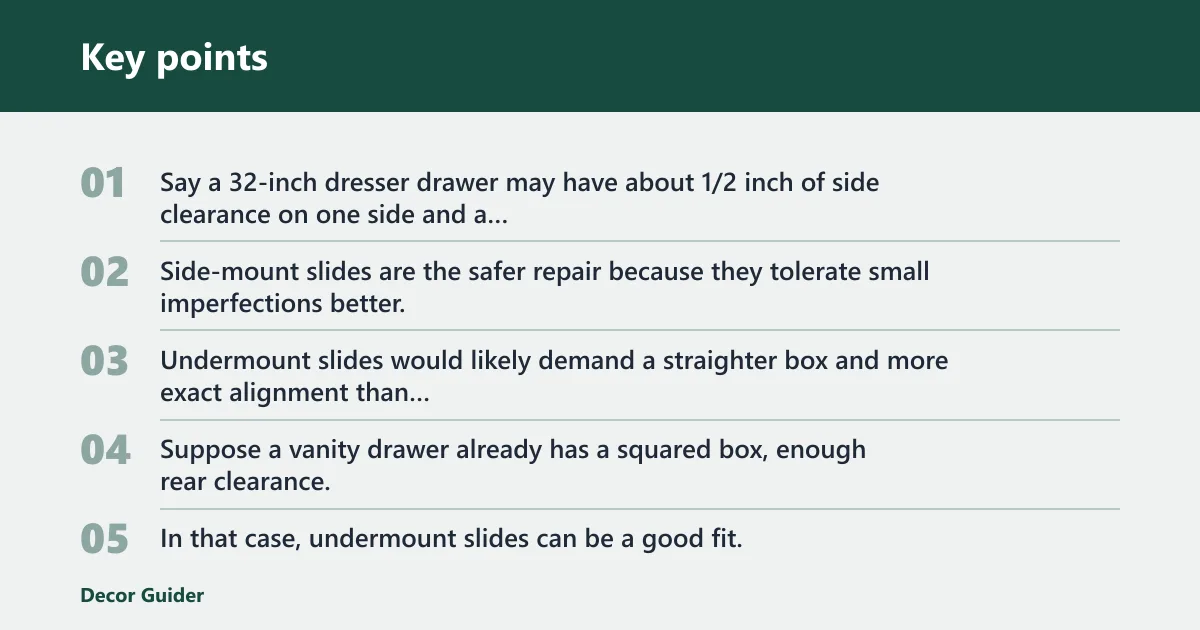
Say a 32-inch dresser drawer may have about 1/2 inch of side clearance on one side and a slightly bowed box on the other. Side-mount slides are the safer repair because they tolerate small imperfections better. Undermount slides would likely demand a straighter box and more exact alignment than that dresser can give, while a bottom/center-mount option may still depend on the underside layout and the existing drawer structure.
Suppose a vanity drawer already has a squared box, enough rear clearance, and a hidden locking clip system from a previous build. In that case, undermount slides can be a good fit, especially if you want full extension and a softer close. The key is matching the hardware system, not just the drawer width, and checking the specific manufacturer’s spacing and locking requirements before buying replacement parts.
Will either slide fit an older dresser?
Older dressers usually favor side-mount slides because the drawer box, runner area, and cabinet opening may not match modern hidden hardware dimensions. Undermount slides can work only if the drawer box shape, rear clearance, and locking devices line up with the slide system. If not, the retrofit can fail even when the drawer looks close enough on paper.
When side mount is the safer retrofit
Choose side mount when the dresser is older, the drawer sides are damaged, or the cabinet opening is not perfectly square. Side-mount hardware gives you more tolerance for worn wood, broken runners, and small alignment errors. It is also a practical choice when you want to replace slides without rebuilding the drawer.
When undermount needs modification
Undermount slides often need a drawer box designed for them, plus precise spacing underneath and at the rear. If the old dresser lacks that geometry, you may need to modify the drawer or cabinet before the hardware will run correctly. That extra work can outweigh the cleaner look, especially when the existing drawer was built around exposed side runners or nonstandard wood thickness.
What about bottom mount and center-mount slides?
Bottom mount hardware attaches to the bottom corner or underside of the drawer and is not the same as true undermount hardware. Bottom mount slides attach to the bottom corner or center underside of the drawer, and center-mount slides sit underneath the drawer, right down the middle. The naming causes confusion during repairs because hidden mounting is not the same thing as a true undermount system.
How bottom mount differs from true undermount
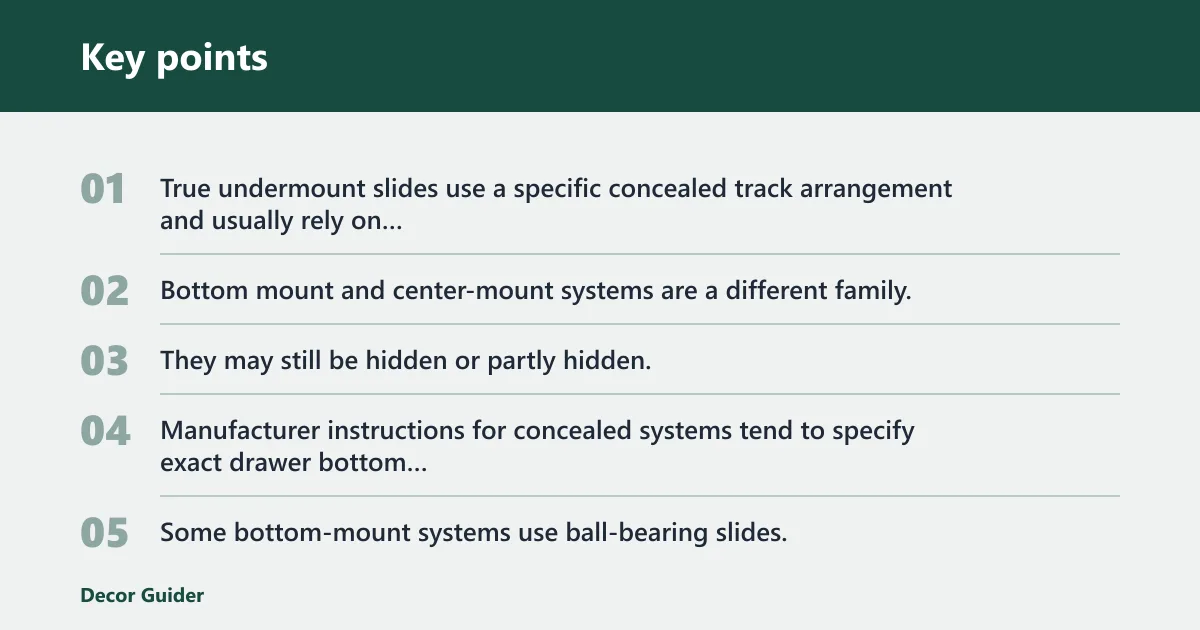
True undermount slides use a specific concealed track arrangement and usually rely on compatible drawer-box geometry and locking hardware. Bottom mount and center-mount systems are a different family. They may still be hidden or partly hidden, but they do not automatically share the same fit requirements as undermount slides. Manufacturer instructions for concealed systems tend to specify exact drawer bottom thickness, rear engagement, and locking clip placement; bottom/center-mount products use their own installation rules.
Where ball-bearing bottom-mount systems fit
Some bottom-mount systems use ball-bearing slides, which reduce friction and suit medium- to heavy-duty use. That makes them useful in repair work when the drawer needs smoother motion but the cabinet does not support a true undermount setup. Check the exact mounting style before you buy replacement parts, because load capacity, extension length, and screw placement vary by product family.
Why the naming mix-up matters in repairs
If you search for the wrong term, you can end up with hardware that mounts in the wrong place or needs parts the drawer does not have. That is a common repair mistake. The safer approach is to identify where the slide mounts, what supports the drawer, and whether the drawer box was built for concealed hardware.
Choose side mount if… / Choose undermount if…
Choose side mount when the dresser is old, damaged, or nonstandard, when you need a budget repair, or when the drawer box is not square enough for concealed hardware. Choose undermount when the drawer box already matches the system, the cabinet has the needed clearance, and you want hidden hardware with full extension or soft-close features. If the setup is borderline, side mount is usually the safer retrofit.
Choose side mount if…
- The dresser is older and the openings are not perfectly uniform.
- The drawer sides are damaged, warped, or already repaired.
- You need a simpler replacement with less measurement risk.
- You want a slide that often carries more weight.
Choose undermount if…
- The drawer box was built for concealed hardware.
- You want a hidden look and cleaner drawer sides.
- You need full extension for easier rear access.
- The cabinet and drawer dimensions already match the slide system.
How to choose the right retrofit slide
- Measure the drawer width, side clearance, and rear clearance before buying any replacement.
- Check whether the drawer box is square and whether the side panels are sound.
- Match the slide family to the existing hardware family whenever possible.
- Choose side mount if the dresser is imperfect, and undermount only if the geometry lines up.
Frequently asked questions
What is the difference between bottom mount and side mount drawer slides?
Side-mount slides attach to the sides of the drawer and cabinet. Bottom-mount slides attach underneath, often at the bottom corner or center underside. That changes the hardware family, the side clearance needed, and how much of the drawer width is preserved during installation.
Can you use side mount drawer slides as undermount?
Usually no. Side-mount slides are built to work on the drawer sides and cabinet sides, while undermount hardware needs a different track location and often locking devices that side-mount slides do not use. If you try to swap them without matching the hardware system, the drawer can bind or sit out of alignment.
What is the difference between side mount and bottom mount drawer slides?
Side-mount slides live on the side walls and are commonly ball-bearing or roller styles. Bottom-mount slides attach under the drawer instead, including center-mount versions that run down the middle. The choice affects visibility, available drawer width, and how much cabinet modification the repair may need.
What is the difference between undermount and bottom mount drawer slides?
Undermount slides are a concealed hardware system under the drawer that often depends on a compatible drawer box and locking mechanism. Bottom-mount slides are a broader group that attach under the drawer, including center-mount styles. They are related in location, but they are not the same hardware family.
Will undermount drawer slides fit an older dresser?
Sometimes, but not by default. Older dressers often have worn wood, uneven clearances, or drawer boxes that were never built for concealed hardware. Undermount slides can work only if the drawer box shape, rear clearance, and locking hardware all match the slide system closely enough for smooth travel.
Are undermount drawer slides harder to install than side mount?
Yes. Undermount slides usually require more exact measurements and tighter alignment, and a small error can cause scraping or binding. Side-mount slides are usually easier because the mounting points are simpler and the hardware is less sensitive to small variations in the drawer box or cabinet opening.
Do side mount drawer slides reduce drawer width?
Yes. Side-mount slides need side clearance, so they take up some of the drawer’s usable width. That trade-off is part of the hardware choice. If the drawer is already narrow, the lost width may matter more than the visibility of the hardware.
Products related to this article
Sponsored / affiliate links. As an Amazon Associate I earn from qualifying purchases. I may earn additional commission from eligible campaigns.