
How to Fix a Wobbly Wooden Bed Frame Without Replacing It
To fix a wobbly wooden bed frame, identify whether the looseness comes from fasteners, corner joints, slats, or a cracked rail, then tighten, shim, glue, or replace only the failed part. Skip the diagnosis, and you can hide a broken joint, keep the frame noisy, and let mattress support fail again. This guide shows the fastest checks, the smallest effective repairs, and the point where you should replace a damaged piece.
What you’ll need


- Screwdriver
- Wrench
- Allen key
- Socket set
- Clamp
- Wood glue
- Sandpaper
- Wood shims
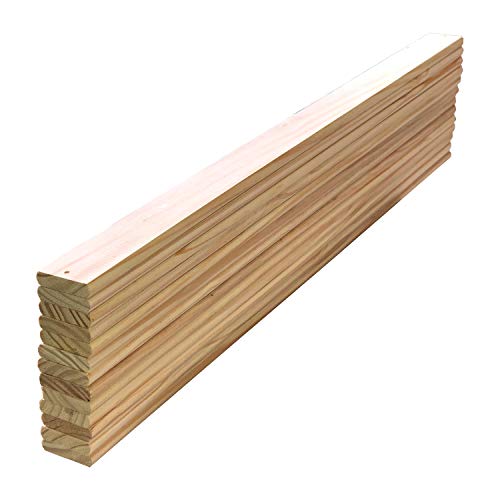
- Replacement slats
- Corner brackets
- Screws, bolts, washers, and lock washers
- Thread-locking compound
- Felt pads
- Wax, bar soap, beeswax, or silicone spray
Keep the hardware sorted as you remove it. A tray or labeled cups stop mixed bolts from ending up in the wrong rail.
How do you fix a wobbly wooden bed frame?
Start by separating wobble from squeak. Remove the mattress and box spring, then rock the frame at each corner and along each side rail. If the frame shifts side-to-side, you have joint movement, loose hardware, or a damaged support member, not just friction noise. If the box spring is also damaged, diagnose that separately before assuming the frame is the only problem.
- Lift off the mattress and box spring, then check whether the frame still rocks.
- Push each corner, headboard, footboard, and side rail by hand.
- Mark every loose point before tightening anything.
- Fix the most obvious failed part first, then retest the frame.
Say your queen frame feels steady at the center but shifts at the left front corner. That points to a corner joint or fastener problem, not a slat problem. Tightening the corner first can stop the wobble without touching the rest of the frame.
How do you fix loose hardware?
Loose screws are a common source of wobble and noise. Tighten every visible screw, bolt, washer, and nut at the side rails, headboard, footboard, and slat connections before you add any filler or bracket.
- Use the screwdriver, wrench, Allen key, or socket set that fits the fastener exactly.
- Snug each fastener until it stops turning, but do not crush the wood.
- Add a washer or lock washer where a bolt keeps backing out.
- Apply thread-locking compound only to fasteners that should not move often.
- Retest the frame by rocking the corner and side rail again.
If a screw keeps spinning, the hole may be stripped. Tightening alone will not hold it.
How do you fix a bed frame wood if the joints are loose?

Loose joints usually mean the wood parts are moving against each other, often at mortise-and-tenon corners or other corner joints. If the mating surfaces are still sound, shim the gap first; if the wood faces can bond cleanly, glue and clamp them. Glue-only repair is appropriate only when the joint surfaces fit tightly, the wood is not split, and the joint is not carrying a cracked rail or badly worn load path.
- Separate the joint enough to inspect the mating faces.
- Check for worn shoulders, crushed fibers, or gaps that open under pressure.
- Insert a wood shim if the joint is loose but not split.
- Sand away old residue before applying wood glue.
- Clamp the joint until fully cured, then reinstall the hardware.
- Add a corner bracket only after the joint is stable again.
Suppose a headboard corner opens by a few millimeters each time you push on it. A thin shim and clamp can restore contact. If the rail itself is split, skip the glue-only fix and move to replacement.
Repair cracked rails and broken slats
Cracked wood is a common bed frame problem, and broken slats are a direct repair target. Replace any split slat or rail that carries load. A brace can hide a surface crack, but it cannot restore a rail that has already lost strength near a joint. Match replacement parts to the manufacturer’s dimensions whenever possible, and follow the frame or mattress maker’s support requirements if they specify slat size, spacing, or a center beam.
- Remove the damaged slat or rail section.
- Match replacement slats to width, thickness, and length.
- Check slat spacing before reinstalling; some mattress manufacturers require closer support than others, so follow the frame or mattress warranty instructions rather than assuming one spacing fits every bed.
- Install the new part with the original fastener style when possible.
- Stop and replace the frame if the crack reaches a weight-bearing joint.
Warped side rails can also affect stability. If a rail bows enough that the slats no longer sit flat, replacement is safer than trying to force it straight.
How do you reinforce the support system?
Check the center support, cross rails, and legs if the frame still flexes after the hardware is tight. A loose support leg or shifting center beam can make the whole bed feel unstable even when the corner joints are sound. Support requirements vary by bed design, mattress type, and warranty language, so use the frame maker’s assembly manual or the mattress warranty guide when deciding whether the existing support layout is enough.
- Inspect the center support from head to foot.
- Check whether each leg sits flat on the floor.
- Verify that the slats contact the side rails evenly.
- Confirm the mattress matches the slat layout and spacing.
- Add a corner bracket or replacement support part if a member is worn.
A heavier mattress can expose weak support faster. If the frame was built for a different mattress type, the support layout may need to change before the wobble disappears.
How do you make a wood bed frame less squeaky and wobbly?
Quieting friction helps only after the structure is tight. Use felt pads, beeswax, bar soap, wax, or silicone spray where wood rubs wood, and use felt at contact points that shift under load. Do not count on lubrication to fix side-to-side movement. If noise seems to come from the box spring instead of the frame, isolate that source before treating the wood.
- Find the contact point by pressing each moving joint.
- Apply felt to wood-on-wood contact where parts rub.
- Rub beeswax or bar soap on the friction edge, or use silicone spray sparingly.
- Retest the frame after each application.
- Stop if the squeak remains and the frame still racks side-to-side.
Picture a slat that squeaks only when weight shifts near the footboard. That is a friction problem. A corner that opens and closes under pressure is a structural problem.
Wooden bed frame repair decision table
| Symptom | Likely cause | Quick test | Severity threshold | Best fix | Tools needed | Estimated cost | Estimated time | Safe to sleep on tonight? | Stop-and-replace warning |
|---|---|---|---|---|---|---|---|---|---|
| Loose bolts | Fasteners backing out | Rock the corner; movement stops when bolt is snugged | Low if the joint closes fully after tightening; higher if the bolt spins or the wood crushes | Tighten, add washer or lock washer, then retest | Wrench, Allen key, socket set | $0–$10 | 10–20 minutes | Usually yes, if the frame is square and the looseness is gone | Replace the part if the bolt spins in a stripped hole |
| Stripped screw holes | Screw no longer bites wood | Screw turns without resistance | Moderate if the screw head will not hold torque; high if the hole is enlarged near a joint | Use a shim or wood repair method, then reinstall hardware | Screwdriver, wood shims, wood glue | $5–$15 | 20–45 minutes plus cure time | Usually not until the hole grips again | Replace the rail if the hole is near a split or joint |
| Cracked rails | Structural damage | Flex the rail and watch the crack open | High if the crack opens under load or approaches a joint; critical if it reaches a weight-bearing connection | Replace the rail or rail section | Screwdriver, wrench, replacement rail | $20–$80 | 30–90 minutes | Only if the crack is tiny, non-growing, and not load-bearing; otherwise no | Stop repair if the crack reaches a weight-bearing joint |
| Broken slats | Overload or age | Slat bends, splinters, or drops out of line | Moderate if one slat fails; high if more than one is cracked, bowed, or unsupported | Replace the slat with matched size and spacing | Screwdriver, replacement slats | $10–$40 | 15–30 minutes | Sometimes for one isolated slat if the mattress is still fully supported; otherwise no | Replace the frame if multiple slats fail together |
| Loose center support | Leg or cross rail movement | Push the center beam and watch for floor lift | Moderate if the beam shifts but stays straight; high if it is bent, cracked, or missing contact | Tighten legs, reset support, or add a new support part | Wrench, socket set, clamp | $10–$50 | 20–60 minutes | Usually not if the beam is visibly unstable | Replace if the center beam is bent or cracked |
| Joint racking | Worn corner joint or warped rail | Frame shifts diagonally when corner is pushed | High if the square cannot be restored by tightening; critical if the joint opens and closes repeatedly | Shim, glue, clamp, or add a corner bracket | Clamp, wood glue, sandpaper, corner bracket | $8–$30 | 30–60 minutes plus cure time | Usually not until the joint holds square under load | Replace if the joint will not hold square after repair |
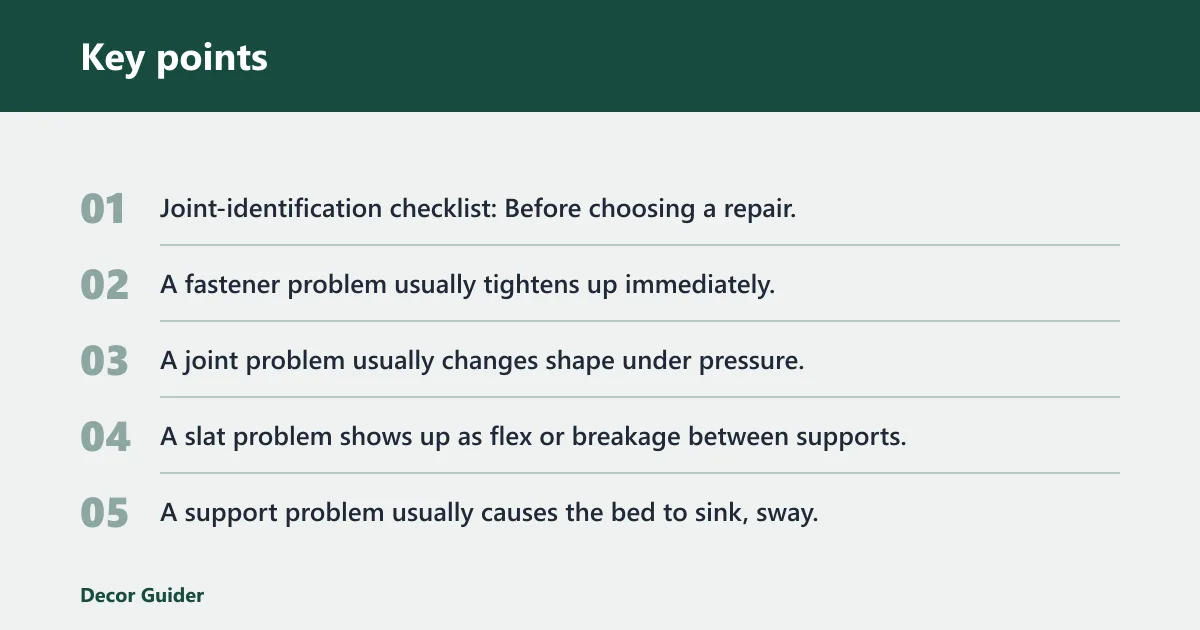
Joint-identification checklist: Before choosing a repair, check whether the problem is in the fastener, the wood-to-wood joint, the slat system, or the support leg. A fastener problem usually tightens up immediately. A joint problem usually changes shape under pressure. A slat problem shows up as flex or breakage between supports. A support problem usually causes the bed to sink, sway, or rock from the middle rather than one corner.
Common mistakes
Tighten before you lubricate. Lubricant can quiet rubbing wood, but it will not stop a loose joint from moving. If you add wax first, you may mask the real failure and make the frame harder to diagnose later.
Do not glue a cracked rail and call it fixed. If the crack carries weight or reaches a joint, replacement is the safer move. Do not ignore the box spring either; a separate noise source can make the bed sound like the frame is failing.
How do you disassemble a wooden bed frame to repair it?
Disassemble only as far as needed to reach the failed part. Remove the mattress and box spring, label the hardware, and take apart the side rails, headboard, footboard, and slat supports in a controlled order so you can put them back square.
- Lay out small bags or cups for each hardware group.
- Remove slats first, then detach the side rails.
- Mark the left and right sides so parts return to the same position.
- Keep washers, lock washers, and bolts matched to each joint.
- Reassemble one joint at a time, then check for square before tightening fully.
A common first-timer mistake is removing every fastener at once. That makes it harder to see which joint caused the wobble and easier to mix up parts.
Frequently asked questions
How do you fix a bed frame that rocks at the corners?
Rocking at the corners usually means a loose corner joint, a stripped fastener hole, or a warped rail. Tighten the corner hardware first, then test the frame again. If the corner still moves, shim the joint or add a corner bracket only after you confirm the wood is not split.
How do you make a bed frame more sturdy for a heavier mattress?
Check the slat spacing, center support, and leg contact before adding reinforcement. Mattress and frame manufacturers may require specific support layouts for warranty coverage, so do not rely on a single universal spacing rule. Use the support dimensions listed for the mattress and frame together.
What tools do you need to repair a wooden bed frame?
A screwdriver, wrench, Allen key, socket set, and clamp handle most repairs. Add wood glue, sandpaper, wood shims, replacement slats, and corner brackets when the damage is structural. Keep felt, wax, bar soap, beeswax, or silicone spray for rubbing contact points after the frame is tight.
When should you replace a wooden bed frame instead of repairing it?
Replace the frame if a crack reaches a weight-bearing joint, the rail stays warped after alignment, or the joint will not hold square after shimming and clamping. Repeated loosening is another warning sign. If the same corner fails again after repair, the underlying wood may be too worn to trust.
How do you fix broken wood bed frame parts without replacing the whole bed?
Replace only the failed member when the damage is isolated. A broken slat, loose center support leg, or single stripped screw hole can often be repaired without replacing the full bed. If the rail itself is split or a joint is failing, swap the damaged part rather than masking it with glue or brackets.
How do you disassemble a wood bed frame?
Remove the mattress and box spring first, then take off the slats, side rails, headboard, and footboard in that order or in the order your frame allows. Label each fastener group as you go. That keeps the rebuild square and prevents the wrong bolt from tearing out a repaired hole.
Sources
- Manufacturer assembly manuals for platform beds and wooden bed frames that specify required slat counts, center supports, and fastener tightening steps.
- Mattress warranty and care documents from major manufacturers that define acceptable foundation support, slat spacing, and center support requirements.
- Woodworking repair guides from recognized furniture repair sources covering wood shimming, glue-and-clamp repairs, and when structural cracks require replacement instead of reinforcement.
Products related to this article
Sponsored / affiliate links. As an Amazon Associate I earn from qualifying purchases. I may earn additional commission from eligible campaigns.