How to Tighten a Bed Frame That Keeps Coming Loose
Tighten the frame only after you find the failure point: loose bolts, a stripped insert, a cracked slat support, or a shifting joint; if the same fastener loosens twice, replace the hardware or add locking hardware. Left alone, the wobble grows, fasteners strip out, and the frame can start squeaking or pull apart. Use the checklist below to find the weak point, match the fix to the fault, and stop the looseness from coming back.
What you need first
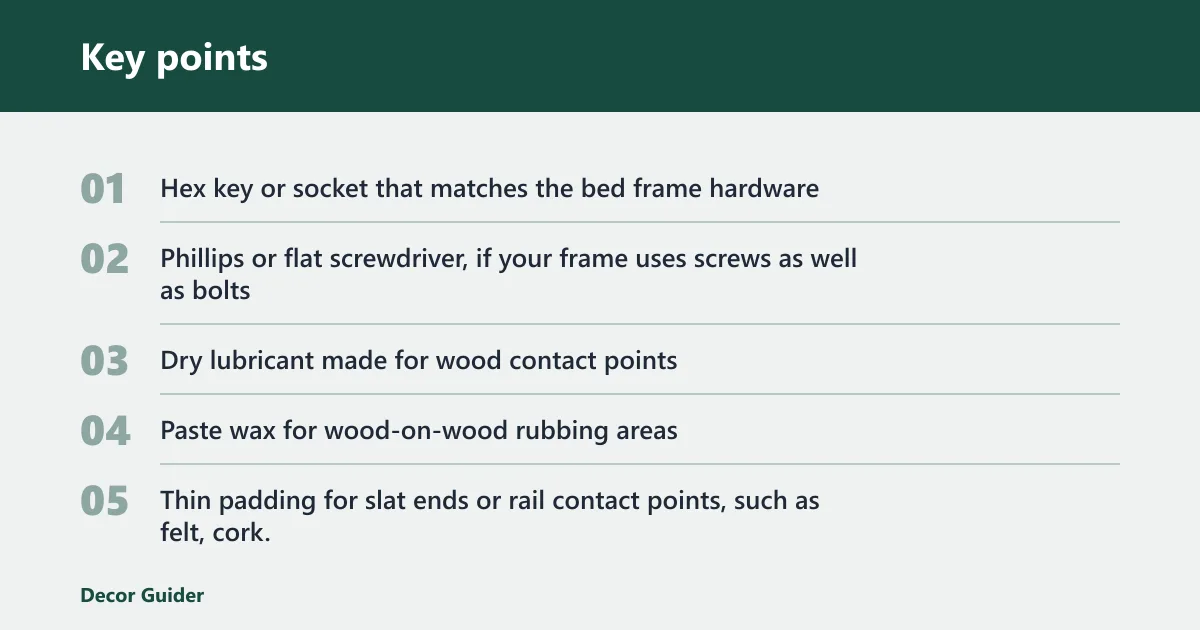


- Hex key or socket that matches the bed frame hardware
- Phillips or flat screwdriver, if your frame uses screws as well as bolts
- Dry lubricant made for wood contact points
- Paste wax for wood-on-wood rubbing areas
- Thin padding for slat ends or rail contact points, such as felt, cork, or rubber shim stock
- Blue threadlocker for bolts that repeatedly back out
- Optional replacement bolts, nuts, inserts, and brackets matched to the frame
- Wood filler or a threaded insert repair kit for damaged wood holes
- Level or straightedge for checking rocking and racking
Bed frame failure checklist
| Symptom | Likely cause | Best fix | When to replace parts |
|---|---|---|---|
| Loose bolts | Fasteners backed out from vibration or normal movement | Retighten with the correct hex key or socket in a diagonal pattern | Replace bolts, nuts, or inserts if threads are rounded or the joint loosens again |
| Stripped inserts | Threads in wood or metal no longer grip the bolt | Repair the insert or hole; use blue threadlocker only after the hardware fits correctly | Replace the insert, bracket, or rail if the repair will not hold torque |
| Rocking legs | Uneven floor, loose leg hardware, or a frame that is out of square | Check level, then square the frame and retighten the leg and corner hardware | Replace bent legs, cracked feet, or damaged leg brackets |
| Shifting slats | Slats slide in their rails or sit with too much gap for the mattress support system | Pad the contact points and secure the slats so they do not walk sideways | Replace broken slats or supports that no longer sit flat |
| Racked frame | Rectangle is out of square, so joints twist under load | Square the frame before tightening the high-leverage joints | Replace bent side rails, warped center support, or damaged corner brackets |
Why does the bed frame keep loosening?

A squeaky bed frame usually comes down to four things: a loose bolt, rubbing wood, a shifting slat, or a rocking leg. Loose fasteners cause more bed noise than anything else, and a frame that is even slightly out of square can make the same joints work loose again after you tighten them.
High-stress joints back out first
Headboard and footboard bolts carry the most leverage, so they are common loosening points. Center support rail connections can also work loose because they may carry load in a more central part of the bed, not just at the corners.
Parts move because the frame is out of square
If the rectangle racks, one corner gets loaded harder than the others. That motion can feel like a loose joint even when the fastener is still present, which is why squaring the frame matters before the last round of tightening.
The mattress, foundation, or box spring may be adding movement
Check the box spring separately from the frame. The mattress and foundation match also matters: a frame that is too flimsy for the load can keep loosening no matter how often you retighten it, and slat spacing needs to match the support requirements in the manufacturer listing.
What should you check first?
Start with the press test on each corner and the headboard side. If you hear a high metallic chirp or tick, suspect a bolt, bracket, or metal-on-metal contact before you add padding. Then inspect slats, corner joints, and the center support rail before touching the box spring or mattress.
Inspect all fasteners before adding pads or lubricant
Use the proper hex key or socket and check each visible bolt, nut, and screw. Tighten the loose bolt first, because a pad or wax block can hide a real hardware problem and delay the repair.
Separate frame noise from box spring noise
Lift the mattress and press on the box spring or foundation by itself. If the noise follows that component, the frame may be innocent. If the movement stays in the frame, continue with the joints and supports.
Check slats, corner joints, and the center support rail
Slats can shift in their rail, and fragile slats are more likely to squeak sooner. A common first-timer mistake is padding the corners while the middle support is still loose. Suppose a queen frame rocks only when weight shifts toward the center; the center rail, not the corner, is the first place to fix.
Tighten the hardware in the right order
Tighten all hardware before you add fixes. The goal is a snug joint, not a crushed one, so use the matching tool and work in a diagonal pattern: front-left, back-right, front-right, back-left. That order helps the frame square up instead of binding in one corner.
Start with the loose bolt and matching fastener
- Back the bolt out just enough to inspect the threads and the insert.
- Clean debris from the threads if the hardware is gritty.
- Reinstall the bolt with the correct hex key or socket.
- Bring the joint snug, then move to the next corner in the diagonal order.
Square the frame, then tighten headboard and footboard joints last
Headboard and footboard joints are high-leverage points, so tighten them after the side rails and supports are aligned. If the frame is racked, tighten the corners in the diagonal sequence first, then finish with the headboard and footboard bolts last.
If that didn’t work, try this next
- Loosen the opposite corner slightly if the frame will not square.
- Reset the center support rail so it sits flat and centered.
- Retighten each joint in the same diagonal order.
- Recheck the press test at the corner and the headboard side.
How do you stop it from loosening again?
Add a small anti-backout measure only where the hardware design needs it. Blue threadlocker is the better choice for bolts that keep loosening, because it is removable. A lock washer can help in some joints, but it is not a cure-all and should be used only when the hardware layout allows it.
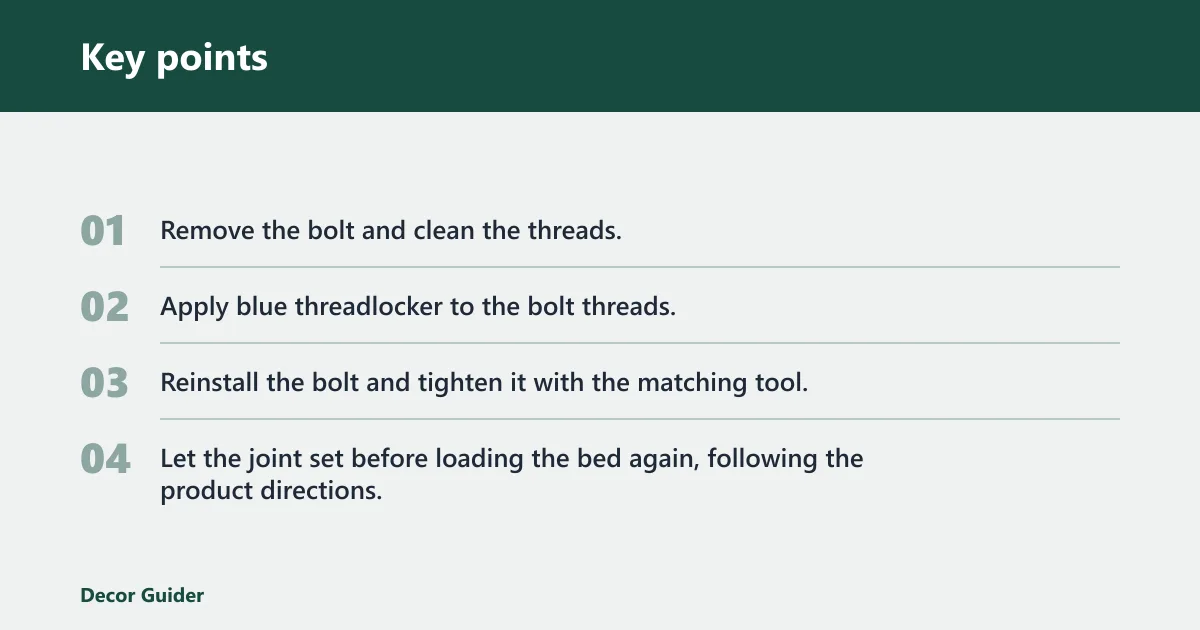
Add blue threadlocker where bolts keep backing out
- Remove the bolt and clean the threads.
- Apply blue threadlocker to the bolt threads.
- Reinstall the bolt and tighten it with the matching tool.
- Let the joint set before loading the bed again, following the product directions.
Use a lock washer only when the joint design calls for it
If the bolt, nut, and bracket setup allows a lock washer, place it under the nut. Do not treat it as a universal fix for every bed frame joint. A repeated loosening problem usually means the joint needs a better fit, not just another ring of hardware.
Add dry lubricant or wax at wood-on-wood contact points
Use wax on wood-on-wood contact points, including slat ends and post joints. Dry lubricant works in the same kind of rubbing area. Avoid oil, grease, and WD-40 on wood joints, because they can attract dust and do not solve a loose fastener.
Adjust slats and spacing before you call the frame stable
Padding where the slats rest on the side rails can stop side-to-side shift. Gap tolerance matters for mattress support, and the mattress or frame listing should set the limit for your model. Wirecutter notes that innerspring mattresses can have trouble if slats are more than 2.5 inches apart, but manufacturer guidance still takes priority.
Common mistakes to avoid
- Over-tightening and crushing the joint instead of making it snug
- Using the wrong tool, which rounds bolt heads and makes future repairs harder
- Adding padding before checking the loose bolt first
- Using grease or oily spray on rubbing points
- Ignoring slat movement, especially if the slats feel fragile
- Skipping the center support rail when the noise seems to come from the middle
- Treating the box spring as part of the frame before you test it separately
- Assuming every repeated looseness needs the same fix
For a wood frame, focus on the joints where wood rubs against wood. Tighten the hardware first, then use wax or dry lubricant on slat ends, post brackets, and other contact points. If the screw hole or insert is stripped, a repair insert or replacement part is usually a better answer than endless retightening.
Frequently asked questions
What should I do if bed bolts keep backing out?
Clean the threads, reinstall the bolt with the proper tool, and use blue threadlocker if the same bolt keeps loosening. If the joint design allows it, a lock washer can help. If the threads are stripped or the bolt head is damaged, replace the hardware rather than forcing another cycle of tightening.
How do I keep a bed frame from loosening again?
Fix the cause, not just the symptom. That means checking for a racked frame, loose fasteners, shifting slats, and a mismatched mattress or foundation. Use dry lubricant or wax at rubbing points, and reserve blue threadlocker for bolts that repeatedly back out after a correct reinstall.
Products related to this article
Sponsored / affiliate links. As an Amazon Associate I earn from qualifying purchases. I may earn additional commission from eligible campaigns.