Box Spring vs Foundation: What Is the Difference?
A box spring adds springy give and extra height, while a foundation is a rigid support base. Use a true box spring with a traditional innerspring mattress, and use a foundation for most foam, hybrid, or latex beds. The wrong base can void a mattress warranty, speed up sagging, or change the bed feel. This guide explains the differences, when each works best, and how to match support to your mattress and frame.
This guide is part of our Bed and Bathroom Fixes: Bed Frames, Mattresses, Toilets, Tubs and Vanities series.
Quick frame check: If your frame has wide slat gaps, choose a rigid foundation or add a slat insert; if the center rail bows, choose neither until the frame is fixed; if your mattress is innerspring and the maker allows it, a true box spring can work; if you have memory foam, latex, or hybrid bedding, a foundation is usually the safer fit. Mattress makers commonly specify slat spacing around 2 to 2.75 inches for many beds, and wider gaps can create unsupported sections that lead to sagging.
| Decision factor | Box Spring | Foundation | Winner |
|---|---|---|---|
| Construction and feel | Wooden frame with internal spring coils; adds bounce and some shock absorption | Rigid support base without springs; wood, metal, or composite construction | Foundation |
| Best mattress match | Best suited to innerspring mattresses | Compatible with most mattress types, including memory foam, latex, hybrid, and innerspring | Foundation |
| Stability under load | Can sag, creak, or lose support over time | Usually firmer with less give | Foundation |
| Height and profile options | Raises the bed more; low-profile options exist | Also available in low-profile and full-height versions | Tie |
| Airflow and upkeep | Can improve airflow, but coils and fabric can age noisily or unevenly | Solid, easy-to-check support; airflow depends on the design and slat gaps | Tie |
| Cost and replacement pressure | Average queen price: $100-300 | Average queen price: $200-500 | Box Spring |
How construction shapes feel and height
A true box spring is a wooden base with internal coils, so it adds springiness and some shock absorption under the mattress. A foundation is a rigid support base without springs, usually made of wood or metal, and it gives firmer, less forgiving support.
That difference changes the bed feel. A box spring adds more movement and can soften the feel of an innerspring mattress, while a foundation keeps the mattress more stable and even. Modern box spring alternatives are different: they may look similar from the outside, but if they do not contain coils, they are not true box springs.
Construction and feel
The coil unit inside a box spring is what creates bounce. That can help a traditional innerspring mattress feel more responsive and absorb some motion from the sleeper or bed frame.
A foundation is built for support first. It does not add spring action, so the mattress sits on a firmer, flatter base.
What that means for height and movement
Both options can add height. Low-profile foundations are typically 3-7 inches tall, while full-profile foundations may range from 8-12 inches in thickness. Low-profile versions are useful when you need support without a tall bed. Mattress brands commonly describe low-profile foundations and box springs in the 3 to 7 inch range, with some low-profile models around 5 to 5.5 inches, so the exact height depends on the product line.
If you want the bed to feel steadier, the foundation usually wins. If you want some bounce and a taller overall profile, a box spring fits that goal better.
Box Spring vs Foundation matrix
The mattress type should drive the choice. In most cases, an innerspring mattress is the only one that clearly favors a true box spring, while foam, latex, and hybrid beds usually need a firm, even base. Retailers and manufacturers also distinguish support categories differently: a true coil box spring adds spring action, a semi-flex foundation may include limited give, a platform bed uses a rigid deck or closely spaced slats, a bunkie board adds a thin rigid layer, and an adjustable base changes position rather than acting as a traditional static foundation.
| Mattress / frame type | Best support option | Why it works | Red flags | Warranty and fit notes |
|---|---|---|---|---|
| Innerspring mattress | True box spring or approved foundation | Coil mattresses can benefit from a little spring give under the sleep surface | Sagging coils, noisy frame, or a mattress that feels too soft and unstable | Follow the manufacturer’s written base requirement; some brands allow only a rigid foundation or platform, and others allow a true box spring only with innerspring models |
| Memory foam mattress | Rigid foundation, platform bed, or bunkie board with proper support | Foam needs a flat, stable surface to prevent uneven compression | Too much give under the mattress, wide slat gaps, or any springy base that changes support | Many warranties require slats close enough together or a fully supported platform; floor placement can also be excluded if moisture or ventilation issues develop |
| Latex mattress | Rigid foundation or platform bed | Latex performs best on even support with minimal flex | Uneven support, flexing center section, or soft spots from a worn base | If the manufacturer specifies slat spacing, keep the gaps within that limit; otherwise a bunkie board or foundation can reduce risk |
| Hybrid mattress | Rigid foundation or platform bed | Hybrid constructions need firm, even support without extra bounce from below | Weak rails, uneven slats, or a base that lets the mattress settle in the middle | Many hybrids are compatible with adjustable bases if the brand approves it; check height and bend limits before buying |
| Platform bed | Usually its own base, sometimes with a bunkie board | A platform is designed to support the mattress directly, often with closely spaced slats or a solid surface | Slats spaced too far apart, center bowing, or no center support on larger sizes | Platform beds often satisfy warranty support requirements if the slats or deck meet the stated spacing and weight guidelines |
| Adjustable base | Adjustable base only if the mattress is rated for it | It flexes the mattress rather than supporting it like a static frame | Mattress binding, excessive stiffness, or model incompatibility | Not all mattresses can bend safely; mattress makers commonly list approved constructions and exclusions |
Innerspring mattresses
Innerspring mattresses are the most compatible with box springs. A true box spring is typically intended for innerspring mattresses only, and that matches the way these mattresses are built to use some spring-supported give underneath.
If your innerspring mattress feels overly firm on a rigid base, a box spring can add some shock absorption. That said, a worn box spring can create the opposite problem by adding sag or noise.
Memory foam mattresses
Memory foam generally does better on a foundation. Its heavier build needs stable, even support, and a true box spring is not typically the right match.
A soft or springy base can let foam bedding lose support in the middle. That can change alignment and shorten the usable life of the mattress. Many mattress warranties also call for a flat, supportive surface or closely spaced slats; if the support system does not meet those requirements, coverage can be at risk.
Latex mattresses
Latex also needs sturdy, even support. Retail guidance from mattress makers and sleep-product brands commonly points latex mattresses toward foundations or rigid platforms, which lines up with the material’s need for a flat surface that does not flex in spots.
If the base dips or the slats are too far apart, the mattress can follow that uneven surface. A rigid foundation is the safer choice.
Hybrid mattresses
Hybrid mattresses usually belong on a foundation. They combine coils with foam layers, so they need firm support that does not add extra bounce from below.
Too much give under a hybrid can make it feel unstable. A foundation keeps the support surface even and helps the mattress perform as intended. If your brand allows an adjustable base, that is a separate category from a foundation and should be chosen only when the mattress is approved for articulation.
Do you need a box spring or a foundation?
If your mattress is innerspring, a box spring may be the better match. If your mattress is memory foam, latex, or hybrid, a foundation is usually the stronger choice because it offers firmer, more even support and better compatibility with those constructions.
If your mattress is innerspring
Start with a box spring if you want a more traditional feel and your mattress maker approves it. It can add bounce, raise bed height, and absorb some shock under a coil mattress.
Check whether the mattress warranty requires a specific base type. If the manufacturer asks for a rigid platform instead, follow that guidance instead of defaulting to a box spring. Warranty language often matters more than general product categories.
If your mattress is memory foam, latex, or hybrid
Choose a foundation for these mattresses unless the manufacturer says otherwise. A rigid foundation is the support style these beds usually need.
This is also the better pick if you want the bed to feel firmer and less springy. The mattress should sit on a stable, even surface without extra flex from underneath.
If your frame has weak or wide-spaced slats
Too-wide slat spacing can require extra support. Many mattress makers and sleep-product brands cite slats around 2 to 2.75 inches apart as a common guideline, so gaps wider than that can be a warning sign for many mattresses.
Say your queen frame has slats spaced farther apart than that and a hybrid mattress starts dipping near the middle. The fix is not a softer base; it is stronger support, such as a foundation, a bunkie board, or a proper slat insert that removes the gap problem.
What your bed frame tells you
Your frame can decide the base for you before the mattress type does. If the support surface is weak, uneven, or too open, no base choice will fully solve the problem until the frame itself is corrected.
Slat spacing and center support
Look for slats that are close enough together to support the mattress across its full width. Brand support pages commonly point to 2 to 2.75 inches as the safe spacing range for many bases, and that is one of the most useful compatibility checks you can make before buying.
A center rail matters too. A queen, king, or other wide frame without solid middle support can sag in the center even if the outer rails seem fine.
Signs the frame needs a firmer base
Watch for creaking, visible bowing, a dip in the center, or slats that shift when you press on them. Those signs mean the frame is already losing support.
A mattress sitting on a tired frame can wear unevenly. If the frame is the weak point, replacing the base alone will not fix the support problem.
When a low-profile base makes more sense
Use a low-profile base when you want mattress support without extra height. Low-profile foundations are commonly described in the 3 to 7 inch range, which is useful for taller mattresses or for sleepers who do not want a high bed.
Suppose a hybrid mattress already sits high and a full-profile base would make the bed awkward to climb into. A low-profile foundation keeps the support firm while limiting total bed height.
Choose Box Spring if… / Choose Foundation if…
Choose the base that matches the mattress and the frame, not the one that sounds familiar. The wrong support can change feel, shorten mattress life, or conflict with warranty terms.
Choose Box Spring if…
- You have a traditional innerspring mattress.
- You want a springier feel with some bounce and shock absorption.
- Your mattress maker allows a true box spring.
- Your frame is already flat, sturdy, and not sagging.
Choose Foundation if…
- You have memory foam, latex, or hybrid bedding.
- You want firmer support and less give under the mattress.
- Your slats are too far apart and need a more stable support surface.
- You want a low-profile or full-height rigid base with fewer movement issues.
Choose neither until the frame is fixed if…
- The center rail bows or the frame dips in the middle.
- Slats are cracked, loose, or visibly uneven.
- The support surface rocks or shifts when pressed.
- The mattress already shows a repeat sag pattern from the current base.


Box spring and foundation comparison table
| Factor | Box Spring | Foundation | Winner |
|---|---|---|---|
| Structure | Wooden frame with internal spring coils | Rigid support base made of wood, metal, or composite materials | Foundation |
| Feel | More bounce and movement | Less give, firmer support | Foundation |
| Compatibility | Best for innerspring mattresses | Works with most mattress types | Foundation |
| Height options | Can add height; low-profile versions exist | Can also be low-profile or full-profile | Tie |
| Noise and wear | Can be noisy or sag over time | Usually more durable and stable | Foundation |
| Airflow and cleaning | Can improve airflow but may collect dust inside the cover over time | Depends on the design; easier to inspect for damage and uneven support | Tie |
Structure and feel
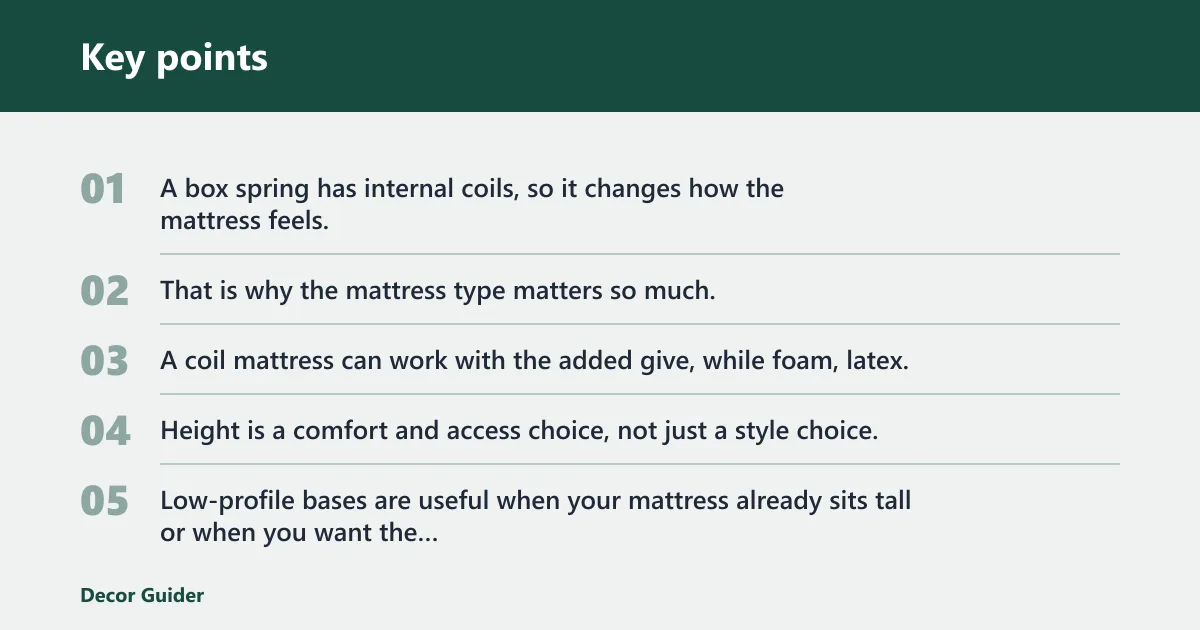
The structure is the biggest difference. A box spring has internal coils, so it changes how the mattress feels; a foundation is built to stay rigid and support the mattress without extra spring action.
That is why the mattress type matters so much. A coil mattress can work with the added give, while foam, latex, and hybrid beds usually should not.
Height options
Height is a comfort and access choice, not just a style choice. Low-profile bases are useful when your mattress already sits tall or when you want the bed closer to the floor.
A box spring can also raise the bed, but its height should not be the main reason to buy one. Support fit comes first.
Durability and noise
A foundation usually lasts better because it has fewer moving parts. A box spring can wear out, squeak, or sag as its coils and wood components age.
That matters most when the mattress is heavy or the frame has weak spots. A base that flexes in the wrong place can become a source of new sagging.
Airflow and cleaning
Airflow is useful, but it is not automatic. A raised base can allow more air movement than a mattress on the floor, yet the real benefit depends on the bed design and how closed off the support surface is.
Cleaning also matters. A base lifted off the floor is easier to inspect, while a covered box spring can hide dust and wear until the problem is obvious.
Can you put a mattress on the floor?
Yes, a mattress can sit on the floor if it has solid, flat support and the mattress type does not require a base. Some manufacturer and retailer guidance says a mattress can be used on a hard, flat surface if the model does not require a box spring or frame.
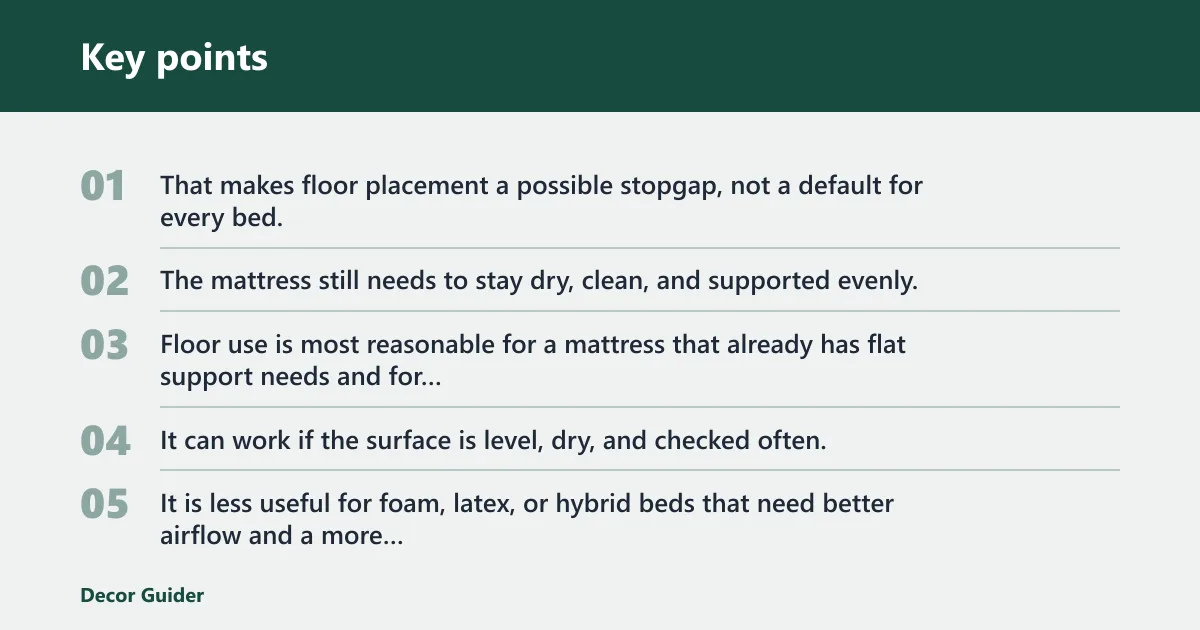
That makes floor placement a possible stopgap, not a default for every bed. The mattress still needs to stay dry, clean, and supported evenly.
When floor placement is acceptable
Floor use is most reasonable for a mattress that already has flat support needs and for short-term situations. It can work if the surface is level, dry, and checked often.
It is less useful for foam, latex, or hybrid beds that need better airflow and a more dependable support system.
Humidity, mold, and cleaning tradeoffs
Floor placement limits airflow under the mattress. That raises the risk of trapped humidity, dust buildup, and cleaning problems, especially in damp rooms or on cool floors. Moisture trapped between the mattress and the floor can create conditions that encourage mold or mildew growth, which is why many mattress brands discourage long-term floor use in humid spaces.
Those tradeoffs matter more in basements, ground-floor rooms, and humid climates. A mattress that stays close to the floor also picks up dirt faster and is harder to move for cleaning.
When floor use is a stopgap, not a long-term fix
Use the floor only when you need a temporary solution and the mattress is safe on a flat surface. If the frame is sagging or the base is missing, the better answer is to replace the support rather than rely on the floor.
A common first-timer mistake is assuming a worn mattress will feel firm again just because it is placed on a box spring instead of a foundation. It does not fix a weak frame, and it can create new moisture and hygiene issues if left in place too long.
Frequently asked questions
What is the difference between a box spring and a foundation?
A box spring is a wooden base with internal coils, so it adds bounce and some shock absorption. A foundation is a rigid support base without springs, usually made of wood or metal, and it gives firmer, less springy support for the mattress.
Do I need a box spring with my mattress?
Only if your mattress type and manufacturer call for one. Innerspring mattresses are the best fit for a true box spring, while memory foam, latex, and hybrid mattresses usually work better on a foundation or another rigid support base.
What mattresses work with a box spring versus a foundation?
Box springs are typically best for innerspring mattresses. Foundations are usually the better choice for memory foam, latex, hybrid, and many innerspring beds, especially when you want firm support and a flatter, more stable surface.
Can I put a mattress on the floor instead of using a base?
Sometimes, yes. A mattress can sit on a hard, flat surface if it does not require a base, but floor use brings airflow, humidity, and cleaning tradeoffs that can make it a poor long-term choice for many bedrooms.
How tall is a low-profile foundation or box spring?
Low-profile foundations are typically 3-7 inches tall, and some brands describe low-profile options around 5 to 5.5 inches. That height range is useful when you need support without making the bed too tall.
Can a box spring wear out or sag over time?
Yes. A box spring can become noisy, lose support, or sag as the coils and frame age. If the mattress starts dipping, creaking, or feeling uneven, the base may be the part that needs replacement first.
What happens if my bed frame has slats that are too far apart?
Wide slat gaps can leave parts of the mattress unsupported, which can cause sagging and shorten mattress life. Mattress makers commonly cite slat spacing around 2 to 2.75 inches, so gaps wider than that often call for a foundation or other added support.
Products related to this article
Sponsored / affiliate links. As an Amazon Associate I earn from qualifying purchases. I may earn additional commission from eligible campaigns.