How to Keep a Bathroom Smelling Fresh Without Masking Odors
Find the source first: musty usually means moisture or mildew, sewer smell often points to a dry trap or vent issue, and ammonia or urine smell usually comes from splashes around the toilet and floor edges. If you skip the source, odor returns fast and can point to hidden moisture damage or plumbing trouble. This guide shows how to pinpoint the smell, fix the cause, and keep the bathroom smelling fresh with steps that last.
What you’ll need
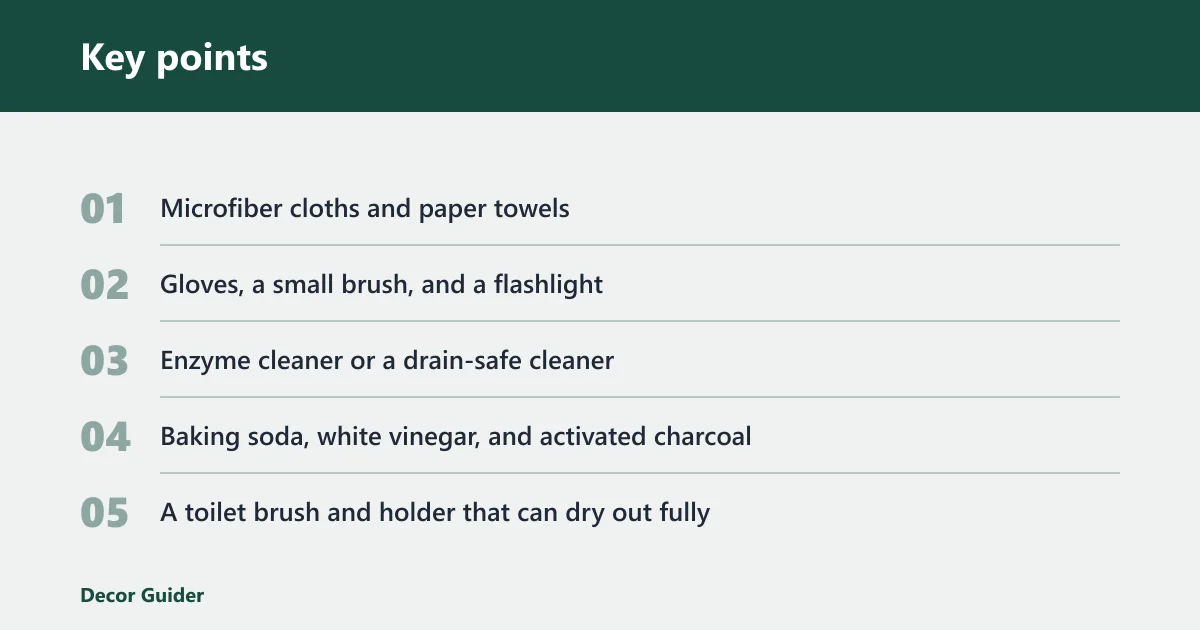


- Microfiber cloths and paper towels
- Gloves, a small brush, and a flashlight
- Enzyme cleaner or a drain-safe cleaner
- Baking soda, white vinegar, and activated charcoal
- A toilet brush and holder that can dry out fully
- A bucket or measuring cup for hot water flushes
Bathroom odor troubleshooting table

| Smell type | Likely source | Fastest test | Best fix | Tools needed | When to call a plumber |
|---|---|---|---|---|---|
| Sewage smell | Dry P-trap, failed toilet seal, or vent issue | Run water in the sink and floor drain, then sniff near the toilet base | Refill traps, check the seal, and inspect venting | Flashlight, gloves, paper towels | If odor returns after refilling traps or the toilet rocks |
| Musty shower smell | Humidity, mildew, damp grout, curtain, or caulk | Check wet corners, grout lines, and the shower curtain | Dry surfaces, improve venting, clean mildew-prone areas | Microfiber cloth, fan, white vinegar for hard surfaces | If stains spread behind tile or caulk keeps blackening |
| Urine smell | Splashes at the toilet base, floor edges, or trash area | Sniff around the base and behind the toilet after cleaning | Spot-clean with enzyme cleaner, then wash the floor edge | Enzyme cleaner, paper towels, gloves | If odor comes from under the toilet or subfloor |
| Drain smell | Hair and biofilm in sink, shower, or floor drains | Remove the stopper and smell the drain opening | Clear debris, flush with hot water, use drain-safe cleaner | Small brush, hot water, drain cleaner | If the smell persists after cleaning or drains gurgle |
| Dirty-towel smell | Wet towels left in a closed room | Sniff towels and hamper lids | Wash sooner, dry fully, and keep them separated | Laundry basket, drying rack | Rarely needed unless moisture damage is present |
| Lingering mildew | Repeated moisture on walls, ceiling, or around fixtures | Check the room after a shower for slow-drying areas | Dry the room faster and clean visible mildew early | Fan, cloths, white vinegar for suitable hard surfaces | If mildew keeps returning in the same spot |
| Trash odor | Wet wipes, tissues, or food scraps in the bin | Lift the liner and smell the can | Empty it, wash the can, and use baking soda nearby | Trash bags, soap, baking soda | Not usually needed |
| Toilet base odor | Loose toilet, wax ring, or leak at the base | Press gently on the bowl and check for movement or stains | Dry the area and inspect the seal | Flashlight, paper towels, gloves | If the toilet rocks, leaks, or smells after cleaning |
How to make the smell go away
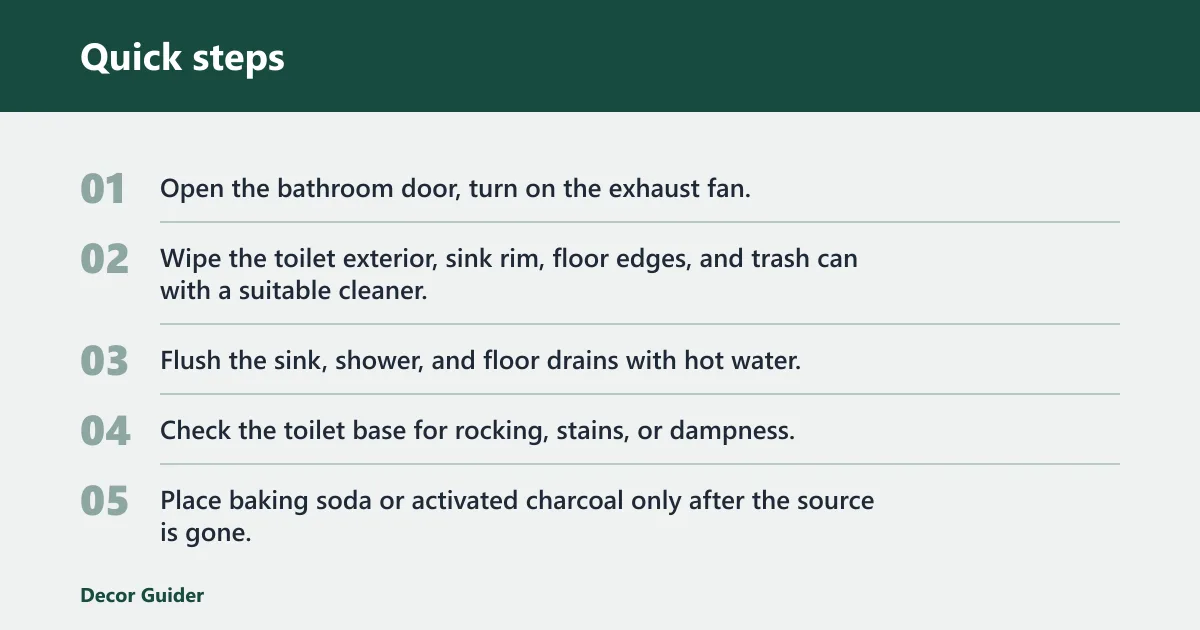
- Open the bathroom door, turn on the exhaust fan, and let fresh air move through the room for about 20 to 30 minutes after showers or other moisture-heavy use.
- Wipe the toilet exterior, sink rim, floor edges, and trash can with a suitable cleaner, then dry every surface you touched.
- Flush the sink, shower, and floor drains with hot water, then follow with a drain-safe cleaner or an enzyme cleaner where biofilm is likely.
- Check the toilet base for rocking, stains, or dampness, and refill any dry trap by running water for about 30 to 60 seconds.
- Place baking soda or activated charcoal only after the source is gone, then recheck the room in a few hours before adding fragrance.
Say your 5-by-8-foot bathroom smells fine at the sink but turns sour after a shower. That pattern usually points to humidity or a drain problem, not a need for stronger spray. Fix the moisture and drain source first, then add a passive absorber if any faint odor remains.
How should you use the exhaust fan?
Run the bathroom exhaust fan after showers, not only during them. A fan that moves enough air should pull visible steam down quickly and keep the room from staying damp. If the grille is coated with dust or the housing is dirty, airflow drops and the smell problem lingers.
What to check
- Turn the fan on after a shower and leave it running for at least 20 minutes, as a common rule of thumb.
- Remove dust from the grille and reachable housing surfaces.
- Check that the duct vents outdoors, not into an attic or ceiling space.
- Replace a weak, noisy, or ineffective fan if moisture stays on mirrors, walls, or tile.
In apartments with no windows, the fan matters even more because stale air has fewer exit paths. If steam hangs around long after a shower, the room is telling you the airflow is not keeping up.
How do you fix drain and toilet odors?
Drain smell and toilet-base smell often need different fixes. Drain odors usually come from hair and biofilm in the sink, shower, or floor drain. Toilet odors often come from a seal problem, a dry trap, or urine around the base and floor edges.
Drain cleanup
- Remove visible hair or sludge from the drain opening and stopper.
- Flush with hot water, then use an enzyme cleaner or a drain-safe cleaner.
- Repeat if the smell returns after the water runs out of the pipe.
Toilet check
- Look for rocking when you press the bowl side to side.
- Dry the base and check for stains, moisture, or odor after flushing.
- Refill nearby traps by running water in unused fixtures.
Suppose the sink smells clean, but the toilet base smells sharp after each flush. That pattern makes a loose seal more likely than a room-cleaning issue, and the fix shifts from scrubbing to repair.
How to use odor absorbers without masking the problem
Baking soda absorbs odor; it does not disinfect. Put an open box or shallow dish near a drain, inside a cabinet, or in the trash area, then replace it every few weeks if the smell starts returning. White vinegar can help on hard surfaces where it is safe to use, but it is not for every stone surface and should never be mixed with bleach. (Wikipedia)
Activated charcoal works passively near the toilet or in a cabinet and does not cover the smell with perfume. Replace it on the package schedule. If you want a quick finishing step, use an air freshener after cleaning the source, not before it. Spray products give a fast burst; automatic dispensers release bursts on a timer, which can bother sensitive users.
Light fragrance use
- Use a spray after the room is dry and the source is fixed.
- Keep scented products away from people sensitive to fragrance.
- Do not treat fragrance as the repair itself.
How do you keep the bathroom dry and clean?
Humidity control stops the musty smell that returns after every shower. Wipe water from the shower walls, tile edge, and glass, then keep the fan running until the room is dry. Towel-dry surfaces that stay damp, especially around grout, caulk, and the toilet base.
Routine care
- Wash the toilet brush holder and let both parts dry between uses.
- Empty the trash before it starts to smell.
- Wash dirty towels often and keep damp laundry out of the closed bathroom.
- Clean visible mildew early on hard surfaces where it starts to appear.
Leave the brush holder open to dry in a spot with airflow. A wet holder can become its own odor source, especially in small bathrooms with poor ventilation.
Common mistakes
- Masking a sewer or drain smell with stronger fragrance before checking the trap or seal.
- Leaving towels damp in a closed room, which feeds the dirty-linen smell.
- Storing a wet toilet brush in a closed holder and trapping residue inside.
- Mixing cleaning products without checking compatibility.
- Ignoring a rocking toilet, which can point to a seal failure at the base.
Use fragrance last. If a smell changes after you run water, flush, or step on the floor near the toilet, that clue matters more than any spray.
Products related to this article
Sponsored / affiliate links. As an Amazon Associate I earn from qualifying purchases. I may earn additional commission from eligible campaigns.