How to Tell If You Need a New Box Spring
A box spring may need replacement if it sags, has broken or noisy coils or slats, is the wrong size or type for the mattress, or does not meet the mattress warranty rules; age alone is not enough. A failing or mismatched base leaves the mattress unsupported, shortens its life, and can send you chasing the wrong fix. This guide helps you check for structural failure, fit issues, and warranty limits so you can decide quickly.
Replacement checklist table
| Check | Replace the box spring or not? |
|---|---|
| Visible damage | Yes if you see broken slats, bent frame members, torn ticking, or a frame that no longer sits flat. Next step: stop using it and replace the base. |
| Center sag | Yes if the center drops under normal load and the sag stays after the mattress is removed. Next step: replace the box spring, then recheck the mattress on the new base. |
| Squeaks | Yes if the noise comes from the base itself, not the bed frame or headboard. Next step: confirm the source, then replace the box spring if the noise tracks with movement. |
| Age | No if age is the only issue and the frame is still flat, quiet, and intact. Next step: keep using it unless another failure sign appears or the warranty requires a different support. |
| Mattress type | No for most hybrid and many foam mattresses. Next step: use a platform bed or mattress foundation if the mattress maker calls for flat, even support. |
| Warranty rules | Yes if the warranty requires a box spring, or forbids the base you are using. Next step: switch to the support type named in the warranty before filing any claim. |
| Support gaps | Yes if the mattress has unsupported spots, a missing center member, or a frame that leaves voids under the sleep surface. Next step: replace the support or move to a proper foundation. |
What a box spring does
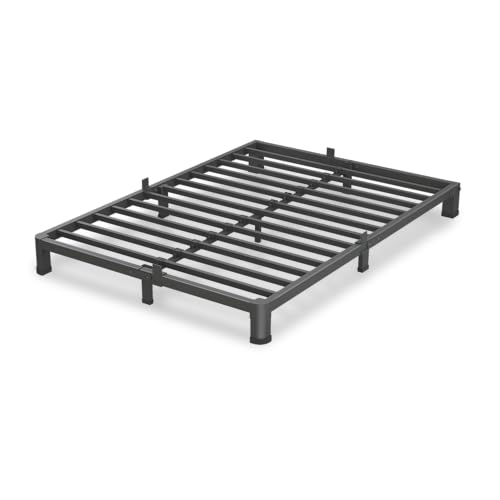
A box spring is an upholstered wooden or metal frame, and modern versions may use a metal grid. It sits directly under the mattress, with no layer between the two. Its traditional jobs are to keep the bed higher off the floor, add some shock absorption, and support the sleep system.
Shock absorption
A box spring can absorb some shock, which matters more for older innerspring mattresses than for many newer builds. That buffering can reduce impact when you sit on the bed or move across it. If the mattress type does not need that function, the extra flex is not automatically helpful.
Height and support
A good box spring keeps the mattress off the floor and increases bed height. That helps with getting in and out of bed and can improve clearance under the frame. Height alone is not a reason to keep a failing base. If the support has broken down, height does not make up for lost structure.
Airflow under the mattress
Some people choose a support base for airflow, since air moving under the mattress can help with moisture management and durability. A platform bed or mattress foundation can also provide that flat support. The key point is simple: airflow helps only when the base is still structurally sound.
Do you need a new box spring?
You need a new box spring when the base itself has failed, not when the mattress merely feels less comfortable. Look for a broken frame, visible sagging, loose or noisy internal parts, or support gaps under the mattress. If the mattress is the true problem, replacing the base will not fix the sleep surface.
When the base is structurally failed
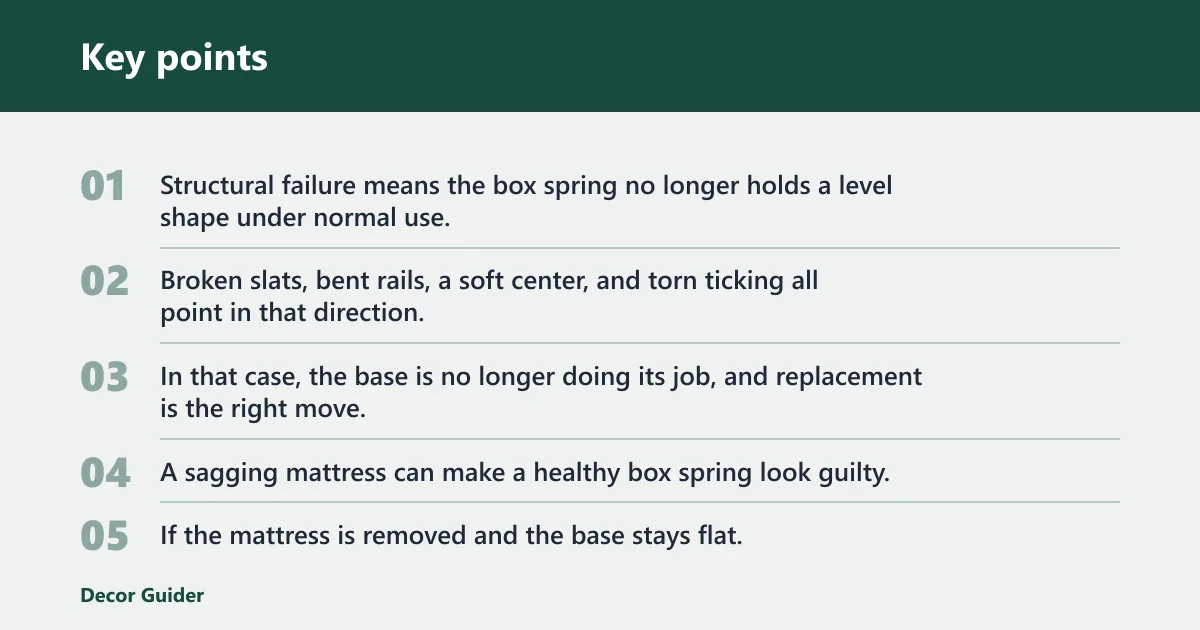
Structural failure means the box spring no longer holds a level shape under normal use. Broken slats, bent rails, a soft center, and torn ticking all point in that direction. In that case, the base is no longer doing its job, and replacement is the right move.
When the mattress is the real problem
A sagging mattress can make a healthy box spring look guilty. If the mattress is removed and the base stays flat, the box spring is probably not the issue. Say your mattress dips in the middle on a flat, solid base; replacing the box spring will not repair that mattress dip.
When replacement will not help
Replace the box spring only when the problem starts with the support underneath. If the mattress itself is worn out, has broken internal support, or no longer matches your comfort needs, a new base will not restore it. A common first-timer mistake is swapping the box spring first and expecting the mattress feel to change.
Which mattresses still use one?
Most modern mattresses do not need a box spring. Older innerspring mattresses were originally designed around one, and many innerspring models may still need box spring support in some cases. Hybrid mattresses do not need a box spring and are generally better suited to a platform bed or mattress foundation.
Innerspring mattresses
Older innerspring mattresses are the main exception. They were originally built with a box spring in mind, and many still work best with that kind of support when the manufacturer allows it. Even then, the warranty should guide the choice, because support rules can vary by model.
Hybrid mattresses
Hybrid mattresses, which combine foam and coils, do not need a box spring. They usually perform better on a platform bed or mattress foundation with flat, even support. Putting a hybrid on the wrong base can create support problems instead of solving them.
Modern foam mattresses
Many foam mattresses also skip the traditional box spring. They tend to need a stable, level base rather than extra springy support. If the mattress maker allows a box spring, that is one thing; if it calls for a flat foundation, follow that instruction instead.
Check the warranty first
Read the mattress warranty before you replace anything. The warranty spells out support requirements, so it can indicate whether a box spring is allowed, required, or not permitted. Choose the wrong base and you can end up with weak support and a coverage problem.
Support requirements
Warranty language usually focuses on the kind of support under the mattress. Some warranties require a box spring for certain innerspring models, while others require a flat platform bed or mattress foundation. Do not guess. The support type should match the mattress instructions exactly.
Allowed foundation types
Many warranties list acceptable support types, and that list matters more than habit or old bed setups. If the warranty allows a box spring, a platform bed, or a specific foundation type, you can choose among those options. If it names only one type, use that one.
What can void coverage?
Using the wrong support can put warranty coverage at risk. Common problems include too much flex, missing center support, or a base that does not meet the mattress maker’s requirements. Before replacing the box spring, confirm whether the current support is actually the issue or just the wrong design for the mattress.
Replace the box spring or not?
Use the support itself as the decision point. If the box spring is structurally failed, incompatible with the mattress, or out of step with the warranty, replace it. If the mattress is sagging but the base is still flat and sound, the mattress is more likely the problem. That distinction saves time and money.
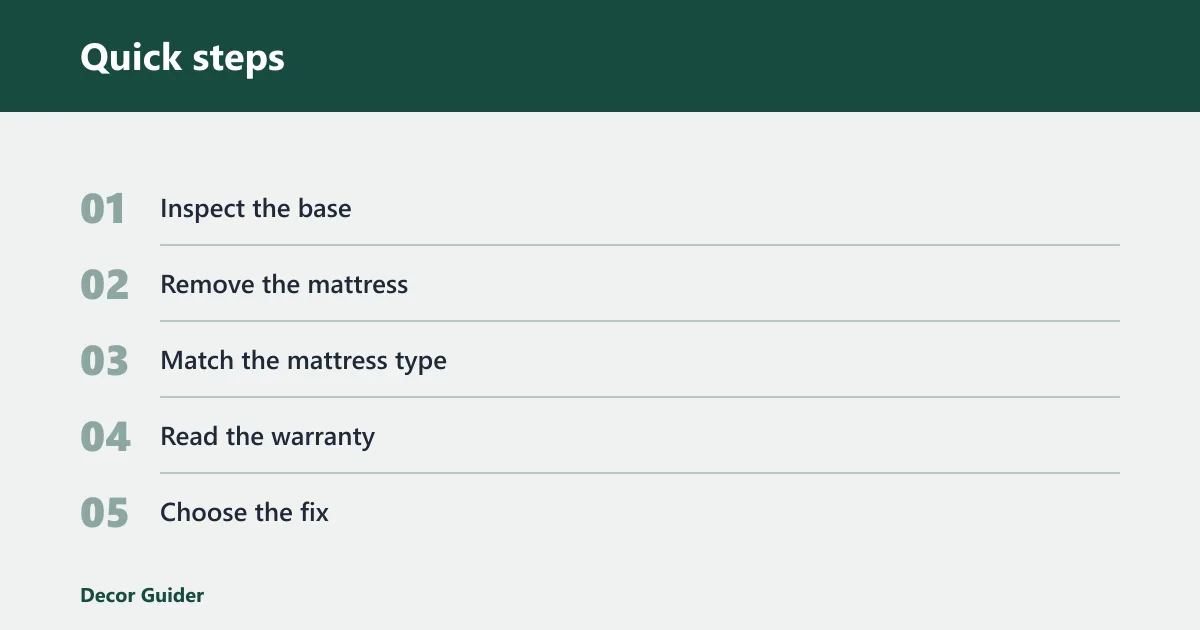
- Inspect the base. Look for broken slats, bent rails, torn ticking, sagging, and squeaks that come from the box spring itself.
- Remove the mattress. Check whether the base stays flat and even without load.
- Match the mattress type. Confirm whether you have an innerspring, hybrid, or foam mattress, since the support needs are not the same.
- Read the warranty. Check for required support types and any rules about allowed foundations.
- Choose the fix. Replace the box spring only when the base fails, the support type is wrong, or the warranty requires a different setup.
What to do next
If the box spring is flat, quiet, and intact, keep it. If it fails any structural check, replace it. If your mattress type does not need a traditional box spring, move to a platform bed or mattress foundation instead. That gives you the right support without replacing parts that are still usable.
Picture a queen hybrid on a five-year-old box spring that still sits flat, but the mattress feels uneven. The base may be fine. In that case, inspect the mattress and the center support in the bed frame, not the box spring.
Suppose an older innerspring mattress sits on a box spring with a soft center and a visible crack in one slat. That is a true replacement case. The base has failed, and the mattress will keep suffering until the support is replaced.
Frequently asked questions
How to know when you need a new box spring
You need a new box spring when the frame sags, breaks, squeaks from inside the base, or leaves support gaps under the mattress. If the base stays flat after the mattress is removed, age alone is not a reason to replace it. Check the mattress type and warranty too.
How do you know if you need a new box spring?
Remove the mattress and inspect the support. If you see a bowed center, broken slats, bent metal, or torn upholstery, the box spring has failed. If it looks flat and solid, the mattress or bed frame may be the real source of the problem.
Does a new box spring make a difference?
A new box spring makes a difference when the old one has lost structure or no longer matches the mattress. It can restore height, support, and some shock absorption. It will not fix a worn-out mattress, so the benefit depends on which part is actually failing.
How long does a box spring last?
There is no fixed replacement age that applies to every box spring. A sound base can keep working, while a damaged one should be replaced right away. The real test is condition: flat support, no broken parts, and compatibility with the mattress and warranty.
Can a bad box spring ruin a mattress?
Yes, a bad box spring can strain a mattress by creating uneven support or extra flex. That can speed up wear and create dips or edge stress. The risk is highest when the base is broken, not when it is simply older but still flat and stable.
What should I replace first: mattress or box spring?
Replace the box spring first only if it is visibly failed or incompatible with the mattress. If the base is still sound and the mattress is sagging, the mattress is usually the part to replace. The order should follow the failed component, not the one that looks older.
Products related to this article
Sponsored / affiliate links. As an Amazon Associate I earn from qualifying purchases. I may earn additional commission from eligible campaigns.