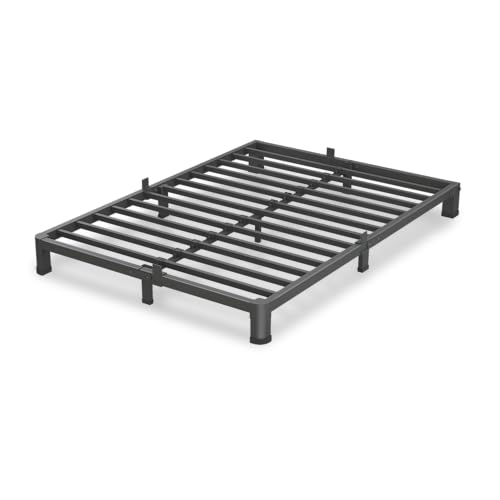
Are Bed Risers Safe? Fit and Load Rules
Bed risers are safe only when the frame, riser rating, and floor can support the total load without wobble. If any leg sits off-center or the base is too narrow, do not use them. Used badly, they can let a bed shift, crack, or tip, and that can injure you or damage floors, slats, and wall surfaces. This guide explains the failure points, then gives a fit-and-load checklist you can use before buying.
Warning signs your bed risers aren’t safe



Yes, but only in the right setup. Bed risers are safe when the bed frame is sound, the leg fit is tight, the floor is flat enough, and the set rating covers the bed’s real load. Safety drops fast when the frame flexes, the fit is loose, or the base rocks.
What makes a setup unsafe fast
Improper installation can make risers unsafe. An uneven floor surface can tilt or wobble the frame. A loose leg fit can seem close enough at first, then shift when weight lands near the edge of the bed. That is how a stable-looking setup turns unstable.
A weak frame is another stop sign. Bent legs, cracked slats, split corner joints, and unstable headboards all raise the chance of movement after lift. If the bed already creaks or leans, risers may make the problem worse rather than solve it.
When bed risers become unsafe
Bed risers become unsafe when the bed, riser, and floor no longer work as one system. That happens with damaged frames, shallow sockets, mismatched leg shapes, slippery hard floors, soft carpet that compresses unevenly, and stacks that are tall enough to increase tipping. Over-stacking adds risk quickly.
One common failure mode is edge-loading. A sleeper sitting on the side of the bed pushes more force through two corners than through the full frame. If the risers are narrow, the bed can rock even when the advertised rating looks generous.
Bed riser safety checklist
| Bed leg shape | Leg diameter | Socket depth | Floor type | Total estimated load | Riser type | Pass/fail verdict |
|---|---|---|---|---|---|---|
| Round, flat-bottom leg | Fits fully with no side play | Deep enough to hold the leg without wobble | Flat hardwood with anti-slip pads | Mattress + sleepers within set rating, with edge-sitting margin | Adjustable or screw-in | Pass |
| Round leg | Close but loose in the opening | Shallow socket leaves the leg partly exposed | Carpet that compresses unevenly | Near the limit once adults sit at the edge | Stackable | Fail |
| Square leg | Match not confirmed | Unknown | Uneven tile floor | Unclear | Any type | Fail |
| Wood leg | Correct diameter | Deep socket with snug fit | Flat vinyl floor | Below rating | Screw-in | Pass |
| Metal leg | Mismatched shape | Too shallow for a locked fit | Hard floor without grip | Moderate load | Stackable | Fail |
Do not use risers if the frame is cracked, a leg is bent or loose, the headboard already shifts, the leg shape does not match the socket, the floor is uneven, the base slides on contact, or the planned height requires over-stacking. Any one of those conditions can turn a bed into a moving platform.
How do you choose the right bed riser?
Choose the type that matches the frame, the height you need, and the level of stability you can tolerate. Sleep Junkie lists screw-in, stackable, and adjustable risers as the main types. A separate incline setup works for head-of-bed use and should not be treated like a full-bed lift.
Screw-in bed risers
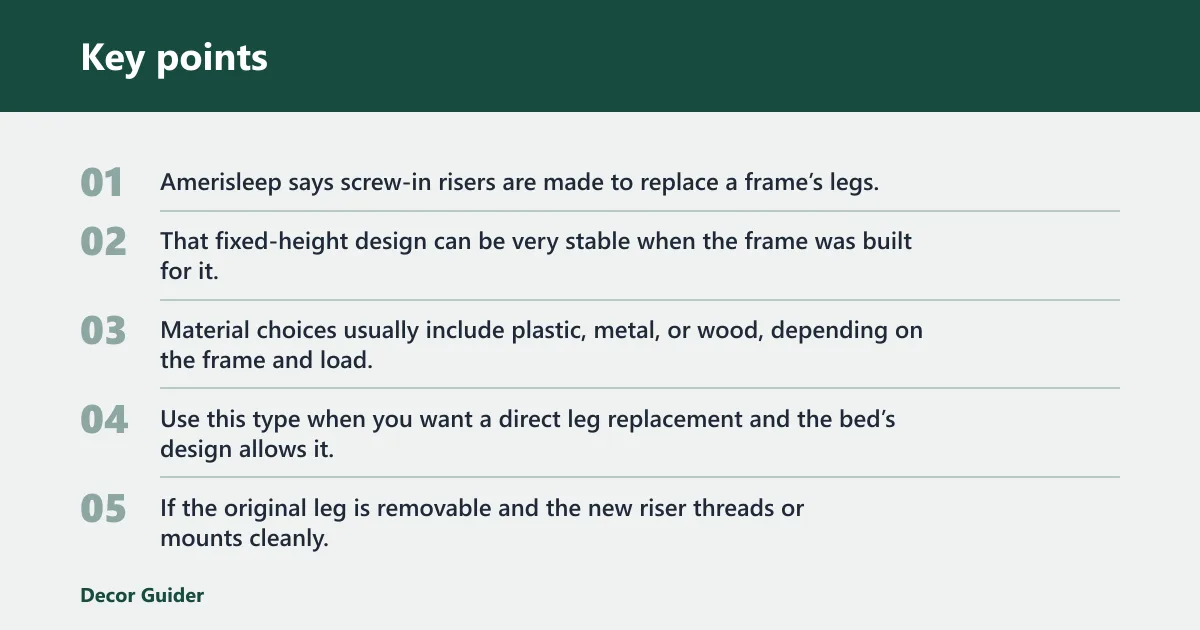
Amerisleep says screw-in risers are made to replace a frame’s legs. That fixed-height design can be very stable when the frame was built for it, but it leaves little room to adjust later. Material choices usually include plastic, metal, or wood, depending on the frame and load.
Use this type when you want a direct leg replacement and the bed’s design allows it. If the original leg is removable and the new riser threads or mounts cleanly, the setup can be simple. If not, forcing the fit is a bad idea.
Stackable bed risers
Stackable risers use layered height pieces. That makes them storage-friendly and useful when you want more lift without changing the whole frame, but the extra layers raise tip risk. Tipo Relax says the Home It set can reach 8 inches of lift when stacked, which is a useful reminder that height and stability move in opposite directions.
Do not treat stacking as the default answer. The more layers you add, the more chance there is for side shift, uneven contact, and corner loading. If you need more than a modest lift, a different riser design is usually safer than piling pieces higher.
Adjustable bed risers
Adjustable risers give multi-height choices in one set. Some adjustable bed riser sets are described as having about eight pieces, which can allow more configurations than a fixed block. Quilt & Quiet lists Home It Adjustable Bed Risers at 3, 5, or 8 inches of lift, and Utopia Bedding Adjustable Bed Risers at 3 or 5 inches.
That flexibility is useful, but it also adds parts that must fit correctly. More components can mean more setup steps and more places for movement if the base is not flat or the leg fit is not secure. Choose them when you need options, not when you want the simplest possible setup.
Incline risers
Incline risers are for one-end lift, usually at the head of the bed. That setup is different from lifting all four legs. It can be used to create a sleeping angle for snoring or reflux, but the bed’s weight shifts toward one end, so the load path and risk profile change.
The same source says its snoring-focused set includes two risers and two floor protectors, which reflects the different setup. Use incline risers only when you want a head-of-bed angle, not when you need general storage height. One-end lift needs careful support under the head legs and a stable floor.
How do you check fit and load?
Check the leg fit, then check the load, then check the floor. A riser can still fail even if the package rating looks high. The real question is whether the leg sits deep and straight, whether the total load stays within the set rating, and whether the base stays planted under normal use.
Match leg shape and diameter
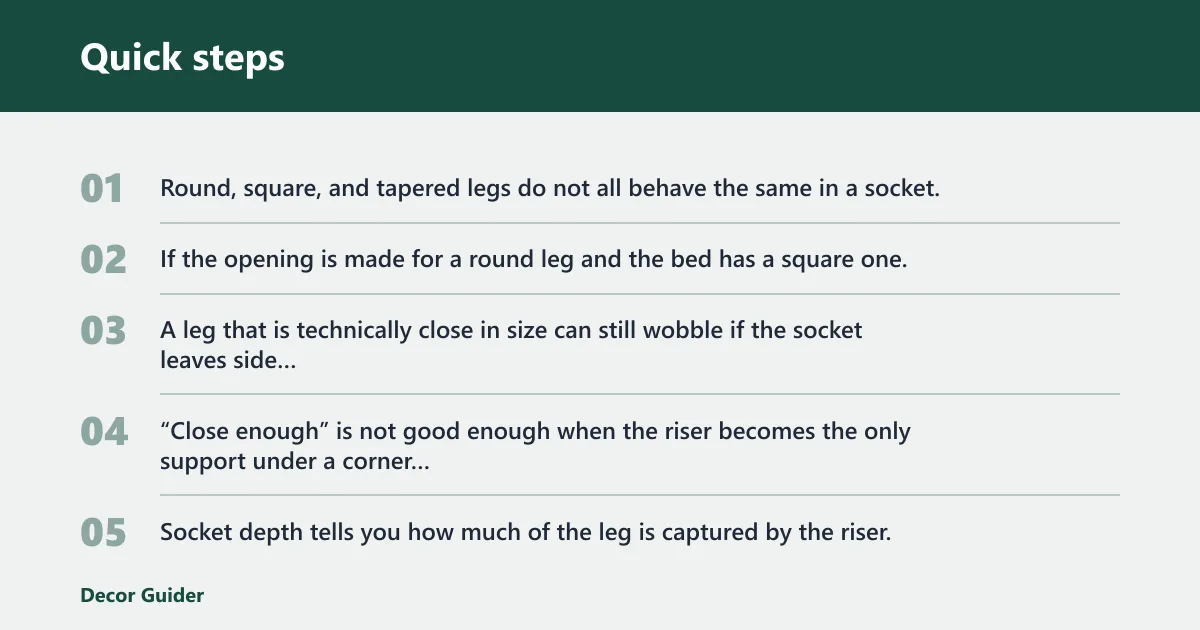
Bed frame leg fit starts with shape. Round, square, and tapered legs do not all behave the same in a socket. If the opening is made for a round leg and the bed has a square one, the contact may be partial and the frame can rock when weight shifts.
Diameter matters just as much. A leg that is technically close in size can still wobble if the socket leaves side clearance. “Close enough” is not good enough when the riser becomes the only support under a corner of the bed.
Check socket depth and wobble
Socket depth tells you how much of the leg is captured by the riser. A shallow socket can hold the leg upright for a moment and still allow movement later. The deeper and more centered the contact, the less chance there is for twist, tilt, or a corner kick-out.
Suppose a frame leg sits in the opening with a small gap around it. The bed may look level on day one, then creak and drift after a few nights because the leg can shift under side load. That is a fit failure, not a minor nuisance.
Estimate total load, not just the label
Weight capacity should be read as a combined load issue, not a single number on the box. Add the mattress, the sleeper or sleepers, and the extra force from sitting on the edge. A set that looks adequate on paper can be marginal once real use is included.
Quilt & Quiet lists a 1,300 lb load rating for Home It Adjustable Bed Risers. That kind of rating is useful, but it still does not replace a fit check or floor check. Capacity is only one part of the decision.
Account for edge-sitting stress
Edge-sitting stress matters because it concentrates load on two corners. A twin bed with one adult may be well under a set rating during sleep, then rock when that person sits at the side to put on shoes. That stress pattern is common and easy to miss.
A practical rule is to leave margin above the total expected load, not just enough to match it. If the bed is used by two adults, or if anyone sits on the edge often, choose a stronger setup with wider support and less height.
How do you use bed risers safely?
Install all four legs evenly, keep the base flat, and use anti-slip or floor protection when the surface calls for it. Bed risers are safe when installed correctly and matched to the bed. If the frame does not sit level after setup, stop and recheck every contact point before regular use.
Set up all four legs evenly
For a full-bed lift, all four legs should sit on the same type of support and reach roughly the same height. One corner lower than the others creates a twist in the frame, which can turn into creaking, slatting issues, or a slow lean toward one side.
Do not mix riser heights on the same bed unless the design specifically calls for it. A level check is not optional here. If the bed tilts, the load is no longer shared the way the frame was meant to carry it.
Add anti-slip or floor protection when needed
Hard floors can be slick, and carpet can compress unevenly. Both can reduce stability. Use floor protectors or anti-slip pads when the riser and floor combination needs more grip, especially on tile, vinyl, or polished wood. Tipo Relax’s inclusion of floor protectors is a useful example of that need.
Carpet also changes how tall the riser sits once weight is applied. A soft carpet can sink more under one leg than another, which is why a surface that seems level at setup may not stay level after use.
Recheck level, creak, and movement after setup
After installation, check for creak, slide, and tilt. Push the frame lightly at the corners. If one corner lifts, shifts, or makes noise, the fit is not secure. Recheck socket depth, leg contact, and floor grip before sleeping on it.
A common first-timer mistake is to stop after the bed looks level from one angle. That can miss small movement at a single corner. A bed that sounds fine and still slides a little is not stable enough for daily use.
Where are bed risers helpful?
Bed risers are useful for storage, for getting into and out of bed more easily, and for creating a head-of-bed incline. Those benefits matter, but they do not change the safety rules. The same load, fit, and floor checks still decide whether the setup is safe.
Under-bed storage space
Bed risers can create under-bed storage space. That is helpful when you need bins, seasonal items, or vacuum access under a low frame. Storage is a benefit, though it should never be the reason to accept a loose fit or an unstable floor.
Mobility and entry height
Bed risers can help older adults or people with mobility issues get in and out of bed more easily by raising the bed height. A modest increase can reduce the drop into the mattress and make standing up less awkward. The lift still has to stay stable, though.
If the bed is already tall, adding risers can overshoot a usable height. The right height is the one that improves entry without making the frame harder to climb, harder to clean around, or more likely to shift.
Head-of-bed incline for reflux or snoring
A head-only incline can help create a sleeping angle for snoring or reflux. That setup uses two risers rather than four and is not the same as a storage lift. Because the weight is redistributed, the head end must be secure and the feet end must stay planted.
Say your mattress and frame are stable, but you want a slight incline for nighttime reflux. A head-only riser set may fit that goal better than a full-bed lift. The important part is that the chosen set is made for incline use, not just for height.
Frequently asked questions
Are bed risers safe?
Are bed risers safe? Yes, when the frame is sound, the leg fit is tight, the floor is flat enough, and the load stays within the set’s rating. They become unsafe when installation is sloppy, the fit is loose, or the bed wobbles under normal use.
How do you choose the right bed risers for your bed frame?
Choose the right risers by checking leg shape, leg diameter, socket depth, and the bed’s total load. Then choose the type that fits the goal: screw-in for direct leg replacement, stackable for layered height, adjustable for multiple heights, or incline risers for one-end lift.
How much weight can bed risers hold?
How much weight can bed risers hold? The answer is the set rating plus a safety margin, not the rating alone. Add mattress weight, sleeper weight, and edge-sitting stress before deciding. If the real-world load comes close to the label, choose a stronger and wider setup.
Can bed risers be unsafe on carpet or uneven floors?
Yes. Uneven floors can make the frame tilt or wobble, and soft carpet can compress unevenly under each corner. Hard floors can also be slippery. If the surface is not flat and stable, use floor protection or choose a different setup rather than forcing the fit.
Where can you buy bed risers?
You can buy bed risers from home goods stores, furniture retailers, and major online sellers. Before buying, check the opening size, the lift height, the set rating, and whether the product is made for full-bed lift or head-only incline. Those details matter more than the packaging.
Products related to this article
Sponsored / affiliate links. As an Amazon Associate I earn from qualifying purchases. I may earn additional commission from eligible campaigns.