Do You Need a Box Spring with a Platform Bed?
You usually do not need a box spring with a platform bed. Use one only if the bed maker allows it, or your mattress warranty requires it. The wrong setup can void coverage, reduce support, and make the bed feel unstable. This guide explains how platform slats, solid decks, foam, hybrid, and innerspring mattresses determine the right choice.
When extra support may be needed



Usually, no. A platform bed already includes built-in mattress support, so a box spring is usually unnecessary for many setups. The real question is what sits under the mattress: a solid deck, closely spaced slats, or a rigid insert. If that support is not right for your mattress, you may need a foundation instead of a box spring.
When a box spring is unnecessary
If the platform bed has a solid deck or closely spaced slats, the mattress usually sits directly on the frame. That works well for memory foam, many latex beds, and many hybrids because they need firm, even support. A box spring can add bounce and height, but that extra movement is often the wrong fit for modern foam construction.
When an added support layer may still be needed
Some platform beds are sold as low-profile bed frames but do not provide enough support for the mattress type you chose. Wide slats, flexible slats, or weak center support can let the mattress sag. In those cases, a rigid foundation or bunkie board-style insert is the safer fix.
Say your queen platform bed has wooden slats spaced too far apart for a memory foam mattress. A box spring would not solve the support problem, because the foam still needs rigid backing. A foundation or slat insert that closes the gaps is the better correction.
How platform beds support a mattress
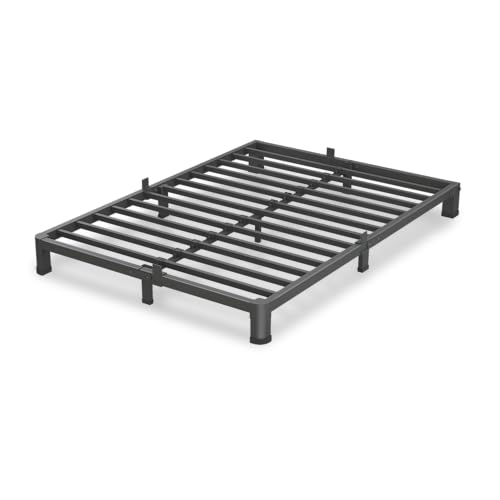
A platform bed may use a solid, metal, or slatted base. That support surface is why these beds usually do not need a box spring. The key issue is how stable that surface stays under load, because slat spacing, slat flex, and center support all affect long-term mattress support.
Solid decks vs. slatted bases
A solid deck generally gives very even support. It works well with foam mattresses and most hybrids, as long as the deck is in good condition and the mattress maker allows it. Slatted bases allow more airflow, but they only work when the slats are close enough together and strong enough to resist bending.
Why slat spacing changes the answer
Slat spacing matters because too wide can cause the mattress to sag. That is especially important with foam beds, which require rigid support. If the slats flex under body weight or the mattress sinks between them, the bed may feel soft in the wrong places and can wear out early.
Where center support fits
On queen, king, and California king setups, center support is generally as important as slat spacing. A platform bed with a weak middle beam can dip in the center even if the slats look fine. That creates a slow sag that can look like a mattress defect when the real problem is the base.
Platform bed decision matrix
Use this matrix to match the mattress, the platform base, and the warranty language before you set the bed up. The safest answer is the one that keeps support intact and matches the manufacturer’s instructions. If the warranty language conflicts with general advice, follow the warranty.
| Mattress type | Platform base type | Manufacturer warranty language | Outcome | Red flags |
|---|---|---|---|---|
| Innerspring | Solid deck | Allows platform or solid support | Yes | Low bounce risk; check height goals |
| Innerspring | Closely spaced slats | Allows slatted support with small gaps | Yes | Watch for flexing slats or weak center support |
| Innerspring | Wide slats | Requires close slats or rigid base | Recheck | Sag between slats, uneven feel, possible warranty risk |
| Innerspring | Metal grid | Allows metal support grid | Yes | Check grid spacing and frame flex |
| Memory foam | Solid deck | Allows rigid base only | Yes | Good support; box spring usually not allowed |
| Memory foam | Closely spaced slats | Allows rigid slatted base | Yes | Slat flex, gap spacing, center support issues |
| Memory foam | Wide slats | Requires rigid support | No | Sag, poor support, possible voided warranty |
| Memory foam | Any base plus box spring | Does not allow box springs | No | Too much give, unstable feel, warranty conflict |
| Hybrid | Solid deck | Allows platform support | Yes | Check mattress weight and edge support |
| Hybrid | Closely spaced slats | Allows rigid slatted support | Yes | Recheck if mattress is heavy or slats flex |
| Hybrid | Wide slats | Requires closer slats or foundation | Recheck | Middle sag, coil stress, warranty risk |
| Latex | Solid deck or closely spaced slats | Allows rigid base | Yes | Too much flex can distort support |
| Latex | Box spring | Requires rigid support | No | Harm from extra bounce and uneven support |
Can you use a box spring with a platform bed?

You can sometimes place a box spring on a platform bed frame, but that is usually a compatibility choice, not the best-performance choice. It works only when the frame can support the added height and the mattress maker allows that pairing. For many foam and hybrid beds, the box spring creates more problems than it solves.
When it works in practice
A box spring can work under an innerspring mattress if the platform frame is built to accept it and the mattress maker approves the setup. Box springs are a support layer built to sit between a mattress and a bed frame, and they can add height and some bounce. That extra height can help if the bed sits too low.
When it creates support problems
All-foam mattresses are not designed to be used with box springs, and foam beds require rigid support. Many latex and hybrid mattresses may also be harmed by box springs. The issue is not only comfort; a coil-based layer can change how the mattress is supported and may void coverage if the warranty forbids it.
Why height can change the decision
A box spring can add height to a bed, and most box springs are about the same thickness as a mattress. Some low-profile box springs are only a few inches tall. If your platform bed already sits high, adding a box spring may make the sleeping surface awkwardly tall. If it sits low, a foundation may be the cleaner fix.
Suppose a platform bed already measures near the upper end of the usual 6 to 18 inch range and the mattress is a relatively tall hybrid. Adding a standard box spring can push the bed too high for easy entry. In that case, a low-profile foundation or direct platform support is the better match.
Which mattress types change the answer?
The mattress type matters as much as the bed frame. Innerspring models are the most likely to work with a box spring. Memory foam usually needs rigid support. Hybrids sit between those two, but most do better on a platform bed or foundation than on a box spring.
Innerspring mattresses
Innerspring mattresses may work with box springs because the coil layers align in a way that can feel natural. That said, the support system still has to be compatible. If the box spring is worn out, too soft, or paired with a weak platform frame, the mattress can still lose support.
Memory foam mattresses
Memory foam mattresses usually should not sit on a box spring unless the manufacturer says otherwise. The material needs rigid support, and too much movement below it can create dips and stress the foam. Casper, for example, says its mattresses are not compatible with box springs.
Hybrid mattresses
Hybrid mattresses often perform better on a platform bed or foundation than on a box spring. The coil core gives some built-in structure, but the comfort layers still need firm, even backing. A flexible base can cause edge instability, uneven wear, or a mattress that feels less controlled at the center.
Do you need a foundation instead?
A foundation is the firmer alternative when a platform bed needs more support but a box spring would be the wrong layer. It is a rigid mattress support with a solid wood or slatted surface. For many modern mattresses, a foundation is a better match than a coil-based box spring.
Foundation vs. box spring
A foundation is rigid. A box spring has coils or a springy interior and adds more bounce. That difference matters for foam, latex, and many hybrids, which usually need firm support without extra give. If you want height without the spring action, a foundation is usually the safer choice.
When a bunkie board or rigid insert makes sense
If a platform bed has wide slats but the frame itself is sound, a bunkie board-like layer can close the gaps without raising the mattress as much as a box spring. This is useful when you need support, but you do not want extra height. It is also a common fix for mixed systems sold as a bed frame without enough internal support.
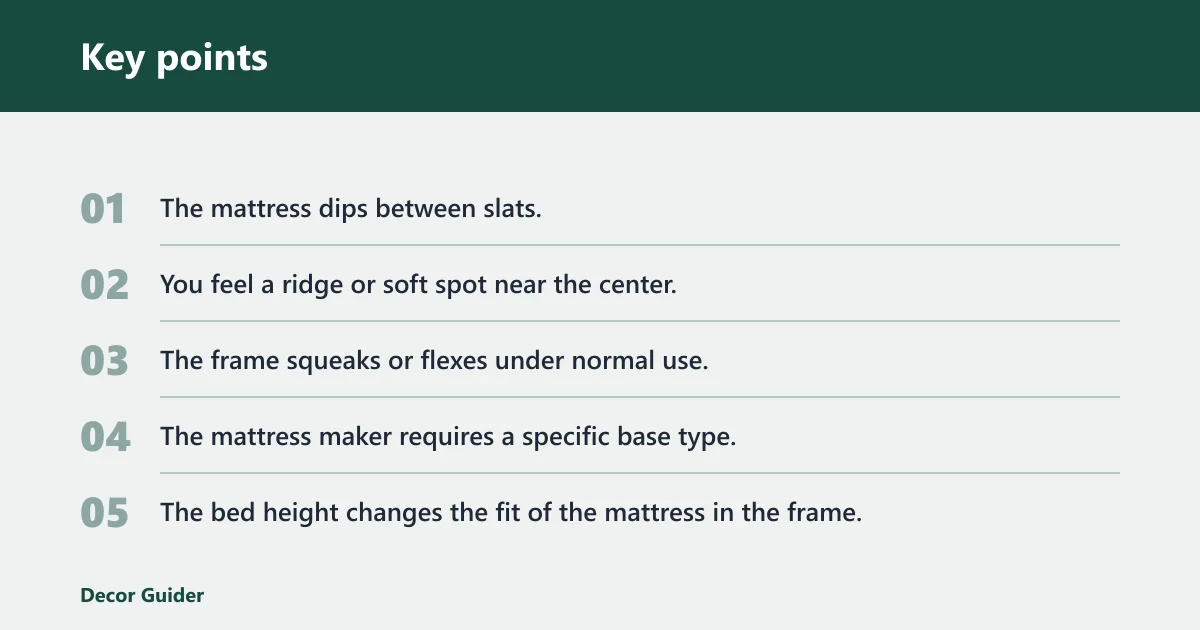
Signs your platform bed needs more support
- The mattress dips between slats.
- You feel a ridge or soft spot near the center.
- The frame squeaks or flexes under normal use.
- The mattress maker requires a specific base type.
- The bed height changes the fit of the mattress in the frame.
A common first-timer mistake is assuming any platform bed is ready for any mattress. If the base has wide slats and the mattress is foam, the frame can look fine at setup and still sag later. The safe move is to match the base, the mattress type, and the warranty language before the mattress goes on.
Frequently asked questions
Do you need a box spring with a platform bed?
Usually no. A platform bed already provides built-in mattress support, and many are designed to work without a box spring. The better check is whether the platform uses a solid deck, closely spaced slats, or another rigid support surface that matches your mattress and the manufacturer’s instructions.
Do you use a box spring with a platform bed frame?
Only when the frame maker and mattress maker both allow it. A box spring can add height and some bounce, but that is often a poor fit for foam and many hybrid mattresses. If the goal is better support, a foundation is usually the cleaner choice.
Can you use a box spring with a platform bed frame?
You can if the frame is built to accept one and the mattress warranty allows it. Still, many modern mattresses are meant for rigid support rather than coil-based support. If your platform bed has wide slats or weak center support, a box spring will not fix those issues.
Do you need a box spring with a metal platform bed frame?
Not usually. A metal platform bed frame is often designed with a grid or slatted support surface that replaces a box spring. Check the spacing and weight support, though. If the metal base flexes or the gaps are too wide, a rigid insert or foundation may be needed instead.
Can you use a box spring and mattress with a platform bed?
Yes, in some cases, but only when the platform frame and mattress are both approved for that setup. A traditional innerspring mattress is the most likely candidate. Foam, latex, and many hybrids usually need firmer support, so a box spring can create warranty and performance issues.
Products related to this article
Sponsored / affiliate links. As an Amazon Associate I earn from qualifying purchases. I may earn additional commission from eligible campaigns.