
Why Does My Mattress Slide Off the Bed Frame?
A mattress usually slides because the frame lacks grip, the support surface is uneven, the mattress is lighter than the frame rails hold, or the floor lets the whole bed creep. Start with the cause, then match the fix to it. If you skip that step, you can keep buying pads or straps that still let the bed shift, squeak, or wear the mattress edge faster. This guide shows how to identify the failure mode and choose the right fix for each one.
This guide is part of our Bed and Bathroom Fixes: Bed Frames, Mattresses, Toilets, Tubs and Vanities series.
Quick triage: 1) Measure the mattress and frame opening first, 2) inspect support, slats, and rails next, and 3) choose friction pads only after you know whether you need restraint hardware instead. Standard mattress sizes are close enough to be checkable with a tape measure, but even a small mismatch can leave room for the mattress to drift; see the size reference in mattress sizes and the fit basics in how to measure a mattress. If the bed is on an adjustable base, confirm the retention setup before adding pads; see adjustable base setup.
Why is your mattress sliding?



The slide usually starts with one of four faults: the frame size does not match the mattress closely, the foundation has weak or uneven support, the mattress surface is slippery, or the bed lacks restraint parts such as rails, retainer bars, or gaskets. Standard mattress dimensions are narrow enough that a correct fit should not leave a visible gap large enough for repeated movement; for reference, a queen is typically 60 by 80 inches, a king is 76 by 80 inches, and a full is 54 by 75 inches. For sizing context, see mattress sizes and box spring vs foundation.
What you’ll need
- Tape measure
- Flashlight
- Notebook or phone notes
- Non-slip pads, rubber mat, or shelf liner for a test fit
Mattress slide diagnostic matrix
| Symptom | Likely cause | 1-minute check | Best fix | What not to use |
|---|---|---|---|---|
| Mattress shifts with visible gaps around the edges | Too-small frame leaves extra room for movement | Measure the inside opening at the head, middle, and foot; compare it with the mattress label size | Use a frame or foundation that matches the mattress dimensions closely | Pads alone; they do not remove the extra space |
| Mattress creeps toward the foot end | Missing rails, retainer bars, or mattress gaskets | Look for a foot-end stop or side rails that physically hold the mattress | Add a retainer bar or mattress gaskets | Thin shelf liner on its own |
| Sliding happens even though the fit is close | Slippery mattress material | Press your hand on the cover; latex and memory foam often feel slicker | Add non-slip pads or rubber mats between mattress and support surface | Straps that only pull from one corner |
| Movement increases over time | Worn mattress surface or slight shrinkage with age | Check for a smoother cover, softened edges, or visible shortening relative to the frame | Combine friction material with frame correction if the mattress has aged out of a snug fit | Heavy adhesive tape on the mattress cover |
| Uneven bounce or a dip under one side | Wide slats create uneven support | Measure slat gaps and inspect for flex in the middle of the bed | Add slats or a solid support layer approved for the frame | Only adding grip pads on top |
| Head-end tilt leads to foot-end creep | Adjustable-base creep | Raise the head section and note whether the mattress moves toward the foot after a few cycles | Add the retention hardware made for adjustable bases | Furniture pads under the frame legs |
If a queen mattress on a platform bed slides about 1 to 2 inches toward the foot after a week, treat that as a diagnostic clue rather than a normal quirk. If the slat spacing is wide and the rails are absent, the fix is not a sticky mat first. It is tighter support and foot-end restraint. For support details, see platform bed support.
How do you stop a mattress from sliding?
Start with fit, then support, then friction, then restraint hardware. That order matters because a mattress that is too small, too large, or sitting on weak slats will keep moving even if you add pads. Support guidelines from mattress makers and bedding retailers commonly recommend narrow slat spacing for foam and hybrid mattresses; a practical threshold is no more than about 3 inches for many foam beds and about 4 inches for many innerspring or hybrid beds, with the exact limit set by the mattress warranty or support instructions. See platform bed support and how often to replace a mattress if the surface has aged out.
- Measure the mattress and the inside frame dimensions at the head, center, and foot.
- Compare the numbers with the label size and correct any mismatch first.
- Inspect the support surface for wide slats, missing rails, or a missing foot stop.
- Install non-slip pads or rubber mat only after the fit checks out.
- Add a retainer bar or mattress gaskets if the mattress still creeps forward.
A common first-timer mistake is choosing a high-friction pad before checking the frame. That can hide a sizing problem for a few nights, then the mattress starts drifting again because the base still gives it room to move.
What should you fix first?

Fix the frame-size mismatch first if the mattress has room to wander. Then repair missing restraint parts, and only then add grip material. If the mattress is visibly floating within the opening, that gap is the problem; if the mattress is centered but still moves, the issue is usually support or friction. For bed-fit guidance, see box spring vs foundation.
First, correct the frame size
Measure the inner opening rather than the outer frame. If the mattress overhangs, sags, or rocks at one edge, the base is too small for the mattress or the mattress is too large for the base. Typical mattress dimensions are close enough that a visible edge gap beyond a small reveal is a signal to recheck the setup rather than mask it with pads.
Then repair missing support parts
Bed rails or railings limit side-to-side movement, and most bed frames have some sort of guardrail to stop sliding. If yours does not, a retainer bar or mattress gaskets may be the missing piece. Adjustable bases need their own retention setup; see adjustable base setup.
Last, add friction
Non-slip pads help when the setup is already sized correctly. Rubber mats, shelf liner, or similar materials increase friction between the mattress and the foundation. Use friction as the final layer, not the only fix.
Can your bed setup be the cause?
Yes. The setup often decides if the mattress stays put or creeps. Box spring beds, platform beds, and adjustable bases fail in different ways, so the fix should match the structure under the mattress rather than a generic anti-slip product.
Box spring setups
A box spring can sometimes let the mattress drift if the top surface is slick, the base frame is too large, or side rails are missing. Check the box spring edge, then add a retainer bar or a friction layer only after the frame fit is confirmed. For the difference between support types, see box spring vs foundation.
Platform beds with wide slats
Wide slat spacing can create uneven support, which makes the mattress shift under load. Support instructions commonly call for tighter slat spacing for foam and hybrid mattresses than for traditional innerspring beds, and the mattress warranty should set the final limit. If the gap is beyond the mattress maker’s recommendation, add slats or a solid support layer before you try pads. See platform bed support.
Adjustable bases and split kings
Adjustable bases can cause creep when the head section rises. If the mattress slides toward the foot as the base articulates, the retention system is likely the issue, not the cover. Split king setups can separate in the middle, so each side should be aligned and restrained separately. For setup steps, see adjustable base setup.
Common mistakes
Using the wrong fix can make the slide harder to solve. The most common errors are adding adhesive products before checking size, using pads when the mattress needs a foot stop, and ignoring side-to-side movement from missing rails or railings. Those mistakes can also leave the bed noisier or more uneven.
- Do not use tape first if the frame is too small or too large.
- Do not rely on shelf liner when the bed needs a retainer bar.
- Do not assume a box spring problem is the same as an adjustable-base problem.
- Do not ignore one-sided wear if sleepers favor one side and the mattress drifts that way.
Picture a split king that separates in the middle every time the head section rises. Non-slip pads on each half may reduce surface movement, but they do not stop the gap from opening. That needs split-setup alignment and the right retention hardware.
FAQs
Why does my mattress slide off the bed frame?
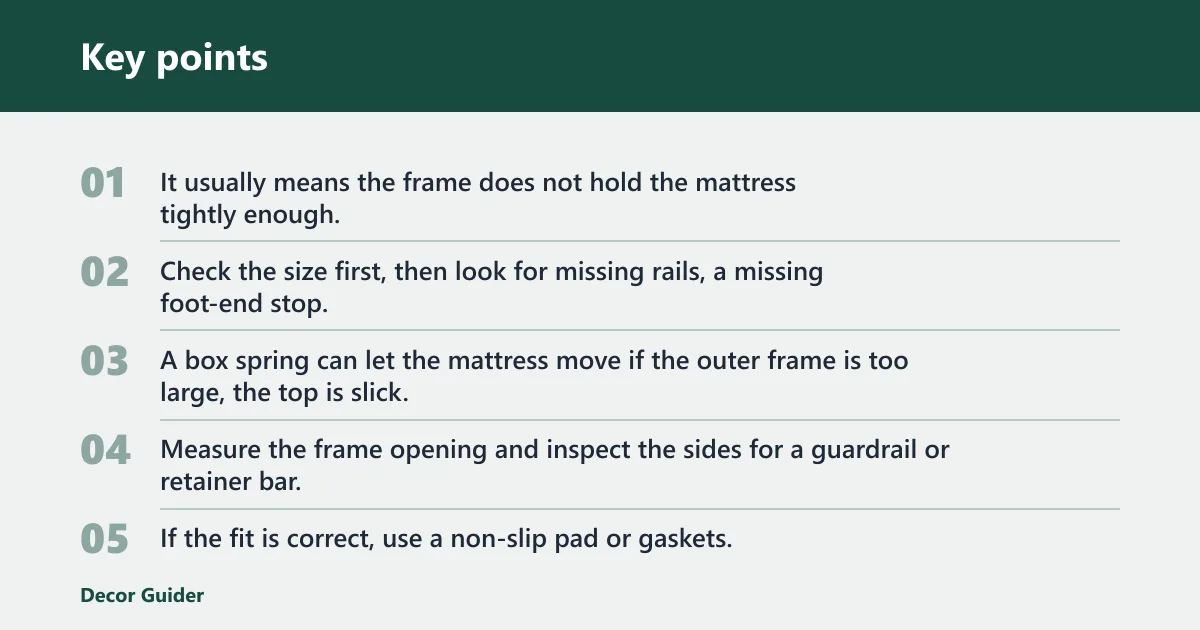
It usually means the frame does not hold the mattress tightly enough, the support surface is uneven, or the mattress is slippery enough to move under normal turning. Check the size first, then look for missing rails, a missing foot-end stop, or slats that flex too much before adding friction products.
Why does my mattress slide off a box spring?
A box spring can let the mattress move if the outer frame is too large, the top is slick, or the mattress has lost grip with age. Measure the frame opening and inspect the sides for a guardrail or retainer bar. If the fit is correct, use a non-slip pad or gaskets.
Why does my mattress keep sliding?
Repeated sliding usually points to a setup issue that has not been corrected yet. Common causes are a wrong-size frame, wide slats, slippery foam or latex, or uneven weight distribution when one sleeper uses one side more than the other. Fix the structural cause before adding any grip layer.
How do I stop my mattress from sliding without replacing the bed?
Start with a measurement check, then add the least invasive part that matches the failure point. A frame that is close but slick may need rubber matting. A base with no foot stop may need a retainer bar. A platform bed with wide slats may need added support under the mattress. If the mattress itself is nearing replacement age, see how often to replace a mattress.
What should I use under a mattress to keep it from moving?
Use a material that fits the setup: common options include non-slip pads, a rubber mat, or shelf liner for friction; a retainer bar or mattress gaskets for restraint. Choose one based on the cause. Do not put a friction layer under a mattress that is already the wrong size for the frame.
When is a mattress too small for the frame?
If you can see extra room around the sides or foot, the mattress is too small for the frame. A mattress that is much smaller than the inside opening can drift because there is enough extra space for motion. A mattress that is larger than the base can hang over the frame and sag, which is a different fit problem. Check against the standard size reference in mattress sizes.
Can an old mattress be why it keeps sliding?
Yes. Older mattresses may lose grip over time, and some mattresses can shrink slightly with age and regular use. That can create enough extra room for movement even when the bed used to fit well. In that case, check the size again before you buy friction pads.
Do wide bed slats make a mattress slide more?
They can. Wide slats can contribute to an uneven sleep surface, and uneven support can make a mattress move more easily. If the slats are too far apart, add support first. Pads may help only after the surface is even and the mattress is held by the frame.
What is the best fix for an adjustable bed that lets the mattress creep?
Use the retention hardware made for that base, then confirm the mattress is centered and properly aligned when the base moves. Pads can help with surface friction, but they do not replace the base’s restraint system. If the head section lifts and the mattress drifts toward the foot, the base setup needs attention first.
Products related to this article
Sponsored / affiliate links. As an Amazon Associate I earn from qualifying purchases. I may earn additional commission from eligible campaigns.