How to Fix a Bed Frame That Slides Across the Floor
Start by finding why the bed frame slides, then match the fix to the frame and floor. Tighten loose joints, add about 4 non-slip feet or pads for light slipping, and use a center-support upgrade for heavier frames. If you skip the diagnosis, you can waste money on pads that fail, scratch the floor, or leave the bed moving again. This guide shows how to identify the cause, choose the right anti-slip solution, and install it correctly for wood, carpet, tile, or laminate.
This guide is part of our Bed and Bathroom Fixes: Bed Frames, Mattresses, Toilets, Tubs and Vanities series.
Quick answer


If a bed frame is sliding but otherwise intact, start with hardware, then floor contact, then structure: tighten Loose bolts, add rubber grippers under each leg, level any uneven floor with shims, and verify the center support rail. For wheeled frames, use caster cups; for damaged frames, repair or replace the broken part first.
For safety and load guidance, follow the furniture maker’s assembly instructions and weight limits, and use threadlocker only on metal hardware where the manufacturer allows it. Major hardware retailers and fastener manufacturers such as Loctite and 3M note that the wrong adhesive or pad can reduce removability, hold poorly, or damage finishes if mismatched to the surface.
Why your bed frame slides

Sliding usually comes from low friction at the feet, loose frame hardware, or a structure that racks under load. The fix changes with the bed type. A metal frame with thin feet needs a different answer than a platform bed with a center rail or a wheeled frame with locks. In many cases, the problem is not the floor alone; it is the combination of a slick finish, a narrow foot, and a frame that twists when weight shifts.
Check the floor first
Hardwood, laminate, vinyl, and tile all have different surface friction. Smooth finished floors let small leg contact patches skate more easily, while carpet can hide a wobble if the frame is uneven. Check for slope, wax, dust, and recent movement of the rug or pad under the bed. Flooring manufacturers generally advise using products specifically rated for finished wood, tile, or resilient flooring, since the wrong pad can either slip or leave residue.
Check the frame legs and footprint
Look at leg material, contact patch size, and leg count. Metal legs with narrow feet move more than wood legs with a wider base. Frames with only corner legs tip into motion sooner than frames with center legs or wider support points, especially if the mattress hangs past the frame footprint. If the mattress overhangs the frame, the load can pull the legs outward and make even a stable bed creep.
Check joints, center support, and wheels
Loose bolts, loose screws, weak corner brackets, and a missing center support rail can let the frame rack side to side. Wheeled frames can roll even when the rest of the frame is tight. If the frame shifts after assembly, treat the joints and support path before buying pads. If the frame is visibly bent, cracked, or split, that is a repair-or-replace issue, not a friction issue.
What you’ll need
- Hex key, wrench, or screwdriver for frame hardware
- Threadlocker for hardware that loosens again
- Non-slip pads or furniture grippers with rubber contact
- Felt-rubber pads if you need floor protection and grip
- Plastic or composite shims for uneven floors
- Caster cups for wheeled frames
- Headboard stabilizer strap or anti-shift strap, if needed
- Flashlight and a level or straightedge
1. Tighten the frame
Start with the hardware. Loose bolts, screws, and corner brackets are the most common reason a bed moves after assembly, and tightening them often fixes the problem before you spend money on pads. Furniture makers generally recommend checking fasteners after assembly and again after the frame has been loaded, because vibration and settling can open joints over time. Use threadlocker sparingly on metal fasteners only when the manufacturer allows it.
- Remove the mattress enough to reach every joint.
- Tighten all bolts, screws, and corner brackets in a cross pattern.
- Check the center support rail and center leg for play.
- Add a small amount of threadlocker to fasteners that loosen again after repeated checks.
How tight is tight enough?
Tighten until the hardware stops turning freely, then give a final firm turn with the tool. Do not crush wood threads or strip metal inserts. If a joint still shifts by hand after tightening, the part is worn or bent and needs replacement, not more force. A joint that clicks, separates under sideways pressure, or reopens after a short rest is usually a structural fault rather than a simple looseness problem.
2. Correct the floor contact
If the frame is tight but still creeps, increase grip where each leg touches the floor. Use grippers for hardwood, laminate, tile, or vinyl. On carpet, use pads only if the frame sinks unevenly; otherwise the better fix is often better support, not more padding. Caster cups and furniture pads from major hardware retailers are designed to spread load, but they only work well when the leg is centered and the surface is clean.
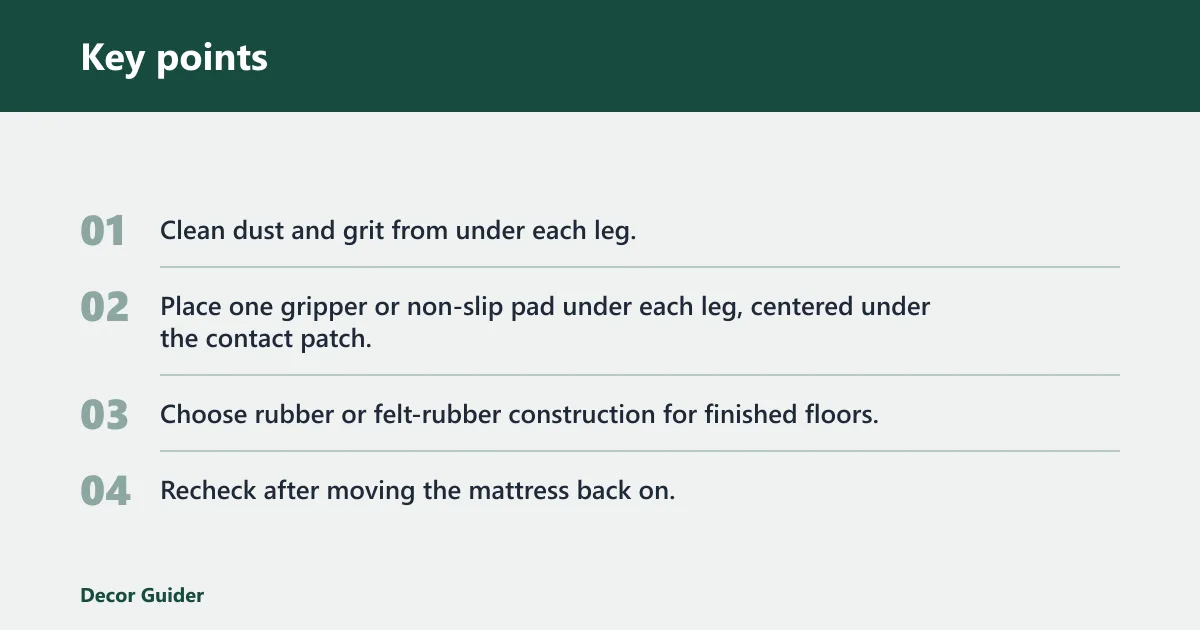
- Clean dust and grit from under each leg.
- Place one gripper or non-slip pad under each leg, centered under the contact patch.
- Choose rubber or felt-rubber construction for finished floors; use loose-lay pads if you need to remove them later.
- Recheck after moving the mattress back on.
Pad choice by floor type
On hardwood and laminate, choose rubber-based grippers rather than felt alone, since felt protects the finish but does little to stop movement. On tile or vinyl, a thicker pad with a textured underside can help, especially if the legs are metal. On carpet, pads should not float the frame higher without improving support. In practical use, soft felt-only pads often compress too much on hardwood and allow the leg to skate, while textured rubber tends to hold better on tile and smooth vinyl.
Prevent scratches while stopping sliding
Use a pad that both grips and protects the finish. A felt-rubber combo is usually the best balance for hardwood and laminate because the felt faces the floor finish while the rubber layer resists creeping. Avoid bare metal feet on finished floors, and keep dirt out from under the leg; grit can turn a gripper into an abrasive contact point instead of a protective one. On tile, choose a non-marking pad rated for hard surfaces.
3. Level an uneven floor
If one leg sits higher or the frame rocks, the floor may be out of level. In that case, grip products can make the wobble worse because the load is uneven. Shims fix the contact plane first, then grippers can do their job. If the bed rocks diagonally, one low corner often causes the opposite corner to unload and drift.
- Check the rock by pressing each corner and the center rail.
- Slide plastic or composite shims under the low leg until the frame stops rocking.
- Keep each shim stack low and trim to fit so the leg still bears weight fully.
- Recheck the frame after the mattress is back in place.
How much shim to add
Add the thinnest shim that removes the rock, then recheck. A stack that climbs too high can shift the leg off-center and create a new slide point. If you need a tall stack, the floor or frame needs a more structural fix, not another layer. The safest result is a level leg that bears directly, without rocking on the shim edge.
4. Stabilize the frame structure
If the bed still shifts, look at the center rail, center leg, and anti-rack stability. A frame that flexes in the middle can move even with good pads at the corners. Structural repair comes before any extra grip product. A weak middle often shows up as a slow sag, a visible dip under the mattress, or a side-to-side sway when someone sits on the edge.
- Inspect the center support rail for sag or side play.
- Adjust the center leg so it bears load firmly and evenly.
- Replace bent slats, cracked brackets, or split wood parts.
- Add a headboard-to-wall stabilizer strap if the headboard is the moving point and you have safe clearance.
When to stop using pad-only fixes
If the frame racks when you sit on one side, if the middle sags, or if joints reopen after tightening, pads are not enough. That is a structural problem. A stronger rail, replacement bracket, or new frame section is the better fix. Manufacturers and retailers generally classify these symptoms as support failure, not simple slipping, because the load path itself is no longer stable.
5. Stop movement from wheels or risers
Wheeled frames and high risers can move more because the load path changes. Caster wheels roll, and tall risers can reduce side stability if the footprint gets too high. Check the hardware before swapping parts. If a wheel spins inside the cup or the brake does not fully lock, the frame can still drift under body movement.
- Check whether the wheels lock and whether the locks actually hold under load.
- Set each wheel into a caster cup matched to the wheel diameter.
- Replace over-tall risers with a lower, load-rated support if the frame feels top-heavy.
- Keep the cup under each wheel before testing movement again.
What to do before buying new risers
Measure the wheel diameter, the frame height, and the load path first. If the bed got less stable after risers were added, the issue may be height, not friction. A lower setup with caster cups often works better than another grip pad stacked under a wheel. In general, risers do not solve sliding by themselves; if anything, they can increase sway when they raise the center of gravity without widening the footprint.
Do risers increase sliding?
They can. Taller risers raise the bed and can magnify rocking, especially on a light frame or one with narrow legs. If the bed started moving after risers were added, reduce height first, then add support and grippers. Load-rated risers with a wider base are safer than improvised stacks because they spread force more evenly.
6. Match the fix to your bed frame type
Different frames fail in different ways. Metal frames often need joint tightening and grippers. Wood frames may need support and shims. Platform beds depend heavily on center support. Wheeled frames need wheel control first, then floor protection.
Metal frame
Metal legs often have a small contact patch, so they slide on smooth floors. Tighten every bolt and bracket, then use rubber furniture grippers under each leg. If the frame still shifts, inspect the center rail and corner joints for flex or cracking. Thin tubular legs are especially likely to skate if the floor is polished or dusty.
Wood frame and platform bed
Wood frames usually fail at the joints or center support, not the feet. Tighten the hardware, check for split wood, and correct any uneven floor with shims. On hardwood or tile, use grippers only after the frame is level and square. If a wood rail splinters, swells, or opens at the joint, repair or replace that part before adding grip products.
Wheeled frame
Locking wheels that still roll need caster cups or replacement wheels with a secure lock. Do not rely on felt pads here. They protect the floor, but they do not stop a wheel from moving. For a wheeled base, a cup that matches the wheel diameter is usually more effective than a softer pad alone.
7. Use the troubleshooting matrix
Use the row that matches the symptom and floor type. Start with the cheapest reversible fix, then move to support or replacement only if the frame still shifts. This keeps you from buying the wrong pad or missing a structural fault. It also helps separate a sliding problem from a broken-frame problem: if a member is cracked or missing, repair comes first.

| Symptom | Likely cause | Best fix | When to replace parts |
|---|---|---|---|
| Hardwood: frame slides on turns or when sitting down | Slick finish, narrow metal legs, loose joints | Rubber grippers under each leg; tighten bolts and corner brackets | Replace bent feet, cracked brackets, or worn leg pads |
| Tile: legs skitter or leave marks | Low friction tile surface, small contact patch | Thicker rubber-felt pads or grippers matched to each leg | Replace any leg that rocks or has a rounded, damaged base |
| Carpet: bed sinks on one side and moves | Uneven carpet pile, soft subfloor, missing center support | Shim the low leg and add center support | Replace sagging slats, damaged rails, or a weak center leg |
| Metal frame: squeaks and creeps after assembly | Loose bolts, corner brackets, or rack in the rail | Tighten hardware; add threadlocker; use grippers | Replace stripped fasteners or bent metal members |
| Wood frame: one corner lifts and the bed shifts | Uneven floor or split joint | Trim-to-fit shims; repair loose joints | Replace cracked wood, failed joinery, or a warped side rail |
| Platform bed: mid-span sag and side movement | Weak center support rail or overloaded slats | Add or adjust center support; verify load distribution | Replace sagging slats, a bent rail, or a failed center leg |
| Wheeled frame: moves even with brakes set | Wheel lock not holding or wheel still rotates | Use caster cups and confirm wheel lock status | Replace worn casters or a lock that no longer engages |
Priority order: tighten hardware, add grippers, level with shims, stabilize the center support, then replace damaged parts. That sequence keeps the fix reversible as long as possible.
Common mistakes
Felt pads alone are often treated as a cure, but felt mainly protects the floor. It does not give much grip on smooth surfaces. Another mistake is skipping the center support rail, which lets the frame rack even if the legs seem secure. Another common miss is over-tightening threadlocker into every fastener; a small amount on the fasteners that repeatedly loosen is safer than coating the whole joint.
Do not stack risers higher than needed. A taller setup can make the bed easier to tip or shift. Do not use wall straps as the first choice for renters either; start with pads, shims, and hardware checks before any strap or anchor method. Furniture anchors and headboard stabilizers are useful for wall movement, but they should not replace a repaired frame or a secure leg base.
Frequently asked questions
How do I stop my bed frame from sliding across the floor?
Tighten the bolts, screws, and corner brackets first, then place rubber grippers under each leg. If the frame still moves, check for uneven floor contact and a missing or weak center support rail. That sequence solves most light-to-moderate sliding without changing the whole frame.
What is the best way to keep a bed frame from moving?
The best fix is the one that matches the cause: hardware tightening for looseness, shims for an uneven floor, and grippers for slick flooring. On a wheeled frame, caster cups or working wheel locks come before any pad. Start with the structure, then add grip.
How do I fix a bed frame that keeps sliding on hardwood floors?
Use rubber furniture grippers, not felt alone, under each leg. Hardwood is smooth enough that narrow metal feet can drift even when the frame is otherwise sound. If one leg sits higher than the others, level it with a plastic shim before adding the grippers.
Can I use non-slip pads under a bed frame?
Yes, if the pad matches the floor and the leg contact patch. Choose rubber or felt-rubber pads for hardwood, laminate, tile, or vinyl, and keep one under each leg. If the frame is damaged or racks under load, pads should be a temporary step, not the full fix.
How do I stop a metal bed frame from moving?
Metal frames usually need two steps: tighten every fastener and add grippers under the feet. If the frame has a center rail, check that the center leg touches firmly and does not pivot. A loose metal frame can still move after pads go on.
What should I do if my bed frame slides because the floor is uneven?
Use trim-to-fit plastic or composite shims under the low leg until the rocking stops, then test again with the mattress in place. Keep the shim stack as low as possible. If the bed still shifts after leveling, look at the center support and the joints next.
Should I fix a sliding bed frame or a broken bed frame first?
Fix a broken frame first. If a rail is cracked, a bracket is bent, a foot is missing, or the center support has failed, friction products will not hold the bed safely. Once the frame is structurally sound, use grippers, shims, or caster cups to stop sliding.
Will threadlocker help keep the frame from sliding?
Threadlocker helps with recurring loose hardware, not floor grip. Use it on metal fasteners that repeatedly back out, following the manufacturer’s directions. It will not stop a smooth leg from moving on hardwood, tile, or vinyl, so pair it with pads or shims.
Do caster cups work better than felt pads?
For wheeled frames, yes. Caster cups stop rolling better than felt pads, while felt mainly protects the floor. For fixed legs, caster cups are not usually the right fit; use rubber grippers or a pad designed for the leg shape and floor type instead.
Can headboard stabilizers stop the whole bed from sliding?
They can reduce wall movement at the headboard, but they do not replace leg grips or frame repair. Use a stabilizer when the headboard itself shifts, especially if it bumps the wall. For full-frame sliding, start with joints, leg contact, and center support.
Sources
- Loctite threadlocker product guidance and metal fastener use notes
- 3M surface protection and removable adhesive guidance for home hardware applications
- Major furniture retailers’ assembly and load-limit instructions for beds and frames
- Flooring manufacturer care guidance for hardwood, laminate, tile, and vinyl surface protection
- General caster cup and furniture pad guidance from major hardware retailers
Products related to this article
Sponsored / affiliate links. As an Amazon Associate I earn from qualifying purchases. I may earn additional commission from eligible campaigns.