
How to Use Bed Risers on a Bed Frame
Use bed risers only on a bed frame with four stable leg points, and choose risers rated above the bed’s estimated total load. Estimate that load by adding the mattress weight and the heaviest expected sleeper weight, then allow for extra stress when someone sits on the edge. A common installation rule is to use the same height at every leg. A poor fit or uneven lift can make the frame wobble, strain joints, or let a leg slip. This guide shows how to choose the right risers and place them safely without creating clearance or stability problems.
What bed risers do



Bed risers add height between the floor and the bed frame. Common heights run from 1 inch upward, and the main material choices are plastic, metal, and wood. Plastic is usually the cheapest option, while metal and wood are described as holding a lot of weight.
Styles matter as much as height. Single-piece risers are the simplest, stackable designs let you build height in stages, and adjustable designs can change range without replacing the whole set. Pick the style that matches the leg shape and the load, not only the size you want.
Single-piece, stackable, and adjustable designs
Single-piece risers are best when you already know the needed height. Stackable versions can help if you want to start low and add height later, but each added layer increases the chance of slip if the fit is loose. Adjustable designs cut down on guesswork, yet they still need a secure socket depth and a flat floor.
📊 Bed risers are commonly available in several heights. Source: wikiHow article 3 Ways to Raise Your Bed.
What you’ll need
- Tape measure
- Ruler or caliper for leg diameter and shape
- Bed risers matched to the frame
- Rubber pads or grippers
- Bed skirt or concealment cover, if needed
Will bed risers work on your frame?
Bed risers are generally best suited to frames with four independent legs that sit squarely on the floor. Check whether the legs are detachable or fixed, whether any corners use wheels, and whether the leg shape fits the riser socket deeply enough to prevent wobble. If a frame has recessed legs, nonstandard feet, or hidden damage, compatibility can fail fast.
Check leg shape, diameter, and recess depth
Measure the leg at its widest point and compare it with the riser opening, then check how far the leg sits down inside the socket. Too much space around the leg raises wobble risk; too little depth can make the frame sit on the rim instead of the socket floor. Amerisleep warns that incorrect installation can make bed risers unsafe.
Look for detachable legs, fixed legs, or wheels
Detachable legs are the easiest fit because they usually seat directly into a socket. Fixed legs need a riser designed for the exact shape, and wheel-based frames are poor candidates unless the wheel assembly is removed and the frame is meant to rest on a stable leg point. Recessed legs may need risers with wider platforms for support.
How to choose the right height
Start with the object you need to clear, then add a small margin for airflow and floor unevenness. If you want storage, measure the bin height with the lid on. If you want robot-vacuum access, check the vacuum’s height plus a little extra room. If you want easier access, keep the finished bed height comfortable for sitting and standing.
Measure the storage or clearance target
Measure from the floor to the top of the storage bin, then add clearance so the bin does not rub. For a robot vacuum, measure the vacuum height and leave enough room for it to pass without scraping. If the mattress and frame already sit high, a riser that adds even 1 inch can change the fit under the bed.
Confirm the final height still feels stable
Bed risers are commonly available in several heights, but higher is not always better. More height means more side force at the corners, which can magnify wobble if the floor is uneven or the socket fit is loose. A common first-timer mistake is choosing the tallest option first and then finding the bed is harder to steady.
Raise one corner at a time, and remove the mattress only if the frame is heavy or awkward to lift safely. Seat each leg fully in the socket so the load transfers to the base of the riser, not the rim. After all four corners are in place, test for wobble before remaking the bed.
- Clear the area around the bed, and remove the mattress only if the frame is too heavy or awkward to lift safely.
- Measure each leg and confirm the same riser type fits every corner.
- Lift one corner just enough to slide the riser into place.
- Lower the leg straight into the socket until it sits fully seated.
- Repeat at the other three corners at the same height.
- Press each corner down and check for rocking on the floor.
- Use rubber pads or grippers under the risers if the floor is hard and slick.
- Recheck alignment after adding the mattress, then again after the first night.
Suppose a metal frame has 2-inch-diameter legs and the riser socket is wider than that. The bed may stand, but the leg can drift inside the opening and shift under side load when someone sits on the edge. In that case, a closer-fitting riser or a different frame support is safer than forcing the fit.
Bed frame compatibility checklist

This table maps the leg style to the fit check, the main risk, and the safest concealment plan. Use it before buying, because the wrong socket depth or shape is harder to fix after the bed is raised.
| Leg shape | Measuring step | Fit risk | Recommended riser type | Concealment option |
|---|---|---|---|---|
| Round detachable leg | Measure diameter and leg insertion depth | Loose socket if the opening is too wide | Single-piece or adjustable riser with deep socket | Bed skirt that reaches the floor |
| Square detachable leg | Measure side width and corner clearance | Twist or wobble if corners do not seat flat | Square or wide-mouth riser | Wraparound skirt with extra drop |
| Fixed leg with small foot | Measure foot width and under-frame access | Leg may not reach full socket depth | Wide-platform riser rated for the load | Concealment cover with side access opening |
| Recessed leg | Measure how far the leg sits back from the frame edge | Frame can rest on the rim instead of the socket floor | Wide-base riser or frame adapter style | Long bed skirt with deep drop |
| Wheel-based corner | Check whether wheels are removable and whether the frame has a true leg point | High risk of roll or slip-out | Avoid unless the wheel assembly is replaced by a fixed leg support | Skip concealment until the support is corrected |
| Nonstandard shape | Trace the profile and measure the widest point | Shape mismatch and edge loading | Custom-fit or universal riser with a broad socket | Bed skirt plus under-bed cover panels |
How do you keep risers from slipping?
Slip usually comes from a loose socket, a slick floor, or uneven load. Use grippers on hard floors, make sure every corner is level, and avoid dropping full body weight onto one edge of the bed. If the fit is loose, a bigger riser is not the answer, the correct socket depth matters more than extra height.
Use grippers on hard floors
On tile, laminate, or polished wood, place rubber grippers where the riser touches the floor. That helps protect the floor and reduces sliding when the bed is pushed or when someone sits down near the edge. Amerisleep identifies uneven floor surfaces as a safety risk, so check the floor first.
Recheck after the first night
After the first night, press each corner and look for rocking, tilt, or a gap at the floor. If one corner shifts, lower the bed and correct the fit instead of hoping it settles. If the frame is still unstable, remove the risers and inspect the legs for hidden damage or bending.
Say your bed uses four 4-inch plastic risers and the floor is slightly sloped near one wall. The frame may feel fine when centered, but wobble can appear after the mattress is back on and someone sits at the edge. Moving the bed to a flatter patch or switching to a wider base can fix the problem without changing the height.
Common mistakes
The biggest errors are easy to avoid: wrong socket depth, ignoring load ratings, and hiding the risers before confirming access. A set of four bed risers can claim support for over 1,000 pounds, but that rating is not a license to overload one corner. To plan safely, add the mattress weight, the sleeper weight, and any likely edge-sitting load before comparing the result with the riser rating. Every corner still needs its own secure seat. (Wikihow)
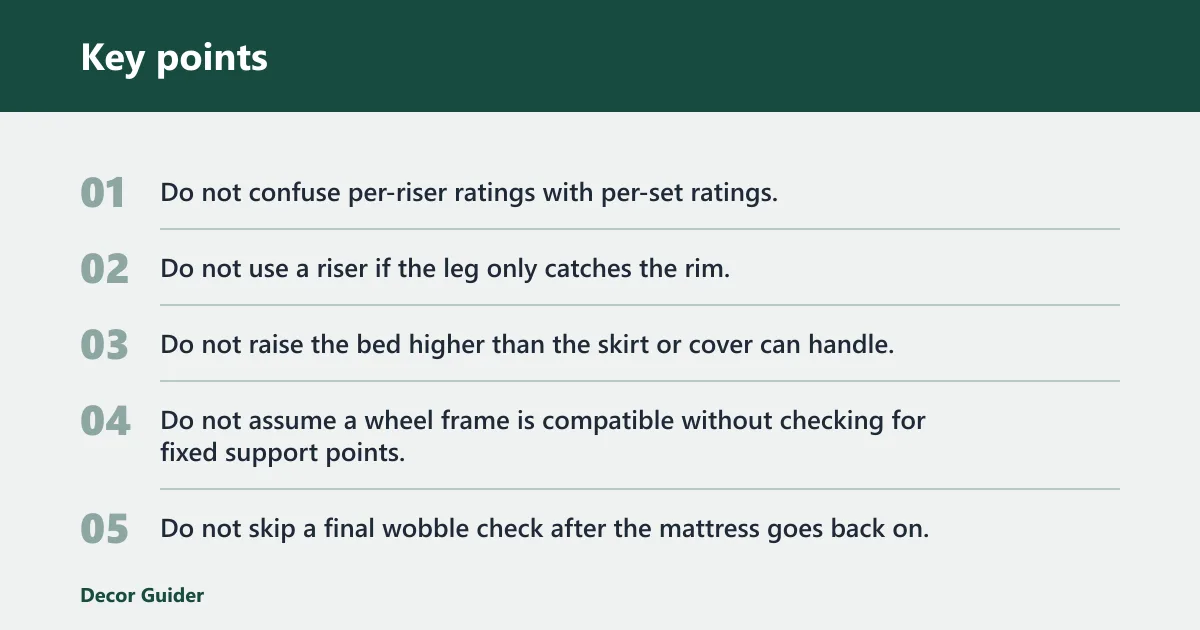
- Do not confuse per-riser ratings with per-set ratings.
- Do not use a riser if the leg only catches the rim.
- Do not raise the bed higher than the skirt or cover can handle.
- Do not assume a wheel frame is compatible without checking for fixed support points.
- Do not skip a final wobble check after the mattress goes back on.
For weight planning, add the mattress weight, the sleeper weight, and the extra stress from sitting at the edge. Metal and wood risers are described as holding a lot of weight, while plastic is usually the cheapest material. If the bed is heavy or shared, choose the more conservative option and stay well within the stated rating.
For a memory foam or latex mattress, spacing under the bed matters too. DeskFinds says these mattresses generally need slats spaced no more than about 3 inches apart, so raising the bed does not solve a weak support base. The frame still needs even support after the risers are installed.
Frequently asked questions
How do you use bed risers on a bed frame?
Pick risers that match the leg shape, remove the mattress only if the frame is too heavy or awkward to lift safely, and place all four corners at the same height. Seat each leg fully into the socket, then check for rocking before putting bedding back on. If the bed shifts, the fit is wrong or the floor is not level enough for safe use.
Will bed risers work on my bed frame?
They work best on a frame with four stable leg points and a leg shape that fits the socket deeply. Fixed legs, recessed legs, and nonstandard feet need closer measurement than a simple round post. If the frame has wheels or flexes at the corners, treat it as a poor match until proven otherwise.
How do I measure the right height for bed risers?
Measure the storage bin, vacuum, or access need first, then add just enough margin for airflow and floor unevenness. Bed risers are commonly available in several heights, so you can match the target more closely than with a guess. Confirm that the final height still feels stable when you sit on the edge.
Are bed risers safe for a heavy mattress?
They can be, if the risers and the frame are rated for the combined load of the mattress and sleepers. A set of four bed risers can claim support for over 1,000 pounds, but each riser still has its own limit. Heavy mattresses need solid frame support, not just a higher base.
Can you use bed risers on a metal bed frame?
Yes, if the frame has stable legs that fit the riser socket and the load rating is high enough. Metal frames often work well with snug sockets, but wheels, thin tubes, or recessed supports raise the fit risk. Check the leg diameter and make sure the corner lands flat before you rely on the setup.
How do you cover bed risers so they are not visible?
How do you hide bed risers under a bed skirt?
Do bed risers work on bed frames with wheels?
Usually not without changes. Wheels can roll, tilt, or leave too little fixed contact for a stable socket, which makes the setup prone to slip-out. If the wheel assembly can be removed and replaced with a fixed leg point, the frame may become usable; otherwise, choose a different support method.
Products related to this article
Sponsored / affiliate links. As an Amazon Associate I earn from qualifying purchases. I may earn additional commission from eligible campaigns.