How to Choose the Right Bed Frame for a Heavy Mattress
Pick a bed frame rated for the mattress plus sleepers, with a rigid center beam, legs under the middle, and slats no more than 2 to 3 inches apart. For very heavy hybrid or latex beds, choose a frame with a total capacity of at least about 1,000 lb. Skip that, and sagging, noise, broken slats, and warranty disputes can follow. This guide shows how to match frame type, support geometry, and weight rating to your mattress and sleeper load.
Choose the right support system
Start with the mattress type, then add sleeper weight, bedding, and any movement from getting in and out of bed. The number on the spec sheet matters, but it is only part of the picture. A frame with weak center support can fail long before the headline rating looks low.
Think of the bed frame as a load-bearing system. A queen with two heavier sleepers and a thick mattress puts more stress on the center rail and slats than a smaller, lighter setup, even before pillows and bedding are counted. That is why the best choice is usually the one with clear support geometry, not the one with the longest style description.
A queen hybrid mattress example may weigh around 150 pounds and support two sleepers at about 200 pounds each, plus roughly 40 pounds of bedding and pillows. The total load is already well beyond a casual frame choice. In that case, a higher listed capacity, a center beam with legs, and closely spaced slats are the safer route.


Do you need a box spring?
A box spring is not automatic, and many heavy mattresses work better without one. Platform frames can replace a box spring when they provide a solid deck or closely spaced slats, while innerspring beds may still need a sturdy frame and box spring for proper stability. Foam mattresses often should skip the box spring because it can add flex and create warranty problems.
Use the mattress design as the guide. Purple says memory foam and latex mattresses need closely spaced slats or sturdy adjustable bases, and Purple notes innerspring mattresses use a sturdy bed frame and box spring for stability. Purple also recommends platform support or adjustable bases for GelFlex Grid mattresses. Those are different support needs, not interchangeable ones.
When a platform frame replaces one
Choose a platform frame when the slats are close enough, the center support is real, and the deck does not flex under load. For foam, latex, and many hybrid mattresses, that setup can remove the need for a box spring entirely. It also lowers the number of parts that can creak or shift.
A platform frame is usually the cleaner choice if you want fewer support layers and less height. It is also easier to inspect. If the mattress sits on a firm, even base, you can spot slat gaps, bowing, and loose fasteners before they become problems.
When innerspring beds still need it
Innerspring mattresses are the main case where a box spring may still make sense, but only if the frame beneath it is built for the load. A weak metal rail or thin center member can turn a box spring into extra height without extra support. That is a common mistake.
Check the mattress warranty language before pairing an innerspring with a box spring. Some brands require a specific support type, and others restrict what can go underneath. If the box spring adds bounce or uneven pressure, it can worsen edge sag and shorten the life of the mattress.
Why foam mattresses often should skip it
Memory foam and latex need stable, even support. A box spring can introduce movement that foam compresses unevenly, especially near the edges and at the center seam. For those mattresses, a platform bed or sturdy slatted base is usually the better match.
If you are choosing between a box spring and a platform frame for foam, pick the option that gives you the flattest support plane. The goal is to prevent soft spots, not add extra give.
Platform frame or slatted base?
A platform bed can support a heavy mattress without sagging if it has closely spaced slats or a solid deck, plus proper center support. A slatted base is often the better fit for foam and latex because it spreads load across the mattress more evenly. The main difference is how the frame carries weight and whether the mattress can bridge gaps.
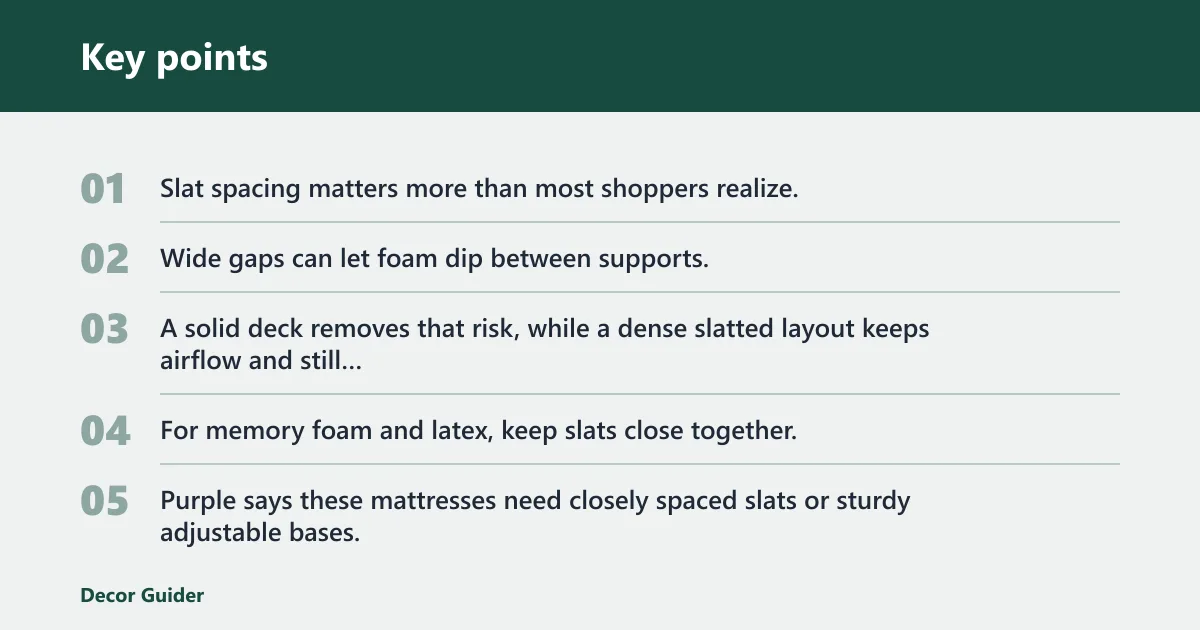
Slat spacing matters more than most shoppers realize. Wide gaps can let foam dip between supports, which encourages edge sag and center bowing over time. A solid deck removes that risk, while a dense slatted layout keeps airflow and still supports the mattress well.
Slat spacing for foam and latex
For memory foam and latex, keep slats close together. The same source says these mattresses need closely spaced slats or sturdy adjustable bases, and that guidance fits the way these materials distribute pressure. Wider gaps create unsupported spans, which can leave visible impressions and uneven wear.
Hybrid mattresses are more forgiving than all-foam beds, but they still benefit from tight spacing, especially when they are thick and heavy. If a product does not state the gap, ask for the spacing in inches before you buy.
Center rails and anti-sag support
How do you know if a frame has enough center support? Look for a center rail that runs the full length of the bed, plus legs that reach the floor under that rail. A frame with only edge legs can flex in the middle, even if the outer rails feel solid.
Stability features matter as much as raw rating. Casper says a frame should not creak or move side to side when pushed or leaned against. That is the kind of motion that exposes weak joinery, loose fasteners, and a frame that twists under load.
When a solid deck makes sense
A solid deck makes sense when you want the simplest support surface for foam or latex and you do not need airflow from slats. It can also help with mattress protection because there are no gaps to manage. The tradeoff is added weight and less ventilation under the bed.
Picture a king memory foam mattress on a frame with broad slat gaps. The center may look fine at first, but the foam can settle into the gaps near the hips and shoulders. A solid deck or much tighter slat layout avoids that failure mode.
Wood or metal for heavy loads?
Metal and wood can both work well, but they solve the problem differently. Solid wood tends to offer more mass and stiffness, while metal often gives lighter construction with strong bracing. For heavy mattresses, the better frame is the one with solid joinery, a center beam, and fewer weak points in the support path.
The same source says a solid wood or metal frame is preferable to composites or plastics for longevity. That is the right starting point. Then compare the actual structure: leg count, rail thickness, center support, and how the frame locks together.
Solid wood for stiffness and mass
Solid wood frames often feel more planted because of their weight and beam size. That can help resist side-to-side movement under a heavy mattress. They also tend to work well when you want a higher level of rigidity without visible metal bracing.
The drawback is that wood frames are usually heavier to move and can be more cumbersome to disassemble. If you plan to move often, check whether the joints are designed for repeated assembly rather than one-time setup.
Metal for lighter construction and bracing
Metal frames are often easier to move, and they can be very stable when the design includes enough legs and bracing. They are common in platform beds, low-profile frames, and heavy-duty queen models. The same source says low-profile steel frames are often used in contemporary or modern bedroom designs.
The drawback is that light metal designs can flex if the rails are thin or the center support is weak. Metal is not automatically stronger; it depends on the gauge, the joinery, and how the load reaches the floor.
Where joinery and fasteners matter most
Assembly and joinery affect long-term stability. Tool-free assembly can be convenient, and Wired notes that the Thuma Classic Bed uses tool-free assembly. But quick setup is only useful if the joints still lock tightly after repeated disassembly and reassembly.
Loose fasteners, poor alignment, and thin connection points can lead to creaks and movement. That is why a well-built frame with fewer parts can outperform a more decorative one with extra hardware and weaker connections.
Heavy mattress frame fit check
This checklist helps you compare frames before you buy. Use it as a spec check, not a style check. If any row raises a red flag, keep shopping.
| Mattress type | Slat spacing | Center support | Listed weight capacity | Frame material | Box spring compatibility | Red-flag failure modes |
|---|---|---|---|---|---|---|
| Memory foam | Closely spaced; avoid wide gaps | Full-length center beam with legs | Look for a rating that covers mattress + sleepers + bedding | Solid wood or steel | Usually skip it | Slat bowing, edge sag, mattress impressions |
| Latex | Closely spaced; stable across the full length | Strong middle rail and middle legs | Higher total capacity preferred for heavy latex | Solid wood or steel | Usually skip it | Center-rail deflection, uneven compression |
| Hybrid | Close spacing recommended | Center support is important | Very heavy builds benefit from 1,000 lb total capacity or more | Solid wood or steel | Usually not needed on a platform | Sagging between supports, noisy joints |
| Innerspring | Can work with sturdier support layouts | Strong frame plus stable middle support | Enough for the mattress and sleeper load | Wood or metal | Often compatible, depending on the mattress | Wobble, frame flex, uneven bounce |
Use the checklist this way: match the mattress type first, then verify the spacing, then confirm the load rating, then look for center support and material quality. A high headline capacity does little good if the middle of the frame is unsupported.
Practical thresholds help: for queen and larger beds, a center beam with one or more middle legs becomes especially important as total load rises; for very heavy sleeper-plus-mattress setups, a 1,000 lb or higher system rating is a useful benchmark, not a guarantee. Slats around 2 to 3 inches apart are a common safe range for foam and latex, while wider spacing demands a solid deck or additional support.
What mistakes should you avoid?
Do not buy on size alone. A full or queen frame can be the right dimension and still be too weak in the middle. Also avoid assuming that a higher number on the box fixes poor slat spacing, loose joints, or a missing center rail.
A common first-timer mistake is choosing a storage frame for the extra space, then finding that drawers or lift hardware reduce rigidity. Storage can be useful, but it can also take away some of the structure that a heavy mattress needs. If storage matters, check how the frame keeps the center supported.
Do not ignore room size either. The same source lists a minimum room size of 9′ x 9.5′ for a full bed and 12′ x 10′ for a king bed frame, so scale matters before the frame even arrives. Purple also says average bed height is 24 inches, which helps when you are comparing low-profile and taller builds.
Finally, do not treat upholstery as strength. A padded or upholstered look can hide weak rails, poor fasteners, or a flexible center section. If the product does not state the support layout, ask for it before you commit.
Room planning also matters for access and airflow. A frame that technically fits can still crowd nightstands, block drawers, or make it hard to change sheets. Keep the mattress footprint, wall clearance, and walking space in mind before you decide.
FAQ
What type of bed frame is best for a heavy mattress?
A platform frame with closely spaced slats or a solid deck is usually the best fit for a heavy mattress, especially foam, latex, and many hybrids. Look for a rigid center beam, middle legs, and a manufacturer-listed capacity that covers the mattress, sleepers, and bedding together.
How much weight can a bed frame hold?
The real answer is the manufacturer-listed maximum load, not a guess based on appearance. For very heavy mattresses and sleepers, a frame with at least 1,000 lb total capacity is a practical target. Also check whether that number changes when the mattress size, slat layout, or center support changes.
Do I need a box spring with a heavy mattress?
Not usually, if you choose a platform frame or slatted base that matches the mattress type. Foam and latex often should skip a box spring, while innerspring mattresses may still use one with a sturdy frame. Always check the mattress warranty so the support setup stays within the rules.
How close should bed slats be for memory foam or latex?
Use closely spaced slats. The same source says memory foam and latex mattresses need closely spaced slats or sturdy adjustable bases. Wider gaps can let the mattress sink between supports, which can lead to sagging and uneven wear, especially near the center and edges.
Is a metal or wood bed frame better for a heavy mattress?
Either can work, but solid wood often feels stiffer and heavier, while metal can be lighter and easier to move. The same source says a solid wood or metal frame is preferable to composites or plastics for longevity. The better choice is the one with strong center support, tight joinery, and low movement.
What bed frame size should I get for a full or queen mattress?
Get the exact mattress size, then confirm the room has enough clearance. The same source lists a minimum room size of 9′ x 9.5′ for a full bed and 12′ x 10′ for a king bed frame. The same source says queen beds measure 60” x 80”, and king beds measure 76” x 80”.
Products related to this article
Sponsored / affiliate links. As an Amazon Associate I earn from qualifying purchases. I may earn additional commission from eligible campaigns.