
Can You Put a Mattress Directly on the Floor?
Yes, you can put a mattress directly on the floor for a few nights, but long-term use raises the odds of trapped moisture, odor, and quicker wear unless you lift it often enough for airflow. Foam mattresses and cool concrete floors need the most caution. This guide explains when floor placement is acceptable, when it turns risky, and the care steps that reduce damage.
When a floor actually works for your mattress
Yes, for short-term use, floor placement can work if the room stays dry and you air out the mattress often enough for both sides to dry. The answer changes fast once it becomes nightly sleep, the room runs humid, or the floor is concrete or carpet that holds moisture.

Floor placement checklist
| Use case | Is floor placement acceptable? | Main risk level | Minimum ventilation steps | When a frame or platform is the better choice |
|---|---|---|---|---|
| Temporary guest setup | Yes, for a few nights | Low to moderate | Vacuum the floor, place a dry barrier if needed, and stand the mattress up after use | Once the stay stretches past a week, or if the room feels damp |
| Short-term rental setup | Yes, if you can air it out often | Moderate | Leave a small airflow gap when possible, rotate the mattress, and use a dehumidifier in humid rooms | When the mattress stays on the floor for repeated stays or several weeks |
| Long-term daily sleep | Usually no | High | Regular lift-outs, room drying, and inspection are required at minimum | Immediately, if you want the safer default for everyday use |
A common first-timer mistake is treating “a few weeks” like “a few nights.” A guest room mattress that gets pulled up and aired after each stay has a very different risk profile from a mattress that never leaves the floor in a closed bedroom.
What changes the risk?
The main variables are mattress construction, room humidity, and the floor surface under it. A mattress can sit on one floor type for a while and still fail on another because the surface either traps moisture, stays cool enough to condense it, or blocks airflow under the bed.
Mattress type
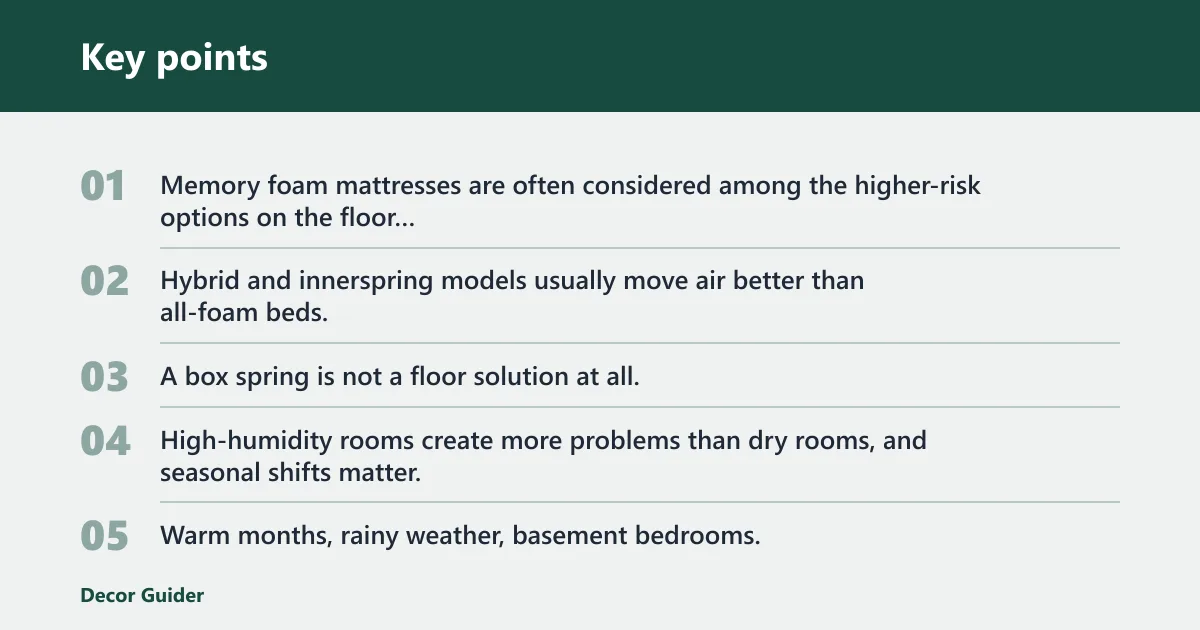
Memory foam mattresses are often considered among the higher-risk options on the floor because thicker foam can hold heat and dry slowly. Hybrid and innerspring models usually move air better than all-foam beds, but they still need clearance or routine lift-outs. A box spring is not a floor solution at all; it is meant to sit on a supportive foundation.
Room humidity and seasonal moisture
High-humidity rooms create more problems than dry rooms, and seasonal shifts matter. Warm months, rainy weather, basement bedrooms, and poor ventilation all raise the chance of condensation under the mattress. A dehumidifier is worth using whenever the room feels damp or the walls and floor stay cool.
Floor surface
| Floor surface | Moisture behavior | Risk notes |
|---|---|---|
| Hardwood | Can dry more easily than carpet, but still traps moisture against the mattress | Watch for finish damage and darkened spots under the bed |
| Carpet | Holds humidity and slows drying | Higher mold and dust exposure; harder to see dampness early |
| Tile | Does not absorb water, but can stay cool enough for condensation | Often safer than carpet, but still needs airflow |
| Concrete | Commonly stays cool and can wick or condense moisture | One of the riskiest surfaces for long-term floor placement |
Picture a studio apartment with a memory foam mattress on concrete. The room feels dry during the day, but the slab stays cool at night. That temperature difference can create condensation under the bed even when the air does not seem wet.
How to keep moisture down
The practical goal is simple: keep air moving under and around the mattress, and keep the room dry enough that the underside does not stay damp. If you cannot do both, floor placement stops being the sensible choice.
Minimum airflow gap and lift-off routine
A small airflow gap is better than no gap at all. Slatted foundations, a low-profile frame, or furniture risers create clearance under the mattress and help ventilation channels form. If the mattress must stay on the floor, lift or stand it up on a schedule so both sides can dry.
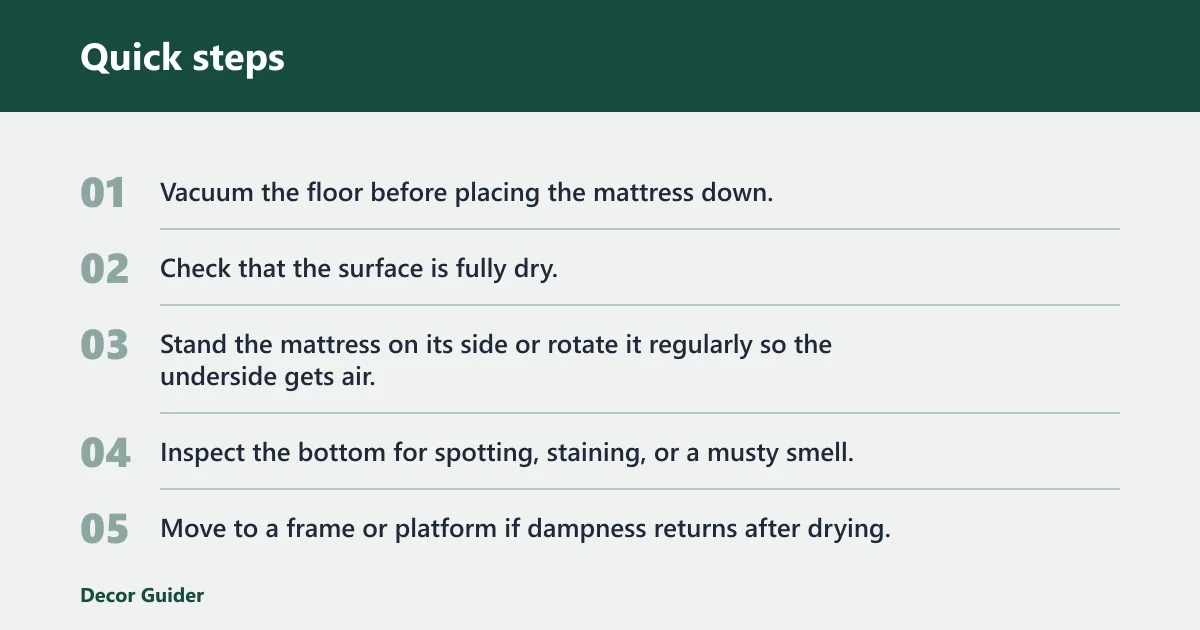
- Vacuum the floor before placing the mattress down.
- Check that the surface is fully dry.
- Stand the mattress on its side or rotate it regularly so the underside gets air.
- Inspect the bottom for spotting, staining, or a musty smell.
- Move to a frame or platform if dampness returns after drying.
Using a dehumidifier in damp rooms
Use a dehumidifier in high-humidity rooms, basement spaces, or bedrooms that collect condensation on walls and windows. If the floor feels cool and the room air seems heavy, the mattress is more likely to hold moisture than dry out. Seasonal changes matter, so check conditions again after weather shifts.
Vacuuming and airing out the mattress
Vacuum both the floor and the mattress surface, then let the mattress air out with open access to both sides whenever possible. This matters for dust and allergen exposure as well as moisture control. A mattress that stays flush to the floor collects more dust and is harder to dry after spills or humid nights.
Can you put a memory foam mattress directly on the floor?
Yes, but memory foam is one of the least forgiving mattress types for floor placement. Its thick foam construction holds heat and moisture more than an innerspring design, so it needs more drying time, more frequent rotation, and a drier room than most people expect.
Why foam needs more attention
Memory foam reduces ventilation compared with innerspring mattresses, and that can slow drying from the bottom up. If the room is humid, the foam may stay warm on top and cool underneath, which is a poor mix for moisture control. Regular standing up or rotation helps, but it is still a compromise.
When a slatted foundation is the better choice
A slatted foundation is usually the better choice once the mattress is used every night or the room runs humid. The added clearance under the bed lets air move, and that matters more with foam than with most other constructions. If the mattress starts to feel clammy or develops odor, move it off the floor.
Suppose a queen memory foam mattress sits on tile in a spare room for two weeks. If the room stays dry and the mattress is lifted twice a week, the risk is lower. If the same setup stays flat on the tile in a humid basement, the risk rises quickly.
What about a box spring on the floor?
A box spring is generally not a good standalone floor solution. It is designed to sit on a supportive foundation, not directly on the floor, and putting it on the floor can trap moisture inside the base. That trapped moisture can damage the box spring and shorten its usable life.
Why box springs do not belong on the floor
Box springs rely on airflow and support from below. On the floor, they can absorb humidity from concrete or carpet and dry slowly. If you place a mattress on top of a box spring that is already on the floor, you add another layer that blocks airflow instead of improving it.
Better alternatives to floor sleeping
If floor placement is only a temporary compromise, a low platform is usually the simplest upgrade. A platform bed, low-profile frame, slatted foundation, or furniture risers all create clearance under the mattress and make cleaning easier. These options also make bed bug inspection more visible because the underside is easier to check.
When to move off the floor
Move the mattress off the floor if you notice a musty odor, visible spotting, staining, or recurring dampness after drying. Those signs point to moisture problems that are already underway. At that stage, a frame or platform is the safer choice, and the mattress may need replacement if mold or mildew has set in.
Frequently asked questions
Can you put a mattress directly on the floor?
Yes, for short periods. The setup becomes riskier with daily use, high humidity, or concrete and carpet floors that slow drying. If you keep it on the floor, vacuum underneath, air the mattress out often, and stand it up on a regular schedule so moisture does not stay trapped.
Can you put a mattress straight on the floor?
Yes, but “straight on the floor” should be treated as temporary, not the default for a bedroom. The biggest concern is airflow. Without clearance under the mattress, moisture can collect, dust builds up more easily, and the underside is harder to inspect for early mold or mildew.
Can you put a box spring and mattress directly on the floor?
That is usually a poor setup. A box spring is meant to sit on a supportive foundation, and the floor can trap moisture inside it. The mattress also loses airflow underneath, so the whole stack dries slowly and can develop odor, mildew, or soft spots over time.
Why can’t you put a mattress directly on the floor?
The main reason is moisture. Floors can block airflow, stay cool, or hold humidity, and that can lead to mold, mildew, odor, and faster wear. Dust and allergens also collect more easily at floor level, and the mattress is harder to inspect and clean from underneath.
How long can a mattress stay on the floor?
There is no fixed safe limit, because the answer depends on the mattress type, the room humidity, and the floor surface. A few nights is very different from several months. If the mattress stays on the floor long enough that you cannot air it out regularly, a frame or platform becomes the better choice.
Products related to this article
Sponsored / affiliate links. As an Amazon Associate I earn from qualifying purchases. I may earn additional commission from eligible campaigns.