How to Attach a Footboard to a Bed Frame
Use the bed frame’s built-in footboard brackets first. If none exist, match the footboard to the frame type with adapter plates, bolt-on rails, or a wood cleat. Wrong hardware can cause wobble, stripped holes, or a footboard that will not sit square. This guide shows how to identify metal, wood, and adjustable frames, choose the right attachment method, and install it without guessing.
Quick decision tree: which footboard path should you use?


Start with the frame type, then match the connection style, then check alignment and clearance. If the holes line up and the footboard clears the frame through its full movement, use the standard kit. If the holes are close but not exact, switch to an adjustable bracket. If the frame moves and clearance is tight, stop and choose a kit built for adjustable beds.
- Frame type: Metal, wood, or adjustable.
- Bolt-on or hook-on: Use the connection style the frame already supports.
- Holes align yes/no: If yes, use the standard bracket path; if no, look for an adjustable or conversion bracket.
- Adjustable clearance yes/no: If no, do not force the fit around moving parts.
- Recommended kit path: Standard footboard bracket, adjustable bracket set, or conversion bracket such as a hook-on-to-bolt-on adapter.
If you are also measuring the bed itself, see bed frame sizes and how to measure bolt spacing before buying hardware. For broader hardware options, compare headboard bracket types and adjustable bed accessories.
What you’ll need
- Footboard bracket kit with matching bolts, nuts, and any short adapters
- Drill
- 1/8-inch drill bit for pilot holes in wood
- Phillips-head drill bit
- Wrench
- Hex wrench
- Tape measure
- Level surface for test fitting
- Replacement hardware if the original bolts or screws do not match the bracket kit
How do you identify your frame type?
Start by checking the attachment points at the foot end. Bolt-on frames use pre-drilled holes and bolts. Hook-on frames use slits or hooks that drop into channels. Adjustable bed frames need extra clearance checks because the head section can rise and the footboard may need a specific mounting slot or extension.
Check for bolt-on holes
Look for a clean hole pattern, then measure it center to center before buying hardware. A bolt-on fit should line up without forcing the bolt at an angle, and the fastener diameter and thread should match the frame hardware exactly. If the spacing is close but not exact, use an adjustable bracket instead of drilling the frame blindly.
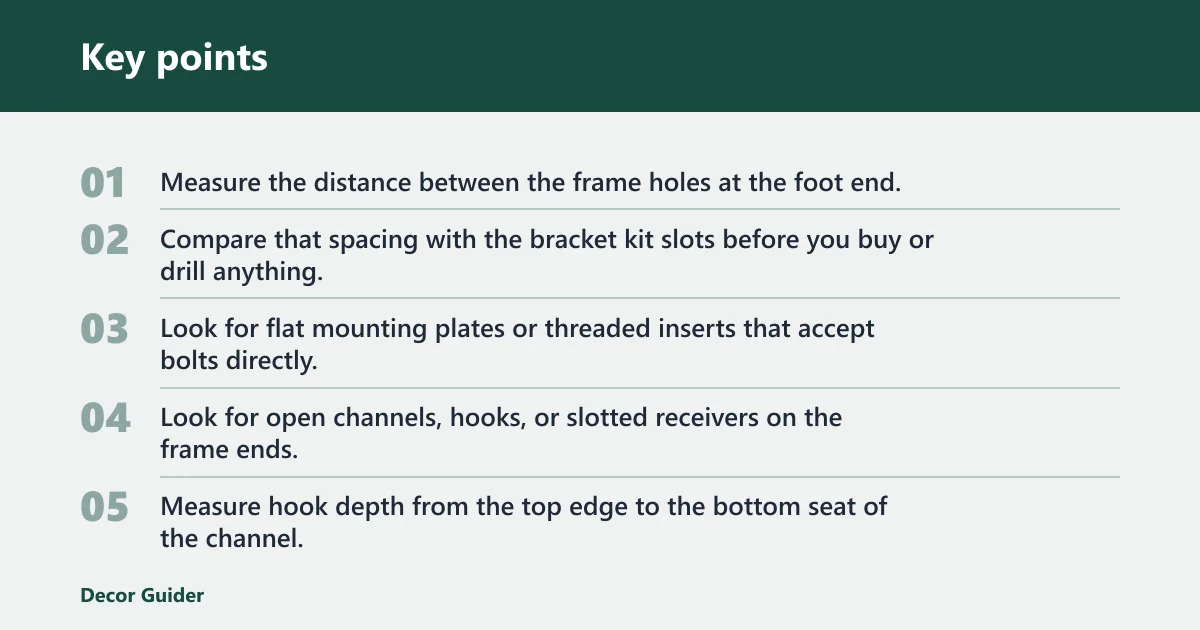
- Measure the distance between the frame holes at the foot end.
- Compare that spacing with the bracket kit slots before you buy or drill anything.
- Look for flat mounting plates or threaded inserts that accept bolts directly.
Most metal bed frames already have the footboard bracket attached, but you still need to confirm alignment. Use a fixed bracket only when the holes, thread, and bolt diameter match without binding. For a visual cross-check, review headboard bracket types alongside the frame layout.
Check for hook-on slots
Hook-on frames rely on depth and seat, not just width. Measure the channel depth, confirm the lip is strong enough to carry the bracket, and make sure the hook seats fully before tightening. If the bracket rocks at all before tightening, the hook profile is wrong or the channel is too shallow for that hardware.
- Look for open channels, hooks, or slotted receivers on the frame ends.
- Measure hook depth from the top edge to the bottom seat of the channel.
- Check that the bracket shoulders sit fully in the channel before tightening.
A hook-on setup fails fast when the hook depth is too short or the bracket lip is too thick. If the connection rocks before tightening, stop and switch to a different bracket path.
Note adjustable frame limits
Adjustable frames often need a separate bracket kit if the bed lacks one. Healthy Americans notes that adjustable-bed headboard attachments come in bolt-on and hook-on designs, and the head of the bed should be raised to its highest setting before installation. That matters here too, because the footboard may need clearance from moving parts.
Footboard compatibility checklist
| Frame type | Connection type | Hole spacing check | Hook depth check | Fastener diameter/thread check | Maximum acceptable misalignment before switching brackets | Required tools | Likely kit type | Red-flag reasons to stop and buy a different bracket |
|---|---|---|---|---|---|---|---|---|
| Metal bed frame | Bolt-on | Yes if holes line up within 1/8 inch center to center | No | Yes; bolts must match the frame threads and diameter | 1/8 inch or less for a fixed bracket; more than that calls for an adjustable bracket | Wrench, hex wrench, tape measure | Standard footboard bracket kit or adjustable bracket set | Hole spacing is off, bolts bind, or the footboard sits crooked after a test fit |
| Metal bed frame | Hook-on | No | Yes; hooks must drop fully into the channel | Yes; any included bolt hardware must still match the bracket kit | No visible rocking; if the hook does not seat fully, switch to a different bracket | Wrench, hex wrench, tape measure | #711 conversion brackets or hook-on-compatible extensions | Hooks sit shallow, the bracket wobbles, or the frame channel is too narrow |
| Wood bed frame | Bolt-on or screw-fastened | Yes if pre-drilled holes match; otherwise drill pilot holes | No | Yes; screw size must match the bracket and wood thickness | Any edge placement that risks splitting or leaves the screw too close to the rail edge | Drill, 1/8-inch drill bit, Phillips-head drill bit, tape measure | Footboard bracket kit with wood-mount hardware | Wood splits, screws pull at an angle, or the bracket lands too close to the edge |
| Adjustable bed frame | Bolt-on or hook-on, depending on kit | Only if the mounting slots match the moving frame position | Only if the kit uses hooks | Yes; hardware must match both the bracket and the moving frame points | Any interference with the moving sections; if the bracket does not clear, switch kits | Wrench, hex wrench, tape measure, drill if the kit calls for it | Adjustable bracket set or separate conversion kit | Head section hits the footboard, the slots do not reach, or the frame has no safe mounting point |
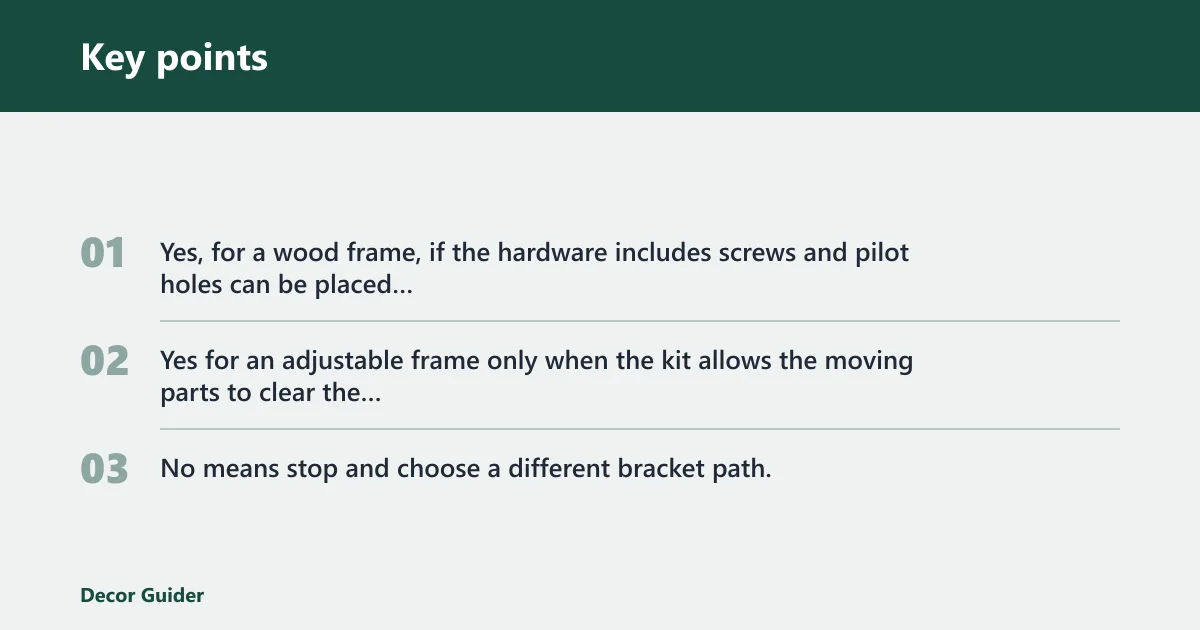
Yes for a metal frame with matching holes. Yes, for a wood frame, if the hardware includes screws and pilot holes can be placed cleanly. Yes for an adjustable frame only when the kit allows the moving parts to clear the footboard. No means stop and choose a different bracket path.
How do you choose the right bracket kit?
Choose the kit that matches the frame’s connection style first, then use adjustment only where the hardware allows it. A footboard bracket kit mounts the footboard to the frame and may include bolts, nuts, short adapters, and bracket hardware. It has to match the frame’s attachment style, or the rest of the install becomes guesswork.
Match the connection style
Use the frame’s existing connection style as the first filter. If the frame already gives you bolt holes, stay with a bolt-on path. If it uses hooks, choose a hook-compatible kit. The goal is to avoid forcing one style into another, because a close-looking fit can still fail once the mattress weight loads the joint.
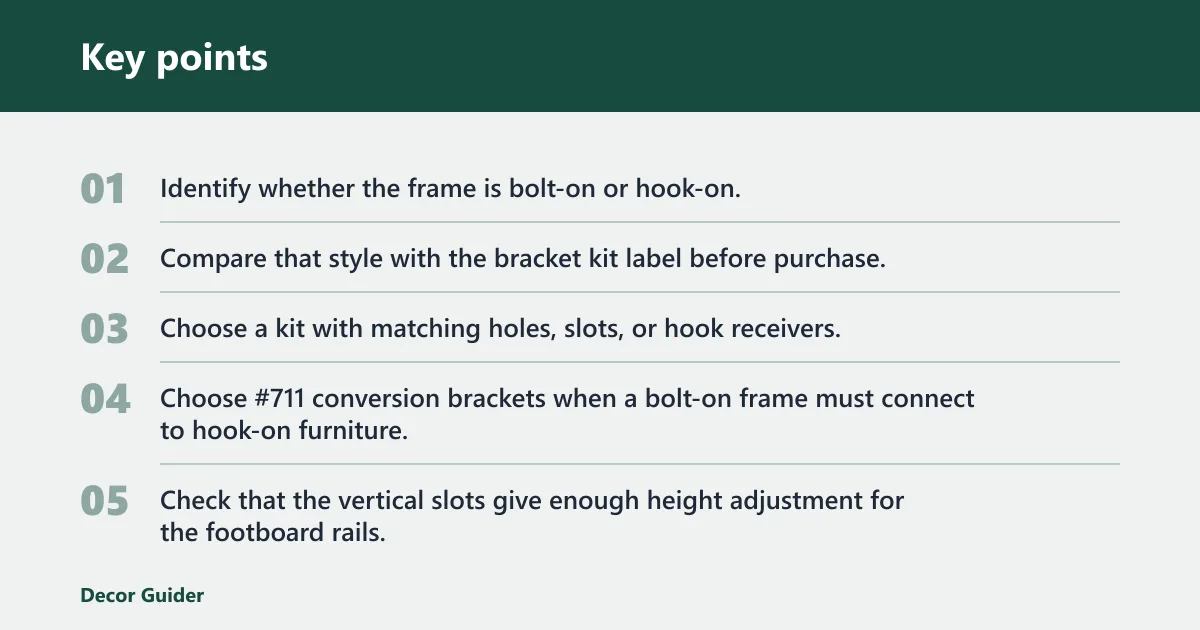
- Identify whether the frame is bolt-on or hook-on.
- Compare that style with the bracket kit label before purchase.
- Choose a kit with matching holes, slots, or hook receivers.
If the frame already has footboard points, use them first. If not, a standard bracket kit or adapter plate is the cleaner path than forcing mismatched hardware.
Use #711 conversion brackets when needed
#711 conversion brackets are for bridging a style mismatch, not for solving every alignment problem. They help when a bolt-on frame must connect to hook-on furniture and the vertical slots give enough height to land the footboard where it needs to sit. If the slot range cannot cover the mismatch, choose a different kit.
- Choose #711 conversion brackets when a bolt-on frame must connect to hook-on furniture.
- Check that the vertical slots give enough height adjustment for the footboard rails.
- Test the bracket fit before tightening any fastener fully.
That conversion bracket set is a targeted solution, not a universal fix. It works when the frame and furniture need a bolt-on to hook-on bridge and the vertical slots can correct the height mismatch.
Choose adjustable brackets for alignment gaps
Adjustable brackets are best when the hole pattern is close but not exact. They let you shift the footboard into center without drilling new holes immediately, which is useful when the frame is structurally sound but the spacing is slightly off. Keep the movement small and intentional so the footboard stays square under load.
- Select an adjustable bracket set if the holes are close but not exact.
- Use the front-to-back and side-to-side movement to center the footboard.
- Add footboard extensions only if the kit includes them and the frame still clears the moving parts.
One bracket set described by Your Modern Living includes two headboard brackets and two footboard extensions. That kind of kit helps when the frame geometry is close, but not quite square enough for a fixed bracket.
How to attach a footboard to a metal bed frame
Metal bed frames often already have bracket points, but you still need to confirm hole alignment, bolt-through fit, and any needed adapter plates or extensions. A metal install usually goes faster than wood, yet it still fails if the holes do not match or the footboard lands out of square.
- Set the frame on a level floor and measure the foot-end hole spacing.
- Hold the bracket against the frame and confirm the bolts pass through without force.
- Add adapter plates or extensions if the bracket holes sit just outside the frame points.
- Insert the bolts by hand first, then tighten with a wrench or hex wrench.
- Measure the footboard from both sides and adjust until the gap matches on each end.
- Tighten the hardware fully after the footboard sits level.
Suppose the left side sits 1/4 inch higher than the right side after the first fit. Loosen the higher side, shift the bracket until both measurements match, and retighten. A footboard that is off by even a small amount can look crooked once the mattress is in place.
How to attach a footboard to a wood bed frame
Wood bed frames may need pilot holes before screw installation. One guide uses a 1/8-inch drill bit for pilot holes and recommends 1-inch screws for securing the adapter to a wood bed frame. That keeps the wood from splitting and gives the screws a cleaner bite.
- Mark the bracket positions with the tape measure and keep both sides level.
- Drill pilot holes with a 1/8-inch drill bit where the screws will go.
- Align the bracket and start each screw by hand before using the drill.
- Drive the screws with a Phillips-head drill bit until snug, not crushed into the wood.
- Check the footboard for level, then tighten each fastener evenly.
A common first-timer mistake is placing the pilot hole too close to the edge of the rail. Move the hole location inward if the wood looks thin, because edge pressure can split the frame when the screw bites. For more setup context, compare headboard bracket types and bed frame sizes before drilling.
How do you attach a footboard to an adjustable bed frame?
Adjustable bed frames need clearance checks first, because the raised head section can change how the footboard sits. Not every footboard setup fits an adjustable base cleanly, especially when mounting slots are limited or the moving frame blocks the bracket path. The safest approach is to test clearance before final tightening and confirm the footboard stays clear through the full range.
- Raise the head of the adjustable bed to its highest setting.
- Check whether the bracket slots clear the moving sections at both ends.
- Set the adjustable bracket position so the footboard stays centered through the full range.
- Test fit the hardware before final tightening.
- Cycle the bed again and confirm nothing binds or touches the footboard.
If the slots do not reach or the footboard contacts the moving base, stop and switch to a different bracket. The best result is a fit that stays clear at both the highest and lowest positions, rather than only working in one setting. If you need more hardware options, review adjustable bed accessories before choosing a kit.
Common mistakes
- Wrong hole pattern. The fix is to remeasure center-to-center spacing before drilling or bolting. If the frame holes are off by more than a very small amount, use an adjustable bracket set instead of forcing the fit.
- Wrong hook depth. If the hook-on bracket does not seat fully, do not pull it down with extra force. Choose a conversion bracket or a different hook profile.
- Crooked final alignment. Tightening one side first can twist the footboard. Snug both sides lightly, measure both corners, then tighten evenly.
If that did not work, stop before adding more force. The next fix is usually a different bracket path, not harder tightening. A bent rail, stripped hole, or mismatched hook almost never improves after another turn of the wrench.
Prevention: Recheck the frame size, attachment style, and hole spacing before buying hardware. That single measurement step prevents most mismatches.
Frequently asked questions
How do I add a footboard to a bed frame?
Measure the frame ends, identify whether the connection is bolt-on or hook-on, and choose a bracket kit that matches that style. If the frame is wood, drill 1/8-inch pilot holes before using screws. If it is adjustable, verify clearance with the bed raised before final tightening.
How do I attach a footboard to a metal bed frame?
Line up the bracket points, start the bolts by hand, and tighten with a wrench or hex wrench only after the footboard sits square. If the holes do not match, use adapter plates, extensions, or a conversion bracket rather than forcing the hardware into place.
How do I attach a headboard and footboard to a bed frame?
Use matching brackets for both ends, and confirm that the frame size and bracket spacing fit the headboard and footboard separately. A frame-mounted headboard often uses struts with holes or horizontal slots, so the two ends may need different hardware even when the bed size is the same.
How do I attach a footboard to a metal bed frame without drilling?
Use the existing bolt-on or hook-on points if the frame already has them. If the hardware does not line up, choose an adjustable bracket set or #711 conversion brackets before you consider drilling, because metal frames often already have usable attachment points.
Can you attach a footboard to a bed frame?
Yes, if the frame has a compatible attachment style or the correct conversion hardware. A footboard bracket kit may include bolts, nuts, short adapters, and bracket hardware, but it still has to match the frame’s holes, hooks, or mounting slots.
How do I know if my frame is bolt-on or hook-on?
Look for pre-drilled holes if it is bolt-on, or slits and hooks that drop into channels if it is hook-on. Bolt-on hardware uses bolts through aligned holes. Hook-on hardware seats from the top and should rest fully in the channel before any tightening starts.
Sources
Healthy Americans: adjustable-bed headboard attachment guidance, including bolt-on and hook-on styles and raising the bed before installation.
Your Modern Living: adjustable bracket kit examples, including footboard extensions and bracket adjustability.
General manufacturer installation guidance for bed-frame brackets and wood pilot-hole sizing.
General hardware-fit guidance for bolt spacing, hook depth, and bracket compatibility from bed-frame accessory manufacturers.
Products related to this article
Sponsored / affiliate links. As an Amazon Associate I earn from qualifying purchases. I may earn additional commission from eligible campaigns.