
How to Fix a Cracked Wooden Bed Rail
Byline: Reviewed by a furniture-repair editor with shop-floor experience diagnosing bed-frame failures, including split rails at bolt holes, crushed end grain, and loose bracket joints. The repair rule is simple: restore the load path, not just the visible crack.
This guide is part of our Bed and Bathroom Fixes: Bed Frames, Mattresses, Toilets, Tubs and Vanities series.
A cracked wooden bed rail can often be repaired if the split is short, clean, and the rail is still straight; replace the rail if the crack reaches a joint, repeats under load, or leaves missing wood. If you patch a load-bearing crack badly, the rail can fail again and damage the frame, slats, or mattress support. This guide shows how to inspect the crack line, check the hardware and joint points, and choose the smallest repair that restores strength. For related decisions, see our guides on wood glue selection, clamp types, epoxy for furniture repair, and when to replace bed hardware.
Can this bed rail still hold weight?

- Includes 8 sets with screws
- Galvanized iron for bed frame hardware
- Designed for easy installation
Short answer: It can hold weight only if the crack is confined to solid wood, stays closed when clamped, and does not involve a fastener hole or joint. If the rail flexes, opens, or shifts under load, treat it as unsafe.
Start with location, not appearance. A surface crack in the middle of a solid-wood rail may be repairable, but a split at a bolt hole, corner, or post joint can interrupt the load path and make the bed unsafe. Look for microfractures beyond the visible split, because the damage may spread farther than the eye can see.
Remove the mattress and bedding, then inspect both faces, the ends, and every fastener point. Tighten loose screws, bolts, and brackets before you judge the crack, since looseness can make a small split look worse than it is. If the rail is bowed, crushed, or opening and closing as weight shifts, treat it as a structural failure.
What you’ll need
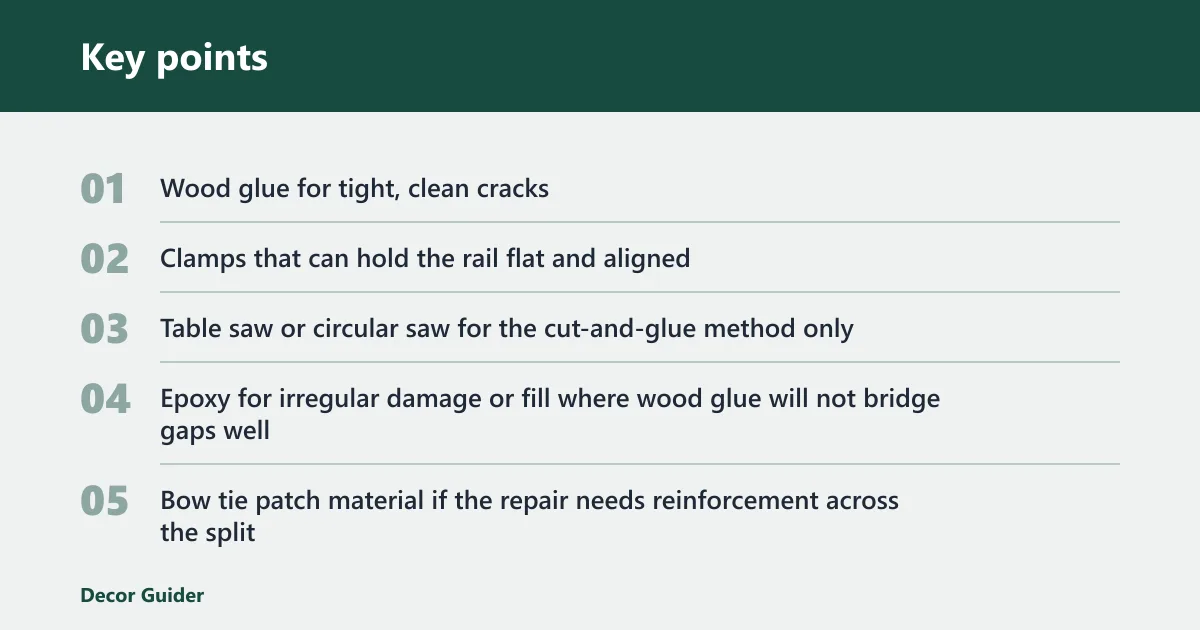
- Wood glue for tight, clean cracks
- Clamps that can hold the rail flat and aligned
- Table saw or circular saw for the cut-and-glue method only
- Epoxy for irregular damage or fill where wood glue will not bridge gaps well
- Bow tie patch material if the repair needs reinforcement across the split
- Sanding discs for finishing and smoothing
- Clean rag, scraper, and brush for debris removal
- Safety glasses, hearing protection, and a dust mask for cutting and sanding
- Replacement hardware if bolts, inserts, or brackets are damaged
Bed rail repair decision table
Short answer: Solid wood can often be repaired if the split is clean and stable; plywood may be repairable only when the surface veneer is split without core failure; particleboard is usually a replace-now material once a crack reaches a fastener, edge, or load point.
| Material type | Crack location | Likely failure type | Symptom under load | Safe fix | Replace-now triggers |
|---|---|---|---|---|---|
| Solid wood | End-grain crack at the rail end | End split that may spread into the rail during load transfer | Rail end opens, squeaks, or shifts when weight is applied | If the wood is solid and the split is clean, open it slightly, glue the edges, clamp flat, then recheck alignment after cure. If the end is crushed or missing wood, add a bow tie or replace the rail. | Missing wood, crushed fibers, repeated opening after clamping, or cracks that run into a joint |
| Solid wood | Mid-span split in solid wood | Longitudinal split along the grain, often with microfractures around the visible crack | Rail bows or the crack grows when the mattress load shifts | Glue and clamp if the split is tight and straight. If the crack is long and clean, the cut-and-glue method can restore a straight bonding surface, then clamp the rail flat and aligned. | Warped rail, spread crack, soft or punky wood, or damage that keeps growing under load |
| Plywood | Veneer split or delamination near the face | Face veneer crack or layer separation that can hide weak glue lines | Surface may look stable but flexes, buzzes, or creaks under step-in load | Only repair if the separation is limited to the veneer and the core remains intact; stabilize the split with glue or epoxy only if the rail stays rigid and the fasteners hold. | Delamination through the core, edge breakup, or separation that reaches a joint or bolt hole |
| Particleboard | Split bolt hole | Fastener tear-out or crushed hole that breaks the load path | Joint loosens, hardware spins, or the rail drops slightly when loaded | Replace the rail or the damaged connector. Epoxy may help fill irregular voids, but it does not restore a split hole to a dependable structural connection by itself. | Hole enlargement, split running from the hole, stripped hardware, or any movement at the joint |
| Solid wood, plywood, or particleboard | Rail-to-post joint failure | Joinery failure that can let the bed rack, drop, or collapse under sleep loads | Frame rocks, connector separates, or the rail slips at the post | Replace the rail, bracket, insert, or post interface as needed. Do not rely on glue alone at a failed joint. | Loose joint, broken dowel or insert, repeated separation, or visible crushing at the connection |
Cracked wooden bed rail checklist
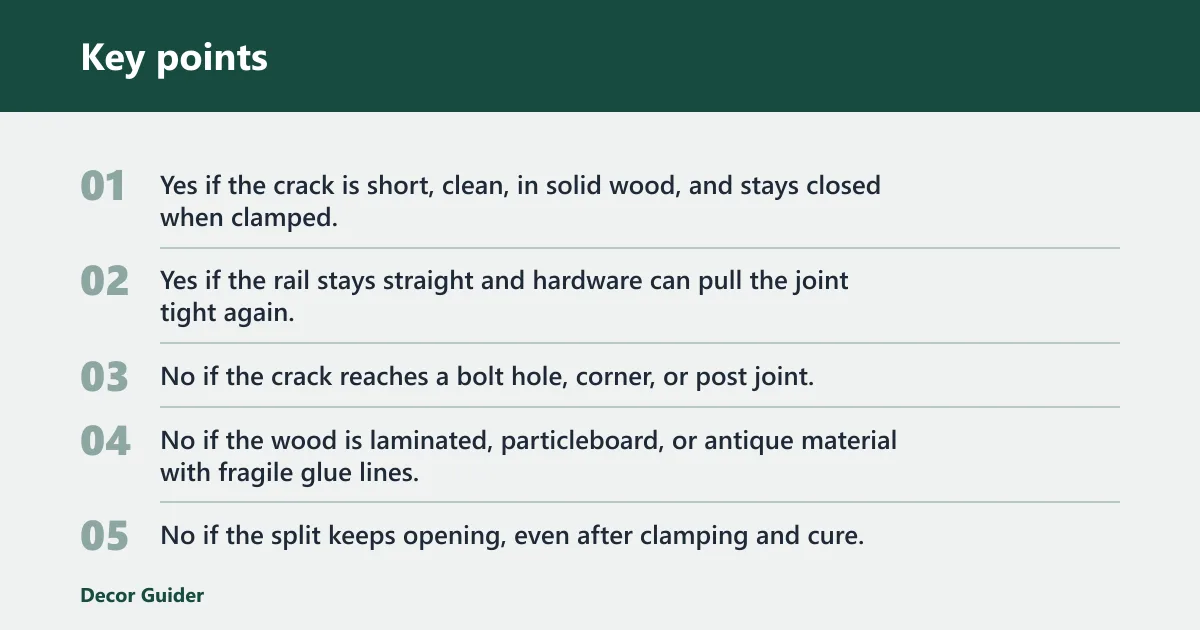
- Yes if the crack is short, clean, in solid wood, and stays closed when clamped.
- Yes if the rail stays straight and hardware can pull the joint tight again.
- No if the crack reaches a bolt hole, corner, or post joint.
- No if the wood is laminated, particleboard, or antique material with fragile glue lines.
- No if the split keeps opening, even after clamping and cure.
- No if there is missing wood, crushing, or visible movement under hand pressure.
How do you fix a cracked wooden bed rail?
Short answer: For a tight, clean crack in solid wood, glue and clamps are the standard repair. For irregular damage, use epoxy or a bow tie. If the crack involves a fastener hole or joint, replace the rail instead.
Use glue and clamps for a tight, clean split in solid wood. Open the crack just enough to clean out dust, then apply wood glue to both crack edges and clamp the rail flat and aligned while it cures. Popular Science recommends wood glue and clamps for thin cracks, says the cut-and-glue repair takes less than 1 hour excluding drying time, lists the material cost at $5 to $10, and labels it Easy. Furniturix says clamps should hold the split for 12–24 hours. Popular Science and Furniturix are cited here for those specific time, cost, difficulty, and curing claims.
Repair steps
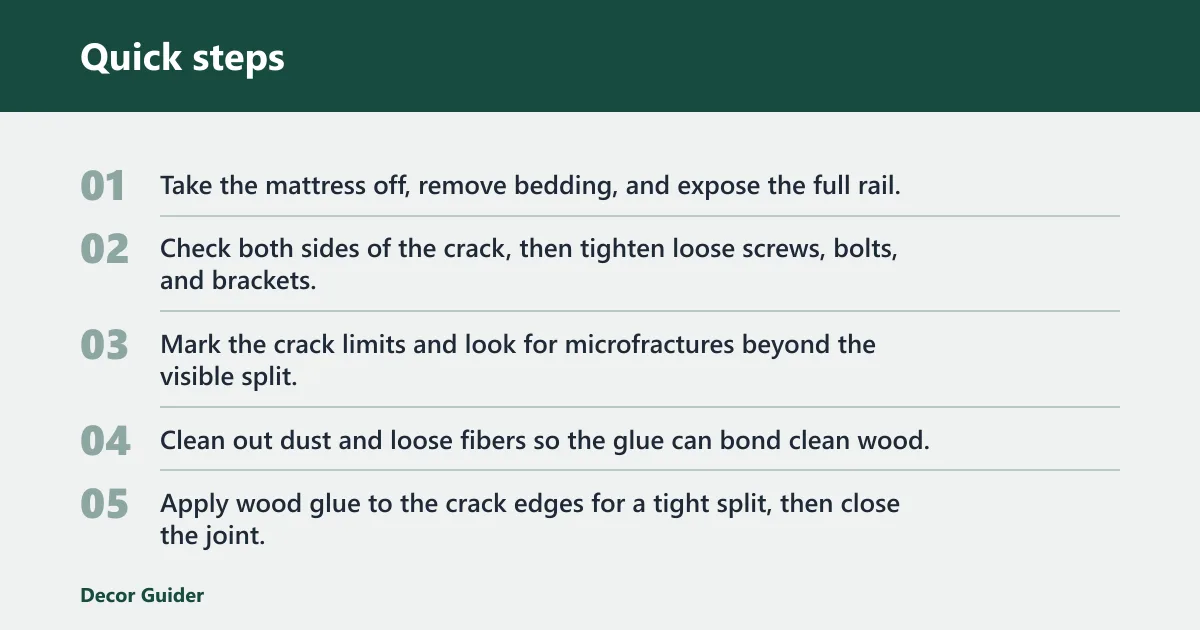
- Take the mattress off, remove bedding, and expose the full rail.
- Check both sides of the crack, then tighten loose screws, bolts, and brackets.
- Mark the crack limits and look for microfractures beyond the visible split.
- Clean out dust and loose fibers so the glue can bond clean wood.
- Apply wood glue to the crack edges for a tight split, then close the joint.
- Clamp the rail flat and aligned; use enough pressure to hold the faces together, not bow the rail.
- For a long, clean split, use a table saw or circular saw to follow the crack and remove the damaged line, then glue the fresh faces together and clamp again.
- If the damage is irregular, add epoxy where fill or reinforcement is needed, or use a bow tie that extends beyond the repair area; Popular Science says the bow tie should be at least a third as thick as the wood.
- Let the rail cure before removal of clamps, then sand with sanding discs to blend the repair and remove proud glue.
- Reinstall the rail and recheck the joint before putting the bed back into service.
Suppose a solid pine rail has a clean split in the middle, but the wood stays flat when it is pressed by hand. That is a glue-and-clamp case. By contrast, a split that starts at the bolt hole and opens when the frame shifts under weight is generally a replacement case, even if the crack looks short from the outside.
If that didn’t work, try this next
- If the crack reopens after clamping, stop using the rail and inspect the fastener points again.
- If the split is irregular, switch from glue-only repair to epoxy fill or a bow tie repair that spans beyond the damage.
- If the rail still flexes, replace the rail or the damaged connector instead of adding more glue.
When should you replace the rail?
Short answer: Replace it when the damage breaks the load path, the material is weak or degraded, or the rail still moves after repair. A neat-looking patch is not enough if the bed can still shift under sleep loads.
Replace the rail when the damage sits at a bolt hole, corner, or post joint, or when the rail is particleboard, laminated in a way that has separated, or antique enough that the existing joinery is already fragile. A repair that looks neat can still be unsafe if the load path is broken. If the rail may fail under sleep loads, replacement is the safer choice.
The same source says a bow tie repair takes 1 to 2 hours excluding drying time, costs $10 to $50 in materials, and is Moderate difficulty. Use that only when the wood is solid enough to accept a reinforcement that extends beyond the repair area. For particleboard, a split often means replacement because the core may crumble around the fastener.
Common causes
- Wear from repeated loading and unloading
- Moisture changes that move the wood
- Overloading or uneven support under the mattress
- Loose hardware that lets the rail twist
- Assembly issues that leave the rail out of alignment
Common mistakes
Short answer: The most common mistakes are using glue where the structure has already failed, ignoring the hardware that caused the crack, and treating all materials the same.
Do not use glue where the rail needs reinforcement or replacement. Wood glue works best for tight, clean cracks, not crushed bolt holes or failed joints. Do not sand first and inspect later; sanding can hide clues about whether the split is moving or if the hole has enlarged.
Another error is treating all materials the same. Solid wood can often take a glued repair. Laminated rails, particleboard, and antique rails may need a different decision because hidden glue lines or weak cores can fail again. A common first-timer mistake is patching the visible split while ignoring the loose bracket that caused the crack in the first place.
Frequently asked questions
How to fix a crack in a wooden bed frame
Short answer: If the frame still carries load rigidly, a repair may work; if it flexes at the crack, replace the damaged part.
Check whether the crack changes how the frame carries weight. If the crack is cosmetic and the member still feels rigid, a glued repair may be enough. If the crack opens at a connection point or the frame flexes under hand pressure, treat it as structural and replace the damaged part.
Products related to this article
Sponsored / affiliate links. As an Amazon Associate I earn from qualifying purchases. I may earn additional commission from eligible campaigns.