
How to Put Wheels on a Bed Frame
Choose casters that match your bed frame leg: threaded stem for tapped legs, grip stem for hollow tubing, or plate casters only when you can bolt through solid wood or metal. Make sure the full set supports at least the bed’s total loaded weight. A poor fit can strip threads, wobble, or pull out under load. This guide shows how to identify your leg type, check clearance and weight rating, and buy or drill the right replacement without guesswork.
What to check first
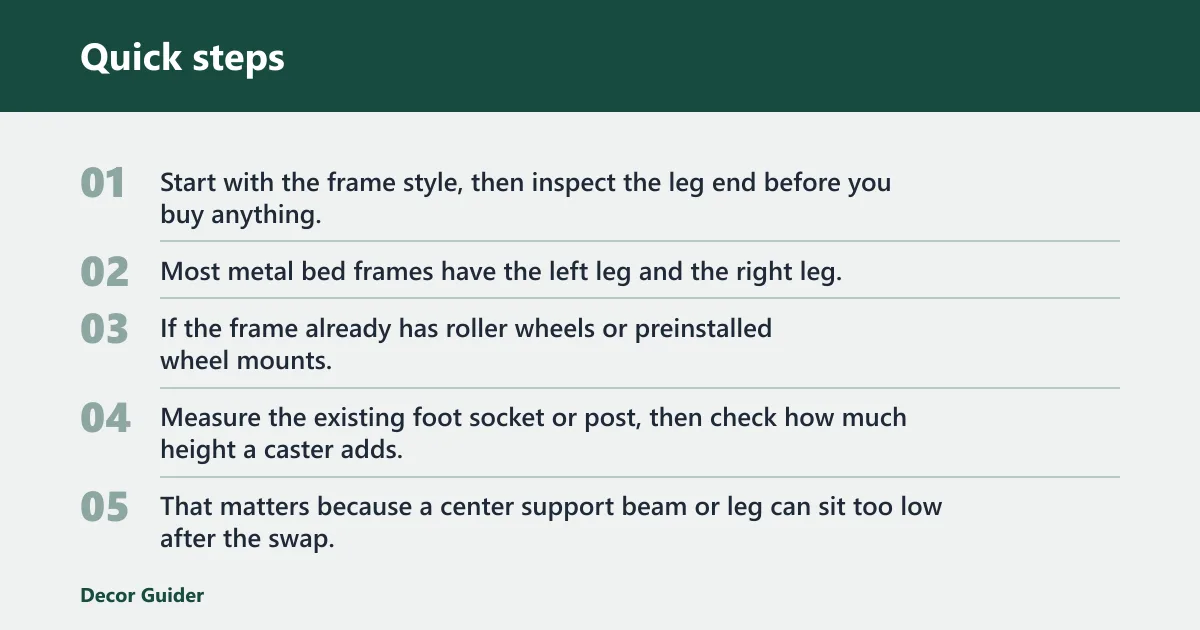


Start with the frame style, then inspect the leg end before you buy anything. Look for the exact attachment point first. Most metal bed frames have the left leg and the right leg, with side rails as the two longest metal pieces, and feet or wheels normally attach at the corners of the bed. If the frame already has roller wheels or preinstalled wheel mounts, the swap may be simple.
Measure the existing foot socket or post, then check how much height a caster adds. That matters because a center support beam or leg can sit too low after the swap. Leaving 1/2 to 1 inch of clearance around all sides.
Frame style and attachment points
Look for one of three setups: a hollow leg end that accepts a grip stem, a tapped hole for a threaded stem, or a flat surface that can accept a plate mount. On many metal frames, cross arms connect the side rails, and those joints can shift if the wheel choice changes the frame height too much.
What to measure before you buy
Measure the inside diameter of any socket, the thread size if the leg is tapped, and the available stem length or insertion depth. Also check the corner attachment point, because some frames need a straight-down stem while others need a low-profile wheel that clears the rail and any center brace.
What you’ll need
- Tape measure or ruler
- Flashlight for checking sockets and underside clearance
- Socket wrench or screwdriver, if the frame uses a screw and nut
- Replacement casters that match the stem type
- Optional washers or adapter plates, if the mount needs them
- Optional floor protection pads for hardwood, tile, or laminate
- Optional locking casters if the bed needs more movement control
- Optional helper for lifting one corner at a time
How do you choose the right caster type?
Match the stem to the leg first, then choose swivel, fixed, or locking wheels based on how you want the frame to move. Swivel casters turn easily at the corners. Fixed wheels track straighter. Locking wheels reduce rolling resistance and help control bed movement, but they still need a correct stem and a safe load rating.
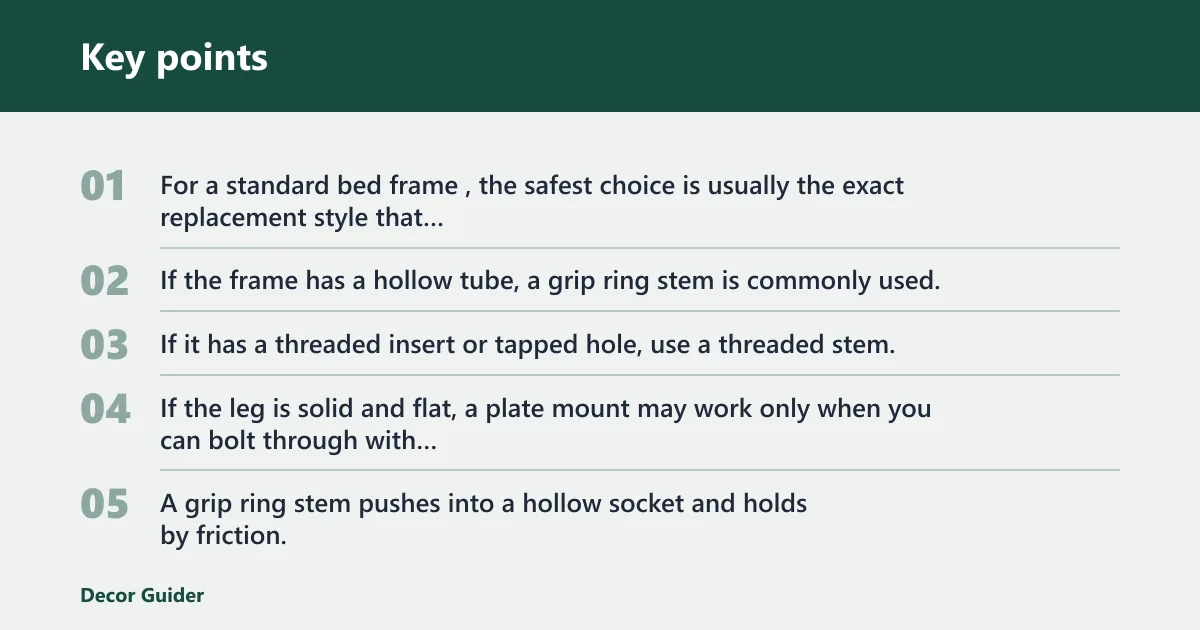
For a standard bed frame, the safest choice is usually the exact replacement style that matches the existing leg. If the frame has a hollow tube, a grip ring stem is commonly used. If it has a threaded insert or tapped hole, use a threaded stem. If the leg is solid and flat, a plate mount may work only when you can bolt through with secure hardware.
Match the stem to the leg or socket
A grip ring stem pushes into a hollow socket and holds by friction. A threaded stem screws into a tapped hole or threaded insert. A plate mount uses a flat bracket with screw holes. If you cannot identify the socket type, do not force a push-in wheel into a threaded leg; that often leads to wobble or stripped threads.
Choose swivel, fixed, or locking wheels
Swivel casters help during cleaning and bed repositioning. Fixed casters resist side-to-side drift. Locking casters are useful when you want the frame to stay put on hardwood or tile, but the brake should lock the wheel and not just add drag. If the bed sits near a wall, a locking option also helps keep the frame from drifting when you make the bed.
Check load rating and wheel diameter
Use the bed, mattress, and occupants’ total loaded weight to choose the caster rating. A common rule of thumb is to divide that total by the number of casters, then add a safety margin so one wheel does not carry more than the others. Larger wheel diameter usually rolls better over carpet and thresholds, while smaller wheels may be fine on a smooth floor if the frame clears the surface.
Bed frame casters checklist
| Bed-frame leg type | Caster stem type | Required measurements | Floor surface | Brake needed | Red-flag failure signs |
|---|---|---|---|---|---|
| Hollow tube leg with open socket | Grip ring stem | Socket inside diameter, insertion depth, added height | Hardwood or laminate | Often yes | Loose fit, wobble, stem backs out under load |
| Tapped leg or threaded insert | Threaded stem | Thread size, thread depth, stem length | Tile or hardwood | Helpful if the bed shifts | Cross-threading, tilted wheel, stripped insert |
| Solid leg with flat mounting face | Plate mount | Plate footprint, screw spacing, clearance height | Carpet or hard floor | Useful for movement control | Mount flexes, screws pull out, uneven corner height |
| Metal frame with preinstalled wheel mount | Factory-matched stem or bolt pattern | Mount pattern, wheel size, load rating | Any surface the wheel is rated for | Depends on frame use | Misaligned holes, frame leans, center support sits too low |
Install the casters
Swap one corner at a time so the frame stays square. If the bed has side rails, a center support beam, or a center support leg, check those parts after each corner change. Some models attach without special hardware, while some require a screw and nut to secure the wheels.
- Remove the mattress, lift the frame corner, and take off the existing feet or wheel hardware.
- Clean the socket or mounting face so the new caster seats fully.
- Push in, screw in, or bolt on the caster that matches the leg type.
- Tighten the hardware until the wheel sits square and does not twist under hand pressure.
- Lower the frame and check that all four corners touch evenly.
- Roll the bed a few inches, then recheck the locks, alignment, and center support clearance.
If the bed gains too much height, stop and remeasure before adding another part. Suppose a queen frame needs room for a center support leg, but the new wheels make that leg hang lower than the side rails. That setup can rock on hard floors and can drag on carpet, even if the corner casters fit correctly.
Can you replace bed frame feet with wheels?

Yes, when the existing feet already use a stem, socket, or mount that matches a caster in the same pattern. A direct swap works best on standard metal frames with corner legs and a clear underside. If the frame has included plastic or rubber feet, or if the leg is sealed with no socket, the swap may need an adapter or a different mount.
When a direct swap works
A direct swap is the cleanest option when the stem type matches and the new caster height still leaves the frame level. That is common on frames with preinstalled wheel mounts or with a simple hollow leg that accepts a grip ring stem. It is also the easiest path when you are replacing worn feet with the same kind of hardware.
When you need an adapter or new mount
If the bed leg is solid, square, or irregular, a plate mount or adapter may be needed. Use this route only when the plate sits flat and the screws bite into solid material. For a metal bed frame, that often means a bolt-through connection, not a loose push-in fit.
When you should stop and choose another option
Stop if the stem diameter is unknown, the socket is cracked, the frame already wobbles, or the center support beam loses clearance after the swap. A bad fit can create noise, uneven loading, or a wheel that pulls out under movement. In that case, replacement feet or a different frame is safer than forcing a mismatch.
How do you keep the bed from moving too much?
Use locking casters where movement is the problem, then level the frame after the swap and check for wobble at each corner. Hard floors let the bed roll more easily, so the brake matters more on hardwood and tile. Carpet adds drag, which can hide a bad fit while still stressing the stem or mount.
Use locking casters where needed
Choose a wheel brake when the bed shifts during getting in and out, or when the frame needs to stay put for cleaning. The brake should hold the wheel from rolling and limit unintended movement. If the room needs frequent access under the bed, locking casters can help keep room for cleaning without turning the frame loose.
Set the frame level after the swap
Check the height of each corner and the center support leg. If one corner sits high, the bed can rock even when the wheels are rated correctly. A level frame also keeps the mattress load spread across the casters instead of loading one leg harder than the others.
Check for wobble, drag, or excess noise
If the bed clicks, leans, or drags when you push it, recheck stem length, wheel diameter, and the mount angle. Say a full-size frame on laminate has one locking caster that feels stiff while the others roll easily; that usually points to a misaligned stem or an over-tightened brake, not a floor problem alone.
Common mistakes
- Buying the wrong stem size. Measure the socket or thread before ordering; never assume a push-in wheel will fit.
- Ignoring center support clearance. Check the beam or support leg after the swap, especially on frames with a low middle rail.
- Using under-rated wheels for the load. Add the bed weight, mattress weight, and occupant weight before selecting the rating.
- Skipping floor protection. Use floor-safe wheels or add pads on hardwood, tile, or laminate when the wheel material is not friendly to the surface.
- Forcing a mismatched mount. If the caster leans or strips as you tighten it, stop and match the hardware instead of tightening harder.
Frequently asked questions
How do I put wheels on a bed frame?
Identify the leg type first, then match the stem and load rating before you remove any feet. Swap one corner at a time, tighten the hardware square, and check that the frame stays level. If the bed has a center support beam, confirm it still clears the floor after the new wheels are installed.
How do I choose the right wheels for a bed frame?
Start with the stem style: grip ring for hollow tubing, threaded stem for tapped legs, or plate mount for a flat attachment point. Then choose swivel, fixed, or locking wheels based on how much you want the bed to move. Finally, confirm the set supports the bed’s total loaded weight with a safety margin.
What size wheels do I need for my bed frame?
Use a wheel size that clears the floor, the rail, and any center support leg. Larger wheels usually handle carpet and thresholds better, while smaller ones fit tighter frames. For mattress sizing, common US widths are Twin 38 inches, Full 54 inches, Queen 60 inches, and King 76 inches, so the frame size must match the wheel clearance plan. (Wikihow)
How do I keep a bed frame from moving too much?
Use locking casters, especially on hardwood, tile, or laminate. Then check each corner for equal height and make sure the brake actually stops the wheel, not just the swivel. If the bed still shifts, the stem may be loose, the floor may be uneven, or the load may be too high for the caster set.
Do bed frame wheels need screws or just push on?
Some bed frame wheels attach without special hardware, while some models may require a screw and nut to secure the wheels. The correct answer depends on the leg type. If you see a threaded insert or a hole for a fastener, use the matching hardware rather than forcing a push-in stem.
Products related to this article
Sponsored / affiliate links. As an Amazon Associate I earn from qualifying purchases. I may earn additional commission from eligible campaigns.