Do You Need a Box Spring for a Memory Foam Mattress?
A memory foam mattress can use a firm, fully supported base only if that base is compatible with the mattress; a standard springy box spring usually is not the right base. Many manufacturers allow a rigid foundation or platform-style support but prohibit a traditional box spring. Using the wrong support can cause sagging, noise, weak edge support, and shorten mattress life. This guide explains when a box spring works, when to skip it, and what to use instead for the base you already own.
Do you need a box spring?
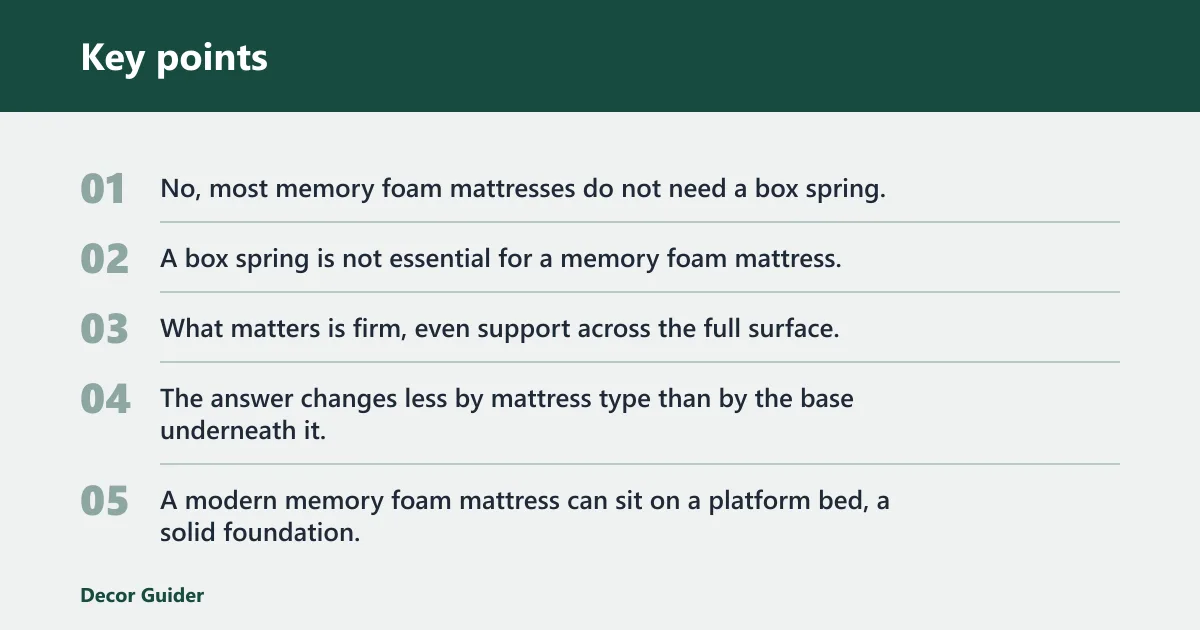


No, most memory foam mattresses do not need a box spring. A box spring is not essential for a memory foam mattress, and a gel memory foam model follows the same rule. What matters is firm, even support across the full surface, so the mattress does not dip in the middle or flex over gaps.
When the answer changes by base
The answer changes less by mattress type than by the base underneath it. A modern memory foam mattress can sit on a platform bed, a solid foundation, a slatted foundation with tight spacing, a floor, or a bunkie board. A traditional box spring is the weak link when its coils or slats are too soft, too far apart, or already worn.
What to do if you already own one
If you already own a box spring, check whether it is truly rigid and fully supported. If it flexes, squeaks, sags, or has bowed rails, replace the support or add a flat layer on top only as a short-term fix. A bunkie board can help, but it should not be used to excuse a damaged base that still moves under load.
| Bed base type | Memory foam compatibility | Risk level | Slat/structure requirement | Best fallback option |
|---|---|---|---|---|
| Traditional box spring | Usually poor | High | Coils and widely spaced slats are a bad match for foam | Solid foundation or platform bed |
| Low-profile, firm box spring with full support | Sometimes acceptable as a temporary setup | Medium | Must not bow or sag; must sit on a stable frame | Bunkie board or foundation |
| Platform bed | Good | Low | Solid deck or closely spaced slats | Foundation if height needs adjustment |
| Slatted foundation | Good | Low | Slats no more than 2.75 inches apart | Bunkie board if the frame feels flexible |
| Solid foundation | Very good | Low | Solid wood or metal base with even support | Usually none needed |
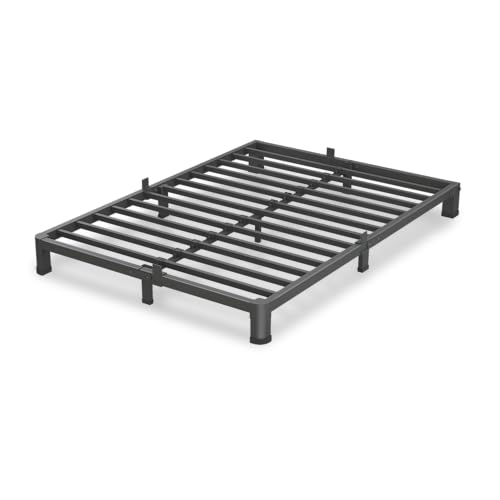
| Metal bed frame with open bars | Depends on deck added | Medium to high | Needs a flat, supported surface over the frame | Bunkie board or proper foundation |
| Adjustable bed | Good, if designed for it | High if a box spring is added | Flexible compatible base only | Use the adjustable base alone |
Which bases work best?
The best base for a memory foam mattress is a firm, even surface that does not sag. Platform beds, solid foundations, and slatted foundations are the most reliable choices because they spread weight consistently and keep the foam from bowing between supports.
Platform beds
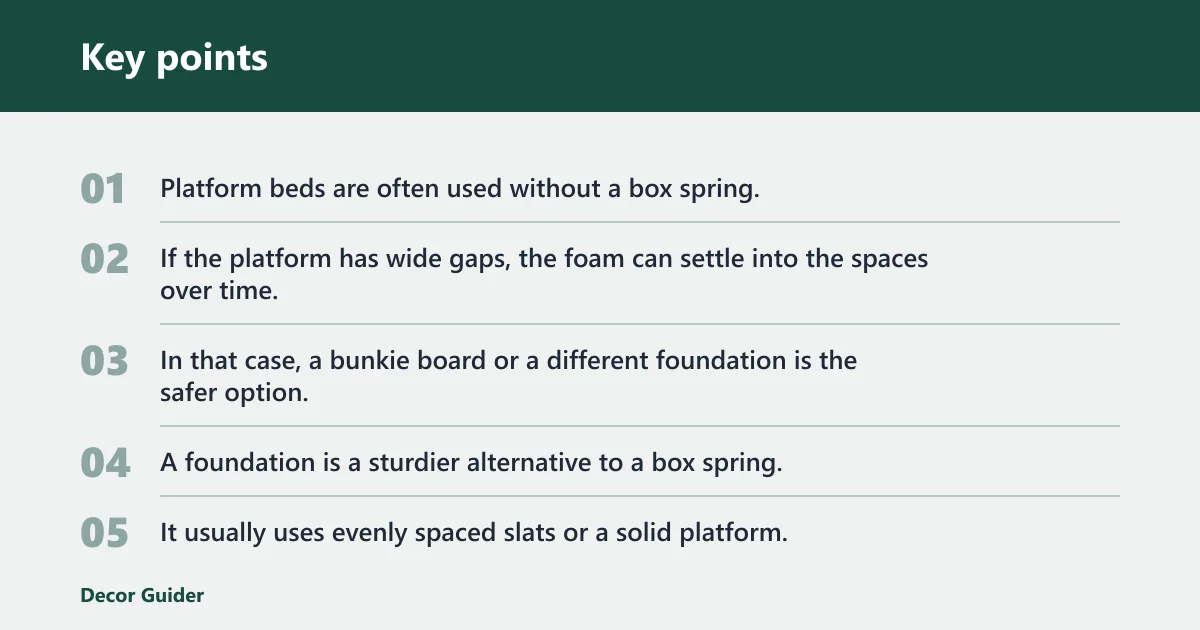
Platform beds are often used without a box spring, and they work well with memory foam when the deck is solid or the slats are close enough together. If the platform has wide gaps, the foam can settle into the spaces over time. In that case, a bunkie board or a different foundation is the safer option.
Solid foundations
A foundation is a sturdier alternative to a box spring. It usually uses evenly spaced slats or a solid platform, which gives memory foam the flat support it needs. PlushBeds says a mattress foundation usually eliminates the need for a traditional box spring, and it lists wood mattress foundations that work with memory foam mattresses.
Slatted foundations
Slatted foundations can work well if the slats are close enough together and the frame does not flex. The exact spacing limit can vary by mattress brand and model, so check the manufacturer’s instructions before setting up the bed. Wider gaps leave the mattress more vulnerable to sinking between slats, especially near the center where most body weight lands.
Adjustable beds
Adjustable beds should not use a box spring on top of the adjustable base. The mattress needs a base that bends with the frame, and a standard box spring blocks that motion. If you already have an adjustable base, pair it with a mattress that is listed as compatible with adjustable use.
If a queen memory foam mattress sits on a slatted platform with about 3-inch gaps, it may bow between the slats. The bed may feel fine at first, but the foam can start to bow between the slats as the center carries more weight. Switching to a tighter slat layout or adding a bunkie board solves the support problem without changing the mattress.
Suppose your bedroom setup is a metal frame with no deck, and the mattress rests directly on the bars. The frame may look sturdy, but the contact points are too narrow for foam. A bunkie board or a proper foundation creates a flat surface and reduces the chance of early wear.
When is a box spring a bad fit?
A box spring is a bad fit when it is built for bounce instead of flat support. Traditional box springs with coils or widely spaced slats can be a poor match for foam and may let a memory foam mattress sag in the middle. Casper says its mattresses are not compatible with box springs and warns that a box spring can cause premature sagging and uneven wear.
Old box springs with weak coils or dips
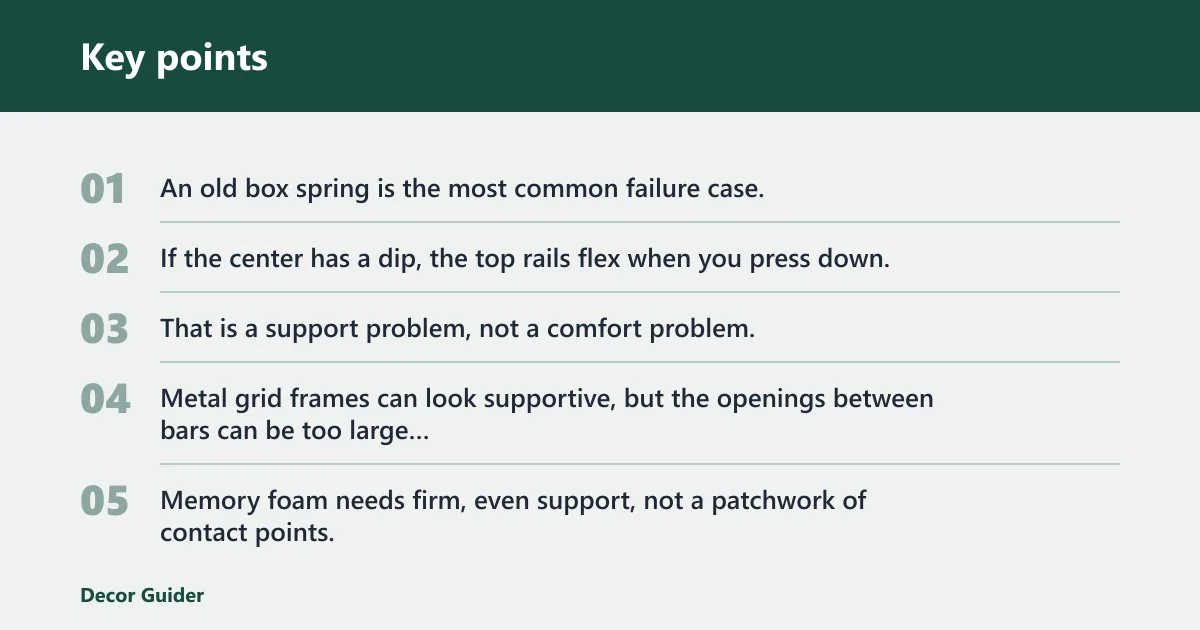
An old box spring is the most common failure case. If the center has a dip, the top rails flex when you press down, or the unit squeaks under weight, the mattress will copy that shape. That is a support problem, not a comfort problem.
Metal grid frames that need a flat deck
Metal grid frames can look supportive, but the openings between bars can be too large for foam. Memory foam needs firm, even support, not a patchwork of contact points. Without a flat deck on top, the mattress can press into the spaces and lose its shape faster.
Bowing, noise, and center sag
Bowing and noise are warning signs that the frame is moving under the mattress. Once the center begins to sag, the foam has to fill a hollow instead of sitting level. That affects edge support too, especially for couples and heavier sleepers who load the middle of the bed more heavily.
A common first-timer mistake is keeping an old queen box spring because it still “looks fine.” If the base creaks when you sit near the edge or dips under the middle of the mattress, it is already giving the foam an uneven surface. Replacing the support is the fix, not waiting for visible damage in the mattress cover.
How much slat support does memory foam need?
Memory foam needs close, even slat support, and the slat spacing should match the mattress maker’s instructions. That matters because the foam should rest on a continuous-feeling base instead of bridging wide gaps. If the slats are too far apart, the mattress can sag between them.
Why even weight support matters
Even support matters because memory foam compresses under load and then recovers. If the support underneath is uneven, the mattress has to span a dip, which can create soft spots, edge drop-off, and a shorter usable life. Couples and heavier bodies tend to expose these weak points faster.
When a bunkie board helps
A bunkie board is a flat, low-profile support layer that can sit on metal frames or box springs. It is useful when the base is structurally sound but too open or too flexible for memory foam. It adds a firmer deck without forcing you to replace the entire frame right away.
- Check the frame first for dips, squeaks, and broken slats.
- Measure slat spacing; keep it at 2.75 inches or less.
- Look for a flat, continuous surface under the mattress.
- Use a bunkie board if the frame needs reinforcement.
- Replace a bowed or noisy box spring instead of padding over it.
Warranty rules to check before setup
Warranty rules can depend on base type, slat spacing, center support, and support requirements, so check them before you set up the mattress. Many manufacturers require a solid or slatted foundation and may exclude damage caused by improper support. A wrong base can lead to denied coverage if the mattress sags or wears unevenly.
Support language in the warranty
Read the support language closely. Some brands call out specific approved bases, such as a solid or slatted foundation, adjustable base, or platform bed, and may also require center support legs or a specific frame type. Others say a mattress foundation removes the need for a traditional box spring. That wording matters because it tells you what the brand considers proper support.
Base type and spacing limits
Look for spacing limits and structural requirements in the warranty terms. If the mattress needs closely spaced slats, a wider-gapped frame may put the coverage at risk. If the base is not listed or the mattress is placed on a damaged box spring, the manufacturer may treat the resulting sag as preventable wear.
What to confirm before you buy or keep the frame
Confirm three things: whether the mattress allows a box spring at all, how much slat spacing is permitted, and whether an adjustable base needs a direct mattress pairing. If the base is not compatible, replace it before setup. That is cheaper than dealing with a warped mattress later.
Frequently asked questions
Do you need a box spring for a memory foam mattress?
No. A memory foam mattress does not need a box spring, and a standard box spring is often the wrong support. A solid foundation, platform bed, or slatted base with slats no more than 2.75 inches apart is usually a better match because it keeps the mattress flat and stable.
Do you need a box spring for a gel memory foam mattress?
No. Gel memory foam follows the same support rule as regular memory foam. The cooling layer does not change the need for firm, even support. Use a compatible foundation, platform bed, or adjustable base listed by the mattress maker instead of a springy box spring.
Can you use a box spring with a platform bed?
Usually, no. Most platform beds are designed to replace a box spring, not sit under one. Adding a box spring on top can raise the bed too high and reintroduce flex that memory foam does not need. Use the platform alone unless the manufacturer says otherwise.
Can you put a memory foam mattress on a metal bed frame?
Yes, if the metal frame has a proper flat deck, a bunkie board, or another approved foundation on top. An open metal grid or bare rails are not enough for most memory foam mattresses because the foam can sink between the contact points and wear unevenly.
Can a memory foam mattress go on an adjustable bed?
Yes. Memory foam is a strong match for adjustable beds because it can flex with the moving base. Do not add a box spring on top of the adjustable base. That blocks movement and can damage the support setup or the mattress itself.
What happens if a memory foam mattress sits on a box spring?
If the box spring is old, springy, or uneven, the mattress can sag in the middle, feel noisier, and wear faster. A temporary setup may work only if the box spring is low-profile, firm, and fully supported. For long-term use, a foundation or platform is safer.
Products related to this article
Sponsored / affiliate links. As an Amazon Associate I earn from qualifying purchases. I may earn additional commission from eligible campaigns.